Alation’s Series E pitch deck, used to secure $123M at a $1.7B valuation, is a highly professional example of a 'momentum deck.' Rather than explaining basic product mechanics, the slides focus on category leadership and ecosystem dominance. The deck highlights a forecasted ARR of >$100M and a customer base of ~450, including >25% of the Fortune 100. A significant portion of the presentation is dedicated to third-party validation, citing leadership positions from Forrester, IDC, and Dresner. The deck also emphasizes organizational health, boasting a 4.7 Glassdoor score and >90% employee engag…
Key takeaways
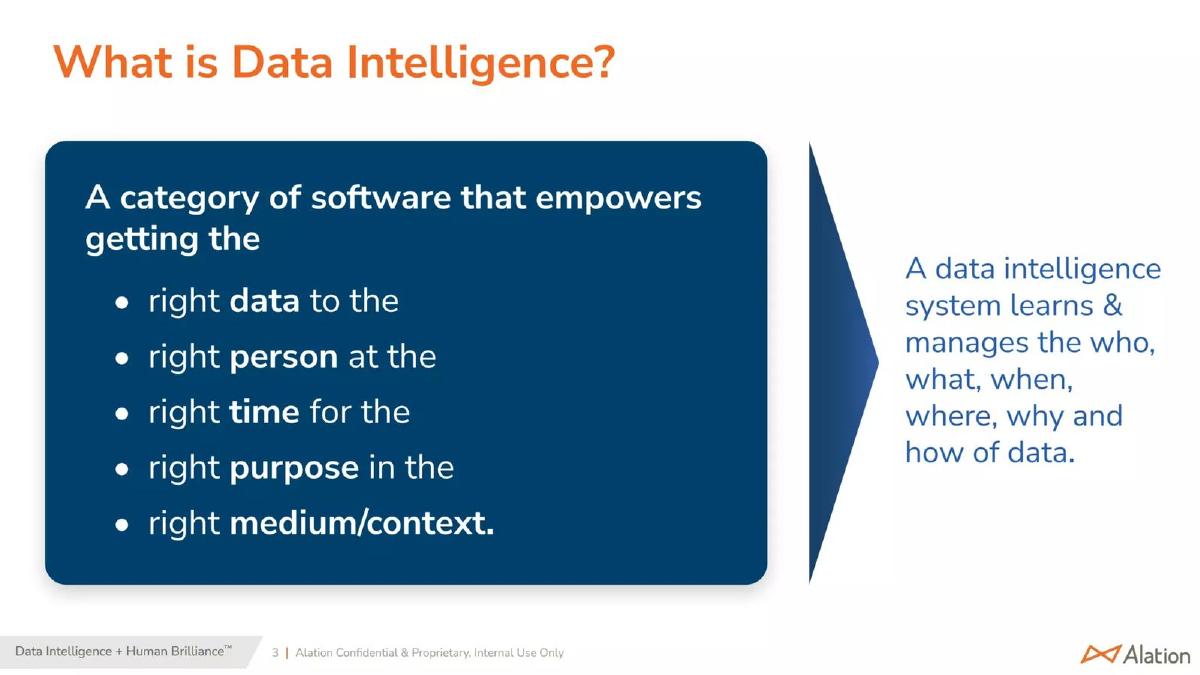
- The deck defines 'Data Intelligence' as a software category that manages the who, what, when, where, why, and how of data (Slide 3).
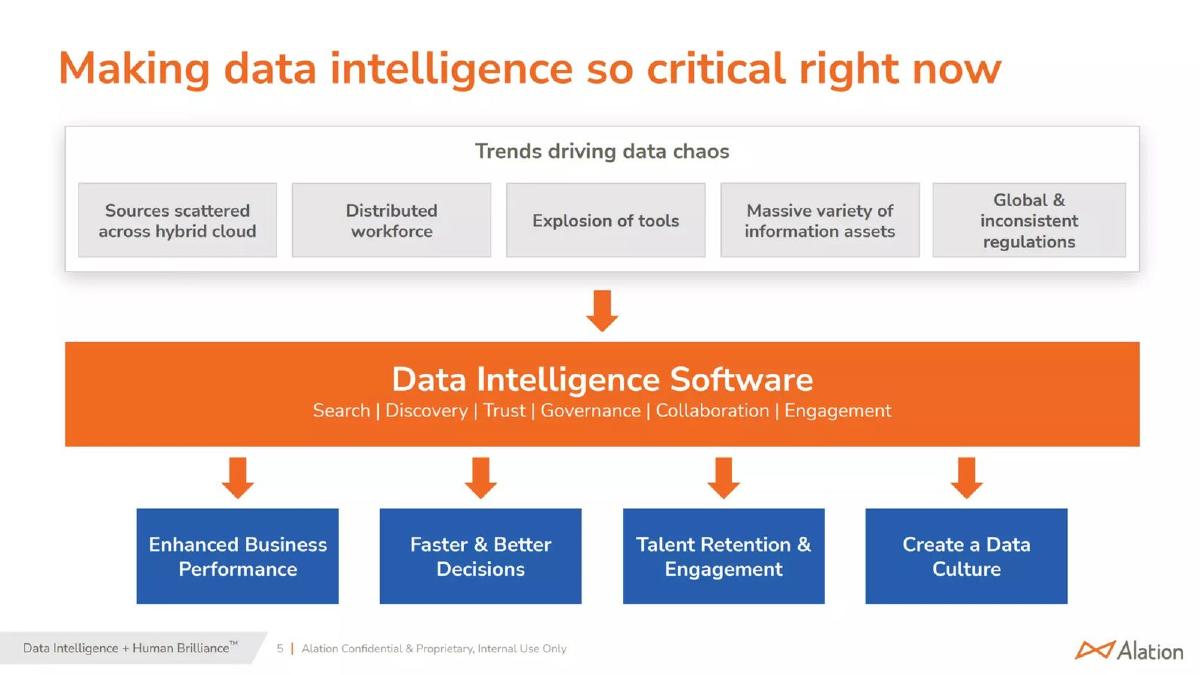
- Alation identifies five key trends driving 'data chaos,' including scattered cloud sources and global regulations (Slide 5).
- Third-party validation is a core pillar, featuring 'Leader' status from five different analyst firms including Forrester and IDC (Slide 7).
- The product is positioned as a central hub, claiming to connect to 'EVERYTHING' in the data stack, including Snowflake, Databricks, and AWS (Slide 9).
- Company culture is used as a proxy for stability, highlighting a 4.7 Glassdoor score and multiple 'Best Workplace' awards (Slide 11).
- Financial scale is the primary hook, with forecasted ARR exceeding $100M as of October 2023 (Slide 13).
- Efficiency is addressed through a 'Cumulative Cash Burn to ARR' ratio of approximately 1.5x (Slide 13).
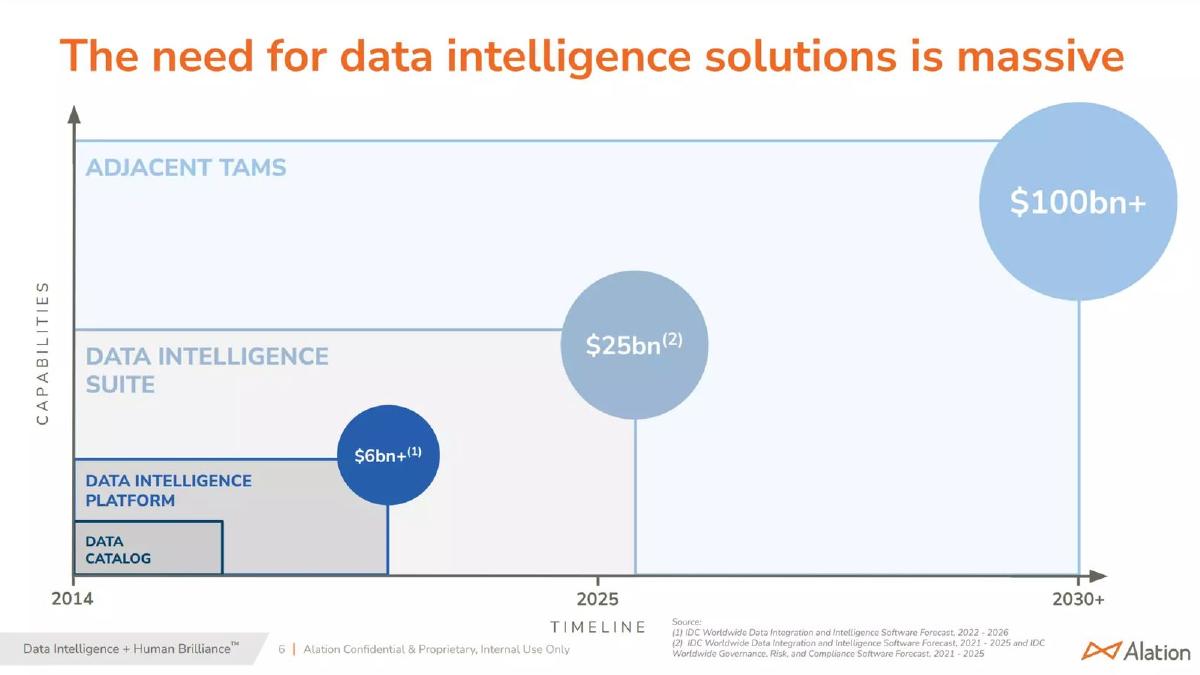
- Market size is explicitly stated as a $25Bn opportunity based on IDC forecasts (Slide 13).
The Series E Momentum Narrative
Alation’s Series E deck is a masterclass in late-stage fundraising. By the time a company reaches a $1.7B valuation, the pitch is no longer about whether the product works, but rather how much of the market the company can capture and how quickly. This deck, dated August 2022, focuses heavily on category leadership, ecosystem integration, and institutional validation.
Slide 1: Title Slide
The deck opens with a clean, professional title slide labeled "Business Overview" and dated August 2022. It uses the standard Alation branding—orange and grey—setting a corporate, reliable tone from the outset.
Slide 3: Defining the Category
Slide 3 addresses the question, "What is Data Intelligence?" It defines the sector as software that empowers getting the "right data to the right person at the right time for the right purpose in the right medium/context." The right side of the slide summarizes the system's function: learning and managing the "who, what, when, where, why and how of data." This is a classic category-creation play, positioning Alation not just as a tool, but as the foundational layer for a new software segment.
Slide 5: The Problem and Drivers
Slide 5 outlines the "Trends driving data chaos." These include sources scattered across hybrid clouds, a distributed workforce, an explosion of tools, a massive variety of information assets, and inconsistent global regulations. The slide uses a flow-down logic: these trends lead to the need for Data Intelligence Software (Search, Discovery, Trust, Governance, Collaboration, Engagement), which in turn leads to four business outcomes: Enhanced Business Performance, Faster & Better Decisions, Talent Retention, and the creation of a Data Culture.
Slide 7: Analyst Validation
This is arguably the most important slide for a Series E round. Titled "We created the fastest growing segment within this massive market," it features a quote from Forrester Wave (2018) stating, "Alation started the ML Data Catalog trend." The slide displays "Leader" badges from six different analyst firms: Forrester (2x Leader), IDC (2x Leader), Dresner (6x Leader), Constellation Research (3x Leader), GigaOm , and KuppingerCole . This overwhelming amount of third-party proof is designed to eliminate any doubt regarding Alation's technical superiority and market position.
Slide 9: Ecosystem Integration
Slide 9 visualizes the Alation platform as a central hub. The headline states, "Alation connects to EVERYTHING in your data stack." It features logos for major partners and integrations including Snowflake, Fivetran, Tableau, Dataiku, Databricks, Matillion, AWS, Google Cloud, dbt, and BigID . This slide communicates that Alation is "sticky"—it sits in the middle of a customer's entire data infrastructure, making it difficult to displace.
Slide 11: Organizational Health
Slide 11 focuses on culture, with the headline "And, people love working here." It cites a Culture Amp score of >90% Employee Engagement , a Glassdoor score of 4.7 , and Inc. Best Workplaces wins in 2019, 2021, and 2022. For late-stage investors, these metrics are indicators of low churn and the ability to attract top talent, which are critical for scaling toward an IPO.
Slide 13: Scale and Market Size
The final slide in this selection, Slide 13, provides the hard numbers. It lists forecasted metrics as of FQ3’23 (Oct 31):
ARR: >$100M · Customers: ~450 · Employees: 700+ · Cumulative Cash Burn to ARR: ~1.5x · Fortune 100 Penetration: >25% · YoY Employee Growth: >55%
The slide also anchors these figures against a $25Bn Data Intelligence Market Size , citing IDC research. This slide effectively justifies the $1.7B valuation by showing a clear path to becoming a multi-billion dollar revenue company.
What Works in the Alation Deck
The most effective element of this deck is its reliance on external authority . By Slide 7, the founders have stopped pitching their own opinions and started quoting the world's leading technology analysts. For a Series E investor, this significantly de-risks the investment. If Forrester and IDC both say Alation is the leader, the investor feels they are betting on a winner rather than a gamble.
The efficiency metric on Slide 13 is also a strong inclusion. Stating a "Cumulative Cash Burn to ARR" of ~1.5x is a transparent way to show capital efficiency. It tells the story of a company that knows how to turn invested capital into recurring revenue at a predictable rate.
What is Missing from the Deck
Based on the 7 slides provided from the 14-slide deck, there are several standard components missing:
Detailed Team Slide: While employee growth and culture are mentioned, the specific backgrounds of the executive leadership team are not shown in this selection. · Unit Economics: There is no mention of Net Revenue Retention (NRR) or Gross Margins, which are typically scrutinized in Series E rounds. · The Ask: The specific use of proceeds for the $123M is not detailed in these slides. · Product Roadmap: The deck focuses on what the product does now and who validates it, but it does not show the future product vision or R&D pipeline.
What Founders Should Copy
Founders at the Series B stage and beyond should emulate Alation’s ecosystem slide (Slide 9). Showing how your product interacts with the giants (AWS, Snowflake, etc.) proves that you are a necessary part of a larger, high-value workflow. It moves the conversation from "why do I need this?" to "how does this make my existing expensive tools better?"
Additionally, the use of forecasted metrics (Slide 13) is a powerful way to frame a narrative. By setting a specific date in the near future (Oct 31) and providing targets, Alation creates a sense of inevitable momentum. If a founder can show they are on a clear trajectory to a milestone like $100M ARR, the valuation becomes a function of that future reality rather than past performance.
Final Analysis
Alation’s deck is a "big company" deck. It is polished, data-heavy, and relies on the weight of its reputation. It succeeds because it doesn't over-explain the technology; instead, it proves that the market has already accepted the technology. For any founder looking to raise a growth round, the lesson here is simple: let your customers, your partners, and the industry analysts do the talking for you.
Frequently asked questions
- What is the primary value proposition Alation presents?
- Alation positions itself as the pioneer and leader of the 'Data Intelligence' category. According to Slide 3 and 5, the software solves 'data chaos' caused by scattered cloud sources and complex regulations by providing a centralized system for search, discovery, governance, and collaboration. The goal is to get the right data to the right person at the right time for the right purpose.
- How does Alation demonstrate market traction?
- Traction is demonstrated through high-level scale metrics on Slide 13. The company highlights reaching over $100M in ARR, serving approximately 450 customers, and penetrating more than 25% of the Fortune 100. They also emphasize their growth rate, noting a year-over-year employee growth of over 55% to reach a headcount of 700+.
- What role does third-party validation play in this deck?
- Third-party validation is central to the Series E narrative. Slide 7 is entirely dedicated to analyst rankings, showing Alation as a 'Leader' in reports from Forrester, IDC, Dresner, Constellation Research, GigaOm, and KuppingerCole. This strategy shifts the burden of proof from the founders to established industry experts, which is typical for late-stage rounds.
- How does the deck address the competitive landscape?
- The deck takes an indirect approach to competition. Slide 7 features a Forrester Wave graphic where Alation is positioned in the top-right 'Leaders' segment, visibly ahead of competitors like IBM, Collibra, and Informatica. By using an analyst's chart rather than a self-made comparison table, Alation gains objective credibility in its claim of market dominance.
- What financial efficiency metrics are included?
- Unlike early-stage decks that focus on unit economics like LTV/CAC, Alation uses a macro efficiency metric on Slide 13: 'Cumulative Cash Burn to ARR.' At ~1.5x, this metric tells investors how much capital was required to build their current revenue engine, signaling a relatively efficient path to $100M+ ARR for a high-growth SaaS company.