Tomorrow University’s 11-slide Series A deck is a masterclass in using regulatory milestones as a competitive moat. By highlighting their status as a state-recognized university in Germany on slide 7, the founders immediately differentiate the startup from unaccredited bootcamps. The deck balances high-level vision—addressing an $8.5 trillion talent shortage (slide 3)—with concrete financial performance, specifically citing an 80% gross margin and 3x year-over-year growth (slide 7). While the deck is light on detailed competitor comparisons and specific use of funds, it successfully positions…
Key takeaways
- The company leverages a massive macro problem, citing a projected $8.5 trillion loss due to talent shortages by 2030 on slide 3.
- Regulatory status is a core value proposition, with slide 7 noting they achieved state recognition in 'record time.'
- The business model demonstrates software-like scalability, reporting an 80% gross margin on slide 7.
- Traction is evidenced by 3x year-over-year growth and a high 95% completion rate as shown on slide 7.
- The product is positioned as 'Mastery Learning' delivered via a mobile-first app, illustrated on slides 4 and 5.
- Pricing transparency is provided on slide 6, stating programs start at 3,300 € per semester.
- The founders emphasize deep domain expertise, with 20+ years in digital products and 15+ years in education innovation on slide 9.
- The deck identifies a $117B market for online degrees and micro-credentials by 2025 on slide 8.
Tomorrow University: The Series A Teardown
Tomorrow University of Applied Sciences raised $10M in a 2023 Series A round to disrupt the traditional higher education model. Their 11-slide deck focuses heavily on the intersection of regulatory credibility and technological scalability. In a sector often plagued by low completion rates and high customer acquisition costs, Tomorrow University uses this presentation to argue that they have solved the engagement and accreditation puzzles simultaneously.
Slide 1: The Hook and Social Proof
The cover slide does more than just state the company name. It immediately establishes credibility through a 'partners and mentors' section. By listing logos from N26, Google, Tesla, Tier, and Flixbus , the founders signal that their curriculum is aligned with the needs of modern, high-growth employers. The tagline, 'Next Generation University For a Better Tomorrow,' sets a mission-driven tone that is consistent throughout the deck.
Slides 2-3: The Macro Problem
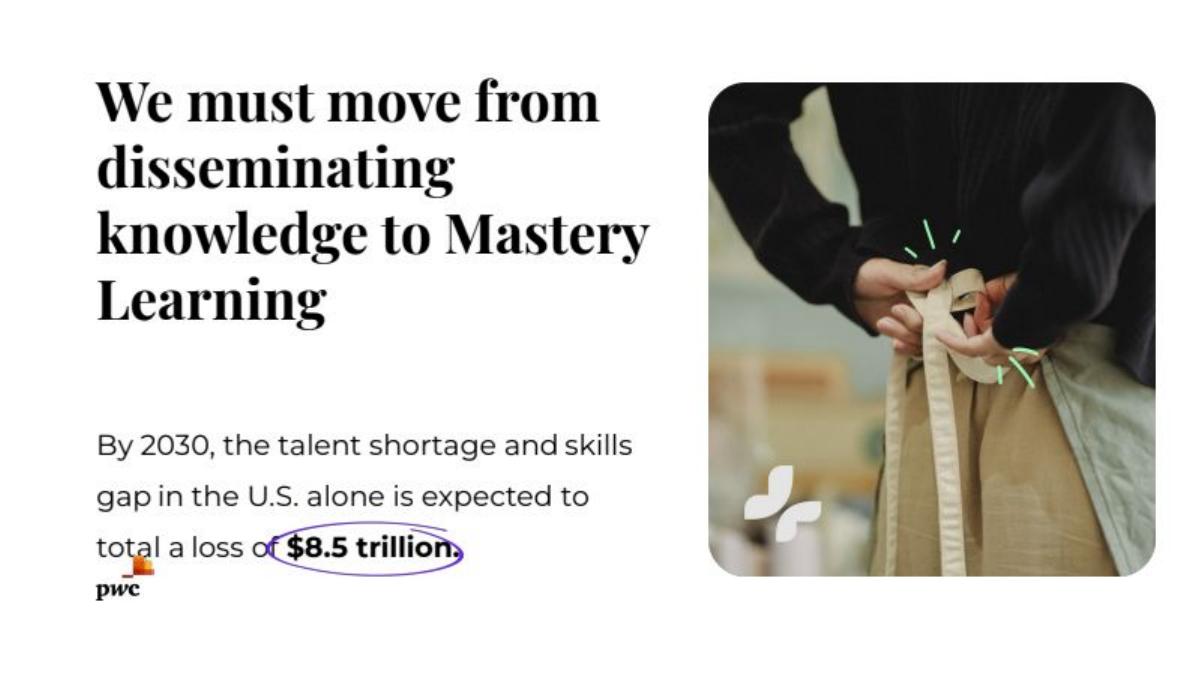
Slide 2 uses minimalist iconography (Wikipedia, YouTube, ChatGPT) to argue that knowledge is now a commodity. This sets up the pivot on Slide 3: the shift from 'disseminating knowledge' to 'Mastery Learning.' The deck cites a PwC study claiming that by 2030, the talent shortage in the U.S. alone will result in a loss of $8.5 trillion . This framing elevates the startup from a simple school to a solution for a multi-trillion-dollar global economic threat.
Slides 4-5: Product and Pedagogy
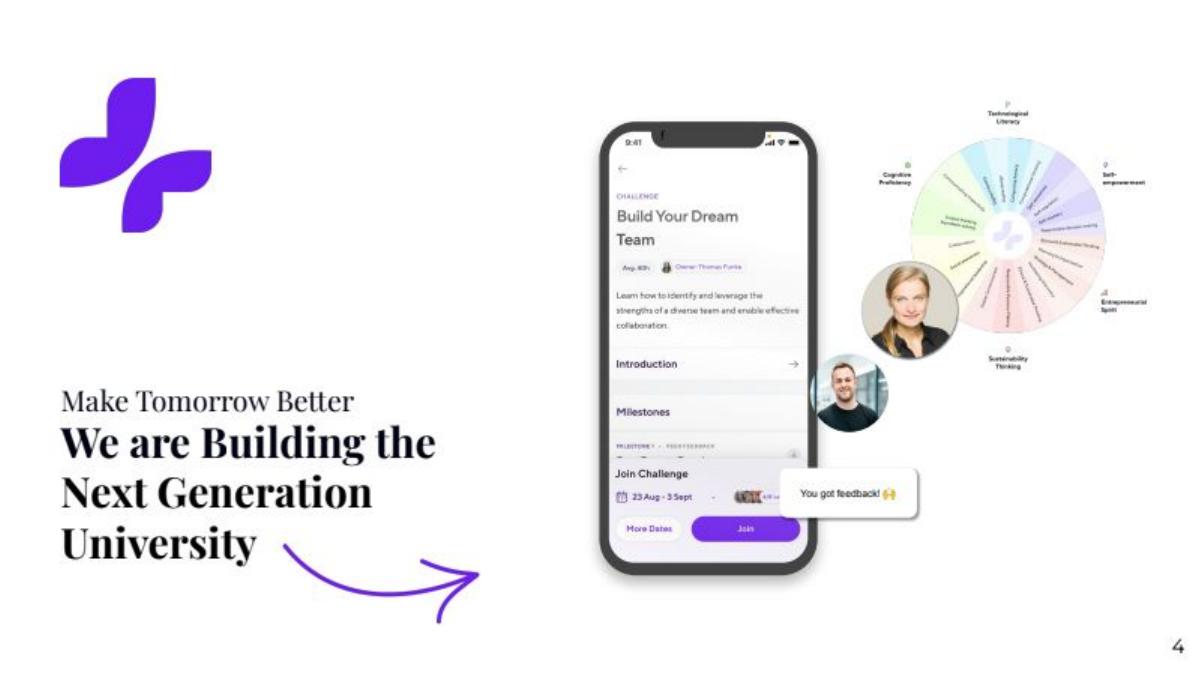
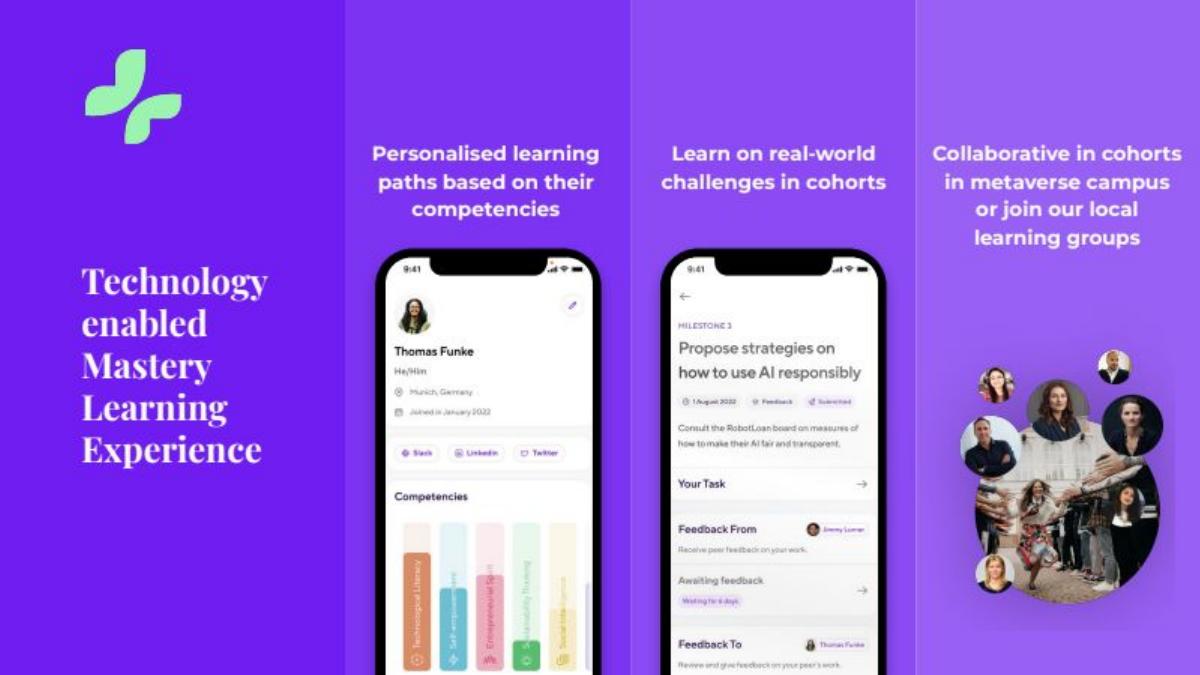
These slides focus on the 'how.' Slide 4 introduces the mobile interface, highlighting 'Challenges' like 'Build Your Dream Team.' Slide 5 details the 'Technology enabled Mastery Learning Experience,' which includes personalized paths based on competencies, real-world cohort-based challenges, and a 'metaverse campus.' The emphasis here is on engagement; the visual of a mobile app suggests a frictionless, modern user experience that contrasts with legacy university portals.
Slide 6: The Offering and Pricing
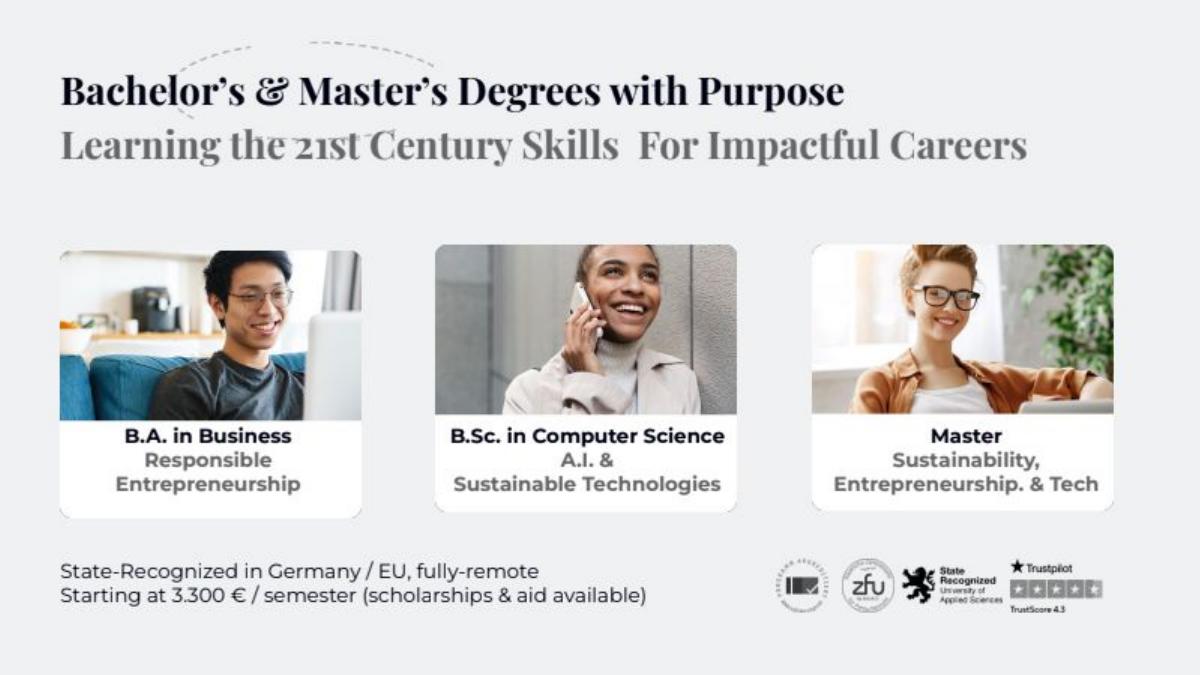
Slide 6 provides the specifics of their degree programs. They offer a B.A. in Business, a B.Sc. in Computer Science, and a Master’s degree. Crucially, the slide notes they are 'State-Recognized in Germany / EU, fully-remote.' This is their 'moat.' They also provide pricing transparency, stating tuition starts at 3,300 € / semester . The inclusion of Trustpilot ratings and accreditation stamps at the bottom of the slide serves to de-risk the investment for VCs who might be wary of the regulatory hurdles in education.
Slide 7: Traction and Unit Economics
This is the most important slide in the deck for a Series A investor. It maps the company’s journey from a 2021 Pre-Seed round to its 2023 status. Key metrics include:
80% Gross margin on their A.I. Learning Platform. · 3x YoY Growth. · 95% Completion Rate (a metric that dwarfs the industry average for online courses). · Achievement of state recognition in 'Record Time.'
By highlighting the 80% gross margin, the founders are explicitly telling investors that this is a scalable software business, not a labor-intensive service business.
Slide 8: Market Size
The deck uses a standard TAM/SAM/SOM concentric circle graphic. It identifies a $7.3T Global Education market , a $2.3T Post Secondary market , and a $117B Online Degrees and Micro-Credentials market growing at 17% YoY . The slide concludes by stating that 'Challenger universities are demonstrating the scalability,' positioning Tomorrow University as the leader of this new category.
Slide 9: The Team
The team slide features two co-founders with complementary backgrounds. Christian Rebernik is presented as the product expert with 20+ years of experience, including time at N26 and Vivy . Thomas Funke is the education expert with 15+ years in innovation, citing affiliations with Goethe University and TQ . This 'Product + Pedagogy' pairing is a classic formula for successful EdTech founding teams.
Slide 10-11: The Vision and Closing
Slide 10 is a purely aspirational closing slide, featuring a person looking over a cloud-filled valley with the text 'Join building the Next Generation University For the Ones Who Change the World.' Slide 11 is a promotional slide for the platform hosting the deck and is not part of the company's original pitch content.
What Works in This Deck
Regulatory Moat: The founders correctly identify that state recognition is their strongest asset. They mention it on slides 6 and 7, ensuring investors understand that they aren't just another 'ed-tech app' but a legitimate institution that can grant degrees.
The Completion Rate: A 95% completion rate (Slide 7) is an extraordinary figure in online education. Highlighting this metric addresses the biggest skepticism in the sector: that students don't actually finish remote programs.
SaaS-like Metrics: By calling out an 80% gross margin, the deck reframes the university model as a high-margin technology platform. This is essential for attracting venture capital rather than traditional private equity.
What Is Missing
The Ask: The deck does not state how much they are raising or how they intend to use the capital. While the catalogue facts confirm a $10M raise, the slide deck itself leaves this to the imagination.
Competitive Landscape: There is no slide comparing Tomorrow University to other challenger universities like Minerva, or traditional incumbents. Investors need to know why a student would choose this over a local university or a bootcamp.
B2B vs. B2C Breakdown: While the business model is listed as B2C in the catalogue, the 'Major Corporate Partners' mentioned on slide 7 suggest a B2B or B2B2C component. The deck doesn't clarify if these partners are paying for employee upskilling or simply providing mentors.
Founder Takeaways
Lead with Credibility: If your industry is highly regulated (like education, fintech, or healthcare), your regulatory milestones are as important as your revenue. Tomorrow University put their accreditation front and center.
Focus on the 'Why Now': Slide 2 and 3 effectively use the rise of AI and the global talent shortage to create a sense of urgency. Founders should always answer why their solution is necessary today, not just why it is a good idea in general.
Quantify the Unquantifiable: Education is often seen as a 'soft' industry. By bringing hard numbers like '80% gross margin' and '95% completion rate,' the founders spoke the language of Series A investors who prioritize unit economics and retention.
Frequently asked questions
- What is Tomorrow University's primary competitive advantage?
- According to the deck, their primary advantage is being a state-recognized university in Germany and the EU that is fully remote. Slide 7 emphasizes that they achieved this status in record time. This accreditation allows them to offer formal Bachelor's and Master's degrees, which distinguishes them from most EdTech platforms that only offer non-accredited certificates or bootcamps.
- How does the company justify its valuation and scalability?
- The company positions itself as a technology-enabled platform rather than a traditional school. Slide 7 explicitly mentions an 80% gross margin for their A.I. learning platform. By combining high margins with 3x year-over-year growth and a 95% student completion rate, they present a financial profile more similar to a SaaS company than a service-based educational institution.
- What specific degree programs does Tomorrow University offer?
- Slide 6 lists their core offerings: a B.A. in Business (Responsible Entrepreneurship), a B.Sc. in Computer Science (A.I. & Sustainable Technologies), and a Master's degree focused on Sustainability, Entrepreneurship, and Tech. These programs are designed to address the '21st Century Skills' gap mentioned in their problem statement.
- Who are the key investors in this $10M Series A round?
- According to the catalogue facts, the round was led by EduCapital. Other participants included Mediahuis Ventures, Redstone, Zanichelli Ventures, Sparkmind, 4P Capital, and Emerge Education. Several prominent angel investors also participated, including Verena Pausder and Ralf Reichert.
- What is missing from the Tomorrow University pitch deck?
- The 11-slide deck is missing a specific 'Ask' slide detailing how the $10M will be spent. It also lacks a dedicated competitor landscape slide, though it alludes to 'Challenger universities' on slide 8. Furthermore, while it mentions 'Major Corporate Partners' on slide 7, it does not provide a detailed breakdown of B2B revenue versus B2C tuition.