Tomorrow Health's Series B deck is a concise, 13-slide presentation that successfully secured $60M in funding. The narrative centers on the shift of medical care toward the home and the massive inefficiencies currently plaguing that transition. By highlighting a team with deep roots in Oscar Health, Amazon, and Flatiron, the company establishes immediate credibility. The deck uses specific case studies, such as their partnership with Geisinger Health Plan, to prove that their software solution can improve on-time care starts from an industry average of 50% to 97%. While the deck lacks a tradi…
Key takeaways
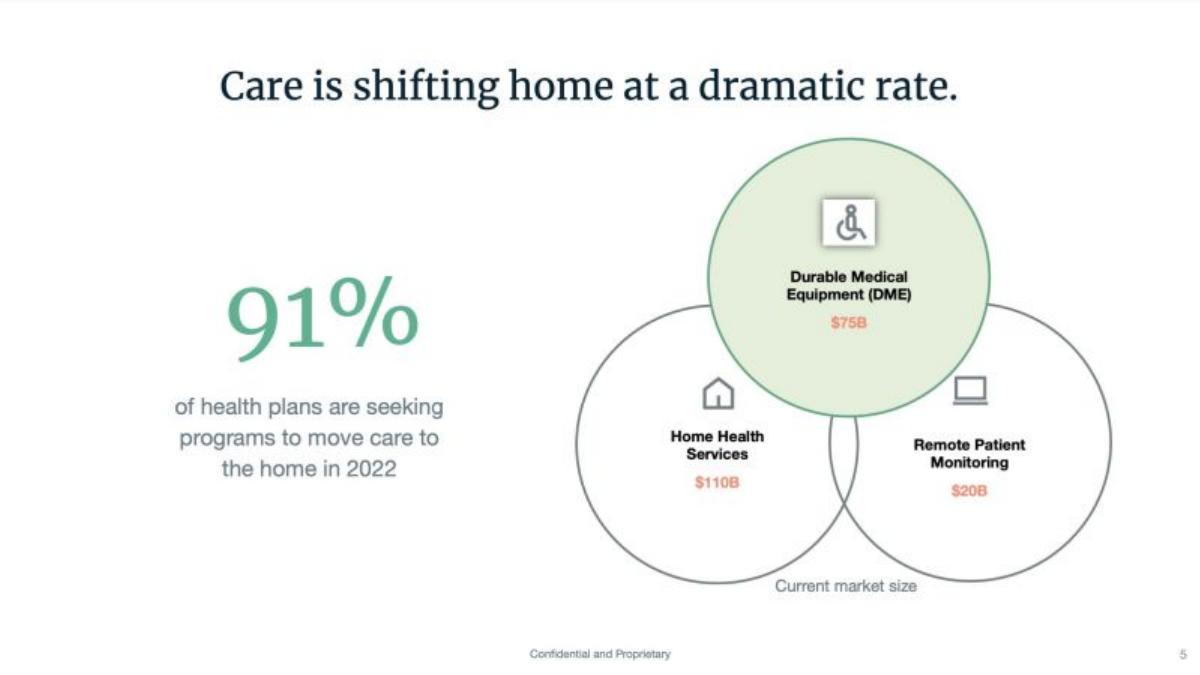
- The company identifies a $205B total addressable market across DME, Home Health Services, and Remote Patient Monitoring (Slide 5).
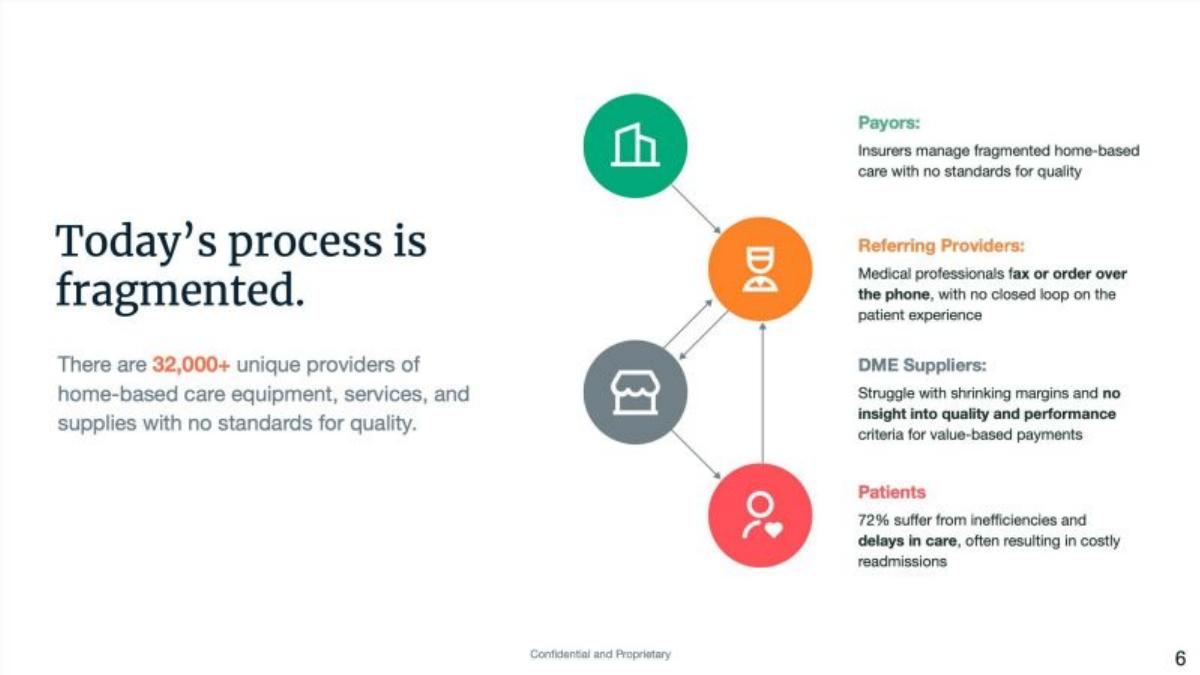
- A strong emphasis is placed on the 'fragmented' nature of the current market, citing 32,000+ unique providers with no quality standards (Slide 6).
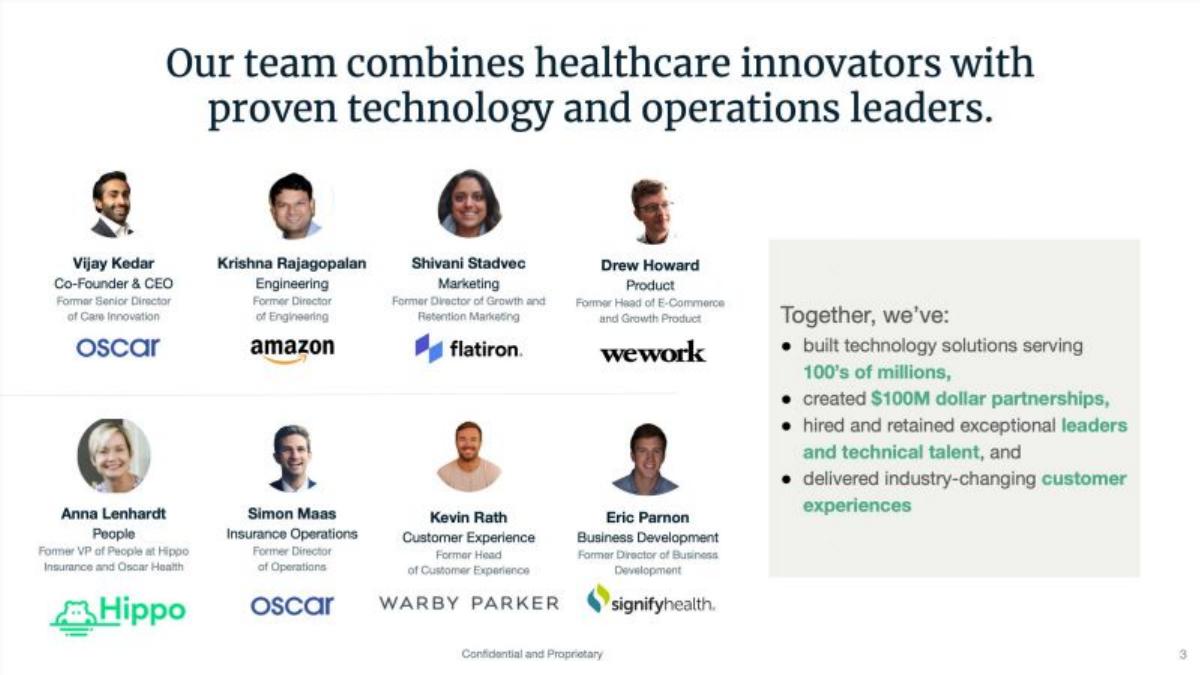
- The team slide highlights significant prior experience at high-growth companies like Oscar, Amazon, Flatiron, and Warby Parker (Slide 3).
- Tomorrow Health claims to improve on-time care starts to 95%, nearly double the industry average of 50% (Slide 7).
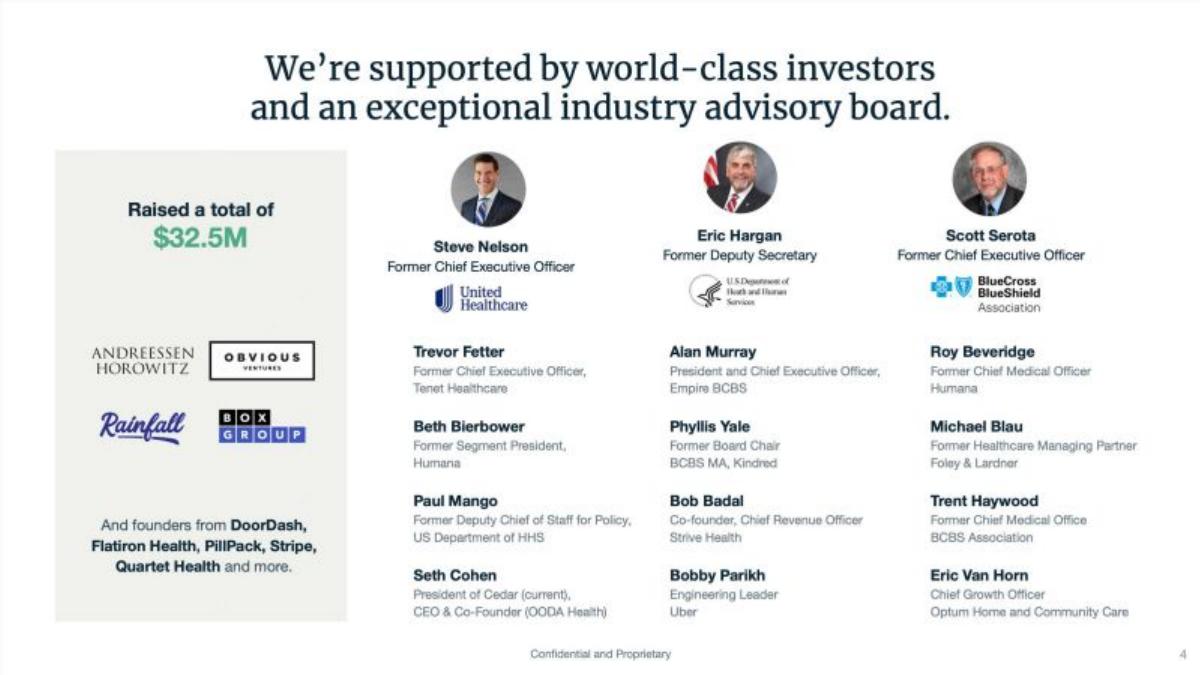
- The deck features a high-profile advisory board including former CEOs of UnitedHealthcare and BlueCross BlueShield (Slide 4).
- Real-world validation is provided through a Geisinger Health Plan case study covering 550,000+ patient lives (Slide 9).
- The solution addresses four distinct stakeholders: Payors, Referring Providers, DME Suppliers, and Patients (Slide 7).
- The deck omits a specific funding request, valuation, or detailed five-year financial forecast (Slides 1-13).
The Narrative: Restoring the Home as the Primary Place of Care
Tomorrow Health’s Series B deck is built on a single, powerful premise: the home is the future of healthcare, but the infrastructure to support it is broken. The deck moves quickly from a high-level vision to a granular breakdown of how their software fixes a multi-sided market inefficiency. By the time an investor reaches the final slide, the company has presented a clear argument that they aren't just a medical equipment provider, but the operating system for home-based care.
Slides 1-2: Vision and Mission
The deck opens with a clean, minimalist title slide featuring the company logo—a stylized bird. Slide 2 immediately establishes the company's purpose: "We are restoring the home as the primary place of care." Below this, they define themselves as "America’s trusted software solution for home medical equipment, supplies and services." This is a critical distinction; they are positioning themselves as a technology company (SaaS) rather than a logistics or medical supply company.
Slide 3: The Team
Placement of the team slide early in the deck is a classic move for Series B companies that have high-caliber leadership. The slide features eight key leaders with logos from Oscar, Amazon, Flatiron, WeWork, Hippo, Warby Parker, and Signify Health . The text highlights that they have collectively built solutions serving 100’s of millions and created $100M dollar partnerships. This slide is designed to signal that the founders have the operational experience to scale a complex, regulated business.
Slide 4: Investors and Advisors
Slide 4 doubles down on credibility. It notes a total of $32.5M previously raised from Andreessen Horowitz, Obvious Ventures, Rainfall, and BoxGroup . More importantly for a healthcare startup, it lists an "exceptional industry advisory board" featuring former CEOs and executives from UnitedHealthcare, BlueCross BlueShield, Humana, and the U.S. Department of Health and Human Services . In healthcare, who you know is often as important as what you build, and this slide proves Tomorrow Health has the necessary institutional backing.
Slide 5: Market Opportunity
The market slide uses a Venn diagram to show the intersection of three massive sectors: Durable Medical Equipment (DME) at $75B, Home Health Services at $110B, and Remote Patient Monitoring at $20B . It also includes a powerful stat: 91% of health plans are seeking programs to move care to the home in 2022. This frames the company's opportunity within a $205B market that is actively being pushed by the largest payers in the country.
Slide 6: The Problem (Fragmentation)
Slide 6 illustrates the current "fragmented" process. It identifies 32,000+ unique providers of home-based care equipment with no standards for quality. The slide maps out the friction points for four groups: Payors (no quality standards), Referring Providers (manual faxing/ordering), DME Suppliers (shrinking margins), and Patients (72% suffer from delays). This sets the stage for a solution that can unify these disparate parties.
Slide 7: The Solution (Ecosystem Wins)
This is the "Value Proposition" slide. Tomorrow Health shows how their platform creates a circular benefit:
Payors: Save 15% on home-based care spend. · Referring Providers: Spend 45% less time ordering and managing care. · DME Suppliers: Spend 60% less time processing orders. · Patients: Start care on time 95% of the time (vs. 50% industry average).
By quantifying the benefit for every participant, the company demonstrates that its growth is incentivized by the entire ecosystem.
Slide 8: The Human Element
Slide 8 brings the problem back to a personal level. It cites that 1 in 10 patients report readmissions or complications due to DME delays. It also includes a personal anecdote from Co-Founder Vijay Kedar regarding his mother's Stage 3 cancer treatment, where delayed equipment led to two hospital readmissions. This provides the "why" behind the company and adds emotional weight to the data presented earlier.
Slide 9: Case Study (Geisinger Health Plan)
For a Series B, proof of concept is mandatory. Slide 9 focuses on their partnership with Geisinger Health Plan , covering 550,000+ patient lives . The results are impressive: 97% on-time care starts and a 9.5 out of 10 patient satisfaction score. This slide proves that the theoretical benefits mentioned on Slide 7 are achievable at scale.
Slides 10-11: Patient Experience and Future Vision
Slide 10 focuses on the patient, citing a 90+ CSAT score and 95+ Patient NPS . It includes a testimonial about a "Care Advocate" fighting on a patient's behalf. Slide 11 looks forward, using a COPD patient as an example of how Tomorrow Health will eventually coordinate everything from CPAP machines to respiratory therapy and remote monitoring in a "connected, partner enabled, home-based care ecosystem."
Slides 12-13: Conclusion
The deck concludes with a simple "Thank You" slide and a promotional slide for the source of the deck. Notably, there is no "Ask" slide detailing how the $60M will be spent, nor is there a financial table showing revenue growth or burn rate. These were likely handled in a separate data room or supplemental document.
What Works in This Deck
Stakeholder Alignment: The deck does an excellent job of explaining how a single platform solves problems for four different groups simultaneously. In healthcare, if you only solve a problem for the patient but increase the workload for the doctor or the cost for the insurer, the product will fail. Tomorrow Health proves they have considered the incentives of the entire chain.
Quantifiable Metrics: Using the 50% industry average for on-time care as a benchmark against their 95-97% success rate is a powerful way to demonstrate value. These aren't just "better" outcomes; they are transformative ones.
Credibility via Association: Between the blue-chip VC logos and the heavy-hitting advisory board, the deck exudes "winner's bias." It suggests that the most important people in healthcare have already vetted this solution and decided it is the future.
What Is Missing
The Business Model Details: While the catalogue listing identifies them as SaaS, the deck doesn't explicitly explain the fee structure. Do they take a percentage of the DME spend? Do they charge a per-member-per-month (PMPM) fee to insurers? For a Series B, investors would want to see the mechanics of how the $205B market translates into Tomorrow Health's top-line revenue.
Competitive Landscape: The deck mentions 32,000+ "unique providers," but it doesn't address other tech-enabled competitors or legacy players who might be building similar coordination software. A slide on why their moat is defensible (e.g., network effects or proprietary integrations) would have been beneficial.
Financial Projections: There is no mention of current ARR, growth rates, or path to profitability. While common in high-level pitch decks, the absence of even a summary chart is notable for a $60M raise.
What a Founder Should Copy
The "Ecosystem Win" Slide: If you are building a marketplace or a platform, Slide 7 is the perfect template. Showing exactly how every participant in your market makes more money or saves more time creates a sense of inevitability for your product.
The Advisory Board Strategy: Tomorrow Health didn't just get "advisors"; they got the former leaders of their potential customers (UnitedHealthcare, Humana). Founders in complex industries should prioritize advisors who provide not just advice, but institutional validation.
The Problem-to-Personal Bridge: Combining a massive market failure (Slide 6) with a personal story (Slide 8) is a highly effective way to make a data-driven pitch memorable. It reminds investors that behind the $205B market are real people suffering from inefficient systems.
Frequently asked questions
- What is Tomorrow Health's primary business model?
- According to the catalogue facts, Tomorrow Health operates as a SaaS company in the B2C healthcare space. However, the deck (Slide 7) illustrates a B2B2C approach where they act as a central software platform connecting payors, providers, and suppliers to facilitate care for the end patient.
- How much did Tomorrow Health raise with this deck?
- The catalogue listing states the company raised $60M in a Series B round in 2022. Slide 4 of the deck notes that they had previously raised a total of $32.5M prior to this specific round.
- Who are the lead investors in this round?
- The Series B round was led by Bond, with participation from Andreessen Horowitz, Obvious Ventures, BoxGroup, and Sound Ventures, as per the catalogue listing.
- What specific problem does Tomorrow Health solve?
- The deck identifies the 'fragmented' process of home-based care (Slide 6). It specifically targets the 72% of patients who suffer from inefficiencies and delays in receiving Durable Medical Equipment (DME), which often leads to hospital readmissions (Slide 8).
- What metrics does the company use to prove its success?
- The company highlights a 97% on-time care start rate, a 45% reduction in coordination time for providers, and a 9.5 out of 10 patient satisfaction score in their Geisinger Health Plan partnership (Slide 9).