The Tokyo Techies pitch deck is a masterclass in grounding a startup's mission in macroeconomic urgency. By citing a projected 50,000 engineer deficit in Japan by 2020 (Slide 4), the company transforms a training service into a critical infrastructure solution. The deck balances high-touch service metrics, such as a $20k MRR and 95% retention (Slide 7), with a vision for digital scalability through their beta learning platform (Slide 9). While the deck lacks a specific financial 'Ask' or a detailed roadmap, it compensates with significant social proof, listing 15 major corporate partners incl…
Key takeaways
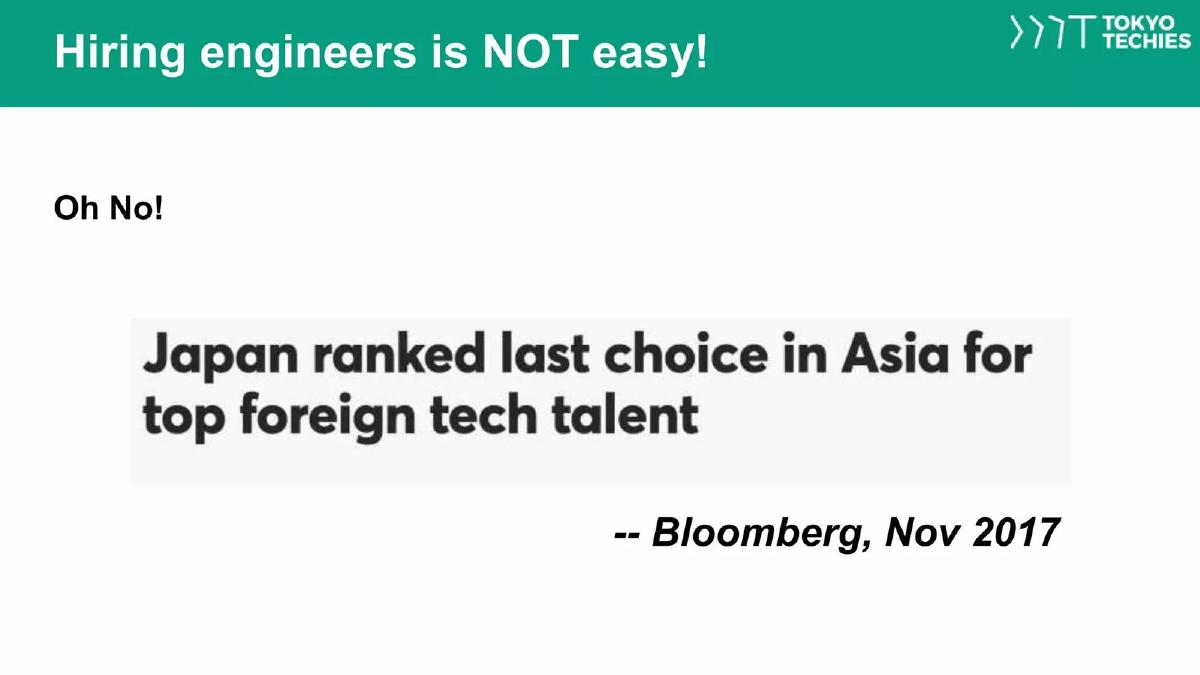
- The deck identifies a specific market crisis: Japan ranked as the last choice in Asia for top foreign tech talent as of 2017 (Slide 3).
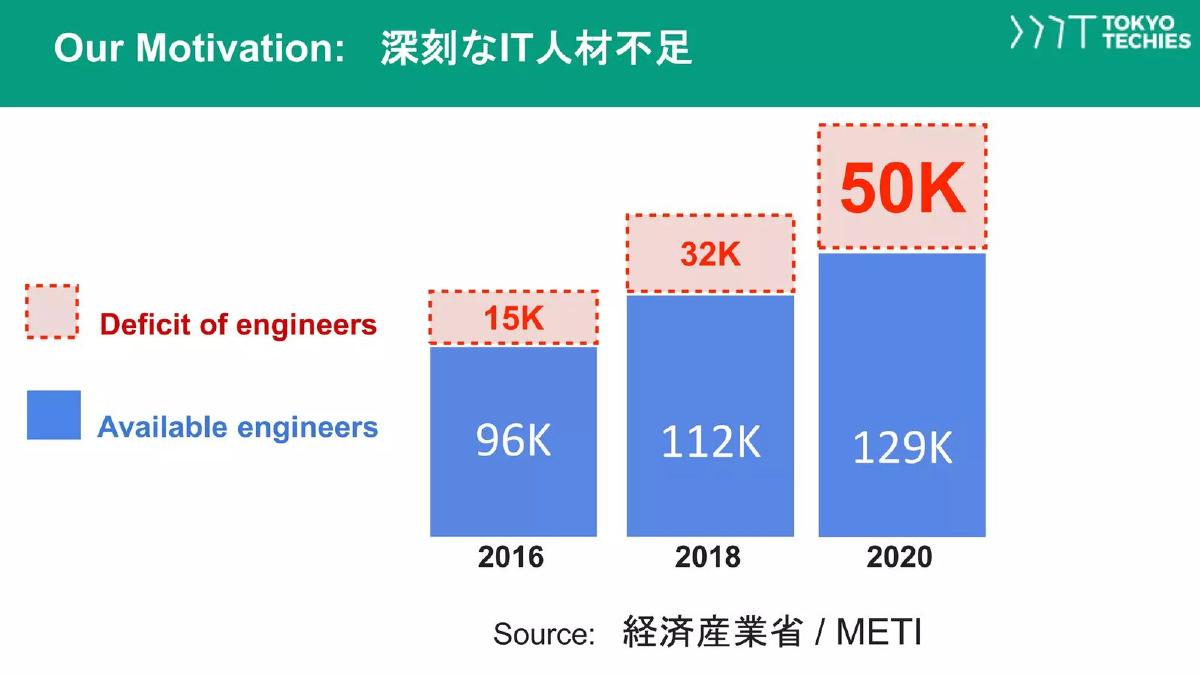
- The core problem is quantified using METI data, showing the engineer deficit growing from 15k in 2016 to a projected 50k in 2020 (Slide 4).
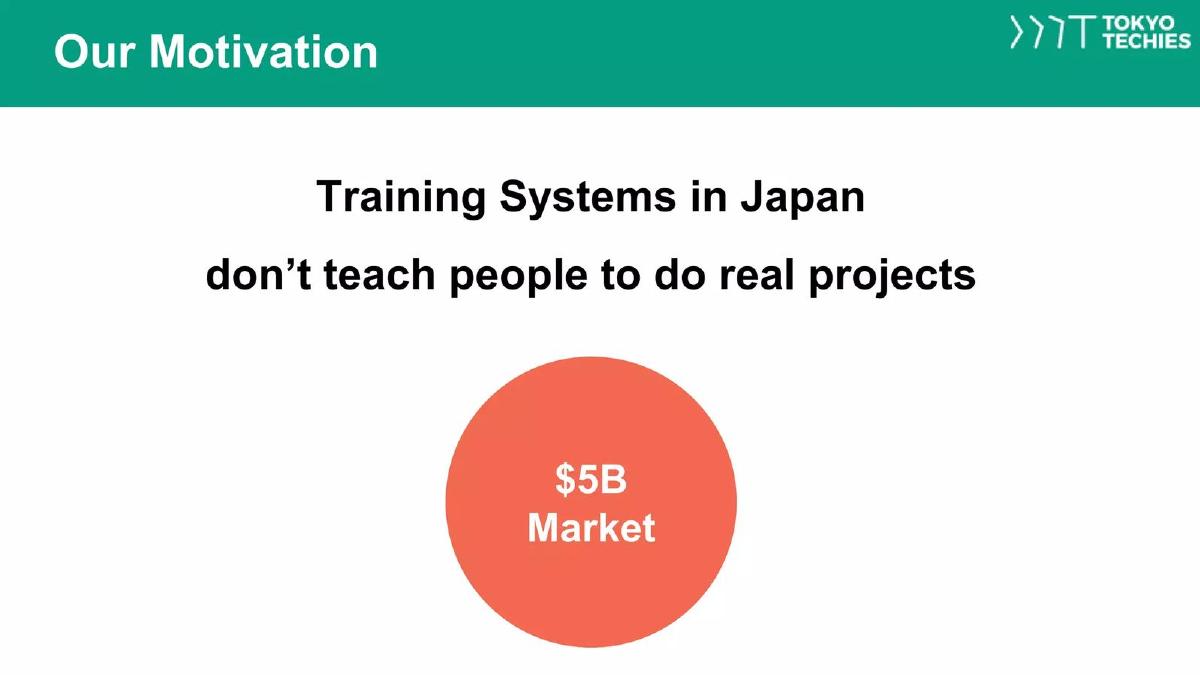
- The company targets a $5B market for training systems in Japan, specifically calling out the failure of current systems to teach 'real projects' (Slide 5).
- Traction is demonstrated through a $20,000 Monthly Recurring Revenue (MRR) and a high 95% retention rate (Slide 7).
- The product strategy shifts from service to scale, introducing a 'BETA Version' learning platform with 85k+ courses and 526k+ tests (Slide 9).
- The team slide emphasizes technical depth, featuring four leaders with advanced degrees (MSc and Ph.D.) and backgrounds at SoftBank, Sony, and Rakuten (Slide 10).
- Social proof is a primary driver, showcasing 15 clients including global brands like Manulife and Tokyo Gas Group (Slide 11).
- The deck omits a formal 'Ask' slide, failing to specify the amount of capital being raised or the intended use of funds.
The Macro-Economic Hook
Tokyo Techies begins their 2018 pre-seed deck by ignoring their product and focusing entirely on a systemic failure in the Japanese economy. This is a sophisticated move for a pre-seed company. By the time the investor sees the solution, they have already been convinced that the status quo is unsustainable.
Slide 1: Title Slide
The cover slide is functional and bilingual. It features the company logo and the tagline 'Personalized Tech Training' in both English and Japanese. The background image shows a diverse group of people working on laptops, reinforcing the 'tech' and 'training' aspects of the brand immediately.
Slide 2: The Hook
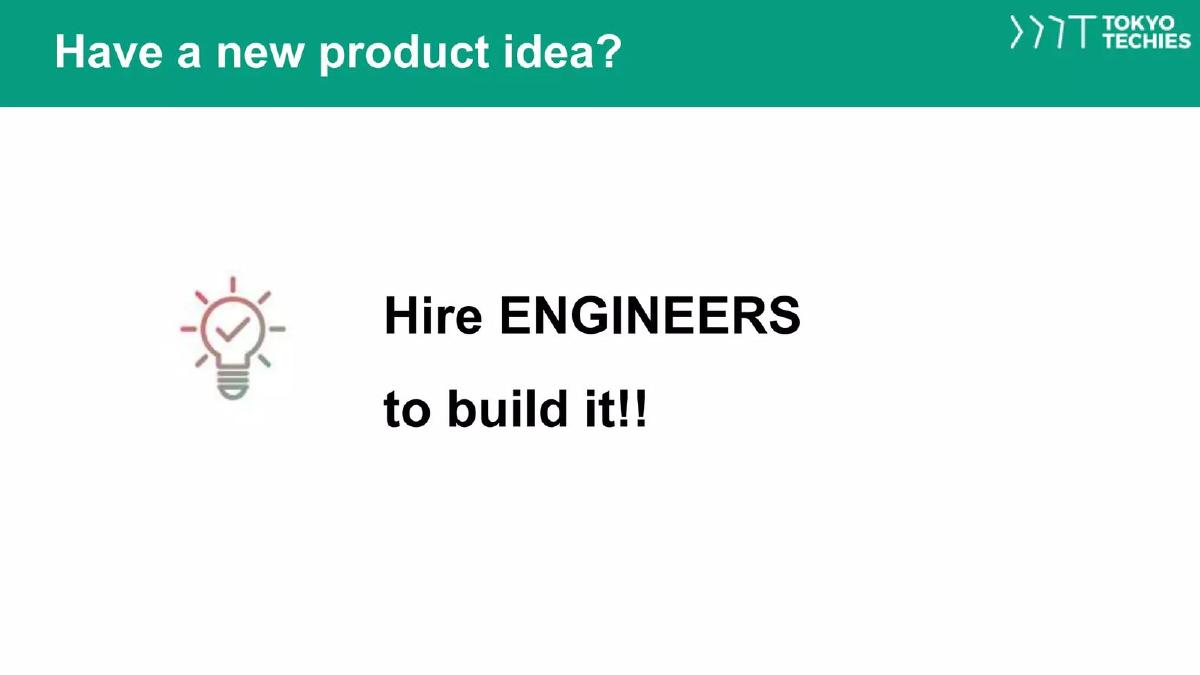
Slide 2 poses a simple question: 'Have a new product idea?' followed by the obvious answer: 'Hire ENGINEERS to build it!!' This sets up a logical flow that the next slide immediately disrupts. It establishes the fundamental dependency of any modern business on technical talent.
Slide 3: The Reality Check
The deck pivots sharply to the difficulty of hiring. It quotes a Bloomberg article from November 2017 stating that 'Japan ranked last choice in Asia for top foreign tech talent.' This slide serves to narrow the focus from a general hiring problem to a specific, regional crisis in Japan, making the startup's mission feel geographically essential.
Slide 4: Quantifying the Deficit
This is the 'anchor' slide of the deck. Using data from the Ministry of Economy, Trade and Industry (METI), Tokyo Techies shows a bar chart of 'Available engineers' versus a 'Deficit of engineers.' The deficit is shown growing from 15,000 in 2016 to 32,000 in 2018, and finally a projected 50,000 by 2020. By providing a specific number (50K), the founders give investors a metric to measure the 'size' of the problem they are solving.
Slide 5: Market Size and Qualitative Problem
The deck identifies a '$5B Market' for training systems in Japan. However, it notes that these systems 'don’t teach people to do real projects.' This slide bridges the gap between the macro labor shortage and the specific product opportunity: the failure of existing education to produce 'job-ready' talent.
Slide 6: The Solution Defined
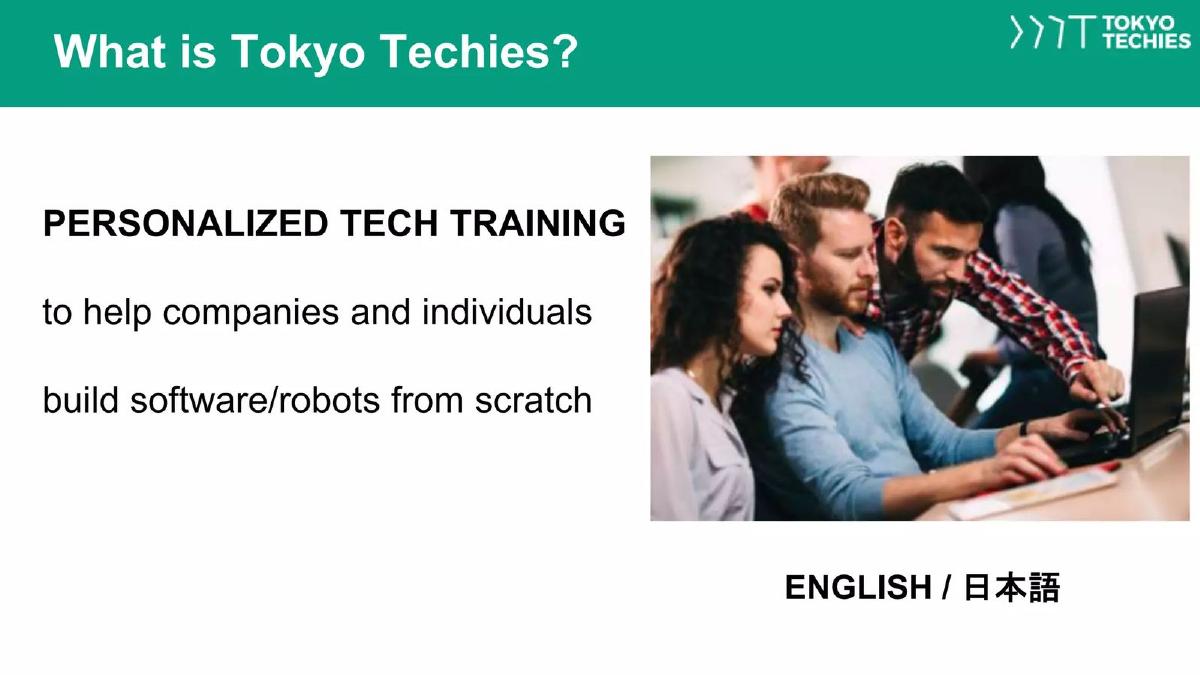
Slide 6 answers the question 'What is Tokyo Techies?' It defines the offering as 'PERSONALIZED TECH TRAINING' for both companies and individuals. Crucially, it mentions building 'software/robots from scratch' and offers the service in 'ENGLISH / 日本語.' The mention of robotics and bilingual support suggests a higher-end, more technical offering than standard coding bootcamps.
Slide 7: Current Traction
At the pre-seed stage, revenue is the best de-risking tool. Tokyo Techies reports an MRR of '$20K' and a 'RETENTION' rate of '95%.' These two numbers, presented simply in large orange circles, suggest a strong product-market fit and a 'leaky bucket' problem that has already been solved.
Slide 8: The Competitive Gap
The deck lists three 'common challenges' they solve: 1. Not personalized, 2. Outdated videos, and 3. Fake Learning (Copy & Paste). This slide is effectively their 'Why Us' slide, positioning their method as a more rigorous and modern alternative to incumbent training providers.
Slide 9: The Scalability Vision
To move from a service-based business to a venture-scale SaaS, the company introduces its 'Learning Platform: BETA Version.' The slide shows a dashboard with impressive cumulative metrics: 85K+ total courses, 526K+ total tests & exams, and 756+ average daily traffic. It also shows flags for Japan, Vietnam, the USA, and the UK, signaling international ambitions.
Slide 10: The Team
The team slide is a significant strength. It features four leaders: Duc Doba (CEO), Konrad Lykowski (MSc), Phong Nguyen (Ph.D.), and Abbi Hamed (Ph.D.). Beneath their photos are logos for SoftBank, LINE, Rakuten, Hitachi, and Sony. This communicates that the '12 professional engineers' mentioned in the header have 'blue-chip' experience in the exact market they are targeting. The bottom bar highlights their expertise in AI, Robotics, Cybersecurity, and Software Dev.
Slide 11: Social Proof
The '15 CLIENTS & PARTNERS' slide is a 'who's who' of Japanese and global industry. It includes Tokyo Gas Group, Toshiba, Manulife, NTT Data, and Tokyo American Club. For a pre-seed company, having this level of B2B penetration is a powerful signal that their 'Personalized Tech Training' is already being bought by enterprise procurement departments.
Slide 12: The Call to Action
The final slide is a simple invitation in Japanese to visit their booth, suggesting this version of the deck may have been used for a specific conference or demo day. It reiterates the brand as 'THE FUTURE OF TECHNOLOGY TRAINING.'
What Works in This Deck
Macro-to-Micro Narrative: The deck starts with a national crisis (labor shortage) and ends with a specific solution (personalized training). This makes the company feel like a 'must-have' rather than a 'nice-to-have.' Hard Metrics: Including MRR ($20k) and retention (95%) on Slide 7 provides immediate credibility. Many pre-seed decks rely on 'projected' numbers; Tokyo Techies relies on realized ones. Technical Pedigree: The team slide (Slide 10) is excellent. Having two Ph.D.s and an MSc on the founding team for a technical training company is a strong signal of 'subject matter expertise.' Enterprise Validation: The logo wall on Slide 11 is exceptional for a 2018 pre-seed round. It proves that the founders can sell into notoriously difficult Japanese enterprises.
What is Missing
The Ask: There is no mention of how much money is being raised or what the terms are. This is a critical omission for a fundraising deck. Use of Funds: Even if the amount wasn't disclosed, a slide detailing 'What we will do next' (e.g., hire 5 more engineers, expand to Singapore) would help investors understand the growth trajectory. Unit Economics: While they show MRR, they don't show the Cost of Acquisition (CAC) or the Lifetime Value (LTV). Given the 'personalized' nature of the training, an investor would want to know if this model can scale without a linear increase in headcount. Competitive Landscape: The deck mentions 'common challenges' but doesn't name specific competitors. A 'Magic Quadrant' or a feature-comparison table would help define their market position more clearly.
What a Founder Should Copy
The 'Problem' Slide: Copy the way Slide 4 uses official government data (METI) to prove the market need. Using a third-party, authoritative source for your 'Problem' slide makes your pitch feel objective rather than speculative. The 'Beta' Reveal: If you are a service-heavy business trying to raise venture capital, copy Slide 9. It shows that while you are doing 'personalized' work, you are building the 'Learning Platform' in the background to handle the scale. Simple Visuals: The deck uses very little text. Most slides have one clear headline and one or two key graphics. This is ideal for a presentation where the speaker needs the audience's attention on them, not on reading the slides.
Frequently asked questions
- What is the primary business model of Tokyo Techies?
- Tokyo Techies operates as a B2B SaaS and professional services hybrid. According to the catalogue facts, it is classified as a SaaS business. Slide 6 and Slide 7 confirm they provide personalized tech training for companies and individuals, generating $20k in MRR with a 95% retention rate, indicating a recurring subscription or contract-based revenue model.
- How does Tokyo Techies differentiate itself from competitors?
- The deck identifies three specific 'common challenges' in existing tech training: lack of personalization, outdated video content, and 'fake learning' via copy-pasting (Slide 8). Tokyo Techies differentiates by offering 'Personalized Tech Training' that helps users build 'software/robots from scratch' in both English and Japanese (Slide 6).
- What is the scale of the market opportunity they are targeting?
- The company targets a $5 billion training market in Japan (Slide 5). This is supported by a massive talent gap; they cite Ministry of Economy, Trade and Industry (METI) data showing that the deficit of available engineers in Japan is expected to reach 50,000 by 2020 (Slide 4).
- Is the product fully automated or a service-based model?
- It appears to be a transition from service to platform. Slide 9 introduces a 'Learning Platform: BETA Version' which features automated metrics like 526k+ tests conducted and 85k+ total courses. However, Slide 10 highlights a 'Team of 12 professional engineers,' suggesting that human-led instruction remains a core part of their 'personalized' value proposition.
- What information is missing from this pitch deck?
- The most notable omissions are the 'Ask' and the 'Financial Projections.' The deck does not state how much money the company is raising, the valuation, or how the funds will be allocated. Additionally, there is no detailed competitive landscape or a multi-year roadmap beyond the 'Next Step: SCALABILITY' mentioned on Slide 9.