Toch.ai presents a concise 8-slide deck focused heavily on the technical efficiency and market opportunity of AI-automated video editing. The core value proposition is a drastic reduction in production time, claiming to turn a 1-3 hour manual process into a 1-3 minute automated workflow (Slide 3). While the deck is strong on product capabilities and market sizing—citing a $210B TAM (Slide 1)—it is notably missing critical investor information. There is no team slide, no financial history or projections, no mention of existing customers by name, and no specific funding ask. Despite these omiss…
Key takeaways
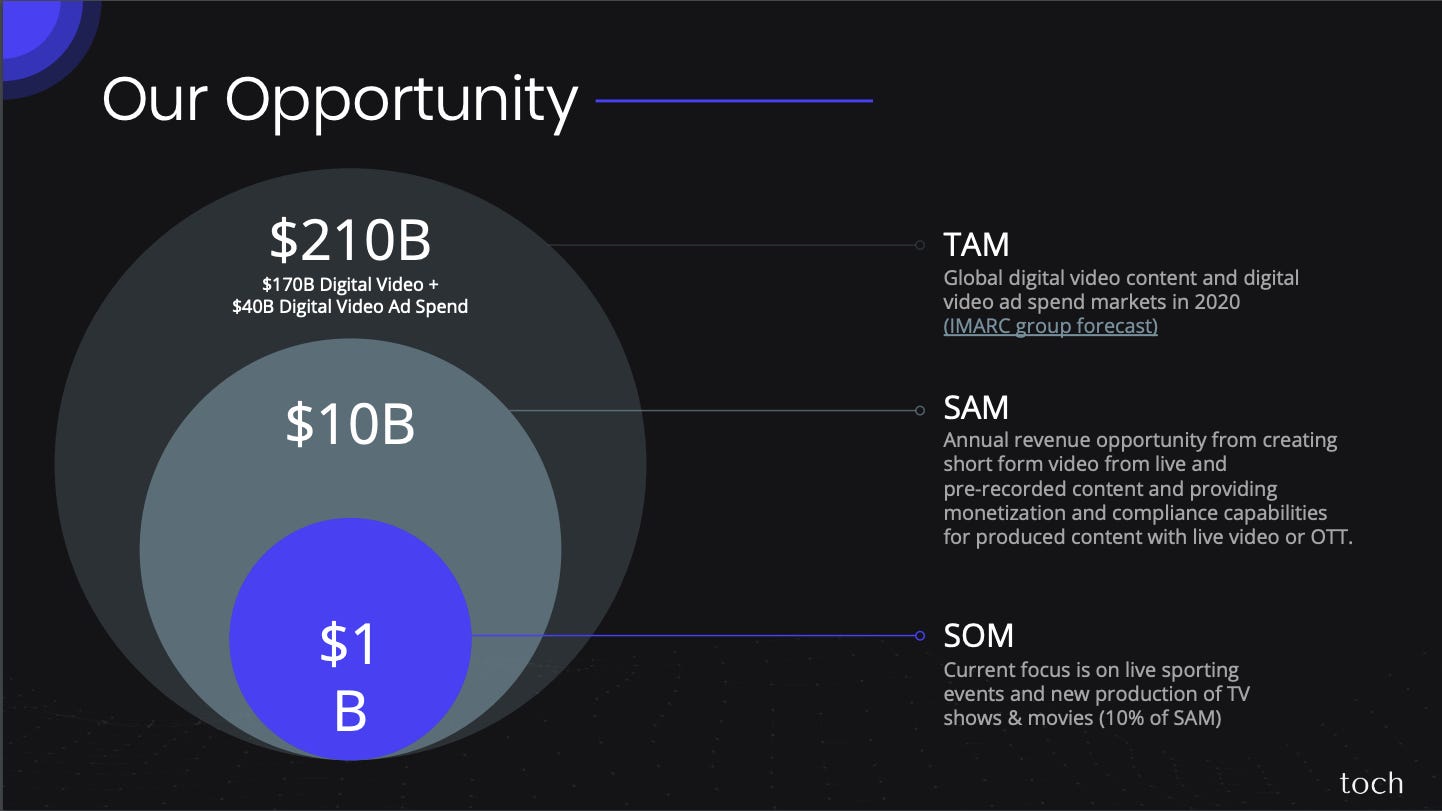
- The company identifies a $210B Total Addressable Market (TAM) based on global digital video content and ad spend (Slide 1).
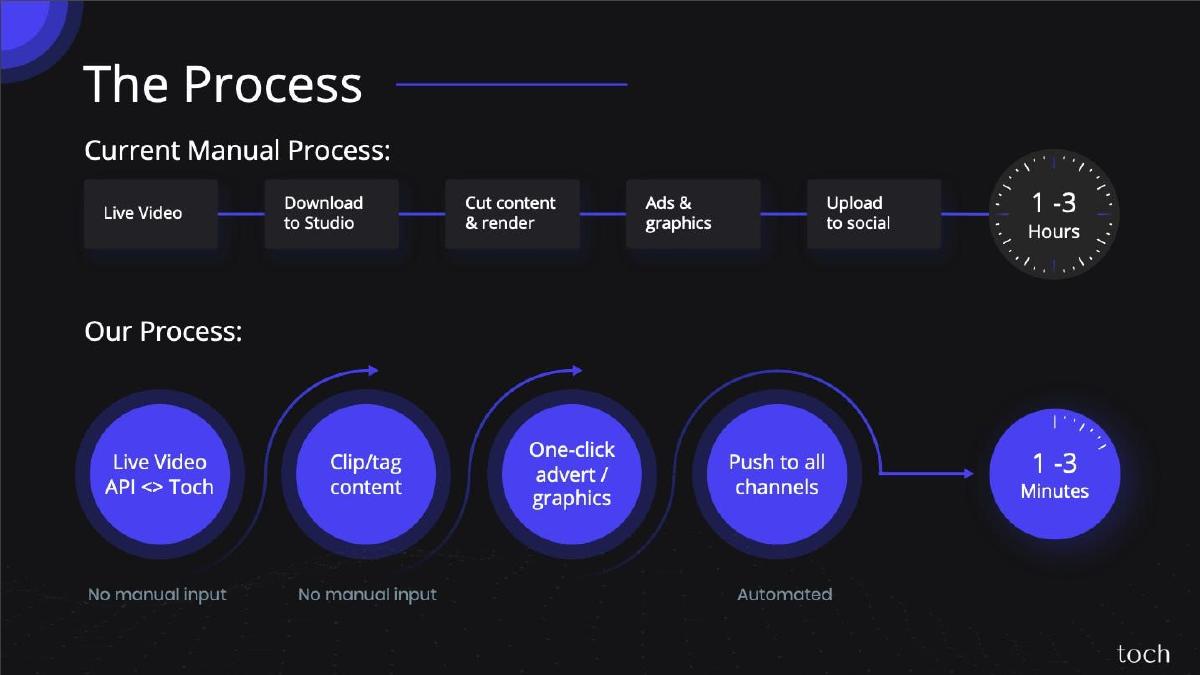
- Toch.ai claims to reduce manual video production time from 1-3 hours down to 1-3 minutes (Slide 3).
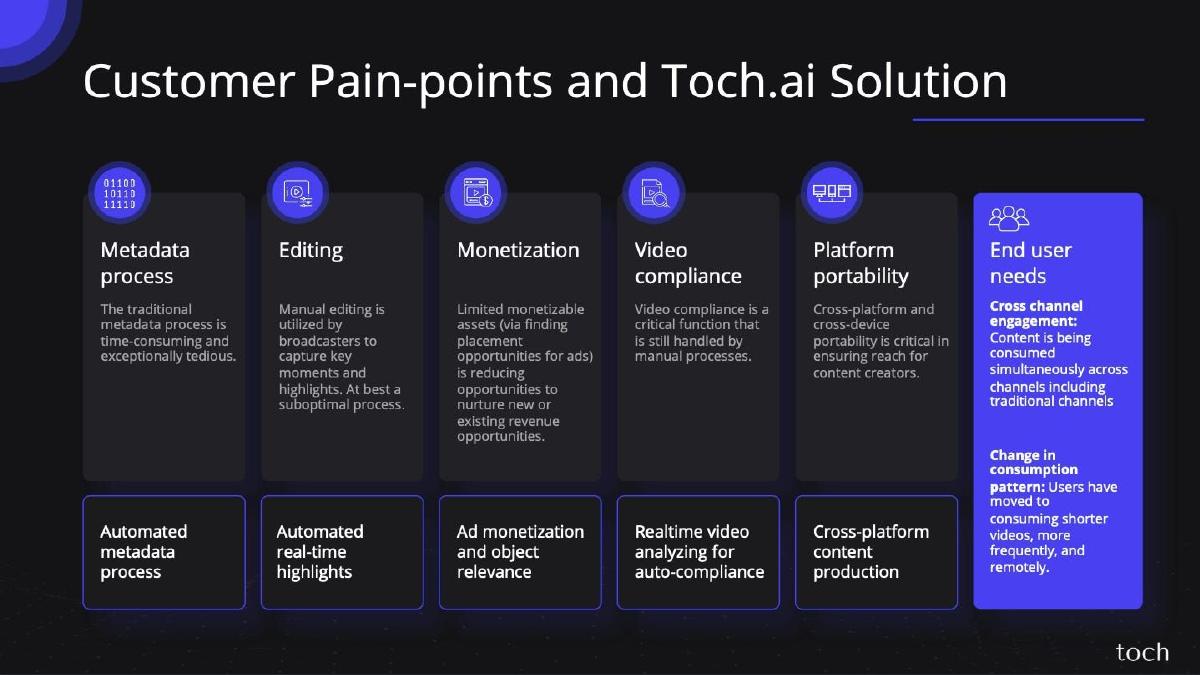
- The solution addresses six specific pain points: metadata processing, editing, monetization, compliance, portability, and end-user needs (Slide 2).
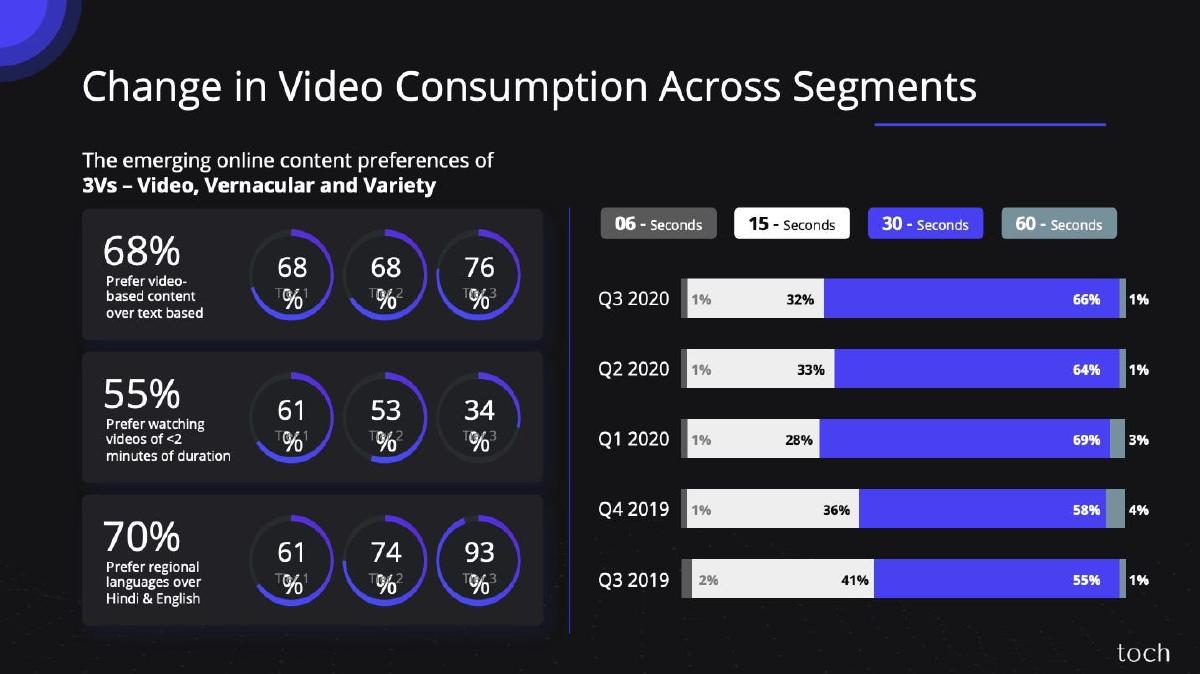
- Market data suggests 55% of users prefer watching videos under 2 minutes in duration (Slide 5).
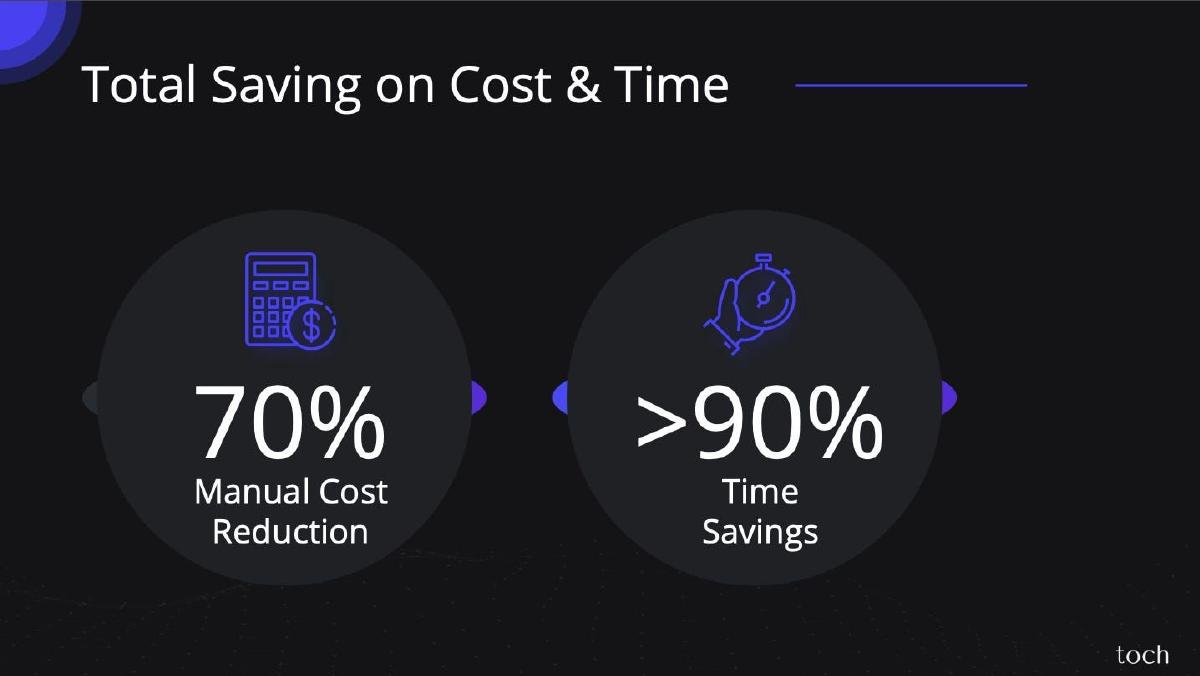
- The platform claims a 70% reduction in manual costs and over 90% in time savings (Slide 6).
- The product enables auto-resizing and publishing content across more than 30 platforms (Slide 7).
- Toch.ai positions itself in the top-right quadrant of the competitive landscape, defined as both 'Real-Time' and 'Cloud Based' (Slide 8).
- The deck completely omits a team slide, financial traction, and a specific funding ask.
Toch.ai: Automating the Future of Sports Media
Toch.ai (now known as Magnifi) operates in the high-growth sector of AI-driven media processing. Based on publisher-reported facts, the company raised $11.8M in a Series A round in 2024. The deck provided is a lean, 8-slide presentation that focuses almost exclusively on the product's efficiency and the macro-market trends supporting its adoption. It is a highly technical, utility-focused deck that assumes the investor is already interested in the sector and wants to see the 'how' and 'why' of the technology.
Slide 1: Our Opportunity
The deck opens with a standard market sizing slide. It uses a concentric circle diagram to break down the market into three tiers. The Total Addressable Market (TAM) is cited at $210B, which combines $170B in digital video and $40B in digital video ad spend, sourced from an IMARC group forecast. The Serviceable Addressable Market (SAM) is narrowed to $10B, representing the annual revenue opportunity from creating short-form video from live and pre-recorded content. Finally, the Serviceable Obtainable Market (SOM) is set at $1B, focusing on live sporting events and new TV/movie productions. This slide establishes that the company is targeting a large, established market with a specific niche (10% of SAM) for their initial focus.
Slide 2: Customer Pain-points and Toch.ai Solution
Slide 2 uses a grid format to align six specific industry pain points with Toch.ai's corresponding solutions. The pain points identified are: Metadata process (tedious), Editing (manual/suboptimal), Monetization (limited assets), Video compliance (manual), Platform portability (critical for reach), and End-user needs (changing consumption patterns). The bottom row of the grid lists the solutions: Automated metadata, Real-time highlights, Ad monetization/object relevance, Real-time video analyzing for compliance, and Cross-platform content production. This slide is effective because it moves beyond just 'editing' to show how the AI impacts the entire value chain of a media company.
Slide 3: The Process
This is arguably the most important slide in the deck. It provides a side-by-side comparison of the 'Current Manual Process' versus 'Our Process.' The manual process involves five steps: Live Video, Download to Studio, Cut content & render, Ads & graphics, and Upload to social. This process is marked as taking 1-3 hours. Below it, Toch.ai's process is shown as a streamlined flow: Live Video API, Clip/tag content, One-click advert/graphics, and Push to all channels. This process is marked as taking 1-3 minutes. By quantifying the time savings so aggressively, the company makes a compelling case for the ROI of their software.
Slide 4: Why Now?
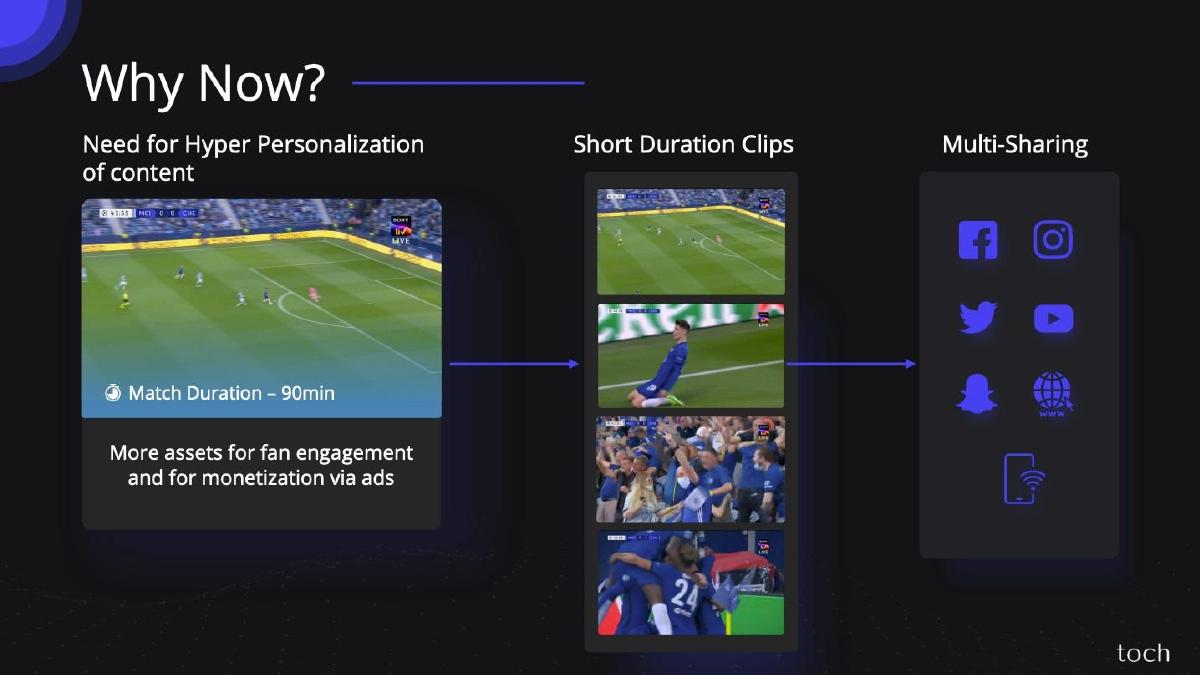
Slide 4 addresses the 'Why Now' question by visualizing the workflow of modern sports broadcasting. It shows a 90-minute match being broken down into 'Short Duration Clips' and then 'Multi-Sharing' across platforms like Facebook, Instagram, Twitter, and YouTube. The text emphasizes the 'Need for Hyper Personalization' and the creation of 'more assets for fan engagement and for monetization via ads.' This slide connects the technical capability shown in the previous slide to the business goal of increasing revenue through volume.
Slide 5: Change in Video Consumption Across Segments
This slide provides the data to back up the 'Why Now' claims. It introduces the concept of '3Vs'—Video, Vernacular, and Variety. Key statistics include that 68% of users prefer video over text and 55% prefer videos under 2 minutes. A bar chart on the right shows the trend of video length preferences from Q3 2019 to Q3 2020, showing a steady dominance of the 30-second and 15-second formats. Interestingly, it also notes that 70% of users prefer regional languages. This justifies the need for automation; if a broadcaster needs to create hundreds of short, localized clips for every game, they cannot do it manually.
Slide 6: Total Saving on Cost & Time
Slide 6 serves as a summary of the economic impact. It features two large circles: one claiming a 70% Manual Cost Reduction and the other claiming >90% Time Savings. This slide is designed to be the 'closer' for the value proposition section of the deck. It distills the complex technical workflow into two numbers that a CFO or Head of Production would care about most.
Slide 7: Product Interface and Capabilities
This slide provides a visual overview of the software interface. It shows the dashboard where users can define parameters for automated clip generation, identify key moments in real-time (using examples from UEFA Champions League and EURO 2020), and add graphical overlays. It also mentions the ability to publish auto-resized content across 30+ platforms and the capability to publish content as Google Web Stories. This slide proves that the product is not just a 'black box' AI but a controllable tool for professional editors.
Slide 8: Competition
The final slide is a competitive landscape quadrant. The X-axis ranges from 'Offline' to 'Cloud Based,' and the Y-axis ranges from 'Delayed' to 'Real-Time.' Toch.ai places itself in the extreme top-right corner (Real-Time and Cloud Based). Competitors like WSC Sports are placed nearby but slightly lower on the Real-Time axis. Other players like TheTake.ai, Blink, and Mirriad are clustered in the bottom-left quadrant (Offline and Delayed). This positioning suggests that Toch.ai's primary competitive advantage is the speed and accessibility of its processing.
What Toch.ai Does Well
The deck is exceptionally focused on the efficiency gap . By contrasting a 3-hour process with a 3-minute one, they create a 'no-brainer' scenario for potential customers. The use of specific sports examples (UEFA, EURO 2020) makes the product feel tangible and ready for high-stakes environments. Furthermore, the market data on Slide 5 is well-chosen; it doesn't just say 'video is growing,' but specifically points to the growth of short-form and regional video, which are the exact use cases their AI is designed to solve.
What is Missing from the Deck
Despite the strong product narrative, this deck is missing several elements that are usually mandatory for a Series A raise. First, there is no Team slide. In AI and media tech, the pedigree of the engineering and sales leadership is a primary factor in investment decisions. Second, there is no Traction slide. While they show the product interface, they do not list current paying customers, ARR (Annual Recurring Revenue), or growth metrics. Third, there are no Financials. Investors need to see how the $11.8M will be spent and what the projected revenue growth looks like. Finally, there is no 'Ask.' The deck ends abruptly on the competition slide without stating how much capital is being sought or what the milestones for the next 18 months are.
Founder Takeaways
Founders should look at Slide 3 as a masterclass in visualizing the 'Before and After.' Many startups struggle to explain exactly how their product changes a user's day; Toch.ai does this with simple boxes and a clock icon. However, founders should also view this deck as a cautionary tale regarding completeness. While a product-heavy deck might work if you have a pre-existing relationship with an investor or if this is a 'teaser' deck, a full pitch requires the human element (Team) and the business proof (Traction). If you are raising a Series A, you cannot rely on product efficiency alone; you must prove that the efficiency is translating into a scalable, profitable business.
Frequently asked questions
- What is the primary value proposition of Toch.ai?
- The primary value proposition is the automation of the video highlight creation process. According to Slide 3, the platform replaces a manual five-step process (download, cut, add graphics, upload) that takes hours with an API-driven automated process that takes minutes. This results in a stated 70% reduction in manual costs and 90% time savings as shown on Slide 6.
- How does Toch.ai define its market opportunity?
- On Slide 1, Toch.ai defines its opportunity using a standard TAM/SAM/SOM model. The TAM is $210B (Digital Video + Ad Spend), the SAM is $10B (annual revenue from short-form video creation and monetization), and the SOM is $1B, focusing specifically on live sporting events and new TV/movie productions.
- What consumer trends are driving the 'Why Now' for this product?
- Slide 5 highlights the '3Vs'—Video, Vernacular, and Variety. It notes that 68% of users prefer video over text, 55% prefer videos under 2 minutes, and 70% prefer regional languages over Hindi or English. This shift toward short, localized content creates a volume of work that requires AI automation to remain profitable.
- Who are Toch.ai's main competitors according to the deck?
- Slide 8 lists several competitors including WSC Sports, ClipMine, TheTake.ai, Blink, Video++, Mirriad, and Minute. Toch.ai differentiates itself by being 'Real-Time' and 'Cloud Based,' whereas most competitors are categorized as 'Offline' or 'Delayed.'
- What essential slides are missing from this pitch deck?
- This deck is missing several standard components: a Team slide (founders and expertise), a Traction slide (revenue or user growth), a Financials slide (burn rate or projections), and an 'Ask' slide (how much money they are raising and what they will do with it).