Homestead Organics, operating since 1988, utilizes a pitch deck that deviates significantly from the standard venture capital template. Instead of focusing on a high-multiple exit, the company highlights its 25-year history, B-Corp certification, and a unique capital structure involving 'Special Preferred Shareholders' and subordinate debt. The deck is remarkably transparent about the 'High Cost of Growth,' admitting that margins are constantly reinvested rather than building working capital. With a total grain volume reaching approximately 7,250 tonnes by 2013, the company leans heavily on i…
Key takeaways
- The company has a long operational history, dating back to 1988 as stated on Slide 1.
- Grain volume growth is non-linear, showing a peak of nearly 7,500 tonnes in 2012 before a slight dip in 2013 (Slide 3).
- Management is candid about financial struggles, noting they are 'always re-investing the margins versus developing working capital' (Slide 5).
- The business has successfully tapped into diverse Canadian grant programs, securing over $178,000 across multiple agencies (Slide 7).
- The capital structure is unconventional, featuring a discretionary fixed annual dividend of 6% for preferred shareholders (Slide 9).
- The founder remains the only common shareholder, with $684,000 currently raised from 24 people (Slide 9).
- B-Corp certification is a core pillar of their identity, with a score of 86 out of 200 (Slide 11).
- The deck targets 'mission minded impact accredited investors' specifically for subordinate debt (Slide 11).
Introduction: A Legacy Approach to Impact Fundraising
The Homestead Organics pitch deck is a departure from the high-gloss, tech-centric presentations typical of Silicon Valley. This is a deck for a brick-and-mortar, dirt-under-the-fingernails agricultural business that has survived for decades. The presentation, likely delivered at the Eastern Ontario Local Food Conference (as noted on Slide 7), serves as both a retrospective of the company’s 25-year history and a call for specialized impact capital. It prioritizes transparency and mission over hyper-growth projections.
Slide 1: Title and Mission
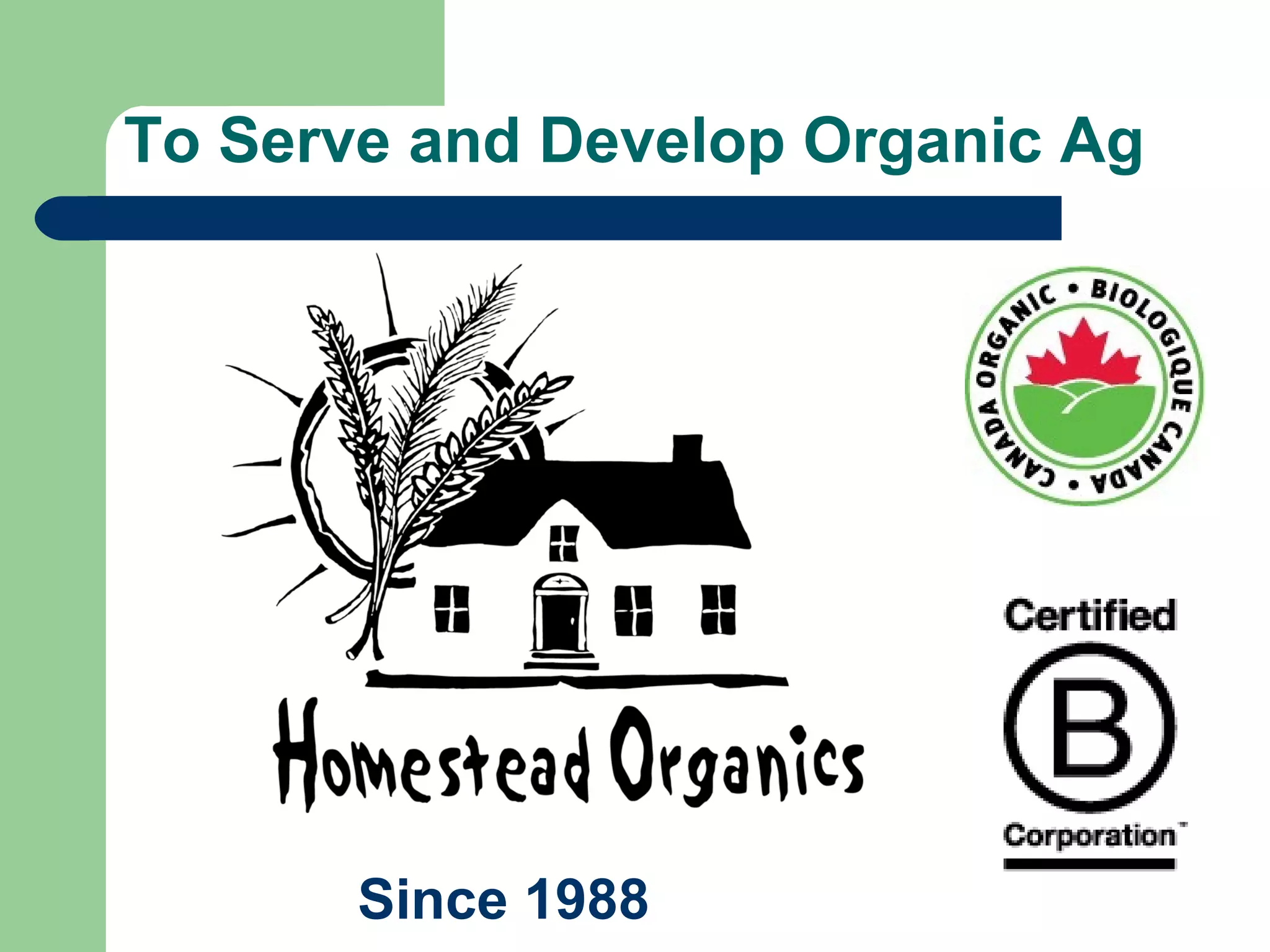
The cover slide establishes the brand identity immediately. Homestead Organics uses a traditional, hand-drawn style logo featuring a farmhouse and stalks of grain. The tagline, "To Serve and Develop Organic Ag," sets a service-oriented tone rather than a profit-first narrative. Crucially, the slide displays two major certifications: Canada Organic and Certified B Corporation. The inclusion of "Since 1988" at the bottom is a powerful credibility marker, signaling that this is not a speculative startup but a proven entity in the organic space.
Slide 3: Continuous Growth (Volume)
Slide 3 provides a historical look at "Total Grain Volume (tonnes)" from 2002 to 2013. The data shows a business that has more than doubled its capacity over a decade, starting at roughly 3,100 tonnes in 2002 and reaching a peak of approximately 7,500 tonnes in 2012. There is a visible dip in 2005 and 2009, and a slight decline in 2013 (finishing around 7,250 tonnes). By showing the full 11-year chart, the company demonstrates resilience through market cycles, though the lack of revenue figures on this specific slide makes it difficult to assess the financial efficiency of this volume growth.
Slide 5: The High Cost of Growth
This is perhaps the most honest slide in the deck. Titled "High Cost of Growth," it outlines the operational struggles of a scaling agricultural business. The bullet points admit to a 10-20% annual growth rate that prevents the company from reaching "optimal production levels." The founder notes that they are "always re-investing the margins versus developing working capital," which explains a perpetual need for external funding. The admission that some ventures were "bad (costly)" is a level of transparency rarely seen in fundraising, intended to build trust with sophisticated impact investors who understand the volatility of the ag sector.
Slide 7: Grant Programs
Slide 7 serves as a proof of concept for the company's ability to secure non-dilutive funding. It lists seven different sources of government and council support. Notable figures include $69,400 from NRC-IRAP for three projects and $67,000 from CME-Smart for two projects. The slide also mentions a $10,000 grant from the Ag Canada Youth Hire program. This list demonstrates that the company is well-integrated into the Canadian agricultural ecosystem and has the administrative capacity to manage complex grant requirements.
Slide 9: Shareholders and Capital Structure
This slide details a very specific and somewhat restrictive capital structure. The founder remains the "only common shareholder," meaning he retains full control of the company's direction. The $684,000 raised to date comes from 24 "Special Preferred Shareholders," who are described as accredited, close family, friends, and associates. The investment is described as having a "fixed value" with a "discretionary fixed annual dividend 6%." This structure is more akin to a high-yield savings product or a community bond than a traditional equity stake, emphasizing that investors should expect steady returns rather than a massive liquidation event.
Slide 11: The Ask and B-Corp Validation
The final slide in this set, titled "Go back to the organic community," clarifies the target audience: "Mission minded impact accredited investors." The specific instrument being offered is "subordinate debt." To justify this request, the company leans heavily on its B-Corp status. They report a score of 86 out of 200, which they note is above the minimum of 80 required for certification. They provide context by comparing their score to the average of 1,941 sustainable companies (84) and 504 B-Corps (105). This positioning suggests that the company views its social and environmental impact as a primary selling point for the debt they are looking to issue.
What Homestead Organics Does Well
The deck excels at establishing longevity and credibility . In an industry where many businesses fail within the first five years, a 25-year track record is a significant asset. By leading with their 1988 founding date and showing a decade of volume data, they prove they are a permanent fixture in the organic market.
The transparency regarding financial strain is also a strategic strength. By labeling the reinvestment of margins as a "High Cost of Growth," they frame their lack of cash flow not as a failure of the business model, but as a necessary byproduct of their commitment to expansion and innovation. This resonates with impact investors who are often more patient than traditional VCs.
Finally, the diversification of funding sources is impressive. Showing a mix of personal network equity, government grants, and a clear plan for subordinate debt suggests a sophisticated approach to capital stack management that doesn't rely on a single, precarious source of income.
What is Missing from the Deck
The most glaring omission is revenue and profitability data . While grain volume in tonnes is a helpful metric for understanding scale, it does not tell the investor if the company is actually making money. Without a corresponding chart showing Gross Margins or EBITDA, an investor cannot determine if the "High Cost of Growth" is sustainable or if the company is structurally unprofitable.
There is also no mention of the competitive landscape . The organic grain market has changed significantly since 1988, with large-scale industrial players entering the space. The deck fails to explain how Homestead Organics maintains its edge against larger competitors or how it secures its supply chain in a volatile commodity market.
Lastly, the team slide is missing from this selection. For a company that has operated for decades, the depth of the management team is a critical factor. Investors need to know if the business is entirely dependent on the founder (Tom Manley) or if there is a robust leadership structure capable of handling the 10-20% annual growth mentioned on Slide 5.
Founder's Guide: What to Copy
Founders in the social impact or agricultural space should look at Slide 11 as a template for benchmarking impact . Don't just say you are a B-Corp; show your score and compare it to industry averages. This provides a quantitative basis for what is often a qualitative claim.
Another element to emulate is the Grant Summary (Slide 7) . If your company has successfully navigated government bureaucracy to secure funding, list it clearly. It acts as a third-party validation of your business's technical or social merit, which can be a powerful signal to private investors.
Finally, the candor regarding operational challenges (Slide 5) is a bold but effective way to filter for the right investors. If your business model requires constant reinvestment that limits short-term dividends, stating that upfront ensures you don't end up with shareholders whose expectations are misaligned with your reality.
Frequently asked questions
- What is the primary business model of Homestead Organics?
- Based on the slides, Homestead Organics is an agricultural company focused on organic grain. Slide 3 tracks their 'Total Grain Volume' in tonnes, suggesting they act as a processor, distributor, or hub for organic agricultural products. Their mission, stated on Slide 1, is 'To Serve and Develop Organic Ag,' and they have been in operation since 1988.
- How does the company fund its operations and growth?
- The company uses a mix of grants, preferred shares, and debt. Slide 7 lists grants from organizations like the NRC-IRAP ($69,400) and CME-Smart ($67,000). Slide 9 reveals they have raised $684,000 from 24 private individuals through preferred shares with a 6% discretionary dividend. Slide 11 indicates they are currently seeking 'subordinate debt' from impact investors.
- What are the biggest risks mentioned in the deck?
- The deck is unusually transparent about growth risks. Slide 5, titled 'High Cost of Growth,' admits the company suffers from 'never optimal production levels' and is 'always spending for the future... before the revenues arrive.' It also notes that some 'costly ventures and innovation' have been 'bad,' leading to financial strain.
- Is this a typical startup pitch deck for venture capital?
- No. This deck is designed for impact investors or community lenders. It lacks a 'Problem/Solution' framework, a competitive landscape, or a path to a billion-dollar exit. Instead, it focuses on longevity (since 1988), social certification (B-Corp), and steady, albeit expensive, growth in physical commodity volumes.
- What is the significance of the B-Corp score mentioned?
- On Slide 11, the company highlights a B-Corp score of 86 out of 200. This is used to 'validate our commitment to a triple bottom line.' They compare themselves to an average of 84 for sustainable companies and 105 for other B-Corps, positioning themselves as a verified social enterprise to attract mission-aligned capital.