Barbeart is a Brazilian startup operating in the men's grooming sector, specifically focusing on a specialized wax for beards and mustaches. The 9-slide deck outlines a micro-investment opportunity, seeking R$ 70,000 to cover company formalization, manufacturing, and initial marketing. The presentation relies heavily on the growth of the Brazilian male cosmetics market, citing figures like R$ 11.6 million in annual revenue for men's personal hygiene products. While the deck provides clear product benefits and a before-and-after visual, it lacks a team slide, detailed unit economics, and a com…
Key takeaways
- The company is seeking a total initial investment of R$ 70,000 as stated on slide 7.
- The product is a 30g beard and mustache wax designed to last an average of 2 months (slide 4).
- Barbeart claims the product is already approved by ANVISA, the Brazilian health regulatory agency (slide 4).
- Market data cites R$ 11.6 million in annual revenue related to men's personal hygiene and cosmetics (slide 3).
- The sales strategy focuses on direct sales through an e-commerce site and social media (slide 6).
- The investment ask includes a 'giro' (working capital) for 3 months of operations (slide 7).
- Financial projections estimate a return of R$ 284,000 over 5 years on the R$ 70,000 investment (slide 8).
- The deck completely omits a team slide, leaving the founders' identities and expertise unknown.
Barbeart Pitch Deck Analysis
The Barbeart pitch deck is a concise, 9-slide presentation aimed at securing a small amount of seed capital to launch a men's grooming brand in Brazil. The deck follows a traditional, if simplified, narrative structure: identifying a market, presenting a product solution, and outlining the financial requirements. However, its brevity and lack of operational detail make it more of a 'teaser' than a comprehensive investment memorandum.
Slide 1: Title Slide
The cover slide introduces the brand name 'Barbeart' with the tagline 'Sua barba, uma obra de arte!' (Your beard, a work of art!). It features a logo consisting of a stylized mustache with horns and a background of colorful paint splatters, reinforcing the 'art' theme. The URL www.barbeartshop.com.br is prominently displayed, establishing the company's digital-first intent.
Slide 2: The Company (A Empresa)
This slide defines Barbeart as a company operating in the male cosmetics sector. It specifies the core product: a special wax that models and controls beard and mustache hair. The slide uses bold text to emphasize that the wax is an 'exclusive product' and claims it is 'tested and approved by those who understand beards,' though it does not specify who these experts are.
Slide 3: Market Potential (Potencial de Mercado)
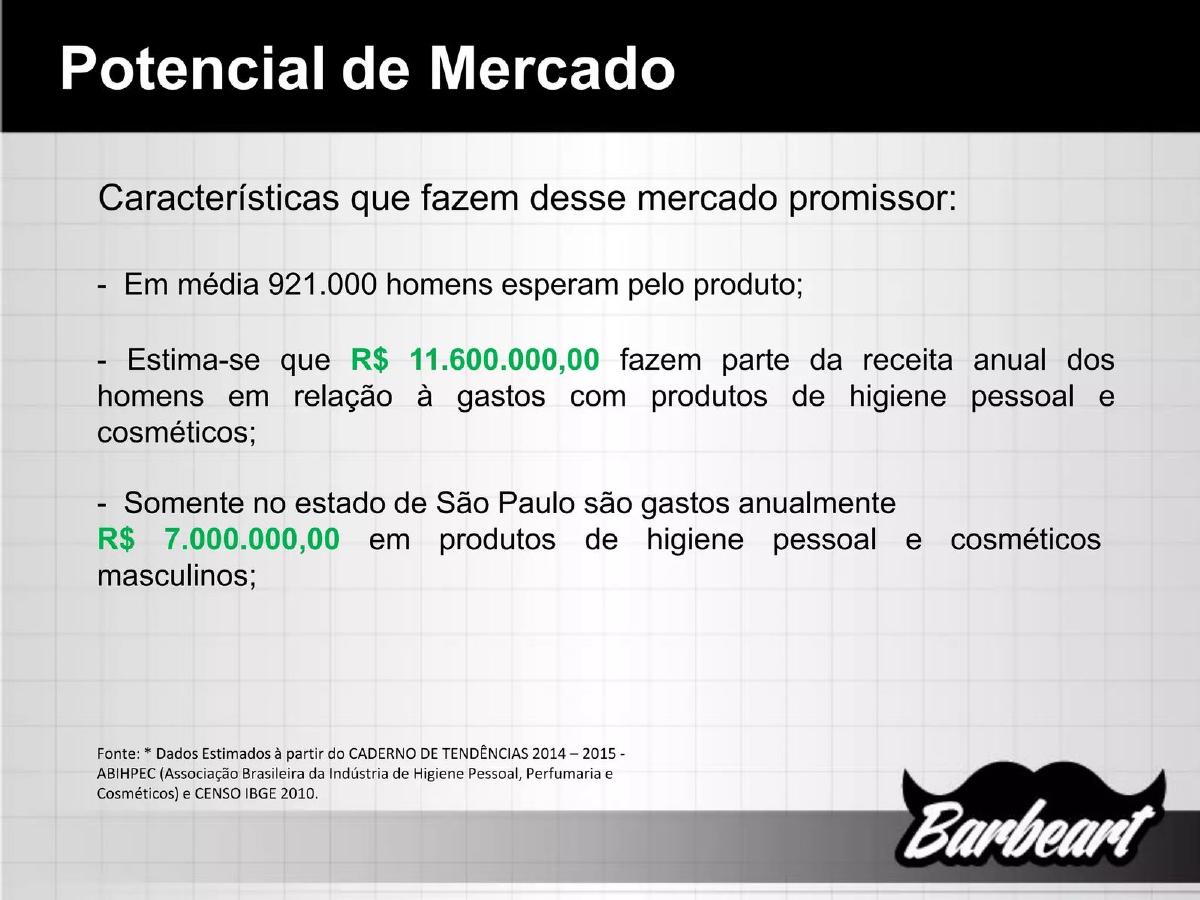
Barbeart attempts to quantify the opportunity using three data points. First, it claims 921,000 men are 'waiting' for the product. Second, it cites a national annual revenue of R$ 11,600,000.00 for men's hygiene and cosmetics. Third, it notes that R$ 7,000,000.00 of this spending occurs in the state of São Paulo. The slide cites ABIHPEC (2014-2015) and IBGE (2010) as sources. The reliance on data that is several years old is a weakness, as the grooming market has evolved significantly since 2014.
Slide 4: The Product (O Produto: Cera para Barba)
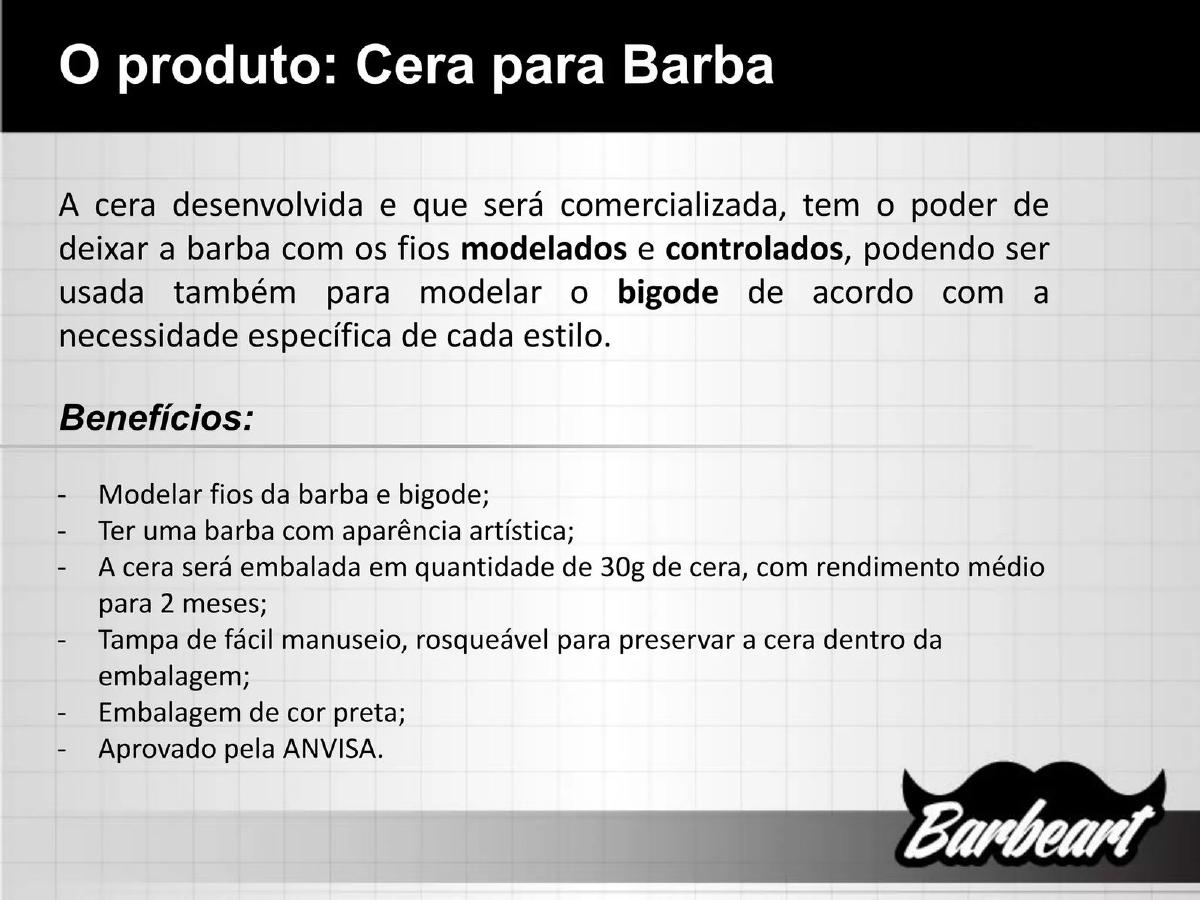
This slide provides technical and functional details. The wax is intended for both beards and mustaches. Key benefits listed include: 30g of product per unit, an average yield of 2 months of use, easy-to-handle screw-top packaging in black, and ANVISA approval. The mention of ANVISA is a strong trust signal for a Brazilian startup, as it implies the product meets national health and safety standards.
Slide 5: Product Demonstration
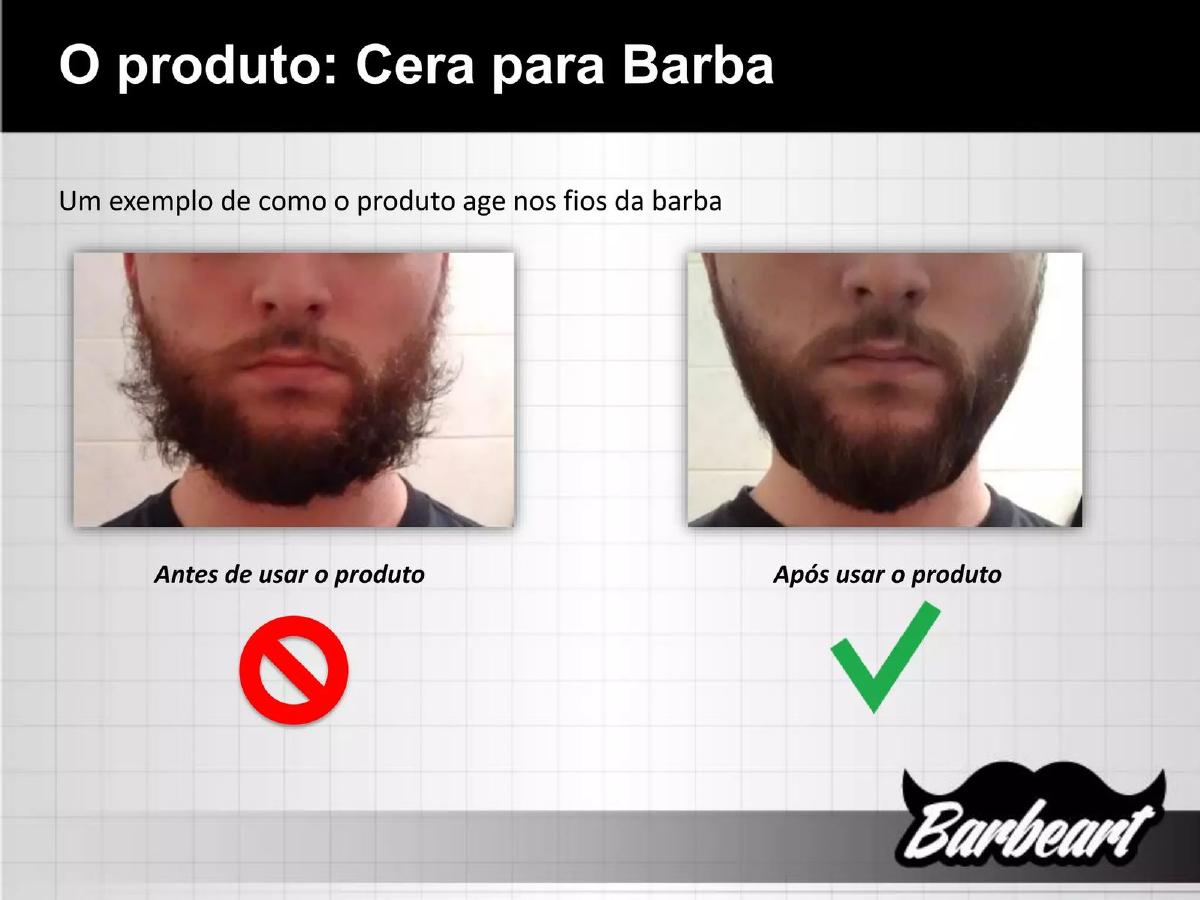
A 'before and after' visual slide shows a split image of a man's face. The 'before' image shows a frizzy, unkempt beard marked with a red 'no' symbol. The 'after' image shows a groomed, shaped beard marked with a green checkmark. This is a standard but effective way to demonstrate the immediate value proposition of a cosmetic product.
Slide 6: Initial Sales Strategy (Estratégia inicial de vendas)
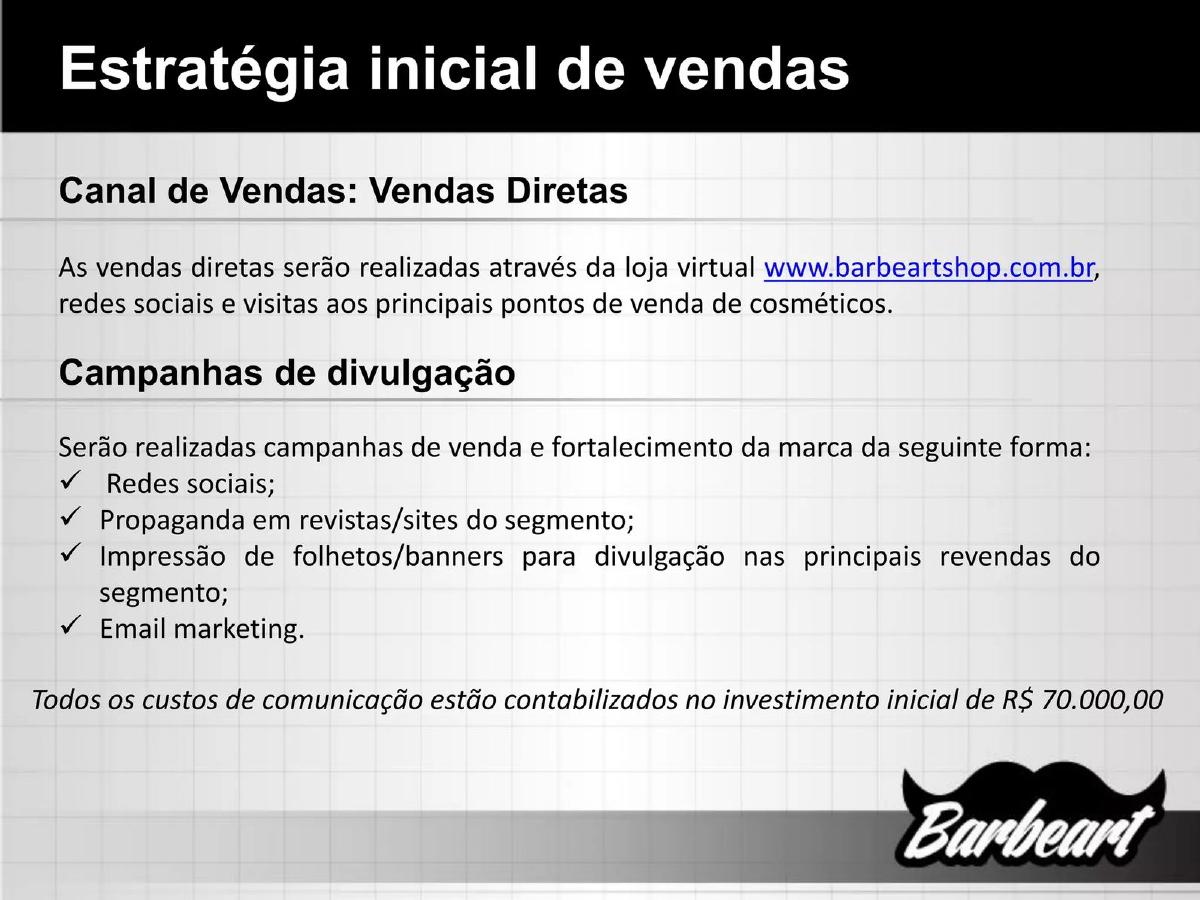
The company plans to use 'Direct Sales' as its primary channel. This includes a virtual store, social media, and visits to physical cosmetic retail points. The marketing plan involves social media campaigns, advertisements in segment-specific magazines/sites, physical flyers/banners for retail points, and email marketing. A crucial note at the bottom states that all communication costs are included in the R$ 70,000 initial investment.
Slide 7: Investment (Investimento)
This slide explicitly states the ask: R$ 70,000.00. It lists seven areas where the capital will be deployed: formalization, manufacturing, packaging, labels, marketing, e-commerce setup, and 3 months of working capital. The slide concludes with the claim 'Low investment cost, high profitability,' though 'high profitability' is not yet supported by unit margin data.
Slide 8: Return on Investment (Valores – Retorno do investimento)
This slide presents a financial comparison to entice investors. It compares a hypothetical R$ 70,000 investment in a financial instrument at 2% monthly interest (yielding R$ 229,000 in 5 years) against the same amount invested in Barbeart (yielding R$ 284,000 in 5 years). It highlights an 'additional gain' of R$ 55,000. This is a very simplified projection that assumes the investor is choosing between a fixed-income-style return and a startup, which are vastly different risk profiles.
Slide 9: Closing Slide
The final slide shows the product packaging (a round tin) and the slogan 'Seu novo investimento, sua nova empresa!' (Your new investment, your new company!). It serves as a call to action for potential partners to join the venture.
What Barbeart Does Well
The deck is highly focused. It does not try to be a platform or a multi-product conglomerate; it focuses entirely on the beard wax. The inclusion of ANVISA approval (Slide 4) is a professional touch that many early-stage cosmetic startups overlook. The 'before and after' imagery (Slide 5) provides a clear, visceral understanding of what the product actually does, which is essential for a consumer brand. Furthermore, the breakdown of the R$ 70,000 investment (Slide 7) shows that the founders have at least considered the basic operational costs of starting a business, from legal formalization to working capital.
What is Missing from the Barbeart Deck
The most glaring omission is the Team Slide . In early-stage investing, the 'who' is often more important than the 'what.' There is no information regarding the founders' backgrounds, their experience in the cosmetics industry, or their ability to execute the sales strategy. Secondly, the deck lacks Unit Economics . While it mentions the investment amount, it does not state the manufacturing cost per unit, the suggested retail price, or the expected profit margin. Without these, the 'high profitability' claim on Slide 7 is unsubstantiated. Thirdly, there is no Competitive Analysis . The Brazilian grooming market is competitive, with both established brands and other startups; Barbeart does not explain how it differs from existing waxes on the market. Finally, the Market Data is outdated, using sources from 2010 and 2014, which may not reflect the current size or growth rate of the niche.
Instructions for Founders: What to Copy
Founders should emulate the clarity of the product benefits found on Slide 4. Listing the weight (30g), the duration of use (2 months), and the specific packaging features helps an investor visualize the physical product. The clear use of funds on Slide 7 is also a good practice; investors want to know exactly where their money is going, and breaking it down into categories like 'working capital' and 'formalization' shows a level of planning. Lastly, the visual demonstration on Slide 5 is a 'must-have' for any physical product startup. If your product changes a user's state, show that change as simply as possible.
Final Thoughts on the Barbeart Pitch
Barbeart presents a very 'small-scale' investment opportunity. The R$ 70,000 ask is low by venture capital standards, suggesting this deck was designed for friends, family, or local angel investors. The simplicity of the financial return comparison on Slide 8 reinforces this. While the product seems well-defined and regulatory-compliant, the lack of founder information and detailed financial modeling makes it a high-risk proposition even at a low entry price. To improve, the founders should provide a current market snapshot, a detailed bio of the leadership team, and a clear breakdown of how one unit of wax translates into profit.
Frequently asked questions
- What is the specific product Barbeart is selling?
- Barbeart sells a specialized wax for beards and mustaches. According to slide 4, the product comes in 30g black packaging with a screw-on lid. It is designed to style and control facial hair, providing an 'artistic appearance.' The slide also notes that the product has received approval from ANVISA, which is a critical regulatory hurdle for cosmetics in Brazil.
- How much money is Barbeart raising and what for?
- The company is seeking R$ 70,000. Slide 7 breaks down the use of funds into seven categories: company formalization, manufacturing costs, packaging, labels, marketing/communication, creation of a virtual store, and three months of working capital. This suggests the company is in the very early pre-seed or launch phase.
- What market opportunity does the deck highlight?
- Slide 3 focuses on the Brazilian male grooming market. It claims that 921,000 men are 'waiting for the product' and estimates annual spending on men's personal hygiene and cosmetics at R$ 11.6 million nationally, with R$ 7 million of that concentrated in the state of São Paulo. These figures are attributed to 2014-2015 industry reports.
- What is the projected return for an investor?
- Slide 8 presents a comparative return on investment. It contrasts a standard financial application of R$ 70,000 at a 2% monthly interest rate (yielding R$ 229,000 over 5 years) against the 'Barbeart Project,' which it claims will yield R$ 284,000 over the same period. This represents a projected additional gain of R$ 55,000 over the baseline.
- What are the biggest red flags in this pitch deck?
- The most significant omission is the team slide; there is no information on who is running the company. Additionally, the deck lacks unit economics (CAC, LTV, or even the retail price per unit). The market data is also somewhat dated, citing sources from 2010 and 2014, and the financial projection is a single-point estimate without a detailed P&L or growth assumptions.