Apprentus is a marketplace platform designed to bridge the gap between private tutors and students, specifically targeting the fragmented 'bulletin board' style of local advertising. The deck, presented by Gaetan Deremince at the 2012 Boostcamp Brussels, identifies a lack of transparency and verification in existing solutions as the primary pain point. By offering a centralized hub with teacher profiles, authenticated reviews, and online booking, Apprentus aims to professionalize the private teaching industry. The business model relies on a freemium structure for teachers and transaction fees…
Key takeaways
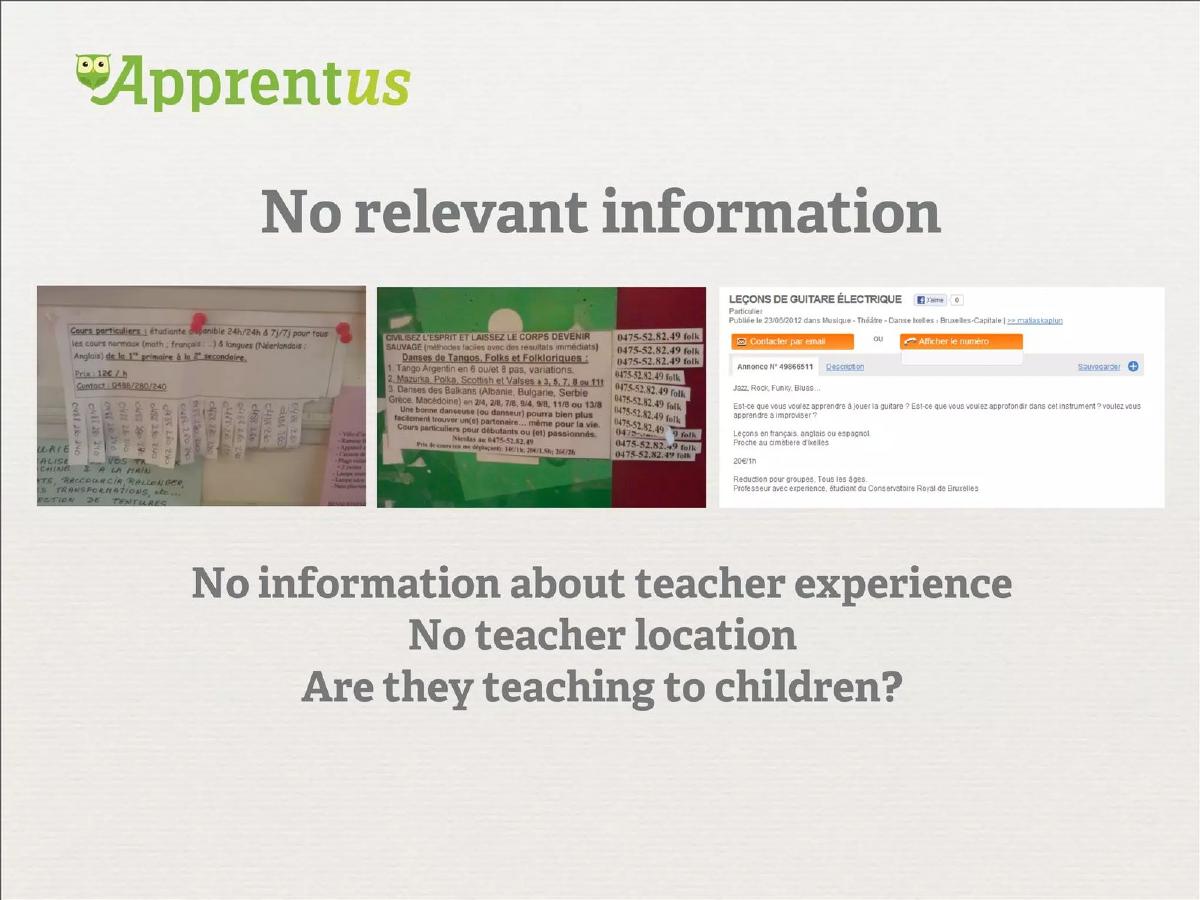
- The problem is framed as a lack of 'relevant information' in traditional tutoring ads, such as teacher experience and location (Slide 3).
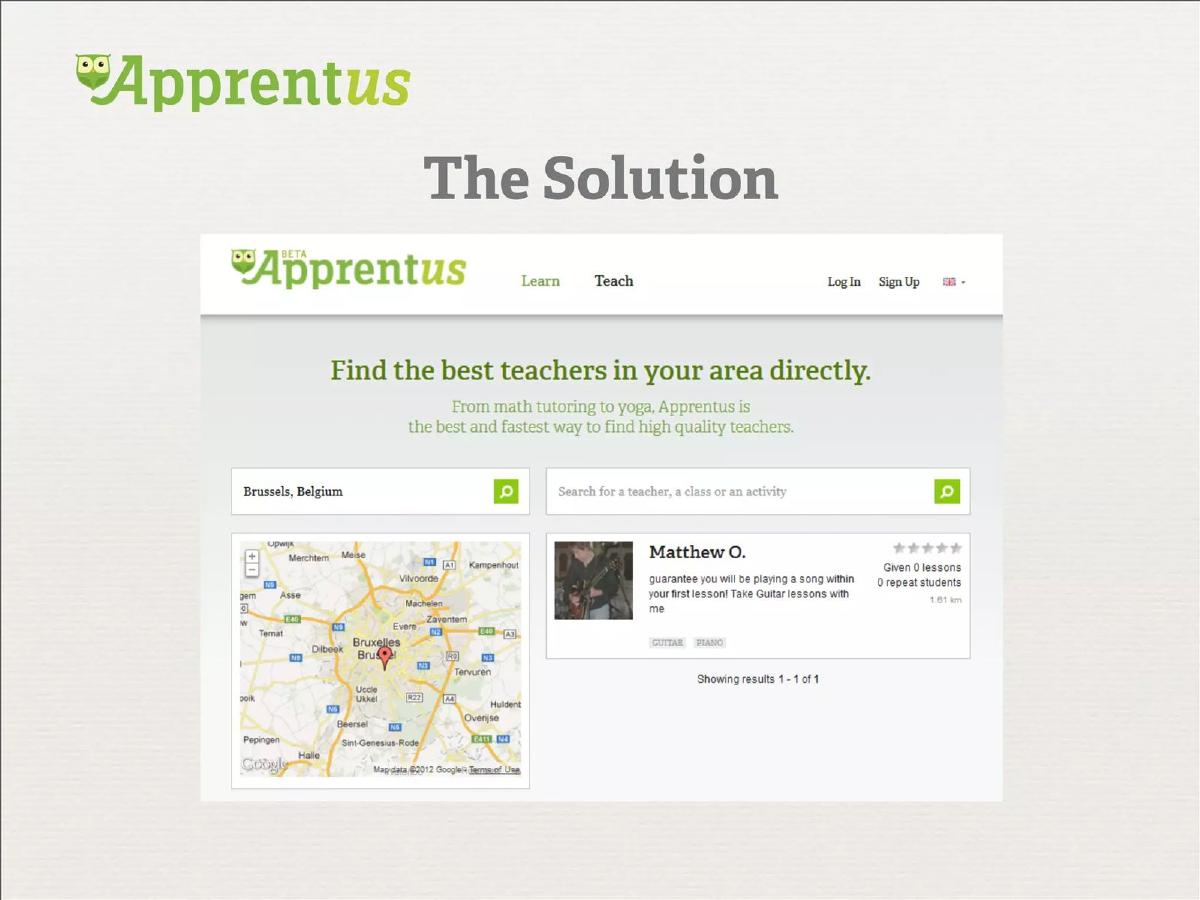
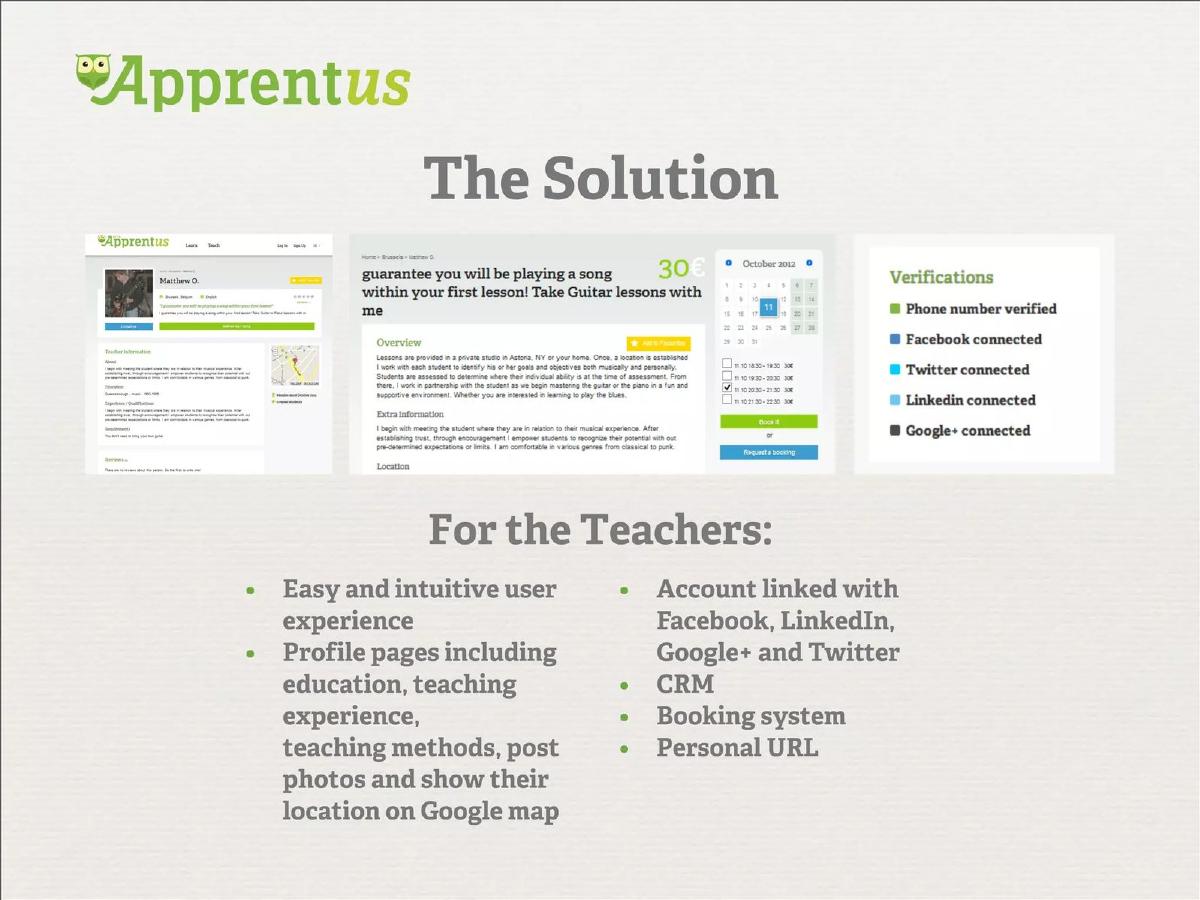
- The solution features a map-based search interface and social media verification (Facebook, LinkedIn, Google+) to build trust (Slide 5).
- The team includes a CTO with experience at a company generating 2.3 million € in monthly turnover (Slide 7).
- Market size estimates place the global tutoring and music teacher market at over 100 billion $ by 2017 (Slide 8).
- The business model includes a 'Plus+' teacher plan at 14,99 € per month and a service fee of 2,49 € per booking (Slide 9).
- The company reported a quiet launch in October 2012 with initial beta feedback (Slide 10).
- Financial projections show a steep growth curve, aiming for 1.65 million € in revenue by 2015 (Slide 11).
- The funding ask is 155.000 € alongside a request for mentors, with a goal of reaching profitability within one year (Slide 12).
Executive Summary: The Modernization of Local Tutoring
Apprentus Boostcamp Brussels is a pitch for a marketplace platform that connects students with private teachers. The deck, dated 2012, focuses on the transition from offline, unverified tutoring advertisements to a digital, trust-based ecosystem. By centralizing teacher profiles and integrating booking tools, Apprentus seeks to capture a share of the multi-billion dollar global tutoring market. The presentation is structured to move from the visual chaos of current solutions to the streamlined efficiency of their proposed web platform.
Slide 1: Title Slide
The deck opens with the Apprentus logo, featuring an owl mascot. The presenter is identified as Gaetan Deremince, and the context is 'Boostcamp – MIC 2012'. The branding is clean and professional, setting a tone for a technology-driven solution in the education space.
Slide 2: The User Persona
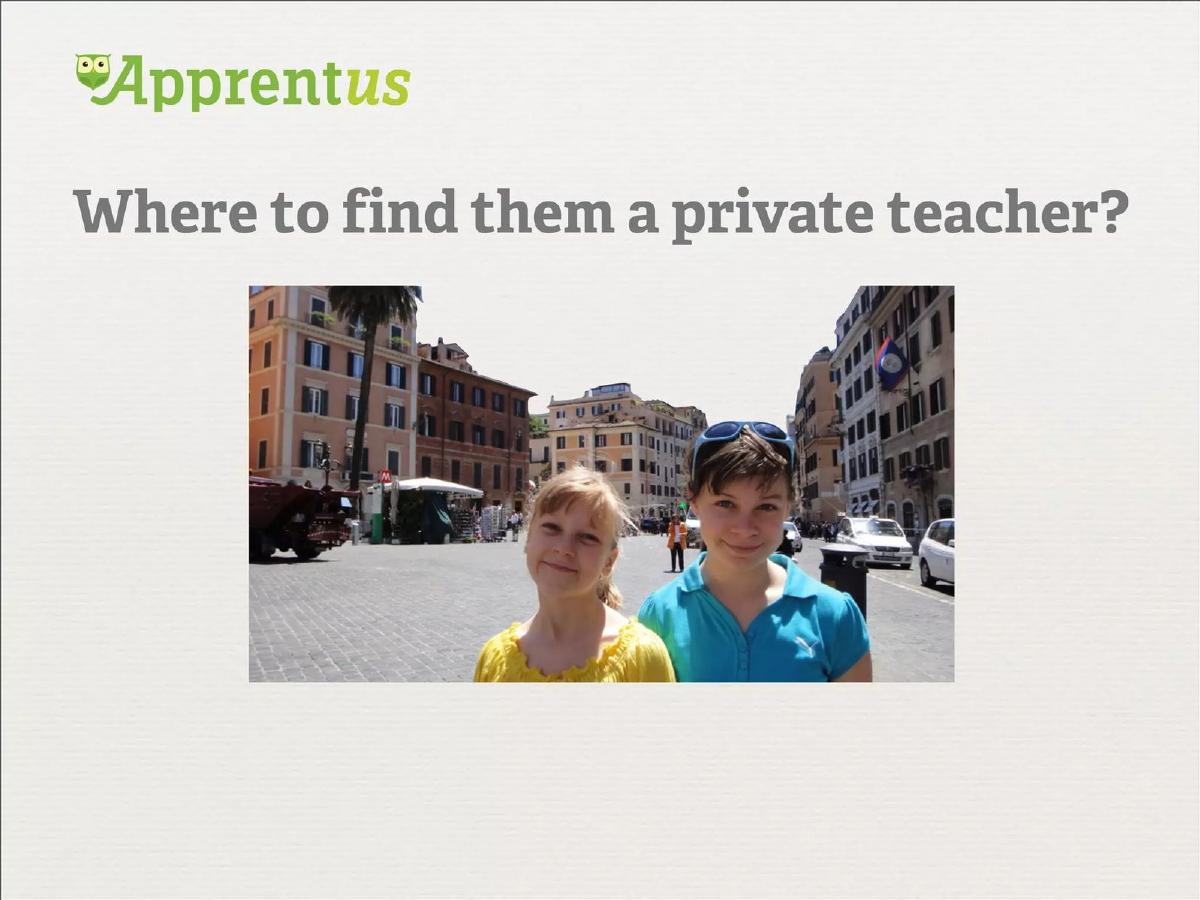
Slide 2 poses the question, 'Where to find them a private teacher?' accompanied by a photo of two children. This slide establishes the target demographic—parents looking for educators for their children—and humanizes the problem by focusing on the end-user rather than just the technology.
Slide 3: The Problem – Fragmented Information
This slide is a visual critique of the status quo. It shows photos of paper flyers with tear-off phone numbers and a basic online listing. The text highlights that these methods offer 'No relevant information,' specifically citing the lack of teacher experience, teacher location, and safety information regarding children. This effectively establishes the pain points of trust and transparency.
Slide 4: The Solution – Search and Discovery
Slide 4 introduces the Apprentus interface. It shows a search bar for location (Brussels, Belgium) and activity, paired with a Google Maps integration. A sample profile for 'Matthew O.' is displayed, showing a star rating and distance (1.61 km). This slide demonstrates the platform's ability to solve the location and quality-vetting issues mentioned in the problem slide.
Slide 5: The Solution – Features for Teachers
This slide focuses on the supply side of the marketplace. It lists features designed to attract teachers: an easy user experience, detailed profile pages (education, methods, photos), and a CRM system. Notably, it highlights 'Verifications' through social media platforms like Facebook, LinkedIn, Google+, and Twitter, which is a key trust-building mechanism for a 2012-era marketplace.
Slide 6: The Solution – Features for Students
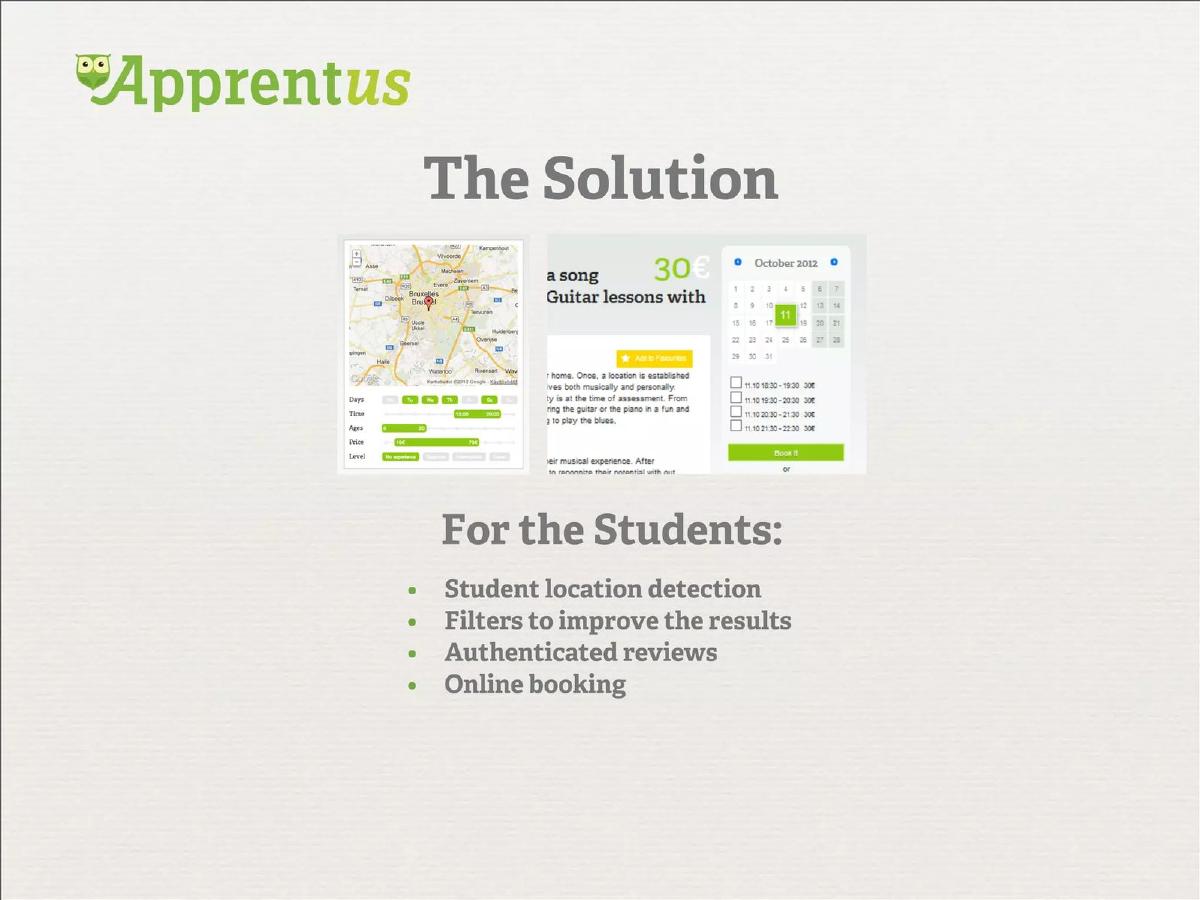
Shifting to the demand side, Slide 6 lists student-centric features: location detection, filters to improve results, authenticated reviews, and online booking. The visual shows a calendar interface for booking specific time slots, indicating that the platform is more than just a directory; it is a transactional tool.
Slide 7: The Team
The team slide introduces three members. Marius Andra (CTO) is noted for his previous work at Cherry.ee, which had a 'Turnover of 2.3 millions € /month.' Gaetan Deremince (CEO) is described as a former IT consultant. Janne Harju (Creative Designer) is labeled an 'Award-winning illustrator.' The inclusion of the CTO's previous company turnover is a strategic move to show experience with scaling high-volume platforms.
Slide 8: Market Size
Slide 8 uses a bar chart to compare the 'Private teaching Industry' in 2011 and 2017 against 'Recorded Music Sales.' It claims the global tutoring and music teacher market will exceed 112.5 billion $ by 2017. It also includes a specific data point for France: '1.000.000 students attend private tutoring lessons every years.' The sources are cited at the bottom, lending credibility to the figures.
Slide 9: Business Plan
The revenue model is clearly defined on Slide 9. Students pay a 'service fee at 2,49€ per booking.' Teachers have two options: a Free (0€) plan with basic features and a Plus+ (14,99€/month) plan that includes premium support and direct publication of contact info. The slide notes that the service fee for teachers is capped at 89.99€ per month, which is a teacher-friendly policy to prevent churn as they grow their business.
Slide 10: Current Status
This slide provides a snapshot of progress as of late 2012. It mentions a 'quiet launch' in October 2012, positive feedback from beta testers, and new teachers signing up. While it lacks hard numbers (e.g., exact user count), it shows the project has moved past the ideation phase into a live product.
Slide 11: Customers Projection & Financial Assumption
Slide 11 presents a growth chart and table from 2012 to 2015. The projections are ambitious: Registered Teachers are expected to grow from 200 to 100,000. Revenue is projected to jump from 45 € in 2012 to 165,000 € in 2013, eventually reaching 1,650,000 € in 2015. The 'Active Teachers' metric (selling 8 hours/week) is used as the primary driver for these revenue calculations.
Slide 12: The Ask
The final slide states the funding requirement: 155.000 € . It also asks for 'Mentors.' The founders claim the business will reach profitability within one year and requires fewer than 200 active teachers to do so. This slide is direct, though it lacks a 'Use of Funds' breakdown to explain how the 155k € will be utilized.
What Apprentus Does Well
The deck excels at identifying a clear, relatable problem and showing a product that directly addresses it. The use of real-world examples (the messy bulletin boards) creates an immediate 'aha' moment for the investor. The business model is transparent, showing both a transactional fee and a subscription model, which provides diversified revenue streams. Furthermore, the emphasis on social verification was forward-thinking for 2012, addressing the primary barrier to entry for marketplaces involving children: safety and trust.
What is Missing from the Deck
The most significant omission is a competitive landscape analysis. In 2012, several tutoring marketplaces and general classified sites (like Craigslist or Gumtree) were already active; explaining how Apprentus would win against these incumbents is missing. Additionally, while the 'Ask' is clear in its total amount, there is no breakdown of how the 155,000 € will be spent—investors typically want to see allocations for marketing, hiring, and product development. Finally, the 'Current Status' slide is vague, providing no specific traction metrics beyond 'positive feedback.'
Founder Takeaways: Lessons for Your Own Deck
Visual Contrast: Use photos of the 'old way' of doing things to make your digital solution look more impressive. The contrast between Slide 3 and Slide 4 is a powerful storytelling tool. · Verification as a Feature: If you are building a marketplace, treat trust as a core product feature. Listing specific social integrations (Slide 5) shows you understand the psychological barriers of your users. · Revenue Capping: The decision to cap service fees for teachers (Slide 9) is a smart marketplace tactic. It encourages high-volume users to stay on the platform rather than taking their business offline to avoid fees. · Specific Projections: Even if they are just assumptions, providing a table that links 'Active Users' to 'Revenue' (Slide 11) shows that you have a logical framework for how your business scales. · The Mentor Ask: Don't just ask for money. Asking for mentors (Slide 12) signals that you are coachable and aware of your own knowledge gaps, which is often attractive to early-stage investors.
Frequently asked questions
- What is the primary problem Apprentus is trying to solve?
- Apprentus targets the inefficiency and lack of transparency in the private tutoring market. Slide 3 illustrates that traditional methods, like paper flyers or unverified online ads, fail to provide critical details such as teacher experience, precise location, or safety information regarding teaching children. The platform aims to centralize this data into a searchable, verified marketplace.
- How does Apprentus plan to generate revenue?
- According to Slide 9, the business model is two-pronged. For students, there is a service fee of 2,49 € per booking. For teachers, the platform offers a 'Free' tier and a 'Plus+' tier costing 14,99 € per month. The paid tier provides benefits like premium support and the ability to publish contact details directly on the profile.
- What kind of growth does the company project?
- Slide 11 outlines aggressive growth targets. Starting from just 200 registered teachers and 45 € in revenue in 2012, the company projected reaching 100,000 registered teachers and 1.65 million € in annual revenue by 2015. This assumes a significant increase in 'Active Teachers' who sell at least 8 hours of lessons per week.
- What is the background of the founding team?
- The team consists of three core members shown on Slide 7: CEO Gaetan Deremince (formerly an IT consultant), CTO Marius Andra (formerly at Cherry.ee, which had a 2.3M € monthly turnover), and Janne Harju, an award-winning illustrator serving as Creative Designer. This mix suggests a balance of technical execution and design, though it lacks a dedicated marketing lead.
- What is the specific 'Ask' in this pitch deck?
- On Slide 12, the founders request 155.000 € in funding and access to mentors. They claim that the business can reach profitability within one year and requires fewer than 200 active teachers to become sustainable. However, the deck does not specify how the 155.000 € will be spent.