APPbyYOU is a German-based software company offering a 'Company-Messenger' designed to replace consumer-grade apps like WhatsApp in professional environments. The deck focuses heavily on the security risks of using public messaging platforms for sensitive R&D and financial data. Their Unique Selling Proposition (USP) is a white-label framework that allows companies to build their own branded messaging apps using an App-Editor and Messaging-SDK. While the deck provides clear use cases for R&D, Finance, and project management, it suffers from a complete lack of market sizing, competitive landsc…
Key takeaways
- The core problem identified is the lack of data rights protection when employees use consumer apps like WhatsApp for R&D projects (Slide 2).
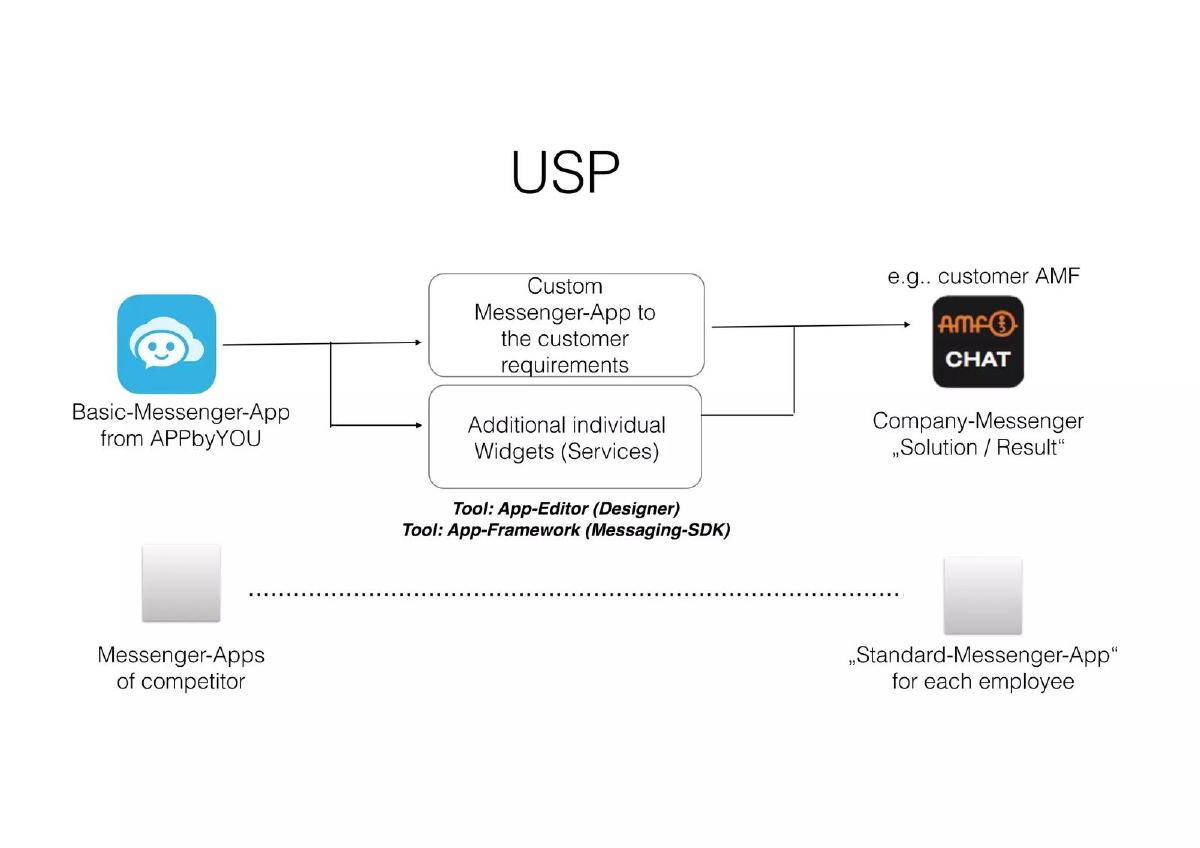
- The USP is a modular 'App-Framework' that allows for custom branding and individual widgets, contrasting with the 'standard' apps of competitors (Slide 3).
- The product architecture is built on a private cloud model using JavaScript, HTML5, and CSS (Slide 8).
- Specific use cases target R&D teams needing to share drawings and patent-related communications securely (Slide 5).
- The platform includes a 'Finance' use case for real-time exchange of KPI reports, budget, and revenue data (Slide 6).
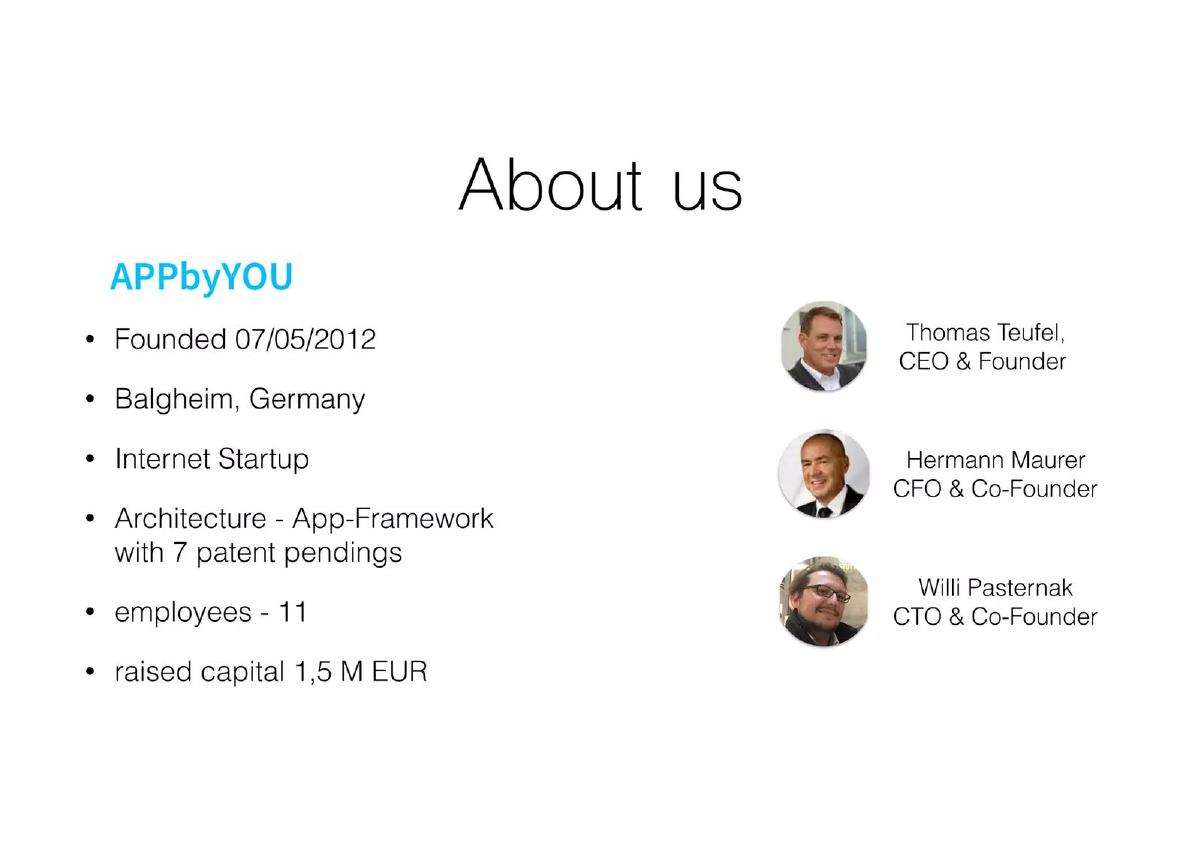
- The deck provides a direct contact for CEO Thomas Teufel but lacks any information on the broader team or their backgrounds (Slide 7).
- There is no mention of a funding 'ask,' current revenue, or user growth metrics in the provided slides.
- The deck relies on the concept of 'Digital Age 4.0' to frame the necessity of private messaging systems (Slide 1).
The APPbyYOU Pitch Deck Teardown
APPbyYOU positions itself at the intersection of enterprise security and internal communication. The deck is structured as a functional walkthrough of why a company needs its own messaging infrastructure rather than relying on third-party consumer platforms. While the technical and use-case descriptions are clear, the deck lacks the traditional financial and strategic depth required for a high-level venture capital pitch.
Slide 1: Title and Vision
The cover slide introduces APPbyYOU and its core product: the "Company-Messenger." The subtitle, "The time is coming when each company will use their own messaging system," sets a prophetic tone for the pitch. It also references "digital age 4.0," a term often used in European industrial contexts (Industry 4.0) to describe the current trend of automation and data exchange in manufacturing technologies. This suggests the company may be targeting the Mittelstand or industrial sectors in Germany.
Slide 2: The Problem Statement
Slide 2 identifies a specific pain point: the use of consumer apps like WhatsApp for business. The text notes that employees are exchanging "critical information" on these platforms, leading to a loss of "data rights" and the potential leakage of "sensitive information of e.g. R&D projects." This is a strong, compliance-led hook, especially in regions with strict data privacy laws like the GDPR.
Slide 3: Unique Selling Proposition (USP)
This slide uses a flow diagram to contrast APPbyYOU with its competitors. On the bottom, "Messenger-Apps of competitor" are shown leading to a "Standard-Messenger-App" for each employee—a one-size-fits-all model. APPbyYOU, conversely, offers a "Basic-Messenger-App" that passes through an "App-Editor (Designer)" and "App-Framework (Messaging-SDK)" to create a "Custom Messenger-App" with "Additional individual Widgets." The result is a branded solution, illustrated by an example for a customer named "AMF.".
Slide 4: Use Case - Important Projects
Slide 4 moves into functional value propositions. It highlights the "closed community" aspect, connecting sales, back office, service, and R&D. Key features mentioned include APP-Cloud storage for documents and machine status, and the fact that all activities are documented in the background. This slide emphasizes cross-platform accessibility (Smartphone, Tablet, PC) for authorized users.
Slide 5: Use Case - R&D
The R&D use case is perhaps the most compelling for a security-focused product. The slide lists communication with "external consultants and patent attorneys" as a primary need. It mentions that "approval processes" and "drawings" are interconnected within the project app. By focusing on patent attorneys and developers, the deck targets high-value intellectual property protection as a core reason to buy the software.
Slide 6: Use Case - Finance
The Finance slide introduces a data visualization component. It claims the messenger can organize internal projects and support "realtime data exchange e.g. finance-KPI-Report (budget, revenue, etc.)." A mobile screenshot shows a bar chart labeled "Eigenbudget [Mio...]" with categories like "DS Inland" and "Stuttgart." This suggests the app isn't just for text, but for structured data reporting.
Slide 7: Contact Information
This slide provides the contact details for Thomas Teufel, CEO of APPbyYOU GmbH, based in Germany (indicated by the +49 country code). It includes a landing page URL (my-app.com) and a direct email address. This serves as the closing slide for the provided set, though the source listing indicates there are 15 slides in total.
Slide 8: Platform and Architecture
The final slide in this set breaks down the technical stack. The "Company Messenger" is the product layer, sitting atop the "App-Framework." The framework components are listed as a responsive frontend, standard elements with parameters, widgets, adapters (http, websockets), and an SDK. The technology stack is explicitly named: JavaScript, HTML5, and CSS. This confirms the product is likely a web-based or hybrid mobile application rather than a fully native build.
What APPbyYOU Does Well
The deck is highly focused on a specific problem: the security risks of consumer messaging in a corporate environment. By highlighting R&D and Finance as primary use cases, they are targeting departments where the cost of a data breach is highest. The emphasis on a white-label "App-Framework" rather than just another chat app is a smart positioning move, as it allows the company to sell a platform rather than a simple utility.
Clear Problem/Solution Fit: The risk of using WhatsApp for R&D is a tangible fear for many executives. · Modular Approach: Showing the "App-Editor" and "Widgets" suggests a flexible product that can grow with a client's needs. · Targeted Use Cases: Instead of saying "everyone can use this," they show exactly how a finance or R&D team would benefit.
What is Missing from the Deck
As a fundraising tool, this deck is incomplete. It functions more as a sales presentation for potential clients than an investment case for shareholders. The following elements are missing from the provided slides:
Market Size: There is no mention of the Total Addressable Market (TAM). How many companies are looking for white-label messengers? · Traction: Aside from a brief mention of "customer AMF," there are no metrics regarding user growth, churn, or revenue. · The Ask: The deck does not state how much money is being raised or what the valuation expectations are. · Competition: While it mentions "competitors" generically, it fails to address heavyweights like Slack, Microsoft Teams, or specialized secure messengers like Threema Work or Signal. · Team: Only the CEO is mentioned. A venture deck needs to showcase the engineering and sales talent behind the product.
Founder Takeaways: What to Copy and What to Avoid
Copy the Use-Case Specificity: Many founders make the mistake of being too broad. APPbyYOU’s decision to dedicate entire slides to R&D and Finance helps the reader visualize the product in action. If you are building a horizontal tool, show vertical applications.
Avoid the Lack of Business Context: If you are pitching to investors, you cannot rely on product features alone. You must explain the business of the product. How do you acquire customers? What is the Lifetime Value (LTV) vs. Customer Acquisition Cost (CAC)? Without these, an investor cannot judge the scalability of the venture.
Be Wary of Generic Terminology: Using terms like "Digital Age 4.0" can feel like filler. It is better to use specific industry trends or regulatory changes (like specific GDPR articles or industry-specific compliance standards) to create urgency.
Final Analysis
The APPbyYOU deck is a solid example of a product-first presentation. It identifies a clear security gap in the market and proposes a modular, white-label solution. However, to be a successful fundraising deck, it needs to transition from explaining what the product does to how the company will become a massive financial success. The technical architecture (Slide 8) is a good inclusion for a seed-stage technical round, but it must be balanced with a robust go-to-market strategy and a clear explanation of the competitive moat.
Frequently asked questions
- What is the primary product offered by APPbyYOU?
- The primary product is a 'Company-Messenger,' which is described on Slide 8 as a combination of a private app, private chat, and private cloud. It is built on an App-Framework that includes a responsive frontend, widgets, and a Software Development Kit (SDK) supporting JavaScript, HTML5, and CSS. The goal is to provide a white-label solution that companies can brand as their own.
- How does APPbyYOU differentiate itself from Slack or WhatsApp?
- According to Slide 3, the differentiation lies in customization and ownership. While competitors offer a 'Standard-Messenger-App' for all users, APPbyYOU provides an 'App-Editor' and 'App-Framework' to create a custom messenger tailored to specific customer requirements. This includes 'Additional individual Widgets' and a fully branded 'Solution / Result' for the client.
- What specific security concerns does the deck address?
- Slide 2 explicitly mentions that using 'original messaging systems, like WhatsApp' prevents a company from protecting its data rights. It warns that sensitive information, specifically regarding R&D projects, can be lost. Slide 5 reinforces this by positioning the messenger as a secure channel for communicating with external consultants and patent attorneys.
- What features are included for project management?
- Slide 4 details a 'Use Case: important projects' which includes closed community chat groups, access to APP-Cloud storage for documents and work status, and background documentation of all activities. It emphasizes that all authorized users can access these conversations across smartphones, tablets, and PCs.
- What information is missing from this pitch deck?
- The deck is missing several critical components for an investment round: there is no market size (TAM/SAM/SOM), no competitive analysis beyond a generic mention of 'competitors,' no business model or pricing strategy, no financial history or projections, and no mention of the amount of capital being raised or how it will be used.