Fluid Fintec presents a solution for the 'Merchant Acquirer Divide,' targeting businesses that struggle with traditional payment processors like Stripe or PayPal. The deck uses a 'Trivago of Payments' analogy to explain its core value proposition: a routing engine that identifies the lowest-cost and most efficient payment methods for both in-person and e-commerce transactions. Seeking €600,000, the company aims to secure an Electronic Money Institution (EMI) license and leverage its Enterprise Ireland HPSU status. While the deck provides specific three-year financial projections reaching €6.1…
Key takeaways
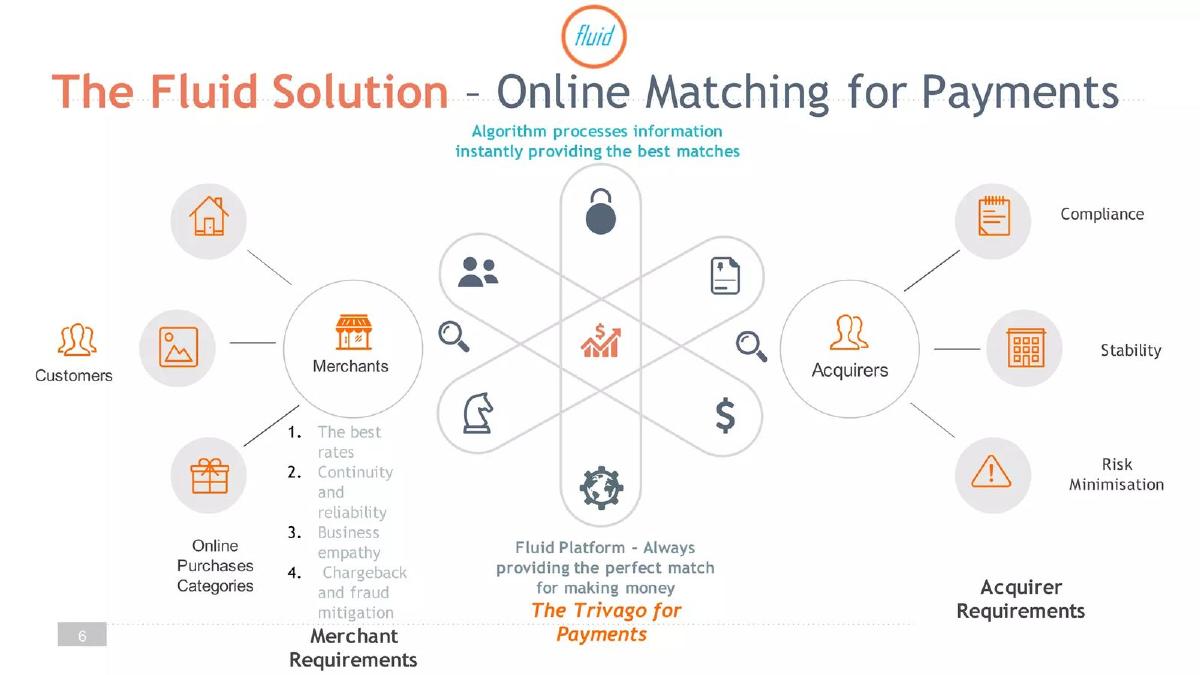
- The company uses a 'Trivago of Payments' analogy on Slide 1 to define its role as a comparison and routing layer in the fintech stack.
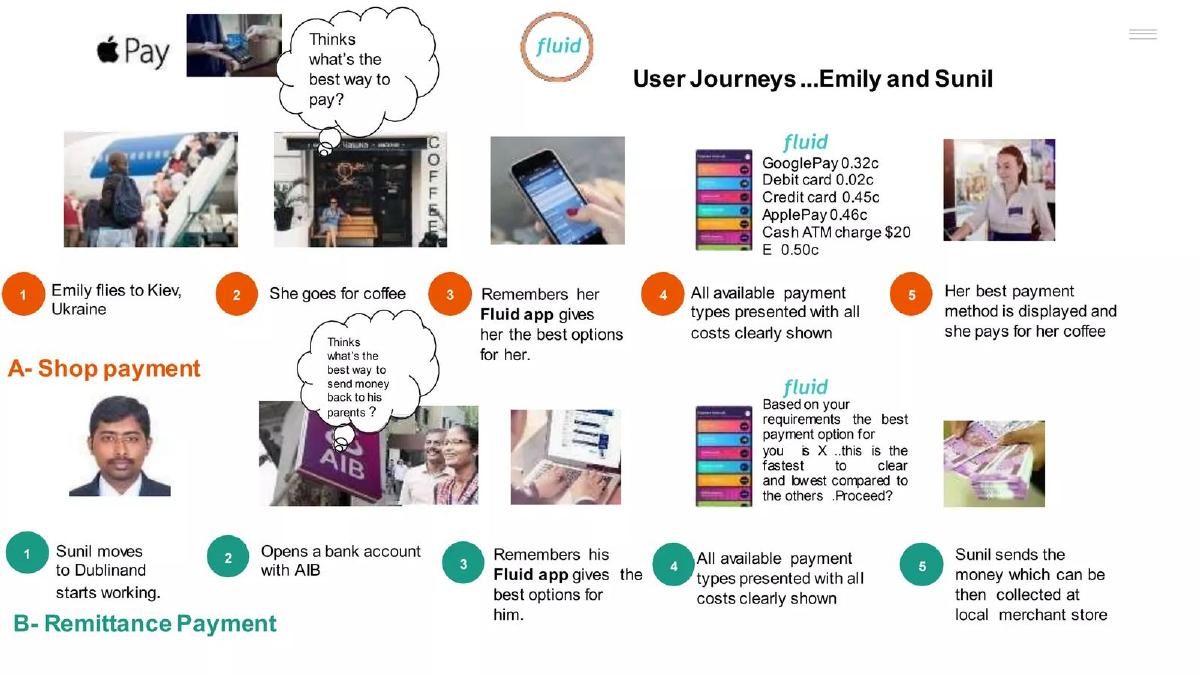
- Slide 3 illustrates two distinct user journeys: 'A- Shop payment' for retail and 'B- Remittance Payment' for international transfers.
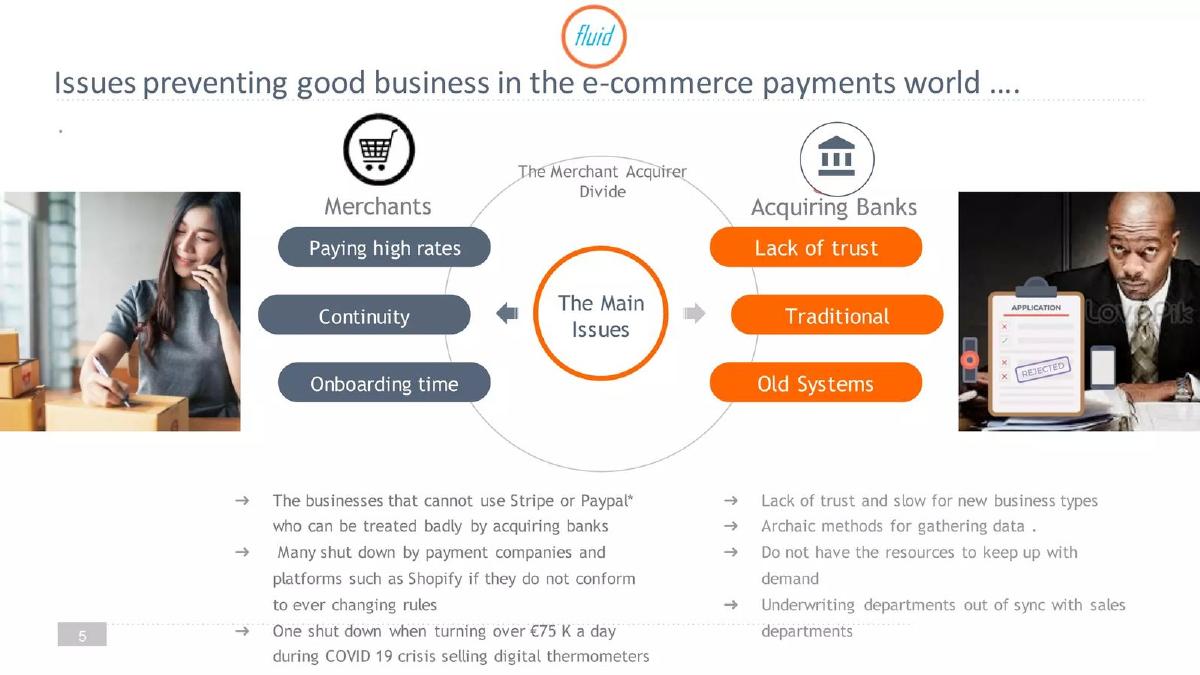
- The 'Merchant Acquirer Divide' is identified on Slide 5 as the primary problem, citing high rates, long onboarding times, and archaic bank systems.
- Slide 5 specifically mentions a case study of a business turning over €75k a day being shut down during the COVID-19 crisis as a justification for their service.
- Core product features listed on Slide 7 include Least Cost Routing, Tokenised Payments, and a rules-based Conformance engine.
- The go-to-market strategy on Slide 9 focuses on targeting acquirers via LinkedIn campaigns, professional associations, and direct sales contacts.
- Slide 11 outlines a €600,000 investment ask, with €350,000 earmarked for regulatory capital to obtain an EMI license.
- Financial projections on Slide 11 forecast a jump from €452,337 in 2021 revenue to over €6.1 million by 2023.
Fluid Fintec Pitch Deck Teardown
Slide 1: Title and Vision
The cover slide introduces Fluid Fintec with the tagline "'The Trivago of Payments' Investment Opportunity Document." This is a classic 'X for Y' value proposition, immediately signaling to the investor that the company acts as a comparison or routing engine. The visual split shows a consumer using a mobile device and a professional interacting with data visualizations, suggesting a bridge between retail users and backend financial technology. The company website is clearly displayed at the bottom.
Slide 3: User Journeys
This slide uses two personas, Emily and Sunil, to demonstrate the application's utility. Emily's journey focuses on shop payments while traveling in Kiev, Ukraine. The slide shows the Fluid app displaying a list of costs: GooglePay at 0.32c, Debit card at 0.02c, and Credit card at 0.45c. This visualizes the 'Least Cost Routing' concept for the end-user. Sunil's journey covers remittance payments, showing how the app helps a worker in Dublin send money back to his parents by identifying the fastest and lowest-cost option. This slide is effective at showing, rather than just telling, how the product functions in real-world scenarios.
Slide 5: The Merchant Acquirer Divide
Fluid Fintec identifies the 'Main Issues' preventing good business in e-commerce. For Merchants , the pain points are high rates, lack of continuity, and long onboarding times. For Acquiring Banks , the issues are a lack of trust, traditional mindsets, and old systems. A significant claim on this slide is that businesses are being shut down by platforms like Shopify if they do not conform to 'ever changing rules.' They cite a specific example: "One shut down when turning over €75 K a day during COVID 19 crisis selling digital thermometers." This adds urgency and a specific market niche (high-risk or high-growth merchants) to their pitch.
Slide 7: Product Features
The deck outlines a "Unique Combination of Ingredients" to eliminate pain points. The six core pillars are:
Least Cost Routing: The core engine for finding the cheapest path between merchant and acquirer. · Conformance: A built-in rules engine and smart contracts to ensure merchant compliance. · POS & Mobile Pay: An omni-channel, API-first approach. · Tokenised Payments: Focused on security, privacy, and loyalty options. · Global Accessibility: A network of global payment solutions for signing merchants. · Third Party Services: Plug-in services for niches like drop shipping.
This slide serves as the technical overview, though it remains high-level without explaining the underlying architecture.
Slide 9: Go-To-Market Strategy
Titled "Targeting Acquirers," this slide shifts the focus from the end-user to the B2B partner. Fluid Fintec intends to act as a filter for banks. The 'Key messaging' is that they provide banks with access to 'proven credentials' and 'KYC & performance vetted' merchants. The sales channels listed include LinkedIn campaigns, professional associations, and direct sales contacts. This suggests a dual-sided marketplace strategy where they acquire merchants to 'sell' them to acquirers who are otherwise hesitant to take on new business types.
Slide 11: Financials and The Ask
The final slide in this set provides a detailed financial breakdown. The investment ask is €600,000 . This is specifically allocated: €350,000 for regulatory capital for an EMI license and €250,000 linked to their 'Enterprise Ireland HPSU status.' The financial table projects a rapid scale-up:
2021: €452,337 Revenue | (€407,066) Profit · 2022: €3,073,104 Revenue | €1,652,130 Profit · 2023: €6,109,345 Revenue | €3,866,507 Profit
The slide claims a 63% profit margin in year 3 and a 18.8% growth rate between years 2 and 3 (though the revenue figures actually show a 100% increase, suggesting the 18.8% might refer to a different metric or is a typo). The turnover is explicitly stated as "€ 6,109,345 million 2023," which is likely a typo intended to mean €6.1 million total, not 6 trillion.
What Works
The 'Trivago of Payments' analogy is a strong hook. It immediately explains a complex fintech concept (routing and orchestration) in terms a generalist investor can understand. The User Journey slide (Slide 3) is also a highlight; by showing the actual cent-level differences between payment methods, they prove the tangible value to the consumer. Furthermore, the specific breakdown of the funding ask (Slide 11) is excellent. Investors want to know exactly where their money goes, and 'regulatory capital for an EMI license' is a very concrete and necessary milestone for a fintech company.
What is Missing
The most glaring omission in the provided slides is a Team Slide . In early-stage fintech, the founders' regulatory and technical pedigree is often more important than the initial product. There is also no Competition Slide . While they mention Stripe and PayPal as platforms that 'shut down' businesses, they do not address other payment orchestrators or routing engines like Spreedly or Primer. Finally, the Unit Economics are not clearly defined. While they show total revenue and profit, they don't explain the take-rate per transaction or the cost of acquiring a single merchant versus a single acquirer.
Founder Takeaways
Use clear analogies: If your product is a middleware or an optimization layer, find a consumer-facing analogy like 'Trivago' to anchor the investor's understanding. Quantify the pain: Fluid Fintec didn't just say banks are slow; they cited a specific €75k/day business being shut down. Real-world examples of market failure make your solution feel necessary. Be specific with the 'Ask': Don't just ask for 'growth capital.' If you need a specific license or have a government matching grant (like Enterprise Ireland), list the exact amounts. It builds credibility and shows you have a roadmap beyond just 'hiring and marketing.'
Frequently asked questions
- What is the primary problem Fluid Fintec is solving?
- According to Slide 5, the company addresses the 'Merchant Acquirer Divide.' This includes merchants paying high rates and facing long onboarding times, while acquiring banks suffer from a lack of trust and reliance on old, traditional systems. They specifically target businesses that are often rejected or shut down by mainstream processors like Stripe or PayPal due to changing rules or high-growth niches.
- How does the 'Least Cost Routing' feature work?
- Slide 7 describes Least Cost Routing as a 'lowest friction' solution between merchants and acquirers. As shown in the user journey on Slide 3, the app presents all available payment types (e.g., GooglePay, Debit card, Credit card) with their specific costs (e.g., 0.02c vs 0.46c) and highlights the 'best' option for the user based on speed and cost.
- What are the specific financial requirements mentioned in the deck?
- Slide 11 states an investment requirement of €600,000. This is broken down into €350,000 for regulatory capital needed for an EMI (Electronic Money Institution) license and €250,000 related to their Enterprise Ireland HPSU (High Potential Start-Up) status. The slide also projects a profit of €3,866,507 by year three.
- Who is the target audience for Fluid Fintec's sales efforts?
- Slide 9 indicates that the company targets 'Acquirers and financial institutions providing merchant services.' Their sales generation methods include direct contacts with sales teams, LinkedIn campaigns, professional groups, and seminars. They aim to provide these institutions with 'access to the best merchants' who have already been KYC and performance vetted.
- What geographic markets is Fluid Fintec targeting?
- The financial table on Slide 11 breaks down revenues and costs into two primary regions: 'Europe & UK' and 'USA.' By 2023, they project nearly equal revenue contributions from both regions, with €3,088,190 from Europe/UK and €3,021,195 from the USA.