Fluency's investor deck from 2013 targets the intersection of youth unemployment and the digital skills gap in small businesses. The company positions itself as a superior alternative to existing freelance platforms like oDesk and PeoplePerHour by emphasizing benefits for both the worker and the client. The deck identifies a $5 billion market opportunity by 2018, growing at 31% annually. While the strategy for customer acquisition is broad—ranging from guest blogging to partnerships with organizations like Enterprise Nation—the deck is notably light on unit economics, specific revenue models,…
Key takeaways
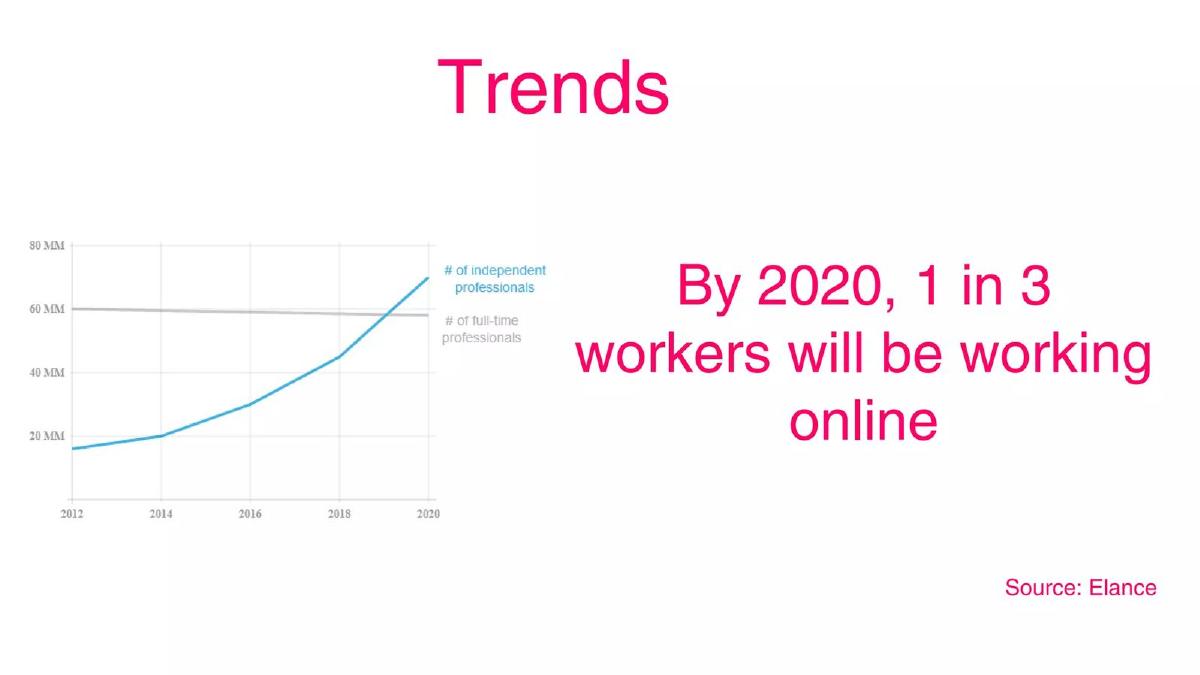
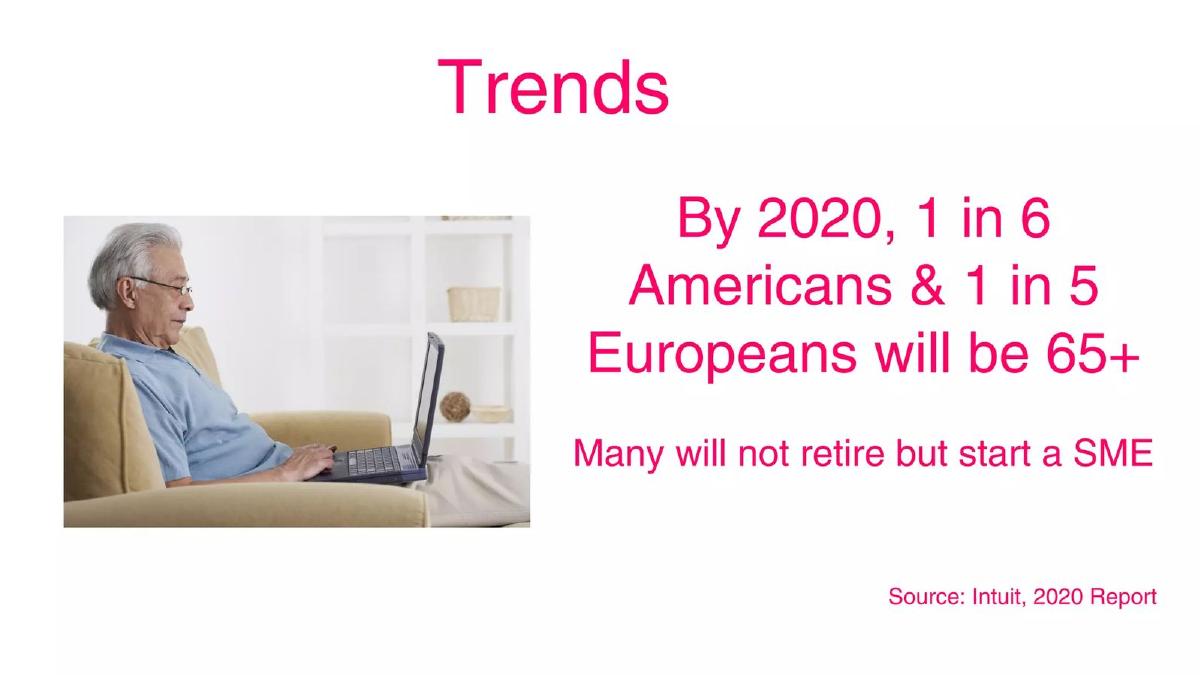
- The deck identifies a demographic shift where 1 in 6 Americans and 1 in 5 Europeans will be 65+ by 2020, leading to more seniors starting SMEs (Slide 2).
- Fluency positions itself in the top-right quadrant of a competitive matrix, claiming higher benefits for both workers and clients compared to oDesk and 99designs (Slide 3).
- The core value proposition relies on young people being 'digital natives' who possess the 'killer app' skills that SMEs lack (Slide 4).
- The product interface simplifies digital services into selectable packages like SEO, Social Media Marketing, and Web Building (Slide 5).
- Market size projections estimate the online work market will grow from $1 billion in 2012 to $5 billion by 2018 (Slide 6).
- The business development pipeline includes non-profit and youth-focused organizations such as Catch 22, MyBnk, and St Giles Trust (Slide 7).
- Customer acquisition strategy includes high-profile guest blogging for The Guardian and Huffington Post, and partnerships with Go ON UK and Startup Britain (Slide 8).
- The deck lacks a team slide, financial ask, or specific revenue breakdown in the provided nine-slide sequence.
Fluency Pitch Deck Teardown
The Fluency investor deck, dated December 2013, presents a marketplace solution designed to bridge the gap between digital-savvy youth and small businesses struggling to navigate the modern digital landscape. The deck is a product of its time, focusing heavily on the 'digital native' trend and the rise of the gig economy.
Slide 1: Title Slide
The cover slide features the brand name 'Fluency' in a script font with the tagline 'The future of work @getfluency.' The background image shows a blurred office environment with a computer monitor, suggesting a tech-enabled service or platform. It is a standard, minimalist opening that establishes the company's focus on the evolving nature of employment.
Slide 2: Trends and Demographics
Slide 2 sets the stage by citing an Intuit 2020 Report. It claims that by 2020, 1 in 6 Americans and 1 in 5 Europeans will be 65+ . The crucial insight here is that 'Many will not retire but start a SME.' This identifies the target customer: older entrepreneurs who may lack the digital skills necessary to compete in a modern economy. By framing the problem through demographic shifts, Fluency attempts to show a growing, non-cyclical demand for their services.
Slide 3: Competitive Landscape
This slide uses a standard four-quadrant matrix to map 'Existing Solutions.' The axes are 'Benefit for Client' and 'Benefit for Worker.' Fluency places itself in the top-right corner, indicating maximum benefit for both parties. Competitors like oDesk (now Upwork) are placed in the middle-left, while 99designs and PeoplePerHour are positioned in the bottom-left. Samasource , Servio , and Clickworker.com are also included. The slide asserts superiority but does not provide specific features or data points to explain why Fluency offers more benefit than established players like oDesk.
Slide 4: The 'Killer App'
Slide 4 introduces the supply side of the marketplace. It states that 'Young people have a ‘killer app’ that SMEs need... They are ‘digital natives’.' This slide relies on the assumption that age correlates directly with digital proficiency. It positions youth unemployment not as a social burden, but as an untapped resource of high-value skills. The imagery shows young women working on laptops, reinforcing the 'digital native' theme.
Slide 5: Product Interface and How It Works
This slide provides a glimpse of the user experience. A laptop mockup shows a simple interface where a client is asked, 'What do you want help with?' Options include Social Media marketing, SEO, Building a web site, and Email marketing . The text 'Client chooses a digital package' suggests that Fluency is not just a raw labor marketplace but a service aggregator that productizes complex digital tasks into manageable 'packages.' This is a key differentiator from general freelance platforms where the client must define the scope themselves.
Slide 6: Market Size Projections
Fluency presents the 'Online work market' as a massive opportunity. The slide states the market was $1 billion in 2012 and is projected to reach $5 billion by 2018 , growing at 31% annually . The use of a simple bubble chart visualizes this 5x growth. While these figures are large, they represent the entire online work market, not just the specific niche Fluency occupies, which is a common tactic to make the TAM appear as large as possible.
Slide 7: The Pipeline
Slide 7 displays logos of organizations in Fluency's 'Pipeline.' These include Catch 22, MyBnk, St Giles Trust, Think Big, and Each One Teach One . Most of these are UK-based charities or social enterprises focused on youth development and financial literacy. This suggests that Fluency’s labor supply strategy involves partnering with existing non-profits to source and perhaps train young workers, adding a social impact layer to the business model.
Slide 8: Customer Acquisition Strategy
Titled 'Getting Customers,' this slide outlines a comprehensive go-to-market plan. It is divided into four categories:
Events: Targeted business events and free digital seminars, including popups at brands like Talk Talk, EE, and Lloyds Bank. · Partners: Mentions Go ON UK, Enterprise Nation, and Startup Britain. · Content and Search: Guest blogging for The Guardian and Huffington Post, plus targeted ads. · Press: Leveraging the 'Fluency / youth / female CEO stories' for media coverage. · Referral & Invite Mechanisms: An affiliate programme.
This slide shows a heavy reliance on 'authority' marketing and partnerships rather than pure performance marketing, which makes sense for a service targeting less tech-savvy SME owners.
Slide 9: User Testimonial
The final slide provided is a testimonial from 'Sofia,' who is quoted saying it is “a really effective way of learning.” This confirms that the platform has an educational or vocational training component for the workers. However, the slide is thin on details—it doesn't specify what Sofia learned or how the platform facilitated that learning beyond the work itself.
What Works in This Deck
The deck does a good job of identifying a specific, relatable friction point: older SME owners needing digital help and young people needing jobs. By framing the solution as 'digital packages' (Slide 5), they address the 'blank page' problem that often prevents small businesses from hiring freelancers on platforms like Upwork. The partnership pipeline (Slide 7) also suggests a scalable way to acquire labor without high individual acquisition costs.
What Is Missing
The most glaring omissions in these nine slides are the Team and the Financials . While Slide 8 mentions a 'female CEO,' there are no bios or track records for the founding team. There is no mention of the business model—specifically the take rate or margins on the 'digital packages.' Furthermore, the 'Ask' is missing; we don't know how much capital is being raised or what the milestones for that capital are. The competitive matrix (Slide 3) is also purely qualitative, lacking any data to back up the claim that Fluency provides more 'benefit' than its multi-billion dollar competitors.
Founder Takeaways
Founders should note the effectiveness of the 'Trend' slide (Slide 2). Instead of just saying 'SMEs are behind,' they used demographic data to show why a specific segment of SMEs will be behind in the coming years. This creates a sense of inevitability. Additionally, productizing a service into 'packages' (Slide 5) is a strong way to reduce friction in a marketplace. However, avoid the mistake of making a competitive matrix that is entirely subjective; if you claim to be better for workers and clients, you should cite specific reasons like 'lower fees' or 'guaranteed turnaround times.'
Frequently asked questions
- What problem is Fluency trying to solve?
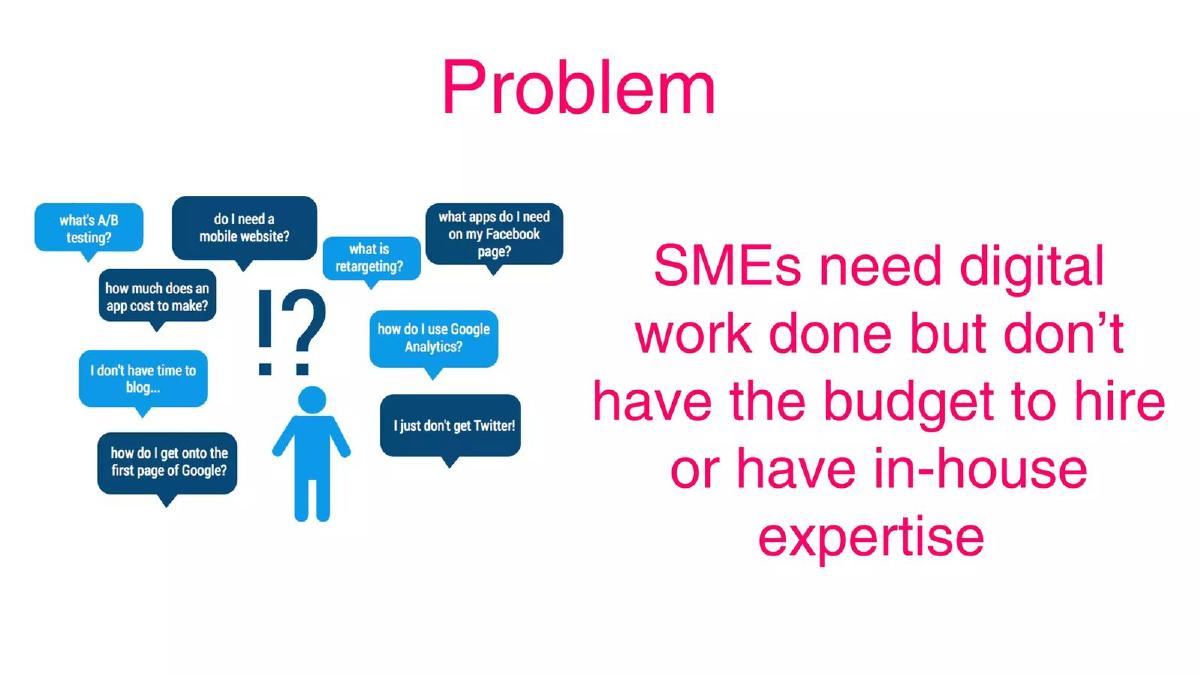
- Fluency addresses two primary issues: the lack of digital skills among small and medium enterprise (SME) owners—many of whom are older entrepreneurs—and the need for effective work opportunities for 'digital native' youth. By packaging digital services like SEO and social media management, they aim to make it easier for non-technical business owners to modernize their operations using young talent.
- How does Fluency differentiate itself from oDesk or 99designs?
- According to Slide 3, Fluency differentiates itself by maximizing the 'Benefit for Worker' and 'Benefit for Client' simultaneously. While platforms like oDesk are shown as having lower benefits for workers and 99designs as having lower benefits for clients, Fluency claims to occupy a premium space that balances the needs of both sides of the marketplace more effectively.
- What is the projected market growth for this sector?
- The deck cites a 31% annual growth rate for the online work market. It notes the market was valued at $1 billion in 2012 and projects it will reach $5 billion by 2018. This data is used to demonstrate a rapidly expanding TAM (Total Addressable Market) for digital labor platforms.
- What is the company's strategy for acquiring customers?
- Fluency outlines a multi-channel acquisition strategy on Slide 8. This includes hosting targeted business events and free digital seminars, forming partnerships with organizations like Enterprise Nation, guest blogging for major news outlets like The Guardian, and leveraging the 'female CEO' narrative for press coverage. They also mention an affiliate programme and referral mechanisms.
- Who are the partners mentioned in the deck?
- The deck lists several UK-centric partners and pipeline organizations. These include Catch 22, MyBnk, St Giles Trust, Think Big, and Each One Teach One. For customer acquisition, they highlight Go ON UK, Enterprise Nation, and Startup Britain, suggesting a strong focus on the UK social enterprise and startup ecosystem.