Flowtab’s pitch deck is a concise, 10-slide presentation that successfully secured a $50,000 initial seed investment. The company positioned itself as a mobile ordering, payments, and loyalty platform specifically tailored for bars and nightclubs. The deck excels at identifying three-sided pain points—customers, bartenders, and owners—while providing early traction data from a three-month pilot. With $12,450 in total sales from seven venues, the founders demonstrated a proof of concept before seeking a larger $500,000 angel round. While the deck lacks detailed market sizing (TAM/SAM) and deep…
Key takeaways
- The company defines itself clearly on slide 2 as a mobile ordering, payments, and loyalty platform for bars and nightclubs.
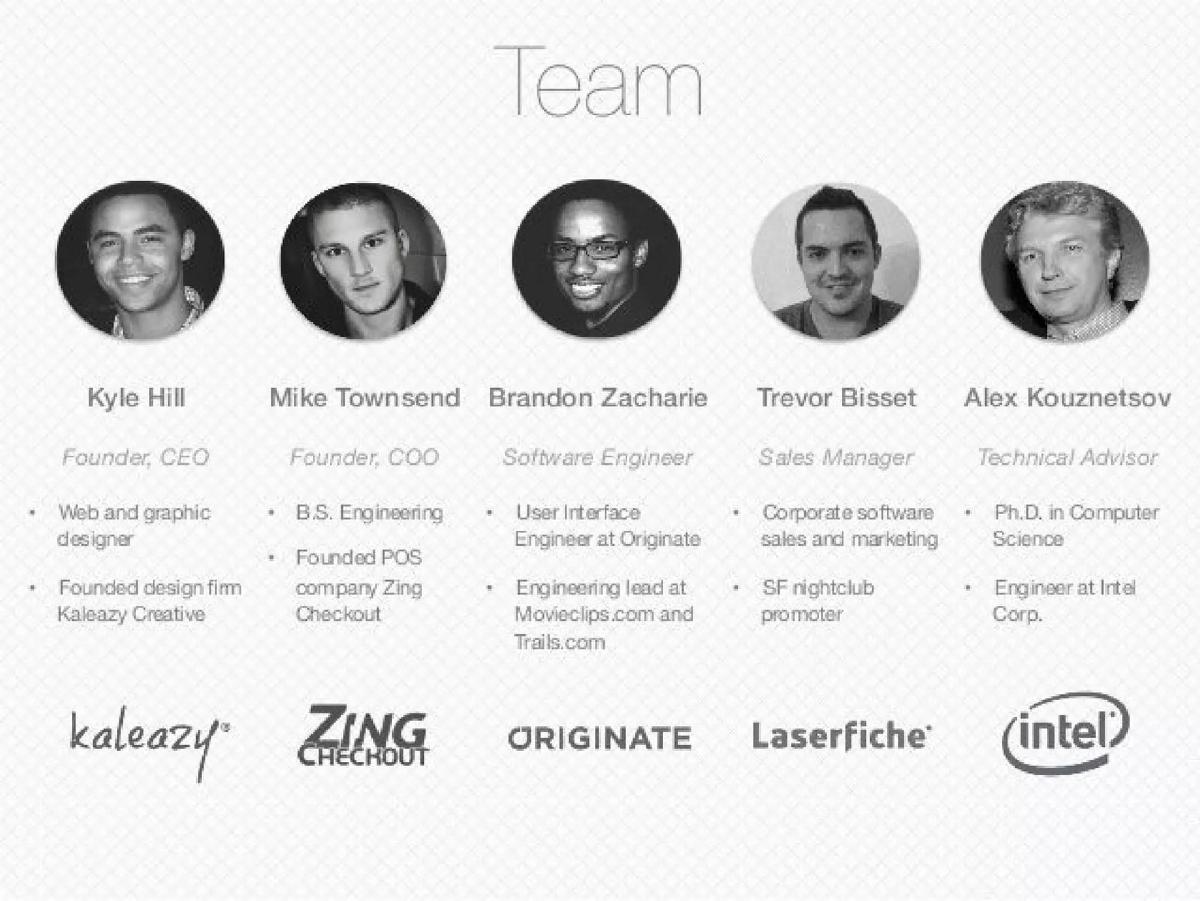
- The team slide (slide 3) highlights relevant domain expertise, including a COO who founded a POS company and a Sales Manager who was an SF nightclub promoter.
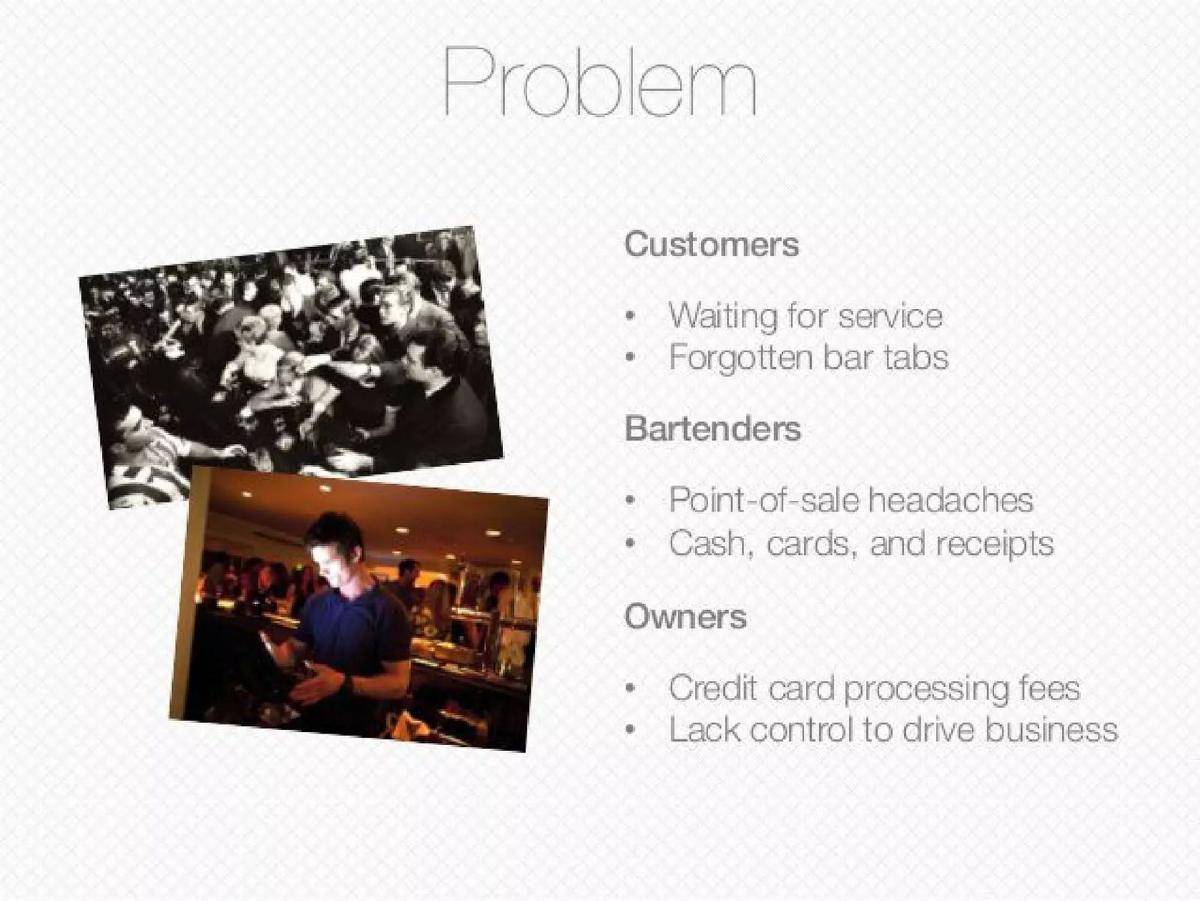
- Slide 4 segments the problem into three distinct groups: customers (waiting for service), bartenders (POS headaches), and owners (credit card fees).
- Traction data on slide 7 shows $12,450 in total sales across 7 venues within three months of launch (11/1/12 to 2/1/13).
- Customer acquisition costs are explicitly stated on slide 7: $1,500 - $2,500 to acquire a bar and $4 - $19 to acquire a user.
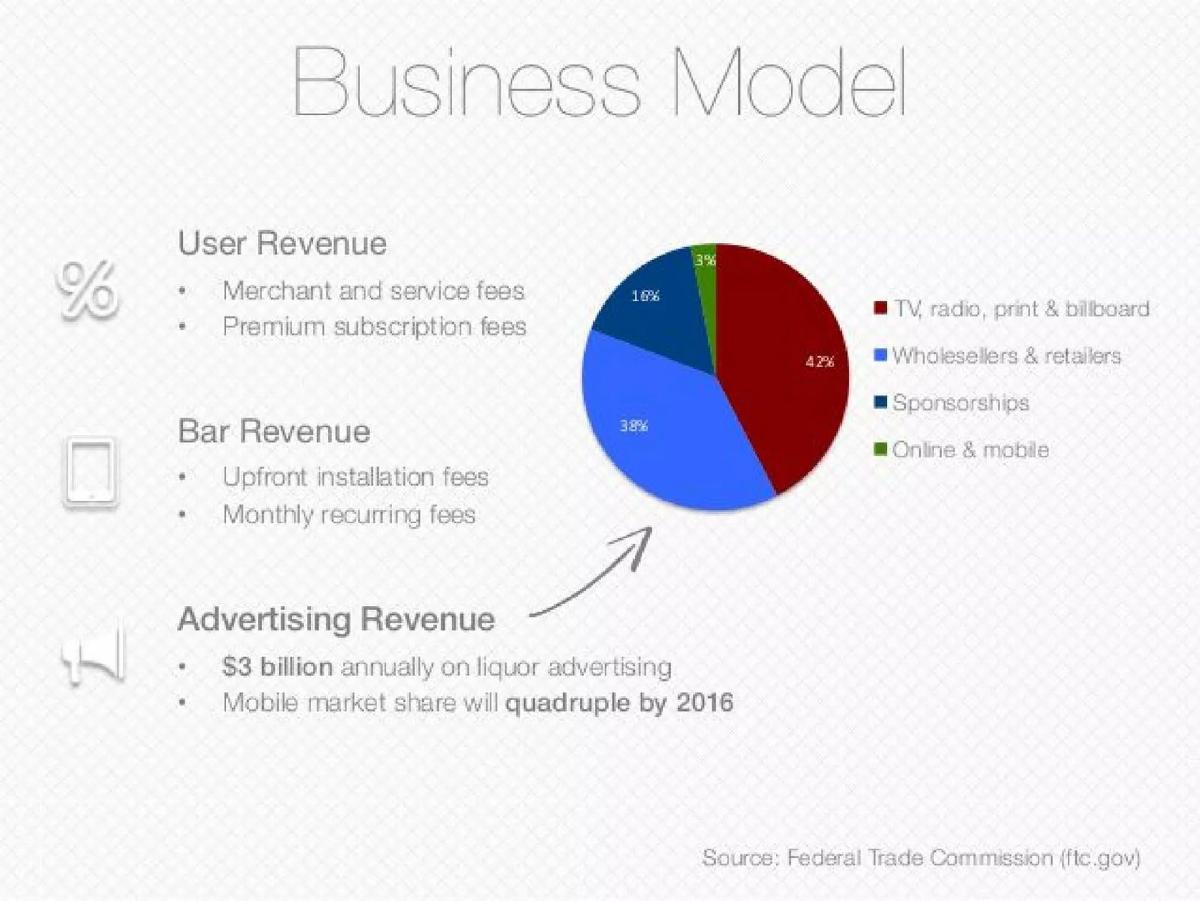
- The business model (slide 6) identifies three revenue streams: user fees, bar fees, and advertising revenue, citing a $3 billion liquor advertising market.
- The competition slide (slide 8) differentiates Flowtab by highlighting features like 0% credit card processing and table ordering.
- Slide 9 outlines a clear funding roadmap, starting with a $50,000 initial seed and targeting a $500,000 angel round followed by a $3M Series A.
Flowtab Pitch Deck Analysis
The Flowtab pitch deck is a classic example of an early-stage 'seed' deck. It is minimalist, focused on a specific niche (nightlife), and relies on early pilot data to justify a small initial investment. At only 10 slides, it follows the Sequoia-style brevity that was popular in the early 2010s. The deck is dated by its iPhone 5-era mockups and references to 2012/2013 timelines, but the structural logic remains relevant for founders seeking their first $50k-$100k.
Slide 1: Title and Branding
The cover slide features the Flowtab logo and a dictionary-style definition of 'flow.' It includes the company's San Francisco address and a contact phone number at the bottom. This slide establishes a clean, professional aesthetic but does not immediately explain the product, relying on the next slide for the 'elevator pitch.'
Slide 2: The Value Proposition
Slide 2 provides a one-sentence summary: "Flowtab is a mobile ordering, payments and loyalty platform for bars and nightclubs." This is a strong, declarative statement. It identifies the product (ordering/payments/loyalty) and the specific target market (bars/nightclubs). By narrowing the focus to nightlife, the company differentiates itself from general-purpose payment apps like Square or PayPal.
Slide 3: Team and Domain Expertise
The team slide is well-structured, featuring five individuals with clear roles and relevant backgrounds. Kyle Hill (CEO) and Mike Townsend (COO) are the founders. Notably, Townsend is credited with founding a POS company, Zing Checkout, which provides direct industry relevance. Trevor Bisset (Sales Manager) is listed as an 'SF nightclub promoter,' which addresses the 'how do we get into bars' question that investors inevitably ask. The inclusion of logos like Intel and Originating adds institutional credibility to the engineering side.
Slide 4: The Three-Sided Problem
Flowtab identifies pain points for three distinct stakeholders. For Customers , the issues are waiting for service and forgotten bar tabs. For Bartenders , the problems are POS headaches and managing cash/cards/receipts. For Owners , the focus is on credit card processing fees and a lack of data to drive business. This slide is effective because it shows the founders understand the friction points for everyone involved in a transaction, not just the end-user.
Slide 5: The Solution (Product Mockups)
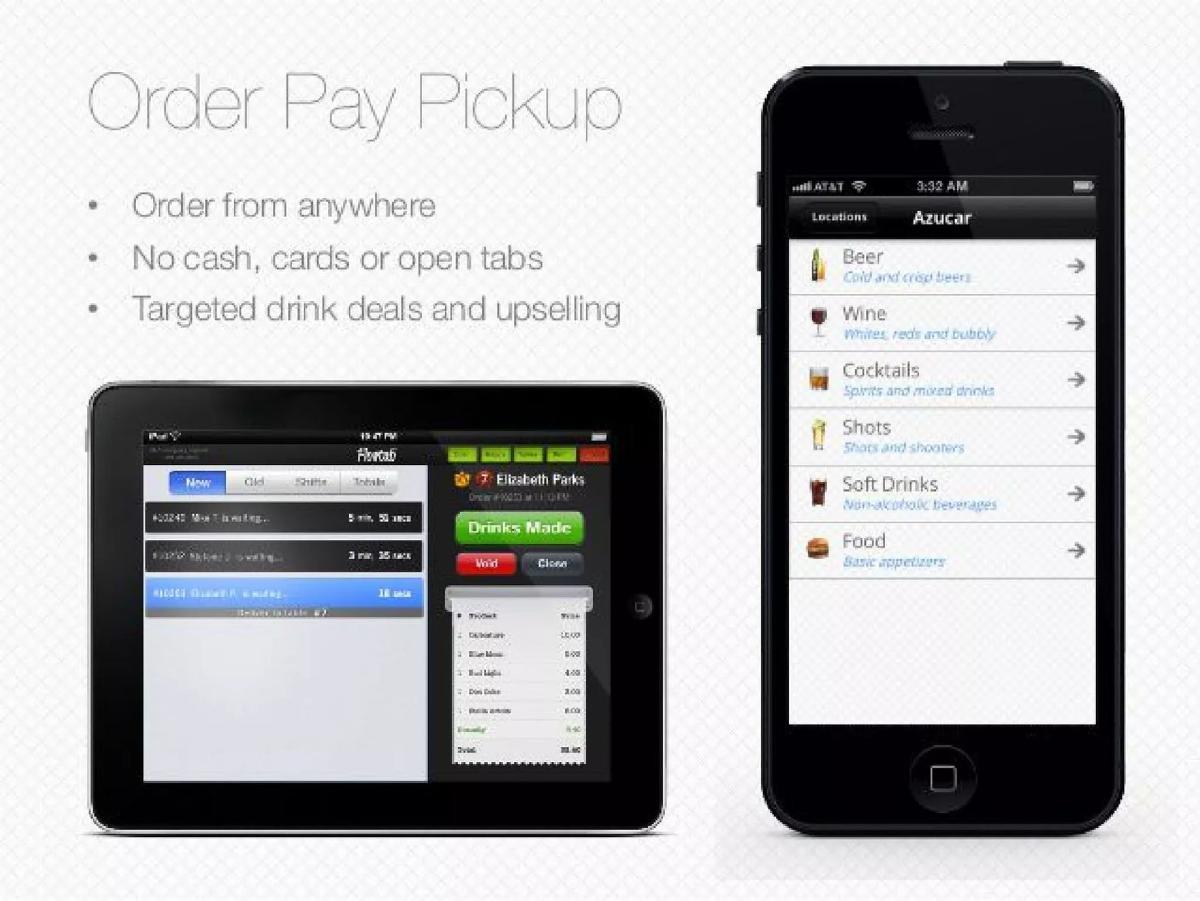
This slide uses the 'Order Pay Pickup' header to describe the user flow. It features two mockups: a consumer-facing iPhone app and a bartender-facing iPad interface. The bullet points highlight 'no cash, cards or open tabs' and 'targeted drink deals.' The visual evidence of a working interface for both the front and back of the house is crucial for a hardware/software hybrid pitch.
Slide 6: Business Model and Revenue Streams
The business model slide is diversified. It lists User Revenue (fees and subscriptions), Bar Revenue (installation and recurring fees), and Advertising Revenue . A pie chart shows the breakdown of the liquor advertising market, noting that TV, radio, and print still dominate (42%), while online/mobile is only 3%. Flowtab cites the Federal Trade Commission as a source and predicts that mobile market share will quadruple by 2016. This slide attempts to show a massive 'hidden' opportunity in advertising beyond simple transaction fees.
Slide 7: Traction and Unit Economics
This is the most important slide in the deck. It lists 7 Venues , 2,200 Users , and $12,450 in Total Sales . A footnote specifies that these sales occurred between 11/1/12 and 2/1/13. Crucially, it includes unit economics: "Cost to acquire a bar is $1500 - $2500" and "Cost to acquire a user is $4 - $19." While these CAC numbers are high relative to the sales, they show the founders are tracking the right metrics. The slide also mentions a pilot distribution deal with Dex One and a partnership with Lyft (signing 10% of drivers), which suggests a creative approach to user acquisition.
Slide 8: Competitive Landscape
The competition slide uses a standard checkmark grid. It compares Flowtab against GoPago, Coaster, TappedOut, and Bartab . Flowtab claims superiority in '0% CC Processing,' 'Distribution Partner,' and 'Table Ordering.' Interestingly, it admits that TappedOut has 'POS Integration,' which Flowtab lacks at this stage. This honesty can actually build trust with investors, as it identifies a clear technical hurdle the company needs to clear.
Slide 9: Financials and Exit Strategy
The financial roadmap is explicit. It notes an Initial Seed of $50,000 in August 2012, an Angel Round of $500,000 in February 2012 (likely a typo intended to be 2013), and a Series A of $3M in Q4 2013. The bottom half of the slide lists potential acquirers: Google Wallet, mFoundry, Intuit, and Micros . Naming Micros is particularly astute, as they are a dominant player in legacy POS systems that might buy a mobile-first startup to modernize their offering.
Slide 10: Conclusion
The final slide is a generic placeholder added by the source agency (chagency) and does not contain company-specific information. The actual Flowtab deck likely ended with a contact slide or a 'Thank You' which is missing here.
What Works in the Flowtab Deck
Specific Niche: By focusing only on bars and nightclubs, they avoid the 'boil the ocean' trap of general mobile payments. · Dual-Interface Design: Showing the bartender's iPad view is as important as the customer's iPhone view. It proves they've thought about the operational workflow. · Early Metrics: Even with only $12k in sales, having hard numbers on CAC and user growth makes the pitch much more tangible. · Strategic Partnerships: The mention of Lyft and Dex One shows that the team is thinking about distribution, not just building an app.
What is Missing from the Flowtab Deck
Market Sizing: The deck mentions a $3B liquor ad market, but it never defines the Total Addressable Market (TAM) for the transaction fees or the number of bars in the US. · Unit Economics Detail: While they list CAC, they don't list LTV (Lifetime Value) or the payback period, making it hard to judge if the $1,500-$2,500 bar acquisition cost is sustainable. · Technical Architecture: There is no mention of how they handle the '0% CC Processing' or how they bypass the need for POS integration in their early pilot. · Use of Funds: While they state they want $500k, they don't explain exactly how that money will be spent (e.g., hiring 3 engineers, expanding to 50 bars).
Founder Takeaways
Be honest about gaps: Flowtab admitted they lacked POS integration compared to a competitor. This identifies a clear use for future funding. · Segment your problems: Don't just say 'payments are slow.' Explain why they are slow for the customer, the staff, and the owner. · Leverage local traction: You don't need 1,000 customers to raise $50k. You need 7 customers and a clear set of data points from a three-month window. · Identify the exit early: In a crowded space like fintech, showing that you know who the 'big fish' acquirers are demonstrates that you understand the industry's consolidation patterns.
Frequently asked questions
- What was the primary goal of this pitch deck?
- The deck was designed to secure early-stage funding. According to the source listing, it successfully raised a $50,000 initial seed investment. Slide 9 indicates this was the first step in a larger roadmap that included a $500,000 angel round and a $3 million Series A.
- How did Flowtab demonstrate traction with such a small raise?
- Slide 7 provides specific metrics from a short operating window (November 2012 to February 2013). They reported 7 venues, 2,200 users, and 120 orders per week. Showing $12,450 in total sales proved that the technology worked in a live environment, which is often enough for a micro-seed round.
- What is the unique selling proposition for bar owners?
- Flowtab addresses owner pain points on slide 4, specifically 'credit card processing fees' and 'lack of control to drive business.' On slide 8, they claim a competitive advantage of '0% CC Processing,' suggesting they may pass fees to the user or offset them through their advertising and subscription models.
- Who are the key members of the Flowtab team?
- Slide 3 lists Kyle Hill (CEO, designer), Mike Townsend (COO, former POS founder), Brandon Zacharie (Software Engineer), Trevor Bisset (Sales Manager, former nightclub promoter), and Alex Kouznetsov (Technical Advisor, Ph.D. in Computer Science). The mix of technical skill and nightlife industry experience is a core strength.
- What revenue streams does the company anticipate?
- Slide 6 breaks revenue into three categories: User Revenue (merchant/service fees and premium subscriptions), Bar Revenue (upfront installation and monthly recurring fees), and Advertising Revenue (targeting the $3 billion liquor advertising market).