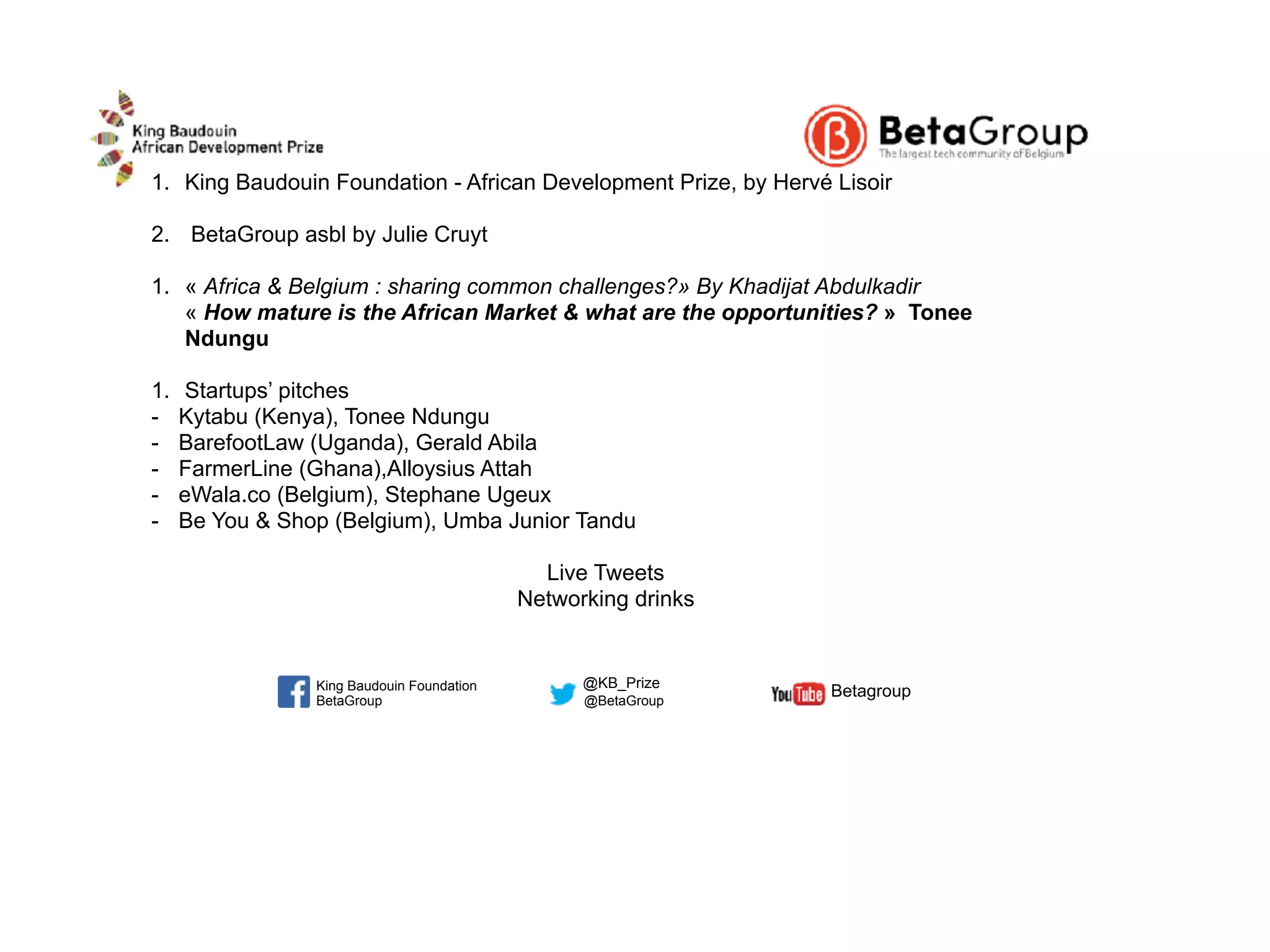
The eWala pitch deck, presented by Stephane Ugeux, addresses the inefficiencies of the global remittance market, specifically highlighting the high commission rates faced by the African diaspora in Belgium. With global remittances totaling 600 billion Euros in 2015, eWala identifies a 5.5 billion Euro market in Belgium where commissions reach as high as 12%. The company proposes a mobile application that allows users to recharge phone numbers and transfer money, bypassing traditional brick-and-mortar services like Western Union. The deck seeks 250,000 Euros to fund three primary axes: Europea…
Key takeaways
- The global remittance market was valued at 600 billion Euros in 2015, with Belgium accounting for 5.5 billion Euros (Slide 3).
- Commission rates for remittances average 8% globally but spike to 12% within the European context for certain corridors (Slide 3).
- The startup is seeking a total of 250,000 Euros in funding for their 2018 development phase (Slide 5).
- Funding allocation is split: 40% for European expansion, 35% for product development, and 25% for widening the product offer (Slide 5).
- A key milestone for the 25% 'Widening of product offer' allocation is the acquisition of a banking license to launch money transfers (Slide 5).
- The team includes founders with experience in the OTAN research division and the African Diaspora Network in Europe (Slide 6).
- The product interface focuses on a three-step mobile process: entering a number, choosing a BIF amount (e.g., 100 BIF for 0.10 Euro), and entering payment details (Slide 4).
- The deck omits a formal business model slide, failing to explain how the company earns revenue beyond the mentioned commissions (Slide 3).
Introduction and Context
The pitch deck for eWala, presented by Stephane Ugeux, is a concise 12-slide presentation (of which 6 are analyzed here) designed for a seed-stage fundraising round. The deck was utilized during a BetaGroup event, a prominent tech community in Belgium, in conjunction with the King Baudouin African Development Prize. The presentation focuses on the intersection of European fintech and the African remittance market, specifically targeting the diaspora living in Belgium.
Slide 1: Agenda and Event Context
The opening slide serves as an agenda for a larger event hosted by the King Baudouin Foundation and BetaGroup. It lists several startups pitching alongside eWala, including Kytabu, BarefootLaw, FarmerLine, and Be You & Shop. Stephane Ugeux is explicitly named as the representative for eWala.co. This slide establishes the company's presence within the Belgian tech ecosystem and its focus on African development through technology. The presence of other established social enterprises suggests that eWala is positioning itself as an impact-driven fintech startup.
Slide 2: The Emotional Hook
Slide 2 uses a simple visual narrative to define the status quo. Under the heading "You inspire us," the slide shows a photograph of two women, presumably members of the diaspora, next to an arrow pointing toward a Western Union kiosk. This slide identifies the current behavior eWala seeks to disrupt: the reliance on physical, legacy money transfer agents. There is no text on this slide other than the header, relying entirely on the visual metaphor of the current "inconvenient" or "expensive" journey of sending money home.
Slide 3: Market Opportunity and Pain Points
This is the core data slide of the deck. It defines "The remittance market" using three key metrics. First, it states the "Amount of remittances in 2015" was 600 billion Euros globally, with 5.5 billion Euros originating from Belgium. Second, it highlights the "Average price of commission," noting a global average of 8% but a significantly higher 12% for the European/Belgian market. The visual layout uses a donut chart to show Belgium's slice of the global pie and icons to represent the flow of money from a single individual in Europe to a family unit in Africa. This slide successfully quantifies the problem: the cost of sending money is disproportionately high in the target geography.
Slide 4: Product Walkthrough
Titled "How does it work?" , this slide provides three screenshots of the eWala mobile application. The user flow is demonstrated as follows:
Step 1: Enter a phone number to recharge (the example shows a Burundi flag and the number +25779881414). · Step 2: Choose the amount. The UI shows various tiers, such as 100 BIF for 0.10 Euro up to 5500 BIF for 3.50 Euro . · Step 3: Enter payment details, including cardholder name, card number, expiration date, and CSV code.
This slide confirms that the current iteration of the product is a mobile airtime top-up service, which often serves as a precursor or a low-friction entry point for full remittance services in developing markets.
Slide 5: The Ask and Use of Funds
The "Next steps : fundraising" slide outlines the financial requirements for 2018. The company is seeking 250,000 Euros . The allocation is visualized in a donut chart with three distinct axes:
40% (100k Euro): European expansion. This includes the "Launching of the digital campaign" to acquire market share. · 35% (87.5k Euro): Product development. The goal is to offer a platform that is "both simple and fast to be more attractive." · 25% (62.5k Euro): Widening of product offer. Specifically, the "Acquisition of bank licence to launch Money transfer."
This slide is critical because it reveals that eWala is currently an airtime platform seeking to transition into a regulated money transfer business, which explains the need for a banking license.
Slide 6: Team Presentation
The final slide in this set introduces the personnel. It highlights two main profiles: Inouhé Monteiro , who has experience with the OTAN research division and as Assistant General Manager at Viva Square , and Stéphane Ugeux , a member of the African Diaspora Network in Europe (ADNE) with experience at Econet Leo Burundi . The slide also lists a supporting team provided by Startup Factory , including a CTO (Stéphane Dehousse), Business Developer, Strategy & Product lead, and Graphic Designer. The footer emphasizes that the team's strength lies in their "deep knowledge of the diaspora community" across Africa and Latin America.
What Works in This Deck
The deck excels at identifying a specific, localized market inefficiency. By pointing out that Belgian remittances carry a 12% commission compared to the 8% global average, the founders create an immediate economic justification for their product. The use of funds is also highly specific; rather than a vague "working capital" request, they tie 25% of the raise to a specific regulatory milestone (the banking license) that fundamentally changes the company's value proposition. The product screenshots are clean and demonstrate a functional, high-fidelity MVP, which reduces perceived technical risk for seed investors.
What is Missing
Despite the clear problem and ask, the deck omits several standard venture capital requirements. There is no Business Model slide; while we know commissions are high, we don't know what eWala's specific take-rate or fee structure is. There is no Competition slide, which is a glaring omission in a market dominated by giants like Western Union, WorldRemit, and Remitly. Furthermore, the deck lacks Traction data. While the app is shown, there are no figures on current user count, transaction volume, or month-over-month growth. Finally, the Go-To-Market strategy is limited to a "digital campaign," which lacks the depth required to understand how they will cost-effectively acquire users in a high-CAC (Customer Acquisition Cost) industry like fintech.
Founder's Takeaway
Founders should emulate the way eWala uses a "Problem" slide to highlight a geographic anomaly (the 12% Belgian commission). This makes a global problem feel personal and solvable. The "Use of Funds" slide is also a model of clarity, linking percentages to specific business outcomes rather than just department hires. However, founders must ensure they include a competitive landscape analysis. In fintech, investors are less interested in the fact that a market is big and more interested in how a small player survives against incumbents with massive marketing budgets. Adding a slide on unit economics—specifically how much it costs to acquire a user versus their lifetime value—would have made this a much more compelling investment case.
Frequently asked questions
- What is the primary problem eWala is solving?
- eWala targets the high cost of sending money home for the African diaspora. According to Slide 3, the average commission in Europe is 12%, significantly higher than the global average of 8%. By moving the process from physical locations like Western Union to a mobile app, they aim to reduce these costs and increase convenience for the 5.5 billion Euro Belgian remittance market.
- How does the eWala product actually work?
- As shown in Slide 4, the product is a mobile application. The user enters a phone number to recharge (specifically showing a Burundi +257 prefix), selects a top-up amount in local currency (BIF) which is converted to Euro (e.g., 5000 BIF for 3.30 Euro), and completes the transaction by entering credit card details. The goal is to evolve this into a full money transfer service.
- What is the specific financial ask and how will it be used?
- The company is asking for 250,000 Euros. Slide 5 breaks down the usage: 100,000 Euros (40%) for European expansion and digital campaigns; 87,500 Euros (35%) for product development to improve platform speed and attractiveness; and 62,500 Euros (25%) to acquire a banking license, which is a regulatory requirement for their planned money transfer service.
- Who are the key members of the eWala team?
- The team is led by Inouhé Monteiro (formerly OTAN research and Viva Square) and Stephane Ugeux (African Diaspora Network in Europe and Econet Leo Burundi). They are supported by a technical and strategic team including CTO Stéphane Dehousse and Business Developer Baudouin de Troostembergh, as well as resources from 'Startup Factory' (Slide 6).
- What critical information is missing from this pitch deck?
- The deck lacks a clear revenue model; while it mentions high market commissions, it doesn't state what eWala charges. It also omits a 'Competition' slide, which is vital in the crowded fintech/remittance space. Furthermore, there are no slides regarding unit economics (CAC/LTV), current traction metrics (users or volume), or a detailed go-to-market strategy beyond 'digital campaign'.