Cloudera raised $5M in its 2008 Series A round using a 15-slide deck that focused heavily on the macro-trends of data growth and the technical pedigree of its founding team. The deck positions Hadoop not just as an open-source tool, but as the inevitable successor to traditional data warehousing for the enterprise. It relies on third-party validation from Google Trends and a list of high-profile early adopters like Facebook and eBay to prove market pull. While the deck is light on specific financial projections or a detailed business model, it excels at defining a 'sea change' in computing. T…
Key takeaways
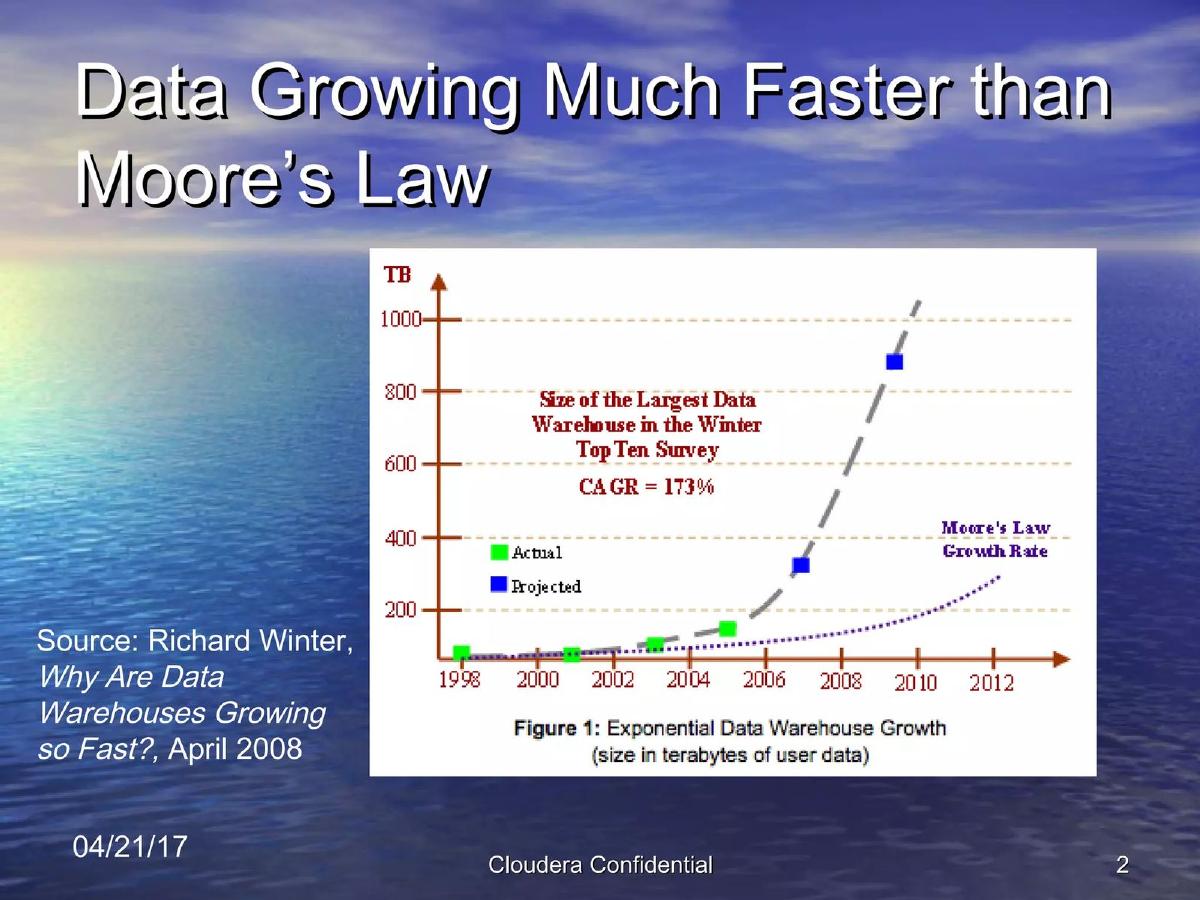
- The deck identifies a massive market gap by showing data volume growing at a 173% CAGR, significantly outpacing Moore's Law (Slide 2).
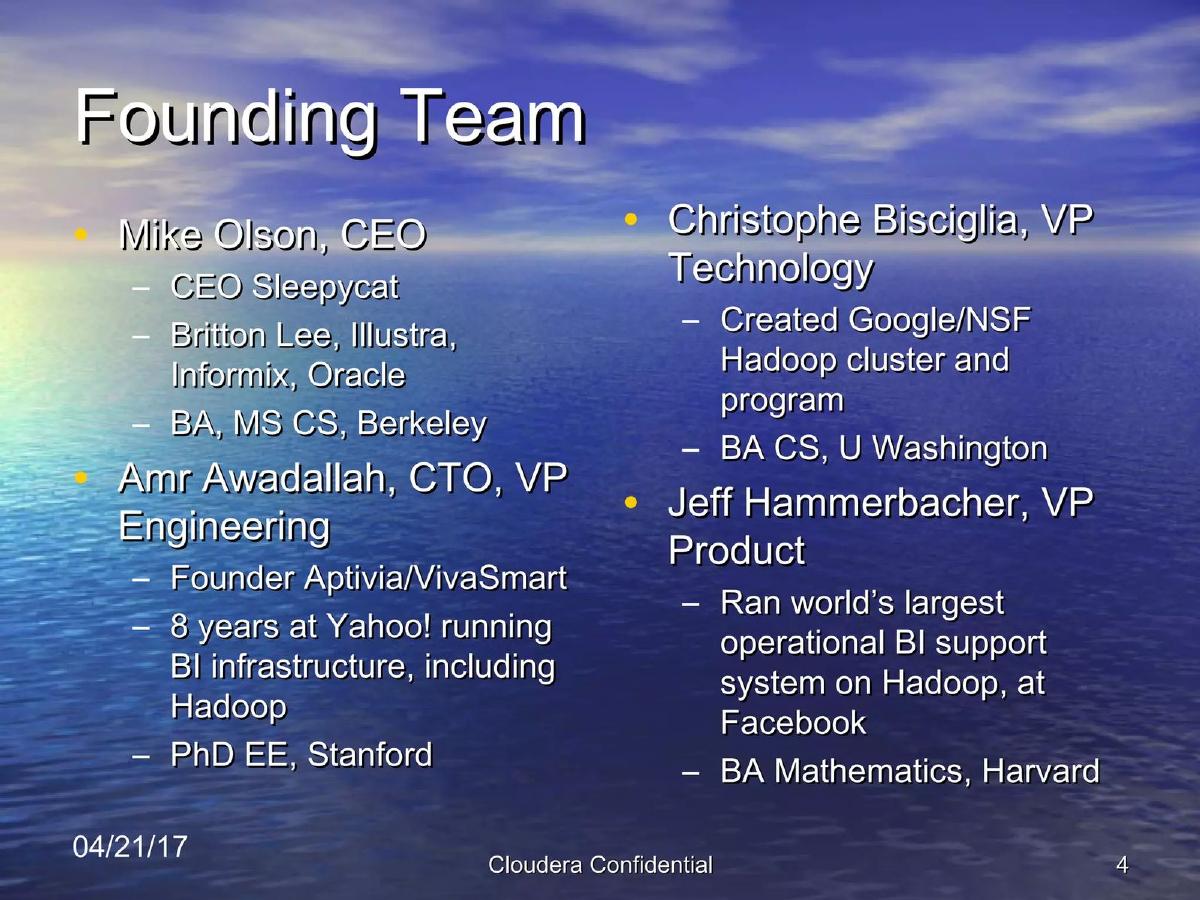
- The founding team is the primary 'trust' signal, featuring leaders from Sleepycat, Google, Yahoo, and Facebook (Slide 4).
- It uses social proof by listing major tech giants like Google, Yahoo, and Facebook as existing Hadoop users to validate the technology (Slide 7).
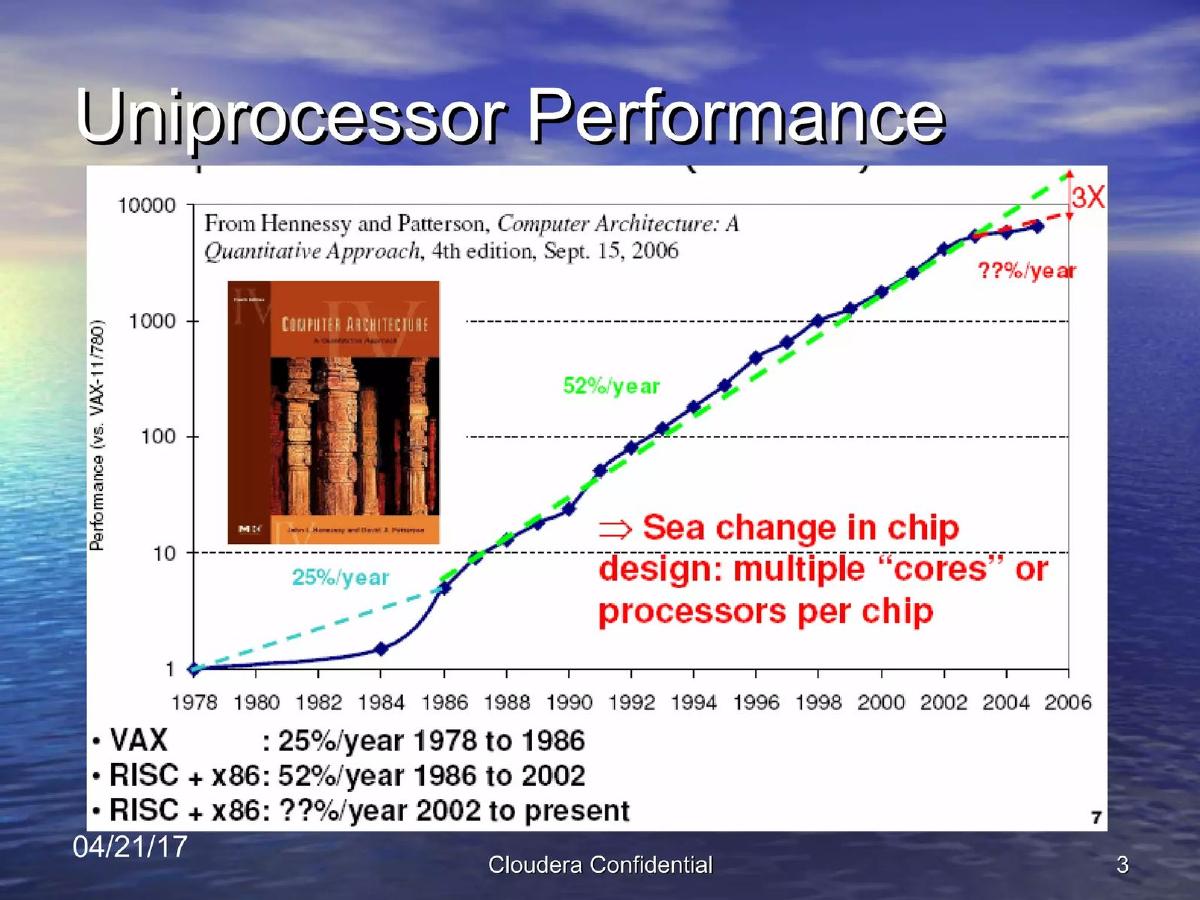
- The deck highlights a 'sea change' in chip design, moving from uniprocessor performance to multi-core processors, necessitating parallel processing (Slide 3).
- It defines the product as a 'Smart Storage Service' that eliminates expensive ETL grids and enables direct data consumption (Slide 12).
- The market opportunity is cited as a $160 billion addressable market based on a 2008 Merrill Lynch report (Slide 14).
- Cloudera differentiates itself by focusing on 'non-sexy' enterprise problems like monitoring, reliability, and connector certification (Slide 15).
- The deck omits a specific 'Ask' slide, financial forecasts, and a detailed breakdown of unit economics.
The 2008 Context: Selling Infrastructure Before the Cloud Boom
Cloudera's Series A deck is a relic from a specific era in Silicon Valley history. In September 2008, the world was on the brink of a financial crisis, but the 'Big Data' movement was just beginning to accelerate. This deck doesn't sell a finished SaaS product with a 20% month-over-month growth rate; it sells an inevitability. The founders were the architects of the data systems at the only companies that actually had 'big' data at the time: Google, Yahoo, and Facebook. The narrative is simple: the rest of the world is about to have the same data problems as Facebook, and we are the only ones who know how to fix them.
Slides 1-3: The Macro Thesis
The deck opens with a clear, albeit visually dated, title slide: "Cloudera: Hadoop for the Enterprise" (Slide 1). It immediately establishes the niche—taking a powerful but difficult-to-use open-source tool and making it palatable for corporate IT departments.
Slide 2 presents the core 'Why Now?' argument. It features a graph showing that the largest data warehouses are growing at a 173% CAGR , while Moore's Law (hardware performance) is lagging behind. This creates a widening gap between the data companies generate and their ability to process it using traditional means. By citing Richard Winter's April 2008 report, they ground their pitch in external research rather than just founder opinion.
Slide 3, titled "Uniprocessor Performance," doubles down on this technical shift. It argues that we have reached a 'sea change' in chip design. Because individual processor speeds are no longer doubling as they once did, the only way to scale is through multiple 'cores' or processors per chip. This necessitates parallel processing—the exact thing Hadoop was built to do. This slide is highly technical, signaling that this is a 'deep tech' investment.
Slide 4: The 'God-Tier' Team Slide
For a Series A, the team slide is often the most important, and Cloudera’s is exceptional. They list four key leaders with specific, high-value pedigrees:
Mike Olson (CEO): Former CEO of Sleepycat (acquired by Oracle). · Amr Awadallah (CTO): 8 years at Yahoo! running BI infrastructure, including Hadoop. · Christophe Bisciglia (VP Tech): Created the Google/NSF Hadoop cluster. · Jeff Hammerbacher (VP Product): Ran the world's largest operational BI support system on Hadoop at Facebook.
This slide effectively tells investors: "We built the infrastructure for the three most important data companies on earth. We are the 'Hadoop' people." In 2008, this level of specific domain expertise was almost impossible to compete with.
Slides 5-6: Defining the Technology
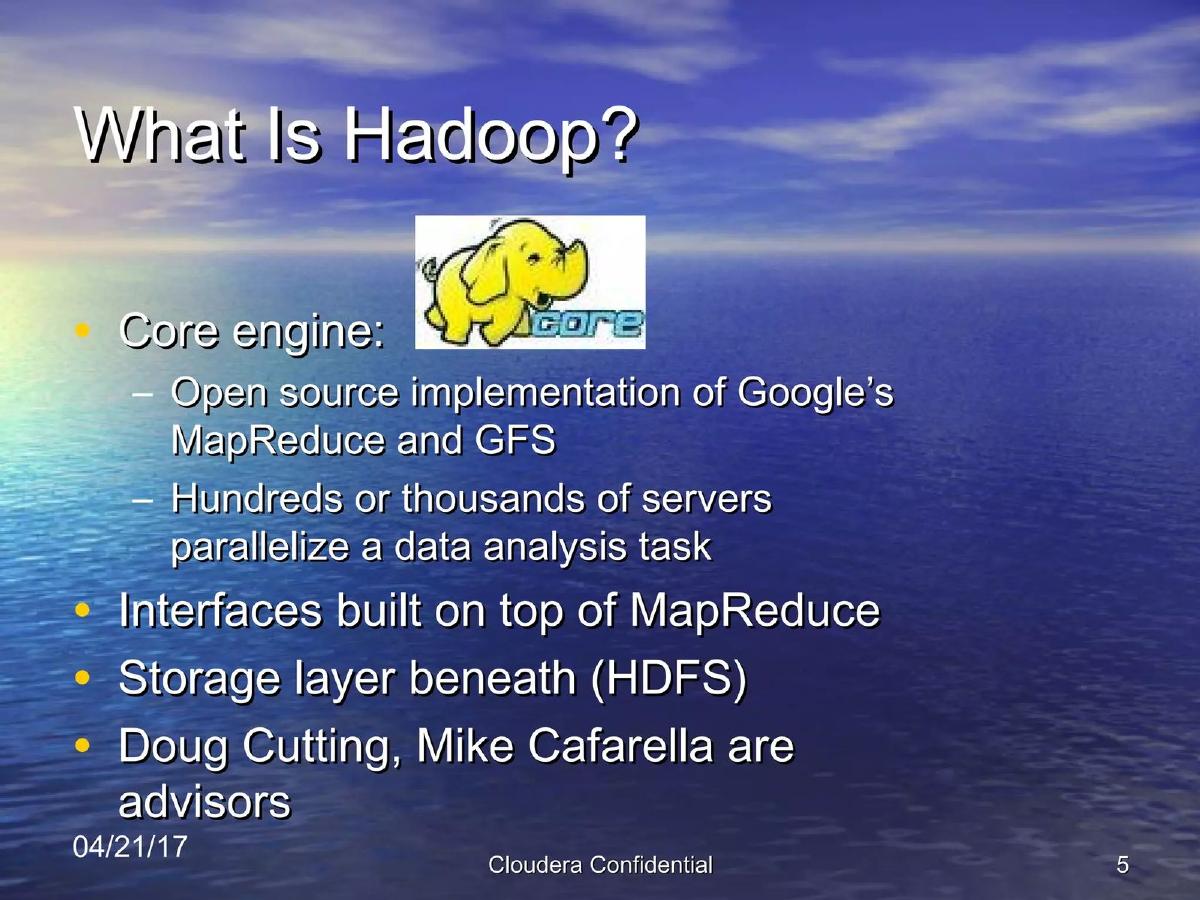
Slide 5 answers the question "What Is Hadoop?" for investors who might not be familiar with the Apache project. It describes it as an open-source implementation of Google's MapReduce and GFS, capable of parallelizing tasks across thousands of servers. Crucially, it mentions that Doug Cutting (the creator of Hadoop) is an advisor, further cementing their ties to the project's roots.
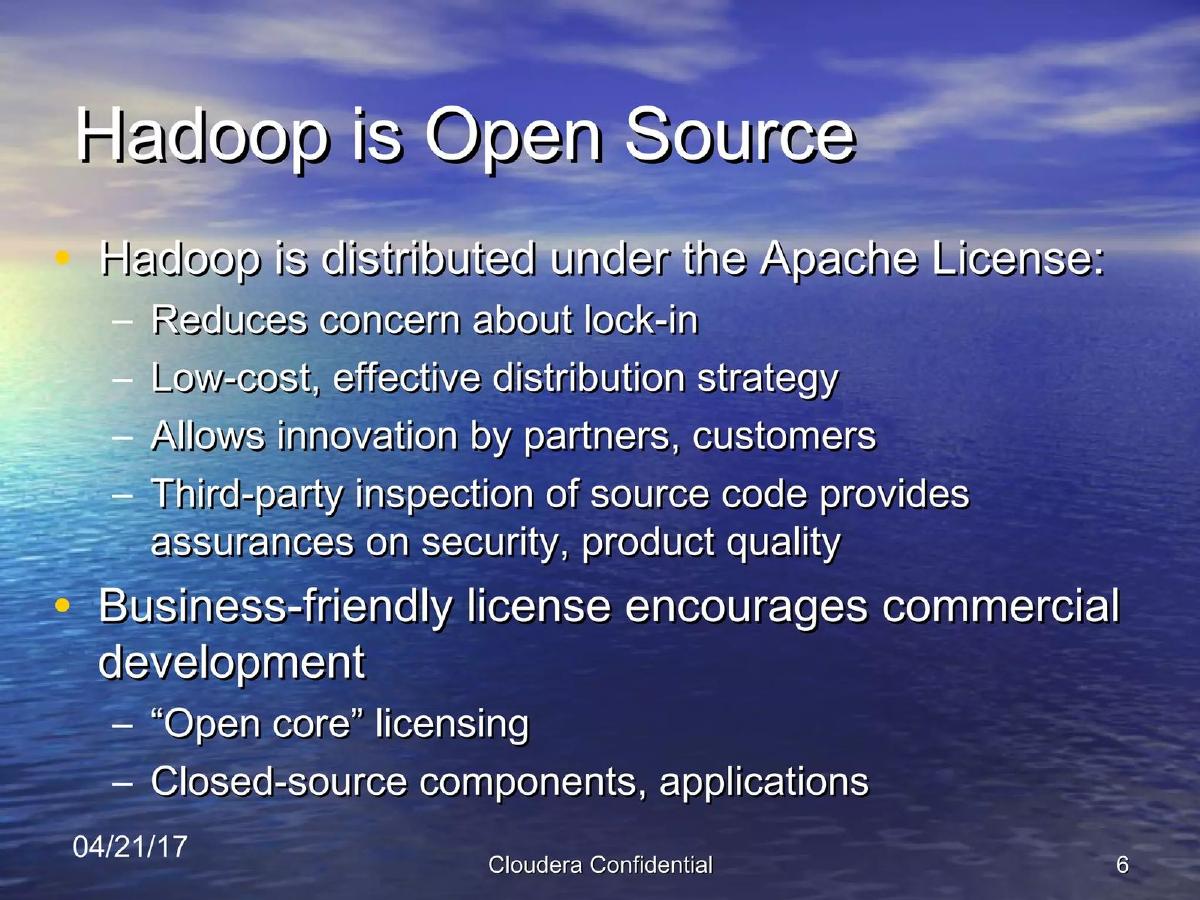
Slide 6 addresses the "Open Source" nature of the business. It explains that the Apache License reduces concerns about vendor lock-in and allows for a "low-cost, effective distribution strategy." They explicitly mention an "Open core" licensing model, which would become the standard for successful open-source companies like MongoDB and Confluent. This slide is vital because it explains how they will make money: by providing closed-source components and applications on top of the free core.
Slides 7-10: Market Validation and Momentum
Slide 7 is a classic 'logo slide' titled "Hadoop Users." It features Google, Yahoo!, Facebook, eBay, The New York Times, and Intel. This proves that Hadoop isn't a science project; it is already running the world's most sophisticated digital operations.
Slide 8 uses Google Trends to show momentum. It compares 'Hadoop' to established competitors like Teradata and Netezza. While Teradata had significantly more search volume at the time, the trend line for Hadoop was clearly upward. The slide also notes the massive revenues of these competitors ( Teradata: $1.7B in FY07 ), suggesting that Cloudera is chasing a very large, established market.
Slide 9 shows a "Worldwide Phenomenon" map, indicating that interest in Hadoop is global, further validating the scale of the opportunity. Slide 10 summarizes "Why is Hadoop Successful?" by highlighting its ability to handle unstructured data and its 'prescriptive development' model that grows with the user without needing a re-architecture.
Slides 11-13: The Solution and Architecture
Slide 11 illustrates the "Current Systems" problem. It shows a fragmented architecture where 'Expensive ETL Grids' act as bottlenecks, isolating users from raw data. The diagram uses red 'X' marks to show 'Non-Consumption'—data that is collected but cannot be queried or mined because the system is too slow or expensive.
Slide 12 presents the "Solution: 'Smart' Storage Service." By replacing the fragmented layers with a unified 'Smart Storage' grid for file storage and data processing, Cloudera claims to "Eliminate Expensive ETL Grids" and "Enable Consumption." This is the 'aha' moment for the product: it simplifies the stack and unlocks the value of the data.
Slide 13 is a complex radar chart comparing "BDP (Batch Data Processing) versus OLAP/OLTP." It maps various technical requirements like 'Schema Complexity,' 'Total Data Volume,' and 'Responsiveness.' The chart visually demonstrates that while traditional databases (OLAP/OLTP) are good for interactive, structured data, Hadoop (BDP) dominates in volume, schema complexity, and per-job data volume. It defines the 'territory' Cloudera intends to own.
Slides 14-15: Market Size and Differentiators
Slide 14, "The Cloud Wars," cites a Merrill Lynch report from May 2008. It highlights a "$160bn addressable market opportunity," including $95 billion in business and productivity apps. This slide places Cloudera within the broader 'Cloud' shift, which was the dominant investment theme of the time.
The final slide (Slide 15), "Cloudera Differentiators," lists what the company actually builds. They aren't just selling Hadoop; they are selling "Multi-Tenant Support," "Monitoring, Reliability, and Availability," and "Connector certification." They call these "non-sexy problems," which is a sophisticated way of telling investors that they are building the 'boring' enterprise features that companies are actually willing to pay for.
What Works in This Deck
The Pedigree: The team slide is the strongest part of the deck. In infrastructure software, the 'who' is often more important than the 'what' at the Series A stage. The founders' direct experience at Google and Facebook provided instant credibility.
The Macro Narrative: The deck does a great job of framing the problem as an inevitable consequence of data growth and hardware limitations. It makes the investment feel like a bet on a fundamental shift in computing rather than just a specific software tool.
Social Proof: By showing that the world's most successful tech companies were already using Hadoop, they removed the 'technology risk' from the equation. The question wasn't "Does this work?" but rather "Can we sell this to everyone else?"
What Is Missing
The Financials: There are no revenue projections, no pricing models, and no unit economics. While this was common for high-end Series A rounds in 2008, a modern deck would be expected to show at least a basic path to monetization.
The Go-To-Market (GTM) Strategy: The deck explains what they will sell (enterprise features) but not how they will sell it. Will they use a top-down sales force? A bottom-up developer motion? The deck is silent on the mechanics of the business.
The Ask: There is no slide stating how much money they are raising, what the valuation expectations are, or how the funds will be allocated. This information was likely handled in the verbal pitch or a separate document, but its absence makes the deck feel incomplete as a standalone fundraising tool.
What a Founder Should Copy
Use Third-Party Validation: Cloudera used Merrill Lynch reports, Google Trends, and Richard Winter's research to validate their market. Founders should always look for external data to prove their 'Why Now?' argument.
Focus on 'Non-Sexy' Problems: Investors love hearing that a team is focused on the difficult, unglamorous parts of a solution (like reliability and certification). It shows a maturity and an understanding of what enterprise customers actually care about.
Define the 'Sea Change': If you are building in a new category, you must explain the fundamental shift that makes your product necessary. Cloudera’s explanation of the shift from uniprocessors to multi-core chips is a perfect example of this.
Conclusion: Cloudera's deck is a masterclass in 'Founder-Market Fit.' It successfully argued that a massive technical shift was occurring and that they were the only team with the scars and the expertise to lead the enterprise through it. While it lacks the polish and financial detail of modern decks, its core narrative was powerful enough to secure $5M and kickstart a company that would eventually raise over $1B.
Frequently asked questions
- What was the primary problem Cloudera aimed to solve in 2008?
- Cloudera targeted the 'data explosion' where user data was growing at a 173% CAGR, far exceeding the growth of hardware performance (Moore's Law). Traditional data warehouses were becoming too expensive and slow to handle this volume. Cloudera proposed using Hadoop to bring computation closer to the data, allowing for massive scalability that traditional systems couldn't match.
- How did the founders use their backgrounds to secure the Series A?
- The team was exceptionally well-positioned. CEO Mike Olson had been CEO of Sleepycat; CTO Amr Awadallah ran BI infrastructure at Yahoo; Christophe Bisciglia created the Google/NSF Hadoop cluster; and Jeff Hammerbacher ran the world's largest BI system on Hadoop at Facebook. This 'insider' status proved they understood the technology better than anyone else.
- Why did the deck focus so much on Hadoop being open source?
- By emphasizing the Apache License, Cloudera addressed enterprise fears of vendor lock-in. They argued that open source allows for a low-cost distribution strategy and third-party inspection for security. This positioned Cloudera as an 'open core' provider, selling proprietary enterprise features on top of a trusted, community-vetted foundation.
- What was the 'Smart Storage Service' mentioned in the deck?
- This was Cloudera's way of re-imagining the data stack. Instead of expensive, siloed ETL (Extract, Transform, Load) grids that isolated users from raw data, the 'Smart Storage' layer allowed for direct data processing and mining. It aimed to simplify the architecture by making the storage layer itself capable of handling complex queries.
- What is missing from this deck that a modern founder should include?
- The deck lacks a clear 'Ask' (how much money they want and for what), a detailed go-to-market strategy, and financial projections. In 2008, for a team of this caliber, the technical vision and market tailwinds were enough. Today, investors would expect more detail on customer acquisition costs and specific revenue milestones.