Sqoop’s 2013 seed deck is a textbook example of leading with traction to overcome a niche market perception. With only 9 slides, the presentation focuses heavily on user acquisition and engagement, specifically highlighting 2,516 registered reporters and a staggering 80% Weekly Active User (WAU) rate. The deck successfully positions a tool for journalists as a gateway to a $10 billion PR market, using a simple 'before and after' visualization to explain their disruption of traditional PR outreach. While the deck lacks a formal 'Ask' slide or detailed financial projections, the strength of its…
Key takeaways
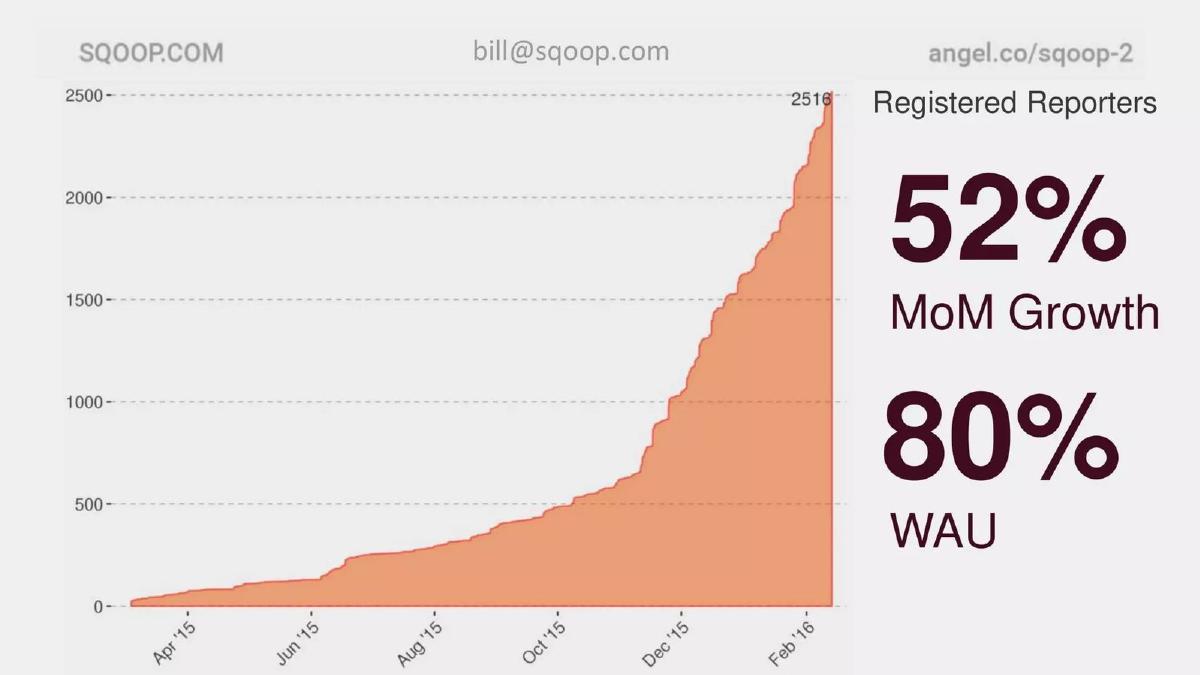
- The deck leads immediately with a traction chart showing a climb to 2,516 registered reporters by February 2016 (Slide 2).
- Engagement is a core highlight, with the company reporting an 80% Weekly Active User (WAU) metric (Slide 2).
- Social proof is used early, featuring a tweet from a GeekWire reporter crediting Sqoop for breaking a Yahoo-Google news story (Slide 3).
- Market penetration is quantified as 1 in 3 business reporters using the platform (Slide 4).
- The business model pivots from journalism to the $10B+ PR market, targeting 400,000 businesses (Slide 5).
- The product value proposition is framed as a 'less expensive, more effective' alternative to traditional media databases and cold emails (Slide 7).
- Founder pedigree is established through previous roles at high-profile firms like AOL, Thomson Reuters, Microsoft, and RealNetworks (Slide 8).
- The deck omits a specific funding 'Ask' and detailed unit economics, relying instead on growth velocity (Slide 9).
The Power of Traction: Analyzing Sqoop's Seed Deck
Sqoop’s pitch deck is a lean, 9-slide presentation that prioritizes data over fluff. In the world of seed fundraising, founders often get bogged down in theoretical problems. Sqoop took the opposite approach: they built a tool, achieved significant market penetration, and then used the resulting data to tell a story of inevitable success. This teardown examines how they leveraged a 52% MoM growth rate to secure $276,000 in 2013.
The Opening: Traction and Social Proof (Slides 1-3)
Slide 1: Title The cover slide is minimalist, featuring a high-resolution image of a newsroom with the tagline 'The news discovery network.' It immediately establishes the industry context. Bill Hankes is identified as the Founder & CEO, providing his contact information and Twitter handle.
Slide 2: Traction Sqoop makes a bold move by placing its traction slide second. This is a tactic usually reserved for companies with undeniable numbers. The slide shows an area chart of 'Registered Reporters' starting near zero in April '15 and skyrocketing to 2,516 by February '16. To the right, two massive data points dominate the slide: '52% MoM Growth' and '80% WAU' (Weekly Active Users). The 80% WAU is particularly impressive, as it suggests the tool has become a daily or weekly necessity for its users.
Slide 3: Validation To prove the utility of the platform, Slide 3 features a tweet from Todd Bishop of GeekWire. The quote, 'We got the jump on the Yahoo-Google news today because of this great service we use, Sqoop,' provides a concrete use case. It moves the conversation from 'people are signing up' to 'people are winning because of this tool.'
Market Penetration and Opportunity (Slides 4-5)
Slide 4: Market Share This slide uses a background collage of major media logos (The New York Times, Bloomberg, ESPN, etc.) with the central text: '1 in 3 business reporters use Sqoop.' This is a powerful 'denominator' slide. It tells investors that Sqoop isn't just a tool for a few bloggers; it has captured a significant percentage of the professional workforce in its niche.
Slide 5: The Pivot to Revenue Having established that they own the attention of journalists, Slide 5 introduces the monetization strategy. It identifies 'The PR Market' as a '$10 B+' opportunity involving 400,000 businesses. This slide is crucial because it answers the 'So what?' question. While journalists use the tool for free, the value lies in the access those journalists provide to the PR industry.
The Solution and Value Proposition (Slides 6-7)
Slide 6: The 'Us vs. Them' Visual This slide is a classic comparison graphic. On the left, 'YOU' (the business) are shown struggling with a tangled web of PR agencies, cold emails, press releases, and databases to reach a few reporters. On the right, the Sqoop model is shown as a straight line: 'YOU -> SQOOP -> REPORTERS.' It visualizes the removal of friction and the consolidation of a fragmented process.
Slide 7: The Value Prop Slide 7 distills the company's essence into a single sentence: 'Sqoop: A less expensive, more effective way to reach highly engaged reporters.' It reinforces the messaging from the previous slide, focusing on cost-efficiency and engagement quality.
The Team and The Close (Slides 8-9)
Slide 8: Team The team slide features CTO David Kellum and CEO Bill Hankes. Rather than long bios, they use recognizable logos to establish credibility: AOL, Thomson Reuters, Evri, RealNetworks, Microsoft, and The Ledger. This tells the investor that the founders have deep roots in both the technical side of search/data and the business side of media and PR.
Slide 9: Conclusion The final slide repeats the traction chart from Slide 2 but with a darker color scheme. It reiterates the '52% MoM growth' and provides the CEO's email address again. Notably, there is no 'Ask' slide here—no mention of the dollar amount being raised or the valuation. This suggests the deck was used as a teaser or a supporting visual for a verbal pitch where the 'Ask' would be handled dynamically.
What Works in This Deck
Extreme Focus on Engagement: The 80% WAU metric is the strongest part of the deck. It proves the product is 'sticky' and essential to the user's workflow. · Visual Simplicity: There is almost no body text in this deck. It relies on large numbers, logos, and simple diagrams, making it very easy to digest in a 2-minute review. · Logical Flow: The deck follows a clear path: We have users (Slide 2) -> They love us (Slide 3) -> We are dominant (Slide 4) -> There is a big market (Slide 5) -> We are the better way (Slide 6) -> We are the right team (Slide 8).
What is Missing
The Business Model: While they identify the $10B PR market, they don't explain how they charge. Is it a subscription? A per-message fee? A freemium model? · The Ask: As mentioned, the lack of a funding slide is a major omission for a standalone deck. An investor needs to know what the capital will be used for (e.g., 'Raising $500k to hire 2 engineers and scale to 5,000 reporters'). · Competition: There is no mention of Cision, Meltwater, or other established media database giants. Investors would want to know how Sqoop defends its position against these incumbents. · Unit Economics: There is no data on Customer Acquisition Cost (CAC) or Lifetime Value (LTV), which are critical for evaluating the scalability of the 52% MoM growth.
What a Founder Should Copy
The '1 in X' Metric: If you have high penetration in a specific niche, use the '1 in 3' or '1 in 4' phrasing. It is much more memorable than a raw user count. · The Tweet as Social Proof: Using a screenshot of a real user's tweet is more authentic and persuasive than a polished, anonymous testimonial. · Logo Credibility: If your team has worked at major firms, use the logos. They act as a visual shorthand for 'these people are professionals.' · Leading with Traction: If your growth curve looks like Slide 2, don't hide it at the end. Put it upfront to immediately grab the investor's attention and set a positive tone for the rest of the pitch.
Frequently asked questions
- How did Sqoop demonstrate product-market fit in such a short deck?
- Sqoop used two high-impact metrics: a 52% month-over-month growth rate and an 80% Weekly Active User (WAU) rate. By showing that 1 in 3 business reporters already used the service, they proved that the product was essential to its target demographic's workflow. This level of engagement is rare for seed-stage startups and served as the primary evidence of fit.
- What was the primary revenue strategy presented in the deck?
- While the product serves journalists, the revenue strategy targets the PR market. Slide 5 identifies a $10B+ market consisting of 400,000 businesses. The deck suggests that by owning the platform where journalists discover news, Sqoop can offer businesses a more direct and cost-effective way to reach those reporters compared to traditional PR agencies and cold emailing.
- Why is the team slide positioned near the end of the deck?
- Positioning the team slide at the end (Slide 8) acts as a 'closer.' After showing explosive growth and a massive market opportunity, the founders reveal their backgrounds at Microsoft, AOL, and Thomson Reuters to prove they have the domain expertise to execute. It validates the traction shown in the earlier slides.
- What are the most notable omissions in this pitch deck?
- The deck lacks a formal 'Ask' slide detailing how much capital is being raised and how it will be spent. It also omits a detailed business model (pricing tiers), a competitive landscape matrix, and long-term financial projections. It is a 'traction deck' designed to generate interest based on current momentum rather than a full business plan.
- How does the deck handle the 'Problem/Solution' narrative?
- Instead of a traditional problem slide, Sqoop uses Slide 6 to visualize the 'chaos' of current PR methods (cold emails, databases, agencies) versus the 'simplicity' of the Sqoop network. This 'Us vs. Them' visual effectively communicates the solution without needing heavy text, focusing on efficiency and direct access.