Sports Reels presents a platform designed to solve the 'struggle' of African athletes who lack professional-grade statistics and video highlights to attract scouts. The deck, built on a scrap-book aesthetic, emphasizes a three-part solution: licensed scout verification, a social environment for skill-sharing, and AI-backed video analytics. While the founder’s personal narrative provides a compelling 'why,' the deck suffers from a lack of concrete business fundamentals. With only 60 users since a June 2022 beta launch, the traction is minimal, and the market sizing slides offer large, unsubsta…
Key takeaways
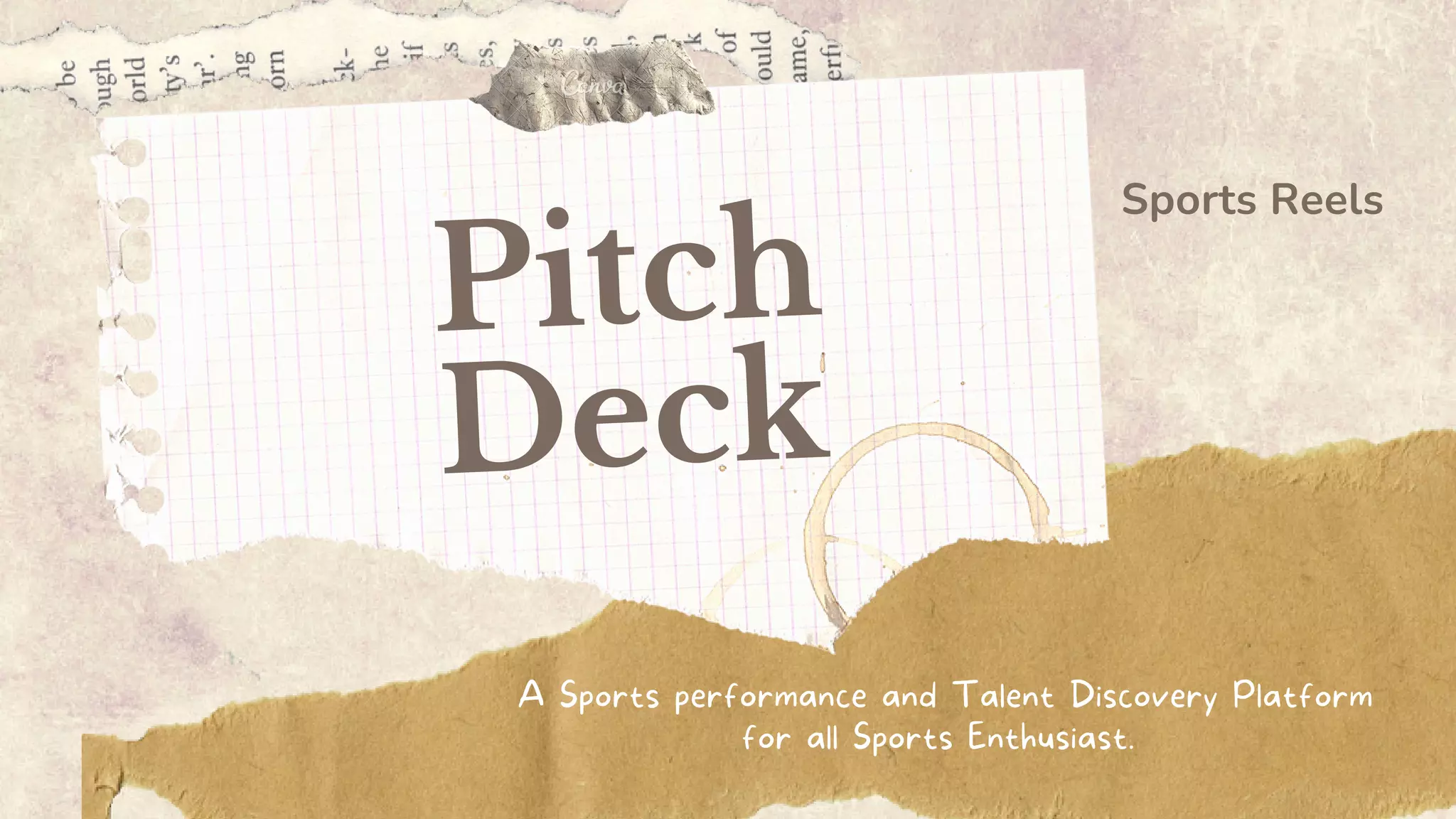
- The platform targets 'Sports Enthusiasts' with a focus on talent discovery and performance analytics (Slide 1).
- The solution relies on verifying scouts via license numbers tied to specific sports federations to ensure platform integrity (Slide 2).
- The founder's motivation stems from a personal failure to 'go pro from Africa in 2010' due to a lack of data and video (Slide 3).
- Product development has followed a long timeline, starting with the initial idea in 2010 and reaching a third step in 2023 (Slide 3).
- Current traction is low, reporting only '60 Users' since the June 2022 beta launch (Slide 4).
- The deck claims a target of '96,000+ Personas' based on social media data, though the conversion strategy is not detailed (Slide 4).
- Market sizing is presented as 1.9 Billion (TAM), 553 M (SAM), and 310.6M (SOM) without units or geographic definitions (Slide 5).
- The deck completely omits a business model, competitor analysis, team biographies, and a financial 'ask' (Slides 1-6).
Executive Summary: A Narrative-Driven Early Stage Pitch
Sports Reels 01 presents a pitch deck that is heavily rooted in the founder's personal experience and a clear 'problem-solution' framework. The deck uses a textured, scrap-book aesthetic that stands out visually but often lacks the professional rigor expected in high-stakes fundraising. While the mission—empowering African athletes through data—is clear, the execution of the deck leaves significant gaps in market validation and business mechanics.
Slide 1: Title and Vision
The cover slide introduces the company as 'Sports Reels.' It defines the product as 'A Sports performance and Talent Discovery Platform for all Sports Enthusiast.' The use of the singular 'Enthusiast' and the broad scope of 'all sports' suggests a wide-reaching ambition, though the subsequent slides narrow this focus significantly toward the African market and professional scouting.
Slide 2: The Utopia (The Solution)
This slide outlines three core pillars of the product. Solution 1 focuses on trust, proposing a 'Streamlined Search of Licensed Scouts' using 'License Number tied to their Sports/Federation.' This addresses a common pain point in sports recruitment: predatory or fake agents. Solution 2 describes a 'Social Environment' where athletes showcase skills via 'Statistics backed videos.' Solution 3 introduces the technical edge, claiming 'AI BACKED Analytical Recorded videos' for both game days and training to 'improve Athletic performance.' The slide uses a checklist format but does not show the actual interface or how the AI functions.
Slide 3: Birth of Product or Service (Origin Story)
This is the strongest narrative element of the deck. The founder explicitly states the motivation: 'After Trying to go pro from Africa in 2010, Having no Proper Statistics or Visually Appealing Videos of my Struggle, I was determined to aid other young Africans.' This provides a clear 'Founder-Market Fit.' The slide also includes a timeline: Step 1 (2010) , Step 2 (2019) , and Step 3 (2023) . This suggests a long gestation period for the idea, though it does not clarify what occurred during the nine-year gap between 2010 and 2019.
Slide 4: Traction and User Research
Slide 4 provides the first glimpse into the company's current scale. It states, 'We Currently Have 60 Users after Social Media Ads and Word of Mouth since Beta Launch in June 2022.' For a platform that launched its beta over a year prior to the 'Step 3' date of 2023, 60 users is a very low figure. The slide also includes a pie chart for 'User Research' broken down into: User Research (40%) , Structure (30%) , Development (20%) , and Marketing (10%) . It is unclear if these percentages represent budget allocation, time spent, or something else. Finally, it mentions a 'Target of 96,000+ Personas from Social Media data,' which functions as a top-of-funnel projection rather than actual traction.
Slide 5: Size the Market
The market sizing slide uses the standard TAM/SAM/SOM model but lacks critical context. The figures provided are: 1.9 Billion (Total Available Market) , 553 M (Serviceable Available Market) , and 310.6M (Serviceable Obtainable Market) . The deck does not specify the currency (presumably USD, but not stated) nor does it explain the source of these numbers. In a global sports context, 1.9 billion could refer to the number of fans, but for a talent discovery platform, the relevant metric should be the number of aspiring professional athletes or the total spend on recruitment and scouting.
Slide 6: Contact Us
The final slide provides contact information, including a Gmail address ('officialsportsreels@gmail.com'), a Nigerian mobile number ('+234(0)9033361870'), and a website ('www.sportsreels.io'). The use of a Gmail address rather than a custom domain email can sometimes be a red flag for institutional investors, suggesting a lack of formal infrastructure.
What Works
Authentic Problem Identification: The founder’s personal story (Slide 3) is a compelling way to illustrate the problem. Investors often look for founders who have lived the problem they are trying to solve. By identifying the lack of 'visually appealing videos' and 'proper statistics' as the primary barriers for African athletes, the deck creates a clear niche.
Feature Clarity: The 'Utopia' slide (Slide 2) does a good job of breaking down the platform into three distinct value propositions. It moves beyond just 'video' to include verification (scouts) and analytics (AI), which suggests a more robust ecosystem than a simple social media clone.
What Is Missing
The Team Slide: This is the most glaring omission. In early-stage investing, the team is often more important than the idea. There is no information about the founder's professional background, technical capabilities, or any advisors involved in the project.
Business Model: The deck never explains how Sports Reels intends to make money. Will athletes pay a subscription? Will scouts pay for access to the database? Is there a commission on successful placements? Without a revenue model, this looks more like a community project than a scalable startup.
The Ask: A pitch deck is a tool for fundraising, yet this deck does not state how much money is being raised, the valuation, or the specific milestones the funding will help achieve. An investor finishing this deck has no idea what the 'next step' is supposed to be.
Competitive Landscape: The sports tech and talent discovery space is crowded with players like Hudl, Wyscout, and various social platforms. Sports Reels does not mention any competitors or explain why their specific focus on the African market provides a defensible moat.
Founder Recommendations
Define the Market Metrics: The market sizing slide (Slide 5) needs to be grounded in reality. Founders should explain exactly what '1.9 Billion' represents. Is it people? Dollars? If it's dollars, what is the source? If it's people, how does that translate into a revenue opportunity?
Professionalize the Infrastructure: Moving from a Gmail address to a professional domain email (e.g., name@sportsreels.io) is a small but necessary step to signal that the company is a serious entity. Similarly, the 'User Research' pie chart on Slide 4 needs a clearer legend to explain what the percentages actually measure.
Show, Don't Just Tell, the AI: Since 'AI BACKED' analytics is a core solution (Slide 2), the deck would benefit from a screenshot or a visualization of what that analysis looks like. Showing a heat map or a data overlay on a video would be far more convincing than a bullet point.
Address the Low Traction: Having 60 users after a year in beta (Slide 4) is a difficult data point to defend without context. The founder should explain if this was a closed pilot, what the engagement rates were among those 60 users, or what specific 'Word of Mouth' feedback led to the 2023 product iteration.
Frequently asked questions
- What is the primary problem Sports Reels is trying to solve?
- According to Slide 3, the problem is the lack of 'Proper Statistics or Visually Appealing Videos' for young African athletes. This deficiency prevents them from successfully transitioning to professional levels. The platform intends to provide the 'Sports Visualization and Analytical Representation' necessary to bridge this gap between talent and scouts.
- How does the platform plan to verify scouts?
- Slide 2 outlines 'Solution 1,' which is to 'Enforce a Streamlined Search of Licensed Scouts.' The platform intends to do this by requiring scouts to provide a 'License Number tied to their Sports/Federation.' This is presented as a security and quality control measure to protect athletes on the platform.
- What is the current state of user growth for Sports Reels?
- Traction is currently in the very early stages. Slide 4 states that the company has '60 Users' following a beta launch in June 2022. These users were acquired through 'Social Media Ads and Word of Mouth.' The slide also mentions a target of '96,000+ Personas,' but does not provide a timeline for reaching this goal.
- What technology does Sports Reels claim to use?
- Slide 2 mentions 'Solution 3,' which involves 'AI BACKED Analytical Recorded videos.' The goal of this technology is to analyze game day or training footage to 'improve Athletic performance.' The deck does not specify if this AI is proprietary or an integrated third-party tool.
- What essential information is missing from this pitch deck?
- The deck is missing several critical components required for a professional fundraise. There is no 'Team' slide to verify founder expertise, no 'Business Model' slide to explain how the company makes money, no 'Competition' slide, and no 'Ask' slide detailing how much capital is being raised and how it will be spent.