Sqeeqee’s 2016 pitch deck presents a platform that blends social networking with commerce, which the company terms 'social networthing.' The deck emphasizes a significant user base of over 250,000 acquired since its 2015 launch and a history of $5 million in funding raised between 2010 and 2016. While the team slide showcases experienced leadership in finance and intellectual property, the product itself attempts to compete across nearly a dozen distinct digital sectors simultaneously—from e-commerce and crowdfunding to cloud storage and gaming. The deck lacks specific unit economics, a clear…
Key takeaways
- The company claims to have invented 'social networthing,' defined as a tool for monetizing online engagement (Slide 2).
- Sqeeqee reported acquiring over 250,000 users between its January 2015 launch and the time of the deck's creation (Slide 2).
- The platform targets a specific demographic of 65 million social media users aged 25 to 45 (Slide 2).
- The marketing strategy is exceptionally broad, listing 20 different online and offline channels including SmartTV ads and public speaking (Slide 3).
- A detailed timeline shows the company originated in 2010 and raised $5 million in funding prior to 2016 (Slide 4).
- The leadership team is heavily weighted toward legal and IP expertise, with two of the four named members serving as IP and General Counsel (Slide 5).
- The CTO and CMO positions are listed as placeholders with generic descriptions rather than specific names (Slide 5).
- The competitive analysis compares Sqeeqee to 11 different categories of services, including giants like Amazon, YouTube, and LinkedIn (Slide 6).
Slide-by-Slide Analysis
Slide 1: Title and Confidentiality
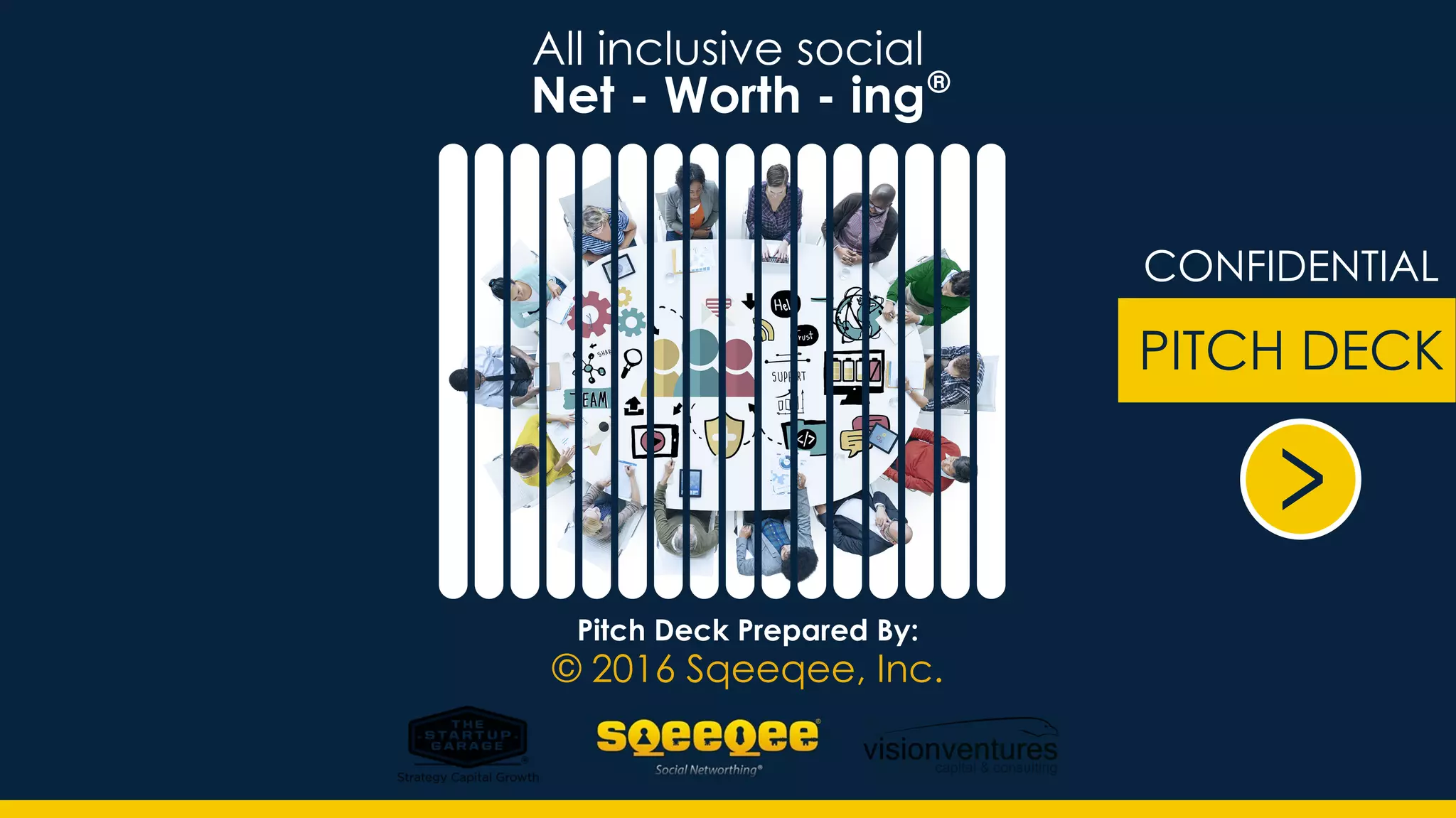
The cover slide introduces the brand name Sqeeqee and its registered trademarked tagline: "All inclusive social Net - Worth - ing." The design is dark blue with a central graphic of a diverse team working around a table filled with digital icons (gears, clouds, lightbulbs, and social symbols). It clearly states "CONFIDENTIAL PITCH DECK" and notes that the deck was prepared by Sqeeqee, Inc. in 2016. Logos for "The Startup Garage" and "Vision Ventures" appear at the bottom, suggesting third-party advisory or consulting involvement in the deck's preparation.
Slide 2: What Is Sqeeqee? and The Opportunity
This slide serves as the executive summary. It defines the company as an evolution in social networking aimed at generating revenue for users. Key claims include the invention of "social networthing," the possession of multiple provisional patents, and a user milestone of over 250,000 acquired since the full site launch in January 2015. The bottom half of the slide addresses market size, citing a Total Addressable Market (TAM) of 2 billion active social media accounts globally and a specific target market of 65 million users aged 25-45. The focus here is on the scale of the social media landscape rather than a specific niche.
Slide 3: Marketing Strategy
Slide 3 presents a dense grid of marketing channels divided into online and offline categories. The online section includes 16 different tactics, ranging from standard SEO and Email Marketing to more specific items like Infographics, Competitions, and Mobile Applications. The offline section lists SMS Messaging, Public Speaking, SmartTV/Gaming Console Ads, and Print/TV Ads. This slide demonstrates an intent to be everywhere at once, though it lacks a prioritized "go-to-market" focus or a discussion of Customer Acquisition Cost (CAC).
Slide 4: Milestones Timeline
This slide provides a historical context for the company, showing a long gestation period. The timeline begins in 2010 with the founder's vision. Key dates include July 2011 (incorporation as "spoopad"), July 2012 (name change to Sqeeqee and alpha launch), and January 2015 (full website launch). It notes that the platform reached 50,000 users in January 2015 and surpassed 200,000 users by June 2015. Crucially, it mentions that $5 million in funding was raised between 2010 and 2016. The timeline ends in January 2016 with the launch of VCNetwork.Co.
Slide 5: Key Management Overview
The team slide highlights four named individuals and two placeholders. CEO Jenny Q. Ta is presented as a seasoned entrepreneur with two exits and experience in investment firms. Shinta Witoyo Dhanuwardoyo (President) is described as a digital pioneer in Indonesia. A significant portion of the named team is dedicated to legal matters: Michael Trenholm and James Italia are both listed as IP & General Counsel. The CTO and CMO positions are represented by icons and generic descriptions ("Leading software developer," "Experienced in strategic execution"), indicating that these key executive roles were either vacant or in the process of being filled at the time of the pitch.
Slide 6: Appendix: Competitive Analysis
The final slide in this set is a massive competitive matrix. Sqeeqee compares itself to 11 different categories of digital services. It positions itself as having "High" site quality and "Extensive" content variety, similar to giants like Facebook and Amazon. Interestingly, it admits to "low" reach compared to the "extensive" reach of established players. The slide attempts to show that Sqeeqee is a "social commercial retail catch-all," combining features that are otherwise fragmented across companies like Yelp, Kickstarter, Box, and LinkedIn. The price for all services is listed as "Free," except for Cloud Storage, which is "Free to Moderate."
What Sqeeqee Does Well
Clear Branding of a New Category: The company leans heavily into the term "Social Networthing." By trademarking the phrase and repeating it throughout the deck, they attempt to own a specific sub-sector of social media. This is a classic strategy to differentiate a startup from incumbent giants like Facebook or LinkedIn.
Transparency on History: The milestones slide (Slide 4) is unusually detailed. It doesn't hide the fact that the company took five years to go from vision to a full website launch. It also explicitly states the amount of capital previously raised ($5 million), which provides investors with a clear picture of the company's capital intensity and development pace.
IP Focus: By including two IP attorneys on the management slide and highlighting provisional patents on the summary slide, Sqeeqee signals to investors that they are building a defensive moat around their "networthing" concept. In a crowded social media space, protecting the "how" of monetization is a logical priority.
What Is Missing from the Sqeeqee Deck
Revenue Model Specifics: While the deck repeatedly mentions "generating revenue for users," it never explains how the company itself makes money. There is no mention of advertising splits, transaction fees, subscription tiers, or data licensing. For a company focused on "net worth," the lack of a business model is a significant omission.
Product Visuals: The deck contains no screenshots of the actual platform. For a social network that claims to be a "bold evolution," seeing the user interface is critical. Investors need to see how these disparate features (e-commerce, gaming, cloud storage) are integrated into a single user experience.
The "Ask": The provided slides do not include a funding request. There is no mention of how much capital is being sought, the valuation, or the specific use of proceeds. Without an ask, the deck functions more as a company profile than a fundraising tool.
Named Technical Leadership: Having a placeholder for a CTO in a technology-heavy startup is a red flag for many investors. Given the complexity of the features listed in the competitive analysis (live streaming, cloud storage, e-commerce), the absence of a named technical lead suggests a reliance on outsourced development or a gap in the core team.
Founder's Guide: Lessons to Take Away
Avoid the "Everything Store" Trap: Sqeeqee’s competitive analysis (Slide 6) shows them competing with Amazon, YouTube, LinkedIn, and Dropbox simultaneously. For a startup, this is often perceived as a lack of focus. Founders should generally pick one primary wedge to enter the market rather than claiming to be a superior version of ten different billion-dollar industries at once.
Use Placeholders Sparingly: If you must use a placeholder for a key role like CTO or CMO, ensure the rest of the team has the technical or marketing depth to cover that gap in the interim. In Sqeeqee's case, the named team was heavily weighted toward finance and law, leaving the execution of the actual product and growth strategy in question.
Define Your Terms: If you invent a term like "Social Networthing," you must define it immediately and clearly. Sqeeqee does this well on Slide 2, ensuring the investor understands the core premise before moving into the market data. However, they should have followed this up with a "How it Works" slide to make the concept tangible.
Prioritize Your Marketing: A marketing slide that lists every possible channel (Slide 3) often suggests a "spray and pray" approach. A more effective slide would identify the top two or three channels that have already proven to have the lowest Customer Acquisition Cost (CAC) and explain how the new funding will scale those specific efforts.
Frequently asked questions
- What is 'social networthing' according to the deck?
- According to slide 2, Sqeeqee defines 'social networthing' as a tool that allows users to create an extensive social network that can be monetized through online engagement. The goal is to generate revenue for users through their daily social networking activities, though the specific mechanism for how users earn that money is not detailed in the provided slides.
- How much money did Sqeeqee raise before this deck?
- Slide 4 indicates that the company raised a total of $5 million in funding between 2010 and 2016. This funding supported a long development cycle, including an incorporation under the name 'spoopad' in 2011, a name change to Sqeeqee in 2012, and an alpha launch in Silicon Valley in July 2012.
- Who are the key members of the Sqeeqee leadership team?
- The team is led by CEO and Founder Jenny Q. Ta, who claims 20 years of executive management and two successful exits. Shinta Witoyo Dhanuwardoyo serves as President. Notably, the team includes two legal experts: Michael Trenholm and James Italia, both focused on Intellectual Property. The CTO and CMO roles were unfilled or unnamed at the time of the deck's printing (Slide 5).
- What is Sqeeqee's target market?
- Slide 2 defines the total addressable market as 2 billion active social media accounts worldwide. However, they narrow their specific target market to 65 million people between the ages of 25 and 45 who use social media. This suggests a focus on working-age professionals who might be more interested in the 'monetization' aspect of the platform.
- Which companies does Sqeeqee consider its competitors?
- Sqeeqee views itself as a 'catch-all' platform, competing with a vast array of services. Slide 6 lists competitors across 10 categories, including Facebook/Twitter (Social Media), YouTube (Video), Amazon/eBay (Ecommerce), Kickstarter (Crowdfunding), Craigslist (P2P), Yelp (Reviews), Box/Dropbox (Cloud Storage), LinkedIn (Professional), Blogger (Blogging), and Miniclip (Gaming).