SprayPrinter presents a hardware-enabled platform designed to automate the creation of wall art. The deck highlights a transition from a simple tool to a 'community' ecosystem where artwork is monetized and printed via a smartphone-controlled device. With 130k € in early funding from sources like Buildit Accelerator and Indiegogo, the company leans heavily on its media presence—citing features in TechCrunch and Gizmodo—to validate market interest. However, the deck lacks traditional financial projections, unit economics, and a clear competitive landscape analysis. It relies on a complex circu…
Key takeaways
- The company has secured 130k € in total funding from a mix of accelerators, angel investors, and crowdfunding (Slide 4).
- SprayPrinter claims to have 'market validated' status and pending patents in both the US and EU (Slide 4).
- The business model is presented as a circular ecosystem involving R&D, Sales, and Communication, rather than a standard revenue table (Slide 5).
- Media traction is a core pillar of their social proof, with mentions in 10 languages and 140 countries (Slide 3).
- The 'Community' slide suggests a marketplace where users pay for artwork to be printed on their walls (Slide 2).
- The team is led by CEO Richard Murutar and CTO Henry Patzig, though their specific backgrounds are not detailed on the slide (Slide 6).
- Hardware production and 'developing special paint' are identified as key operational pillars (Slide 5).
- The deck omits a formal 'Ask' slide, leaving the specific funding target for the current round unstated in the provided slides.
The SprayPrinter Pitch Deck Teardown
SprayPrinter enters the hardware-meets-art space with a device designed to turn any wall into a canvas for digital designs. This teardown looks at a 6-slide selection from their 11-slide deck, focusing on how they communicate a complex hardware product as a scalable community platform.
Slide 1: Title and Vision
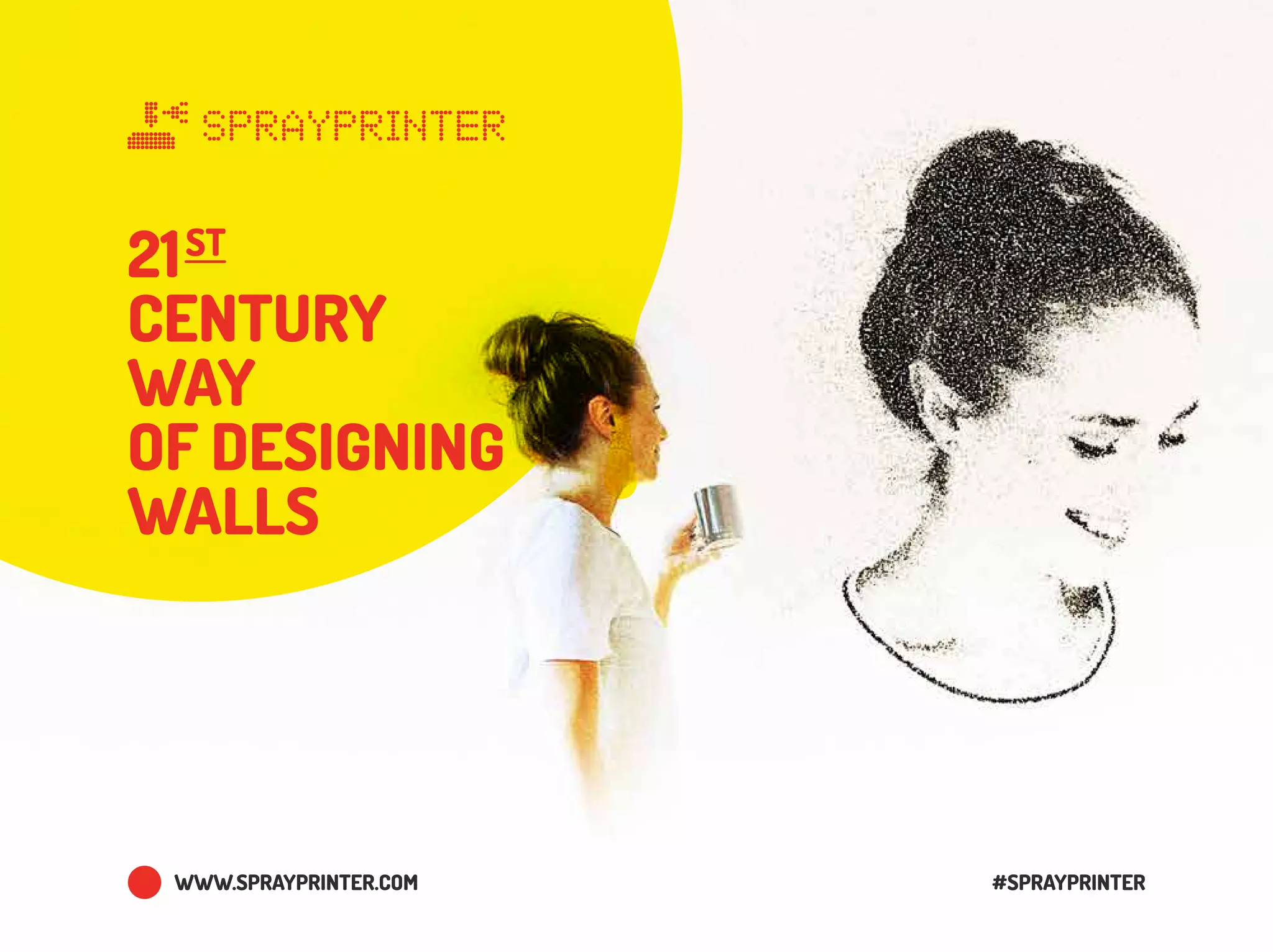
The cover slide establishes the brand identity immediately with a high-contrast yellow and white color scheme. The tagline, "21st Century Way of Designing Walls," positions the product as a modern disruption to traditional interior design or street art. The visual shows a woman standing next to a large-scale, dot-matrix style portrait on a wall, which serves as a functional demonstration of the product's output. It is a clean, professional start that avoids clutter and focuses on the 'wow' factor of the end result.
Slide 2: The SprayPrinter Community
This slide attempts to explain the ecosystem through iconography. It follows a linear path: a creator generates an idea on a computer, the artwork is uploaded to the SprayPrinter app, a transaction occurs (indicated by the $ and € icons), and finally, the image is printed on a wall. This is a crucial slide because it shifts the narrative from "we sell a tool" to "we run a marketplace." By showing the smartphone in the center, they emphasize that the hardware is controlled by a digital platform, which is a much more attractive proposition for venture capital than a standalone hardware play. However, the slide is light on details regarding the take-rate or how artists are recruited.
Slide 3: Media Validation
SprayPrinter leans heavily on social proof here. They list major tech and design publications including Gizmodo, designboom, Discovery Channel, ArcticStartup, Mashable, and TechCrunch. Below the logos, they provide impressive reach metrics: "10 Languages," "100 Blogs," and "140 Countries." For a hardware startup, global interest is a proxy for market demand. If people in 140 countries are talking about a product that hasn't fully launched, it suggests a low cost of customer acquisition (CAC) once the product hits the shelves. This slide is effective because it uses recognizable logos to build instant credibility.
Slide 4: Funds Received and Results
This is the most data-dense slide in the set. It provides a transparent look at their cap table history. They have raised a total of 130k € . The breakdown is specific: 25k € (Buildit Accelerator), 8k € (Prototron), 47k € (Angels), 20k € (Enterprise Estonia), and 25k € (Indiegogo). The inclusion of Indiegogo is important because it proves that customers are willing to pre-pay for the hardware. The "Results" section lists "US/EU patents pending" and "Market validated," which are standard checkboxes for a seed-stage hardware company. It tells the investor that the 'risky' early work of prototyping and legal protection is already underway.
Slide 5: Business Model
The business model is presented as a circular diagram centered on the CEO & COO . It branches into four quadrants: Communication, R&D, Sales, and Production. While visually interesting, this slide is somewhat difficult to parse. It lists partners like MTN, Betek, and Toppan within the Sales and R&D sections. The mention of "Developing Special Paint" suggests a razor-and-blade revenue model where the company might sell the printer at a low margin but make recurring revenue on proprietary paint canisters. This is a strong business model for hardware, but the slide could be clearer about the actual revenue flows.
Slide 6: Team and Contact
The final slide in this selection introduces Richard Murutar (CEO) and Henry Patzig (CTO) . It also features a vertical stack of logos representing their support network, including Wazombi, iseasi, Prototyp, Buildit, HWTrek, Prototron, and Ajujaht. While it is good to see the founders' names and contact info, this slide lacks 'biography' details. Investors want to know if the CTO has built hardware before or if the CEO has experience in international logistics. The logos provide some comfort that they are well-advised, but the human element is thin.
What Works in This Deck
Visual Proof: The use of the dot-matrix portrait on the cover and the final slide shows exactly what the product does without needing a long technical explanation. · Funding Transparency: Slide 4 is excellent. It doesn't hide where the money came from, showing a healthy mix of grants, equity, and crowdfunding. · Global Reach: The media slide (Slide 3) effectively argues that this is a product with universal appeal, not just a local hobbyist tool.
What is Missing
The Ask: None of the provided slides state how much they are currently raising or what the milestones for the next round will be. · Unit Economics: There is no mention of the Bill of Materials (BOM), the retail price, or the margin on the 'special paint.' · Competition: The deck assumes SprayPrinter is the only way to get art on a wall. It ignores traditional muralists, vinyl decals, or large-format industrial wall printers. · Financial Projections: There are no charts showing projected growth or user acquisition targets for the 'Community' platform.
Founder's Guide: What to Copy
The 'Community' Workflow: If you are building a hardware product, copy the way Slide 2 explains the software ecosystem. It makes the business feel like a platform rather than a one-off sale. · The Funding Timeline: Using a simple bar or line to show previous funding sources (Slide 4) is a very clean way to show momentum and institutional support. · Logo Grouping: Grouping media mentions and partner logos separately (Slides 3 and 5) helps categorize different types of validation—one for 'hype' and one for 'operational capacity.'
Frequently asked questions
- How much money has SprayPrinter raised to date?
- According to slide 4, the company has received a total of 130k €. This is broken down into 25k € from Buildit Accelerator, 8k € from Prototron, 47k € from Angel investors, 20k € from Enterprise Estonia, and 25k € from an Indiegogo crowdfunding campaign.
- What is the core product of SprayPrinter?
- While the slides do not show the physical device in detail, the cover and community slides imply a handheld or automated system that 'prints' digital designs onto walls. Slide 2 shows a process where a digital image is selected via a smartphone app and then reproduced as a dot-matrix style mural on a physical surface.
- What is the revenue model for the SprayPrinter community?
- Slide 2 illustrates a marketplace dynamic. A creator thinks of an image, it is uploaded to the SprayPrinter app, and a user pays (indicated by dollar and euro icons) to have that artwork printed. Slide 5 further suggests revenue streams from 'Developing Special Paint' and 'Sales' through partners like MTN and Betek.
- Does the company have intellectual property protection?
- Yes, slide 4 explicitly states that SprayPrinter has patents pending in both the United States and the European Union. This is listed as one of their primary 'Results' alongside technical progress and market validation.
- Who are the key partners mentioned in the deck?
- Slide 5 and 6 list several partners and supporters, including MTN (Montana Colors), Betek, Toppan, and Wazombi. They also highlight involvement with accelerators and organizations like Buildit, HW Trek, and Enterprise Estonia.