Spring Labs operates at the intersection of cryptography and data networking, providing a protocol that allows institutions to verify information without actually exchanging the raw data. Their 10-slide deck is a highly professional, enterprise-focused presentation that prioritizes institutional credibility and technical architecture over typical startup growth metrics. By leveraging a 'give-to-get' model and blockchain technology, they address the $85bn+ market for financial data sharing. The deck is notable for its heavy emphasis on a high-profile advisory board and its clear articulation o…
Key takeaways
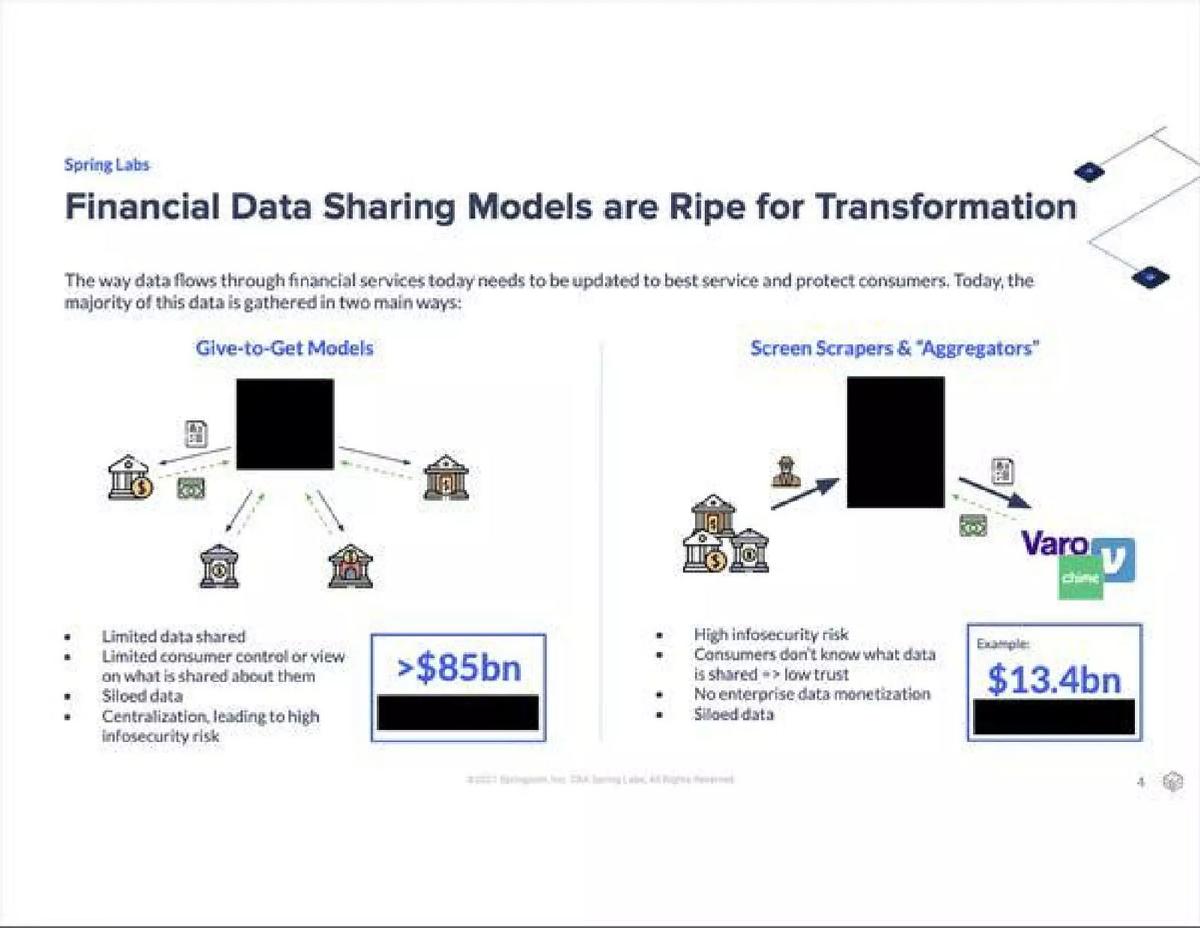
- The deck identifies a massive market inefficiency where over $85bn is tied up in 'Give-to-Get' data models that suffer from siloed information (Slide 4).
- Spring Labs positions itself as a decentralized alternative to traditional aggregators like screen scrapers, which represent a $13.4bn segment (Slide 4).
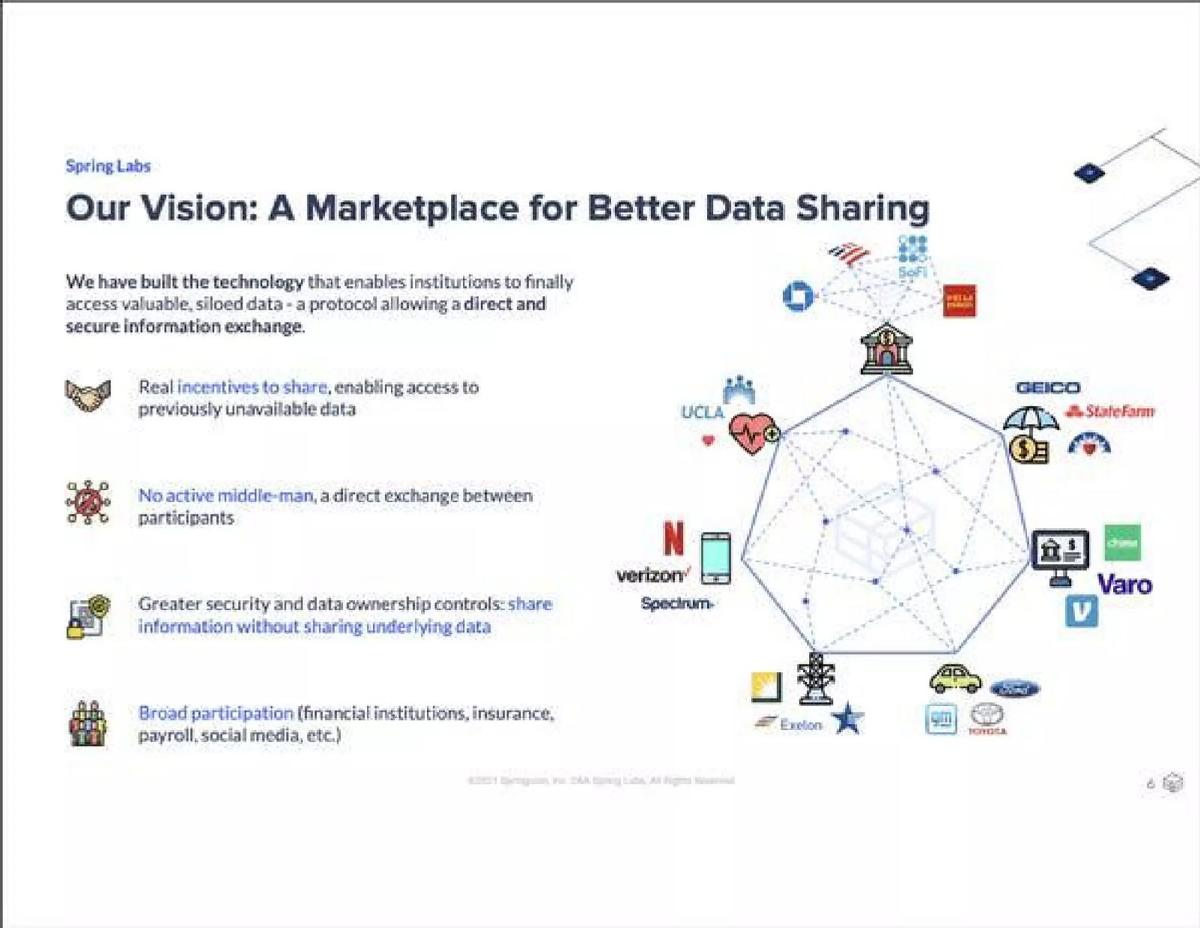
- The core value proposition is the ability to share information without sharing the underlying data, solving for competitive sensitivities and privacy concerns (Slide 6).
- The founding team has significant pedigree, having previously built companies like Avant and Amount (Slide 7).
- The company boasts an exceptionally high-profile advisory board including former chairs of the FDIC and SEC, and former presidents of Goldman Sachs and Oracle (Slide 7).
- Total equity funding raised to date at the time of this deck was $38.75M (Slide 7).
- The 'Spring Protocol' is described as patent-protected technology at the intersection of cryptography and data networks (Slide 9).
- Initial live use cases include the PACE Network for loan stacking detection and MainNet for fraud and income data sharing (Slide 10).
Introduction: The Infrastructure of Trust
Spring Labs represents a sophisticated breed of fintech startup that doesn't just build an application, but rather an underlying protocol for the entire financial ecosystem. This 10-slide deck, dated May 2021, was used during their journey to secure a Series B round. According to catalogue facts, the company has raised a total of $68,800,000. The deck is a masterclass in positioning a complex, technical product for institutional adoption.
Slides 1-3: Vision and Mission
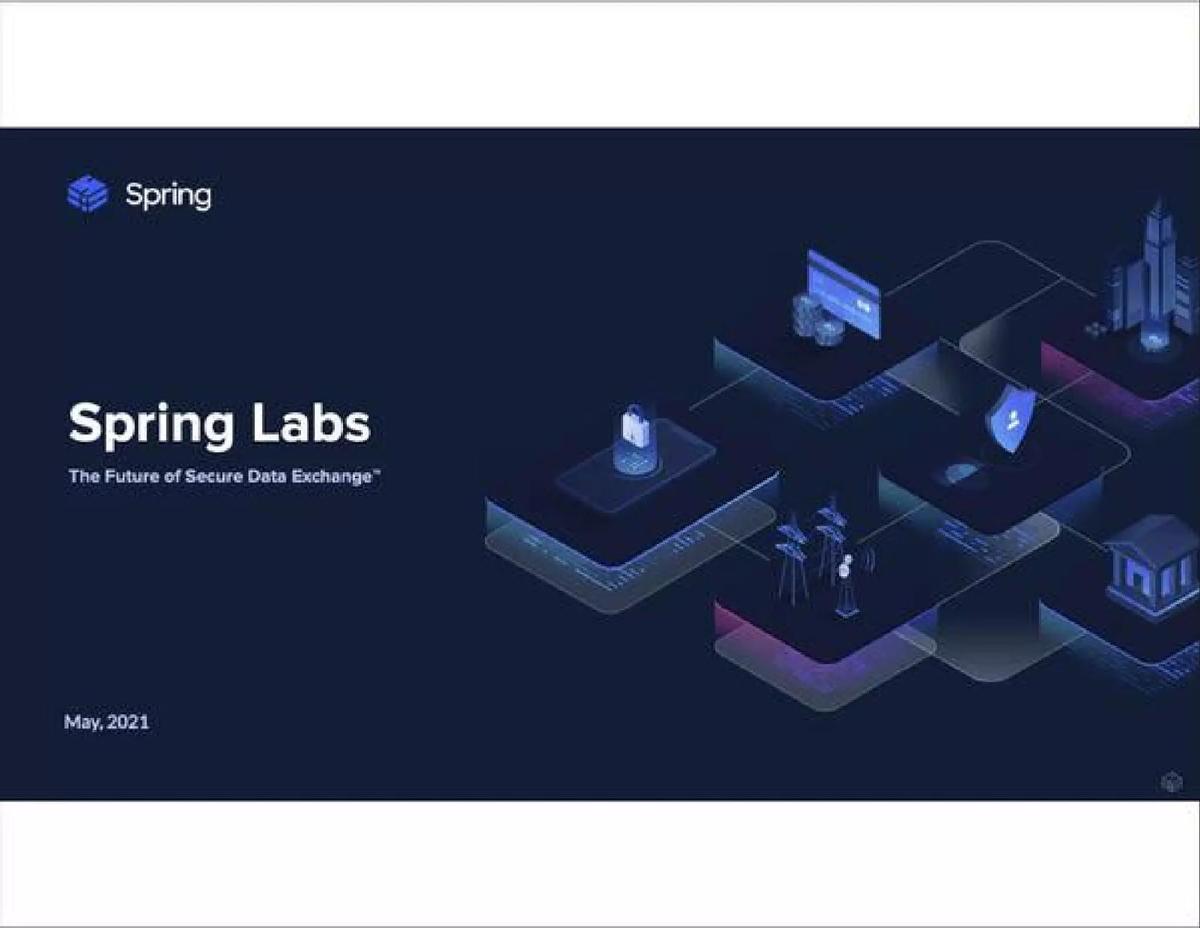
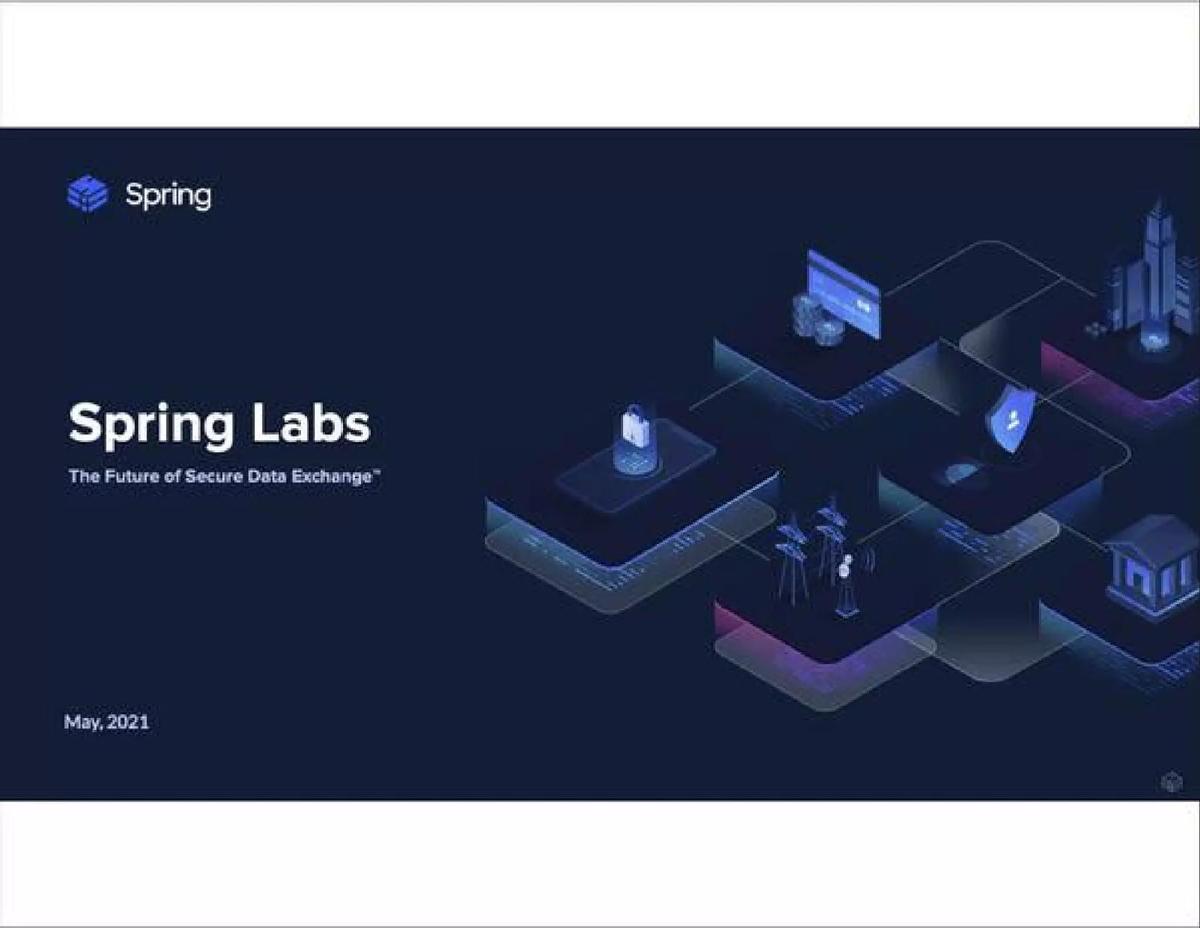
Slide 1: Title Slide The deck opens with a clean, dark-themed aesthetic. The tagline "The Future of Secure Data Exchange" immediately sets the stage. The imagery of interconnected nodes representing credit cards, buildings, and shields reinforces the concept of a secure, multi-industry network.
Slide 2: Disclosure Statement Standard for a Series B company, this slide contains heavy legal text regarding forward-looking statements. It identifies the legal entity as Springcoin, Inc. dba Spring Labs and explicitly mentions the risks associated with blockchain technology and token issuance.
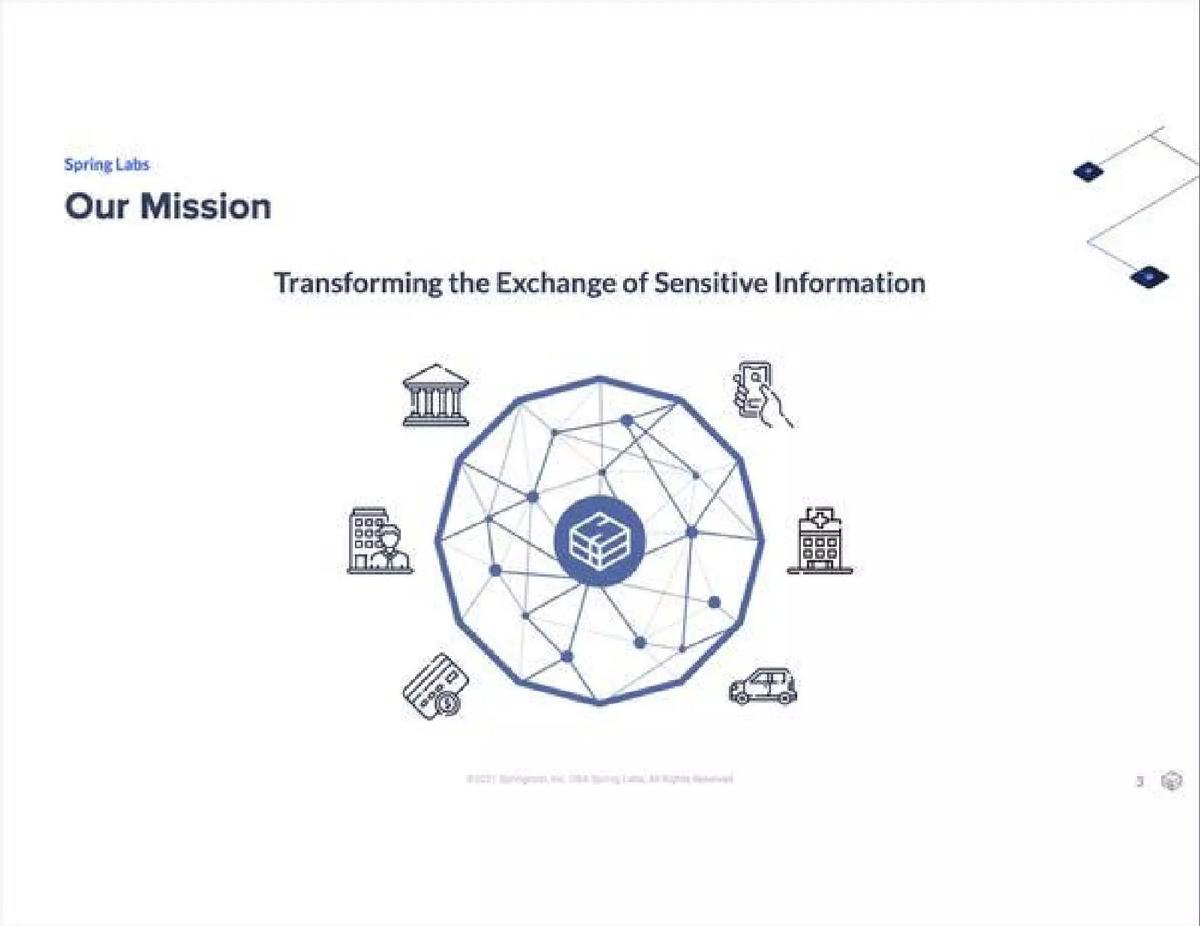
Slide 3: Our Mission The mission is stated simply: "Transforming the Exchange of Sensitive Information." The graphic shows a central node (Spring) connecting various sectors: banking, healthcare, automotive, and mobile. This suggests that while their initial focus might be finance, the protocol is designed to be industry-agnostic.
Slides 4-6: The Problem and the Solution
Slide 4: Financial Data Sharing Models are Ripe for Transformation This is the core 'Problem' slide. It breaks down the current landscape into two flawed models:
Give-to-Get Models: Valued at over $85bn, these are criticized for limited data sharing, siloed data, and high infosecurity risk due to centralization. · Screen Scrapers & Aggregators: Valued at $13.4bn (citing examples like Chime and Varo), these are noted for high infosecurity risk and low consumer trust because users often don't know what data is being shared.
The use of black boxes to redact specific competitor names or sensitive figures suggests this version of the deck was prepared for public or semi-public viewing.
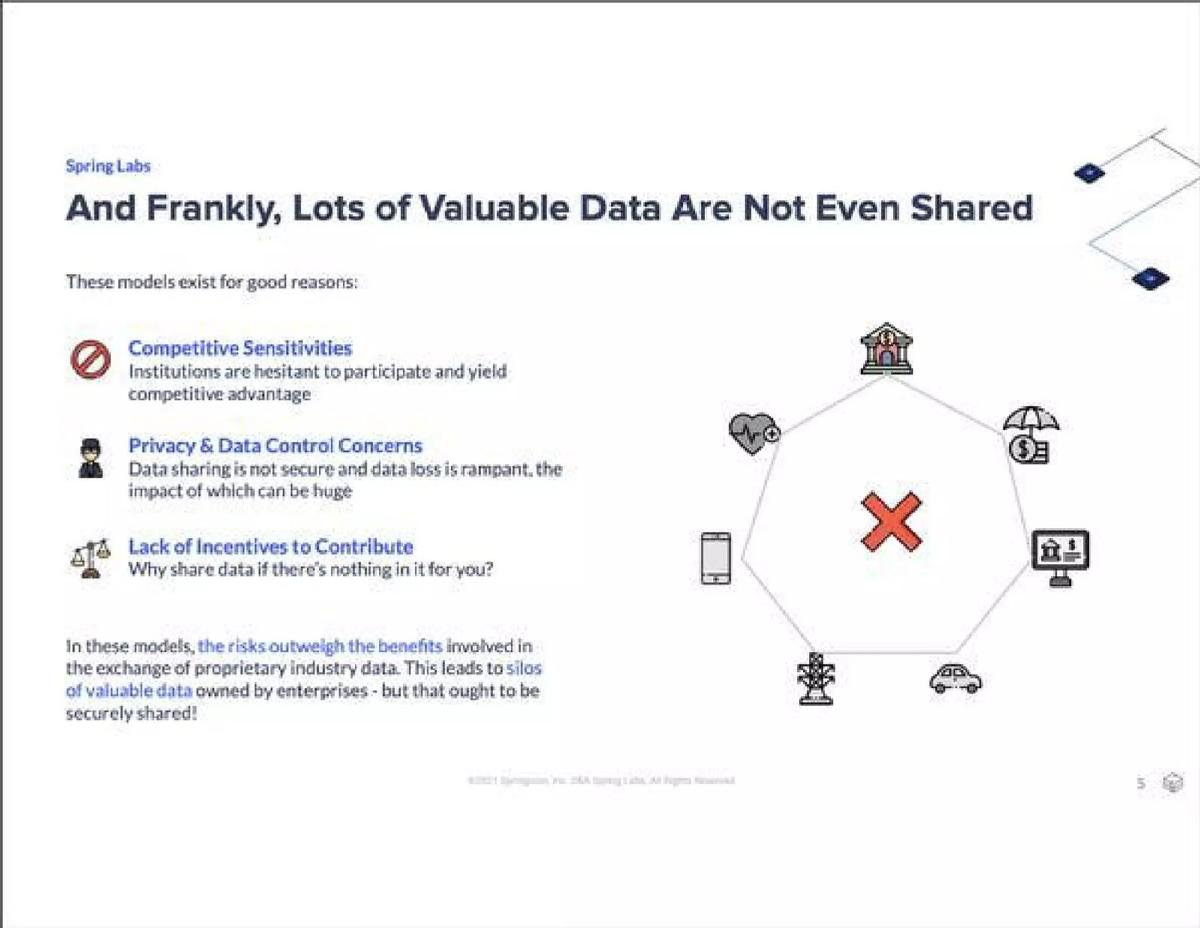
Slide 5: The Data Paradox The deck argues that "lots of valuable data are not even shared." It lists three primary barriers: Competitive Sensitivities (fear of losing advantage), Privacy & Data Control Concerns (fear of data loss), and Lack of Incentives. The slide concludes that currently, the risks of sharing outweigh the benefits, leading to valuable data being trapped in silos.
Slide 6: Our Vision: A Marketplace for Better Data Sharing This is the 'Solution' slide. Spring Labs proposes a protocol that allows for direct, secure information exchange without an active middleman. The key differentiator is the ability to "share information without sharing underlying data." The graphic displays a network of high-profile logos including JPMorgan, Wells Fargo, State Farm, GEICO, and Netflix, implying a broad potential reach across finance, insurance, and media.
Slides 7-8: The Team and the Technology
Slide 7: Proven Business Builders, Backed by Industry Leaders This is arguably the strongest slide in the deck. It separates the leadership from the advisors. The founders (Jiwan, Sun, and Fridman) highlight their experience building Avant and Amount. Below them, it notes $38.75M in total equity funding raised to date. The 'Active Advisors' section is a 'who's who' of regulatory and financial power, featuring former heads of the FDIC, SEC, and OCC, alongside former top executives from Goldman Sachs, Capital One, and Oracle. For a company dealing with sensitive financial data, this level of institutional backing is a critical trust signal.
Slide 8: Spring Protocol and Use Cases This slide bridges the gap between the high-level vision and the actual product. It defines the technology as a "modular data security and sharing layer." Four key technical pillars are listed: Trustless & Deterministic, Data Agnostic, Graph Analysis Enabled, and Flexible Entity Resolution. Below, it introduces four specific products: PACE Network, MainNet, Crypto Middleware, and Spring Index.
Slides 9-10: Product Deep Dive and Roadmap
Slide 9: The Spring Protocol (Process Flow) This slide explains the 'how.' It shows an illustrative process flow for "Spring Income." A bank on the left sends an Entity ID and Income data into a secure Spring node. A bank on the right does the same. The Spring Protocol matches the encrypted strings and returns a simple "Result: Income Verified." This visualizes the concept of verifying data without revealing the underlying PII.
Slide 10: Initial Use Cases The final slide provides a status update on their product suite:
PACE Network: Live. Focuses on detecting loan stacking with 100% industry coverage. · MainNet: Live. Focuses on fraud and income data sharing. · Crypto Middleware: In Development (Coming Q3 2021). Focuses on bridging off-chain identity to on-chain ecosystems for KYC/AML. · Spring Index: Early Development (Coming Q4 2021). Focuses on sharing sensitive threat data.
The presence of redacted black boxes under the 'Differentiation' sections for the live products suggests specific client names or proprietary metrics were removed for this version of the deck.
What Works in the Spring Labs Deck
1. Institutional Gravity: The advisory board slide is exceptional. In the world of enterprise fintech, regulatory compliance and 'old guard' approval are often more important than the code itself. Showing that the former Chair of the FDIC and the former President of Goldman Sachs are active advisors immediately de-risks the investment for a Series B VC.
2. Clear Problem Articulation: Slide 4 and 5 do an excellent job of explaining why the current system is broken. By quantifying the market ($85bn and $13.4bn), they show the scale of the opportunity without needing a traditional TAM/SAM/SOM slide.
3. Technical Simplification: Explaining zero-knowledge proofs or secure multi-party computation to non-technical investors is difficult. Slide 9 uses a simple 'match/no-match' visual to explain the value of the protocol without getting bogged down in the math of cryptography.
What is Missing from the Spring Labs Deck
1. Financial Performance: There are no revenue figures, growth rates, or burn metrics. While this is common in 'redacted' decks, a Series B investor would typically expect to see the 'Live' products (PACE and MainNet) backed by actual usage data or ARR.
2. The 'Ask': The deck ends abruptly on a roadmap slide. There is no slide detailing how much capital is being raised, the intended use of funds, or the milestones that the new capital will unlock.
3. Competitive Landscape: While they mention 'Aggregators' as a category, they don't explicitly map out how they compare to other blockchain-based identity or data projects. In a crowded 'Web3' or 'DeFi' landscape, this distinction is important.
What a Founder Should Copy
1. The 'Advisory Board' Layout: If you have high-profile advisors, don't just list their names. Use the layout on Slide 7—include their photos and, more importantly, their former titles in a clear, bold font. It creates an immediate sense of 'industry inevitability.'
2. The 'Paradox' Narrative: Spring Labs frames their solution as the only way to solve a fundamental conflict (sharing data vs. keeping it secret). Founders should look for the 'unsolvable' paradox in their own industry and position their product as the unique bridge.
3. Use Case Specificity: Instead of just saying "our protocol is for everyone," Slide 10 lists four very specific, high-value problems they are solving. This makes a broad horizontal technology feel like a series of focused, vertical wins.
Frequently asked questions
- What is the primary problem Spring Labs is solving?
- Spring Labs addresses the 'data silo' problem in highly regulated industries. Currently, institutions are hesitant to share data due to competitive sensitivities and privacy risks. This leads to inefficient fraud detection and identity verification. Spring Labs uses a blockchain-based protocol to allow these institutions to verify data points (like income or fraud flags) against each other's records without ever actually seeing or holding the other party's raw sensitive data.
- How does the Spring Protocol actually work?
- As shown on Slide 9, the protocol acts as a cryptographic intermediary. When a bank needs to verify an 'Entity ID' or 'Income,' the data is passed through the Spring Protocol which matches it against other participants' data. The result is a simple 'Verified' or 'Not Verified' signal. This ensures that the underlying PII (Personally Identifiable Information) remains with the original owner while the network benefits from the collective insight.
- Who are the key people behind Spring Labs?
- The leadership includes Adam Jiwan (Executive Chairman), John Sun (CEO), and Anna Fridman (Co-founder). They have a track record of building fintech giants like Avant and Amount. More impressively, their advisory board includes Nigel Morris (Capital One Co-founder), Gary Cohn (former Goldman Sachs President), and Sheila Bair (former FDIC Chair), providing the regulatory and institutional 'gravity' required for this type of infrastructure.
- What are the specific products mentioned in the deck?
- The deck highlights four main products: the PACE Network (live, for detecting loan stacking), MainNet (live, for fraud and income sharing), Crypto Middleware (in development, for KYC/AML in digital assets), and the Spring Index (in development, for sharing threat data). These products demonstrate the protocol's versatility across traditional finance and the emerging crypto sector.
- Is there a financial 'ask' or valuation in this deck?
- No. This deck follows a common pattern for late-stage or high-profile raises where the specific terms of the round are omitted from the general presentation. It mentions that they have raised $38.75M to date (Slide 7), but it does not specify how much they are seeking in the current round or what the target valuation is. This information is typically reserved for one-on-one data room discussions.