The dynaCERT deck from Fall 2014 focuses on the commercialization of HydraGEN, a bolt-on technology for diesel engines that generates hydrogen and oxygen to enhance combustion. The company, already trading on the TSX Venture Exchange (TSX:V DYA), presents a clear case for fuel savings of 10-20% (Slide 13) and a significant reduction in emissions. The deck is heavily weighted toward technical validation and financial projections, forecasting a net profit of $174,063,750 at a scale of 60,000 units (Slide 19). While it lacks a specific 'Ask' for a new funding round, it serves as a comprehensive…
Key takeaways
- The company is a publicly traded entity on the TSX Venture Exchange under the symbol DYA (Slide 1).
- HydraGEN technology claims to improve fuel economy by 10-20% through enhanced combustion (Slide 13).
- The product has undergone a 40% weight reduction in its 'New Design' phase to improve vehicle integration (Slide 10).
- Market focus is bifurcated between on-road heavy-duty trucks (Class 6-8) and large-scale power generation up to 30,000hp (Slide 16).
- Financial modeling assumes a fixed dealer price of $6,750 against a manufacturing cost of $2,200 per unit (Slide 19).
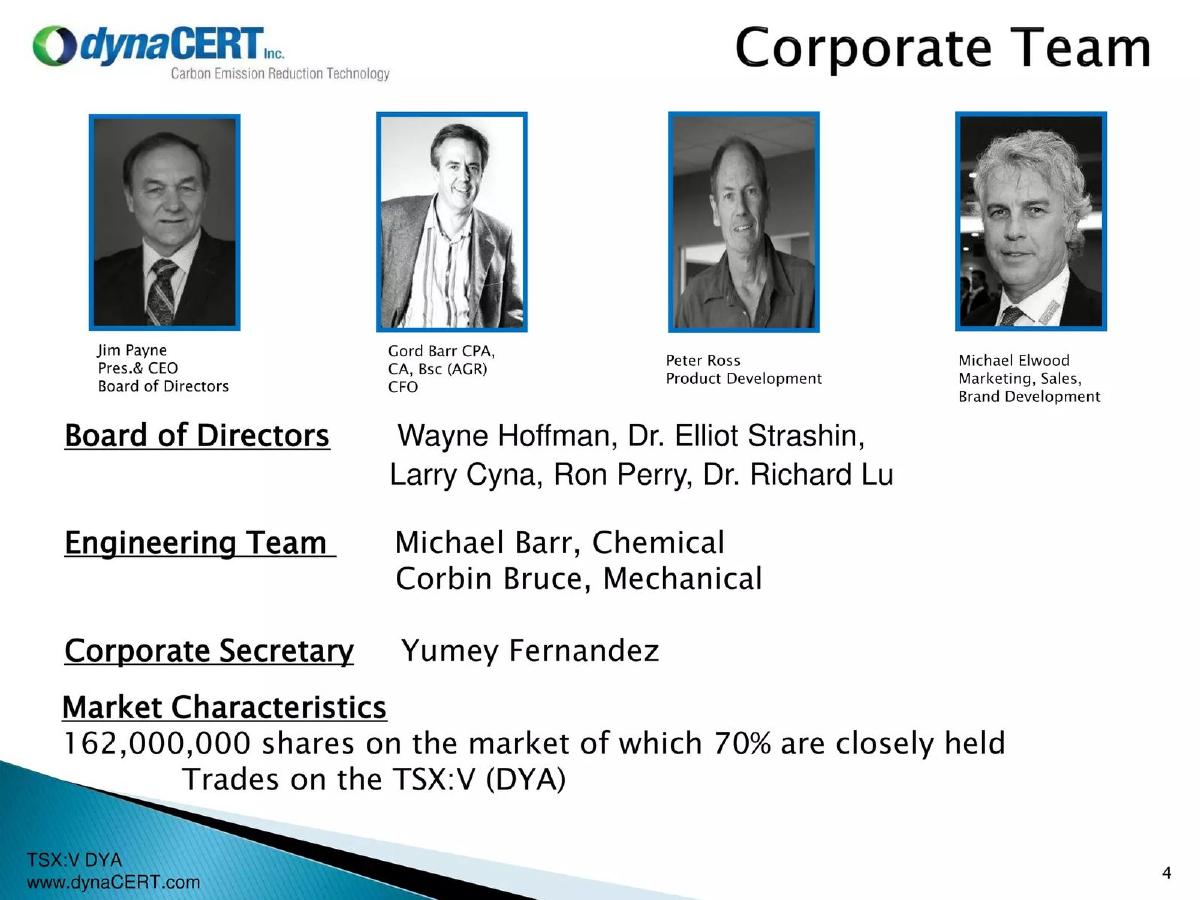
- The corporate structure is heavily weighted toward engineering and board-level oversight, with 70% of shares closely held (Slide 4).
- The deck includes a dedicated references slide citing nine academic and government studies to validate hydrogen-assisted combustion (Slide 25).
Introduction and Corporate Identity
The dynaCERT Investor Presentation from Fall 2014 positions the company as a leader in carbon emission reduction technology. Unlike many startup decks, this is a presentation for a publicly traded entity on the TSX Venture Exchange. The branding is consistent, featuring the HydraGEN product prominently alongside the corporate logo.
Slide 1: Title Slide
The cover slide establishes the company name, dynaCERT Inc., and its tagline: "Carbon Emission Reduction Technology." It identifies Jim Payne as the presenter and dates the deck to Fall 2014. Crucially, it includes the stock ticker TSX:V DYA and the company website, signaling to investors that this is a liquid, public investment opportunity. The visual focus is on the HydraGEN unit, showing both its external housing and internal reactor components.
Slide 4: Corporate Team and Market Characteristics
This slide introduces the leadership, led by Jim Payne (President & CEO). The team includes Gord Barr (CFO), Peter Ross (Product Development), and Michael Elwood (Marketing and Sales). Below the executive photos, the slide lists a substantial Board of Directors and a two-person engineering team consisting of Michael Barr (Chemical) and Corbin Bruce (Mechanical). The bottom of the slide provides a snapshot of the capital structure: 162,000,000 shares outstanding, with 70% closely held. This high level of insider ownership is often viewed by investors as a sign of management's confidence in the long-term value of the company.
Technology and Product Evolution
Slide 7: Dramatic Fuel Improvements
This slide explains the 'how' of the technology. HydraGEN is described as a system that supplies the engine with pure hydrogen and oxygen gases. The stated benefits are fourfold: faster and more complete combustion, increased fuel economy, and reduced emissions. The slide uses a 'Before' and 'After' diagram of a combustion chamber to visually represent the enhanced flame spread and efficiency provided by the hydrogen additive. Small citation numbers (4, 6-8) point to the references slide at the end of the deck, providing a layer of academic rigour to the claims.
Slide 10: New Design Specifications
Slide 10 focuses on the engineering improvements made to the hardware. The 'New Design' features upgraded reactor, plumbing, and gasket materials, along with weather-tight housing and vibration dampeners. A key metric shared here is a "40% weight reduction," which is critical for the trucking industry where every pound of equipment weight can subtract from the allowable payload. The inclusion of technical drawings with dimensions (e.g., 17.86 inches in width) suggests the product is ready for manufacturing and physical integration into various vehicle engine compartments.
Slide 13: Impact on Fuel Economy
This is the 'proof' slide. It features a scatter plot measuring Fuel Economy in MPG over a five-week period. The data points show a clear separation between vehicles equipped with HydraGEN (blue diamonds) and those without (red squares). The trend lines indicate that while the control group stays between 6 and 7 MPG, the HydraGEN group consistently operates between 8 and 9 MPG. The slide explicitly highlights a "10-20%" improvement, which represents a massive cost saving for fleet operators.
Market Strategy and Financials
Slide 16: Current Market Focus
dynaCERT identifies two primary growth sectors. The 'On-Road' segment targets Class 6-8 engines, which includes the heavy-duty tractor-trailers that form the backbone of logistics. The 'Power Generation' segment targets much larger engines (6,000hp to 30,000hp) used in remote areas. This dual-track strategy allows the company to pursue high-volume sales in trucking while seeking high-margin, large-scale installations in industrial power. The slide also mentions future transitions into Marine and Rail, showing a long-term roadmap for market expansion.
Slide 19: Annual Profit Projection
This slide provides a detailed financial model based on unit sales of HydraGEN for trucks. The projections scale from 1,000 units to 60,000 units. Key figures include:
Dealer Price: $6,750 (constant across all volumes) · Manufacturing Cost: $2,200 (constant across all volumes) · Net Profit at 1,000 units: $1,101,563 · Net Profit at 60,000 units: $174,063,750
The model also calculates Earnings Per Share (EPS), projecting a jump from $0.007 to $1.071 as volume increases. One notable omission in this table is the lack of manufacturing cost reduction (economies of scale) as volume increases from 1,000 to 60,000 units, which suggests the projections might be conservative regarding gross margins.
Slide 22: Commercialization Strategy
The strategy is presented as a linear five-step process: Design and Testing, Manufacturing and Assembly, Distribution and Sales, Installation and Maintenance, and finally, Performance Monitoring and Improvement. This flow indicates that dynaCERT views itself as a full-stack provider, managing the lifecycle of the product from R&D through to ongoing maintenance and data collection.
Slide 25: References
The final slide is a bibliography of nine scientific sources. These include papers from the International Journal of Hydrogen Energy and reports from the US Energy Information Administration. Including this level of documentation is a strategic move to deflect skepticism regarding 'hydrogen-on-demand' technologies, which have historically faced scrutiny in the automotive aftermarket.
What Works and What is Missing
What Works: The deck is exceptionally strong on technical validation and clear financial modeling. By citing external academic sources and providing a week-by-week MPG comparison, dynaCERT builds a credible case for a technology that might otherwise seem 'too good to be true.' The clear distinction between manufacturing costs and dealer pricing allows investors to quickly grasp the unit-level profitability.
What is Missing: The deck lacks a competitive analysis. There is no mention of other hydrogen injection systems or alternative fuel saving technologies (like aerodynamic kits or electric drivetrains). Furthermore, while the team slide lists names, it lacks biographies or career highlights, making it difficult to assess the specific expertise of the leadership team beyond their titles. Finally, as a public company presentation, it lacks a specific 'Ask'—it does not state how much capital they are looking to raise or how that capital would be deployed to reach the 60,000-unit milestone.
Founder Takeaways
Founders in the 'hard tech' or hardware space should emulate dynaCERT's use of data visualization. The MPG scatter plot on Slide 13 is far more convincing than a simple bullet point claiming '20% savings.' Additionally, for companies operating in sectors with a history of 'snake oil' products, the inclusion of a formal references slide (Slide 25) is a professional way to anchor claims in established science. However, founders should ensure their financial projections account for scaling efficiencies; keeping manufacturing costs flat while increasing volume 60x is a missed opportunity to show the true power of their business model.
Frequently asked questions
- What is the core technology behind dynaCERT?
- The core technology is called HydraGEN. It is a hydrogen-on-demand system that supplies pure hydrogen and oxygen gases to a diesel engine. According to Slide 7, this process generates a faster and more complete combustion, which leads to increased fuel economy and reduced carbon emissions. It is designed as an aftermarket or integrated addition to existing diesel infrastructure.
- What are the projected unit economics for the HydraGEN system?
- Slide 19 details the unit economics clearly. The company sets a dealer price of $6,750 and a manufacturing cost of $2,200. This results in a gross profit of $4,043,750 for the first 1,000 units after accounting for a selling commission of $506,250. As volume scales to 60,000 units, the manufacturing cost remains constant at $2,200, suggesting the model does not yet account for economies of scale in production.
- Who is the target customer for this technology?
- The deck identifies two primary sectors on Slide 16. The first is 'On-Road,' specifically targeting Class 6-8 engines used in tractor-trailers and buses. The second is 'Power Generation,' targeting massive 6,000hp to 30,000hp engines often used in remote locations. The slide also notes that this provides a transition path into the Marine and Rail sectors.
- How does dynaCERT validate its performance claims?
- Validation is presented through two methods. Slide 13 shows a scatter plot comparing fuel economy (MPG) over a 4-week period, demonstrating a 10-20% improvement for vehicles equipped with HydraGEN versus those without. Additionally, Slide 25 lists nine academic references, including studies from the US Energy Information Administration and the International Journal of Hydrogen Energy, to provide scientific backing for their combustion claims.
- What is the current corporate status of the company in this deck?
- At the time of this Fall 2014 presentation, dynaCERT was already a public company trading on the TSX Venture Exchange (TSX:V DYA). Slide 4 indicates there were 162,000,000 shares on the market, with 70% of those shares being 'closely held,' implying significant insider or founder ownership.