Pento raised $15.6M in 2021 with a remarkably lean 8-slide deck that breaks almost every conventional rule of fundraising. There is no team slide, no traction slide, no financial projections, and no specific 'ask' regarding the round size or valuation. Instead, the deck functions as a product manifesto. It identifies a specific, painful timeline in legacy payroll (Slide 2) and presents a real-time automated alternative (Slide 3). The narrative pivots quickly from a SaaS tool to a foundational infrastructure play, highlighting an Open API strategy (Slide 6) designed to power third-party platfo…
Key takeaways
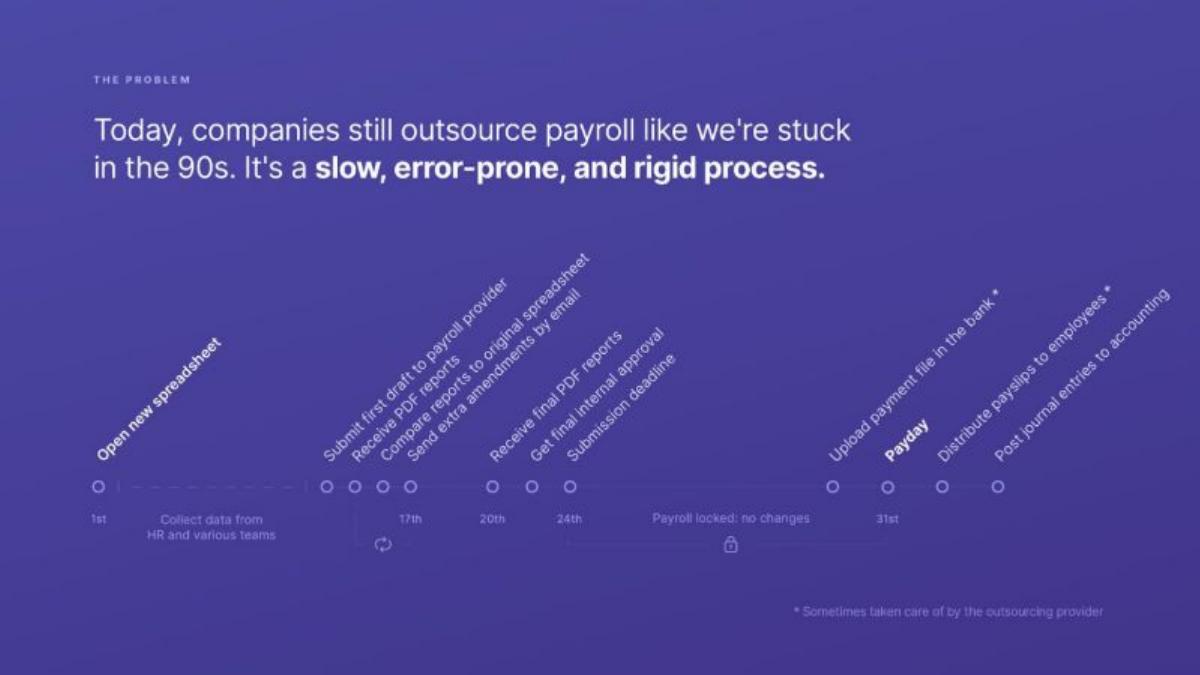
- The deck identifies a 'slow, error-prone, and rigid' legacy process that spans an entire month, from opening a spreadsheet on the 1st to posting journal entries after the 31st (Slide 2).
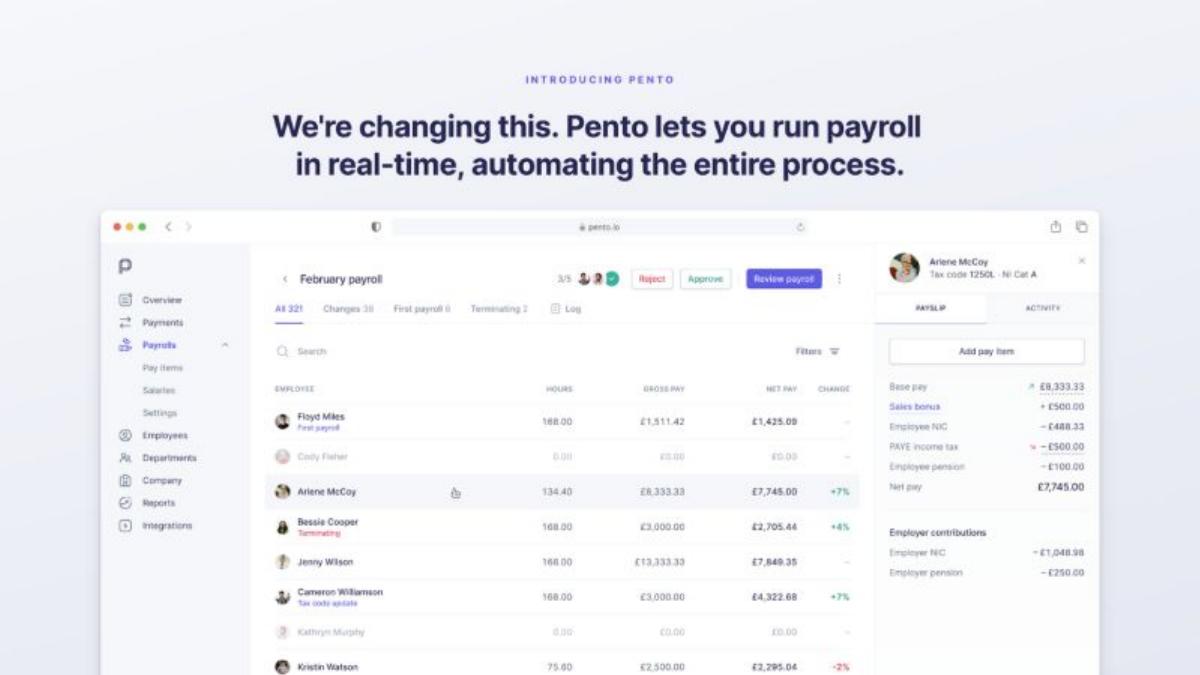
- Pento positions itself as a real-time automation platform, contrasting sharply with the 'locked' payroll periods of traditional providers (Slide 3).
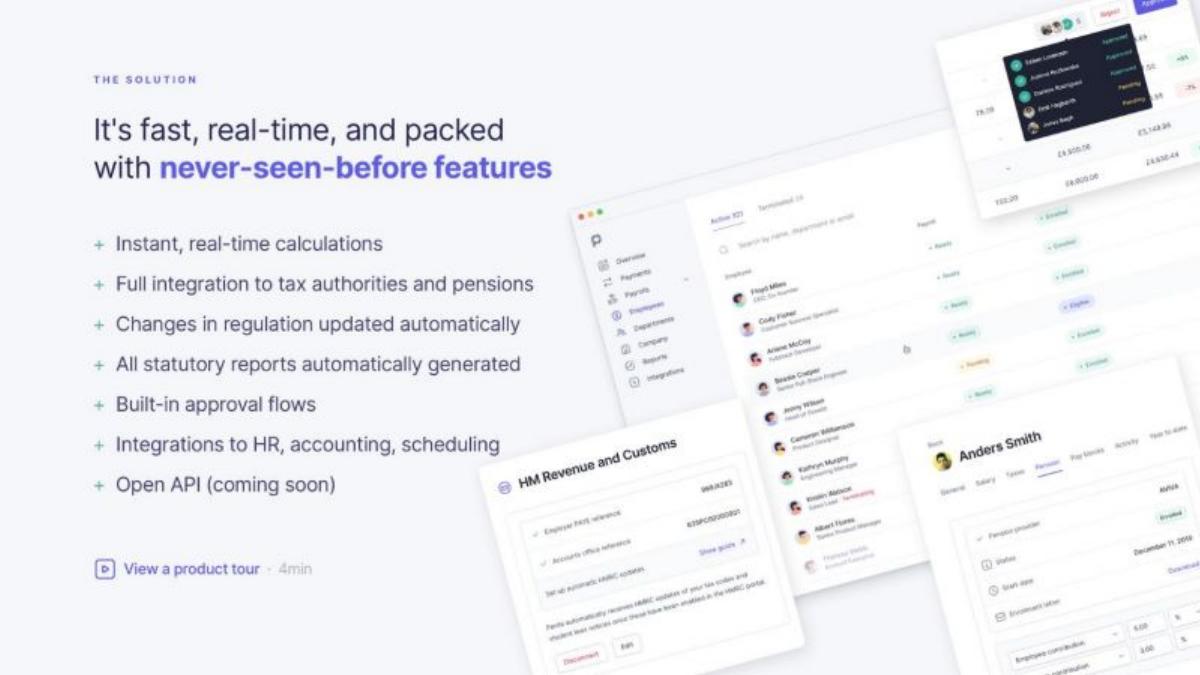
- The solution highlights deep technical integrations, specifically mentioning HM Revenue and Customs (HMRC) for tax authority automation (Slide 4).
- A future-facing 'Open API' is listed as a core component of the vision, though it is noted as 'coming soon' at the time of the deck (Slide 4).
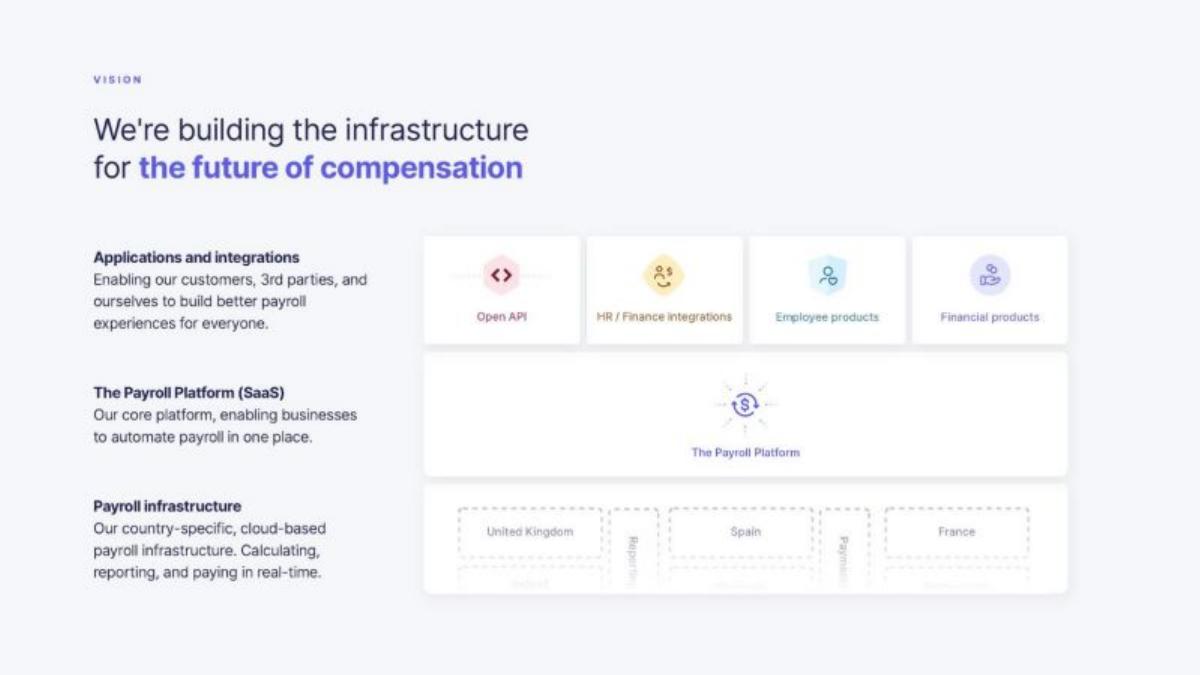
- The company defines its three-tier architecture: Payroll Infrastructure, The Payroll Platform (SaaS), and Applications/Integrations (Slide 5).
- The vision expands beyond a simple tool to include 'Employee products' and 'Financial products' as part of the future of compensation (Slide 5).
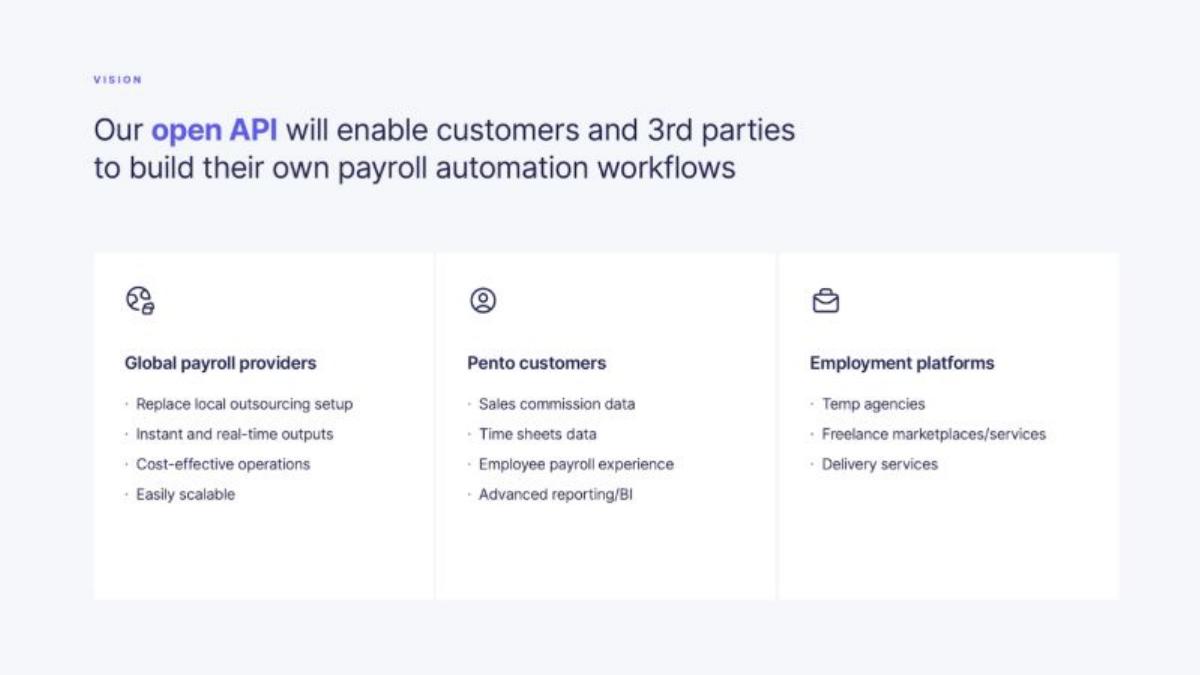
- The deck targets three distinct user groups for its API: Global payroll providers, Pento customers, and Employment platforms like temp agencies or delivery services (Slide 6).
- There is a total absence of a team slide, which is highly unusual for a Series A deck (Slide 1-8).
The 8-Slide Series A: A Product Manifesto
Pento’s Series A deck is an anomaly in the world of startup fundraising. At just eight slides, it is shorter than most Seed-stage decks. According to the catalogue facts, this deck helped secure $15.6M in 2021. What is most striking is not what is included, but what is missing: there are no revenue charts, no growth metrics, no competitive landscape, and no team bios. This is a deck that assumes the investor already knows the market is huge and the team is capable, focusing entirely on the technical superiority of the product and the long-term vision of becoming payroll infrastructure.
Slide 1: Title Slide
The deck opens with a clean, minimalist title slide. "Pento – The Payroll Automation Platform" is the core value proposition. The inclusion of "Series A" immediately sets the stage for the level of maturity expected from the conversation, even if the deck itself remains high-level. The branding is consistent with a modern fintech: purple hues, plenty of white space, and a simple geometric logo.
Slide 2: The Problem - The 90s Payroll Loop
Slide 2 is arguably the most important slide in the deck. It defines the problem not through abstract statistics, but through a painful, chronological timeline. It labels the current state of payroll as "slow, error-prone, and rigid." The timeline shows a month-long slog starting on the 1st with "Open new spreadsheet" and ending after the 31st with "Post journal entries to accounting." Key friction points highlighted include "Compare reports to original spreadsheet," "Send extra amendments by email," and the dreaded "Payroll locked: no changes" period between the 24th and 31st. This slide effectively communicates that the current system is a series of manual hand-offs that Pento intends to eliminate.
Slide 3: The Solution - Real-Time Automation
Slide 3 introduces the product with a simple headline: "We're changing this. Pento lets you run payroll in real-time, automating the entire process." The slide features a high-fidelity screenshot of the Pento interface. The UI shows a list of employees (e.g., Floyd Miles, Arlene McCoy) with gross and net pay calculations already visible. By showing the product in action, Pento proves that their solution isn't vaporware; it is a functional, modern web application that looks and feels like the software people use in their personal lives, contrasting with the '90s' feel mentioned in the previous slide.
Slide 4: Feature Breakdown and Product Tour
Slide 4 dives into the specific technical advantages. It lists seven key features, including "Instant, real-time calculations," "Full integration to tax authorities and pensions," and "Changes in regulation updated automatically." Notably, it mentions a "View a product tour" link, suggesting that the deck was intended to be sent as a teaser to prompt a deeper dive. The mention of an "Open API (coming soon)" is a strategic inclusion, signaling that the company is moving toward an infrastructure model rather than just a standalone SaaS tool. The visual elements show specific integrations like "HM Revenue and Customs," grounding the product in the regulatory reality of the UK market.
Slide 5: The Vision - The Infrastructure Play
Slide 5 shifts the narrative from a tool to a platform. The headline "We're building the infrastructure for the future of compensation" is a bold claim. The slide uses a tiered diagram to explain the business model: 1. Payroll infrastructure (the base layer), 2. The Payroll Platform (the SaaS layer), and 3. Applications and integrations (the ecosystem layer). This slide tells investors that Pento isn't just competing with other payroll software; they are building the rails that other companies will eventually build upon. It mentions future expansions into "Employee products" and "Financial products," hinting at a much larger fintech play beyond simple salary disbursement.
Slide 6: The API Strategy
Slide 6 expands on the "Open API" mentioned earlier. It identifies three specific use cases: Global payroll providers who want to replace local outsourcing, Pento customers who want to sync sales commission or timesheet data, and employment platforms like temp agencies or delivery services. This slide is crucial for a Series A because it demonstrates a clear understanding of the market segments and how Pento can scale horizontally across different industries. It moves the conversation from "how many HR managers can we sign up?" to "how much of the global payroll volume can we process?"
Slide 7 & 8: Closing and Call to Action
Slide 7 is a simple "Thank you" slide with the Pento logo. Slide 8 is an external promotional slide for the deck library and is not part of the Pento presentation itself. The lack of a concluding 'Ask' slide—detailing how much they are raising and what the milestones are—is highly unconventional. It suggests a high-demand round where the terms were likely being set by the market or discussed in a more formal pitch deck version not captured here.
What Pento Omitted
The omissions in this deck are staggering for a $15.6M Series A. There is no Team Slide. Usually, the founders' backgrounds are a primary selling point. There is no Traction Slide. No mention of ARR, number of customers, or growth percentages. There is no Competition Slide. Pento does not mention Gusto, Rippling, or legacy players like ADP by name, choosing instead to bucket them all as '90s-style' outsourcing. There is no Financial Forecast. The deck makes no attempt to project future earnings. These omissions suggest that this was a 'vision deck' used to supplement a very strong, data-heavy due diligence process, or that the company had such significant momentum that the product spoke for itself.
What Founders Should Copy
Founders should emulate Pento's ability to visualize the problem. Slide 2 is a perfect example of how to make a boring back-office process look like a nightmare that needs solving. The use of a timeline to show the inefficiency of the status quo is much more effective than a bulleted list of complaints. Additionally, the infrastructure diagram on Slide 5 is an excellent way to show how a simple product can evolve into a massive platform. It gives investors a clear path to a 10x or 100x return by showing the layers of value the company intends to build over time. Finally, the clean, high-fidelity product shots are essential. They convey a sense of quality and attention to detail that is vital in the fintech space, where trust and reliability are paramount.
Conclusion
Pento's deck is a masterclass in brevity and product-led storytelling. While most founders should be cautious about omitting as much data as Pento did, the core lesson remains: if you can clearly define a painful problem and show a technically superior, real-time solution that has the potential to become industry infrastructure, you don't need 50 slides to get an investor's attention. This deck is designed to spark curiosity and lead to a demo, which is exactly what a great pitch deck should do.
Frequently asked questions
- How did Pento raise $15.6M without a traction slide?
- While the deck lacks a traction slide, it is highly likely that the data was provided in a separate data room or during the due diligence process. For a Series A, investors usually require ARR, churn, and growth rates. Pento's deck focuses on the 'Product Vision,' suggesting the founders relied on the strength of their technical solution and existing momentum to secure meetings where the hard numbers were then discussed.
- Why is the problem slide so effective in this deck?
- Slide 2 uses a linear timeline to visualize the '90s-style' payroll process. By mapping out specific dates (1st, 17th, 20th, 24th, 31st) and the manual tasks associated with them—like 'Compare reports to original spreadsheet'—it creates a visceral sense of inefficiency. This makes the 'Real-time' solution on the following slide feel like a necessary evolution rather than just a marginal improvement.
- What is the significance of the 'Open API' mention?
- By emphasizing an Open API (Slide 6), Pento signals that they aren't just building a SaaS tool for HR managers; they are building infrastructure. This expands their Total Addressable Market (TAM) to include gig economy platforms and other fintechs who need to embed payroll into their own products. This 'infrastructure play' often commands a higher valuation than a standard SaaS tool.
- Is the lack of a team slide a mistake?
- In a vacuum, yes. However, Pento's founders likely had significant pedigree or previous successful exits that made a formal introduction slide less critical for the initial 'hook.' For most founders, omitting the team slide is a high-risk move that can lead to immediate rejection, as investors primarily bet on the people at the early stages.
- How does Pento differentiate itself from legacy payroll providers?
- Pento focuses on the removal of the 'submission deadline' and 'payroll locked' periods. Slide 2 shows that traditional payroll is rigid and requires multiple PDF report reviews. Pento’s solution (Slide 4) automates statutory reports and regulation updates, allowing for 'instant, real-time calculations' that legacy providers, who often rely on manual back-office processing, cannot match.