The Permex Petroleum presentation from June 2022 serves as a public market investor update for a junior oil and gas company operating in Texas and New Mexico. The deck emphasizes a 'Conservative Plan – Aggressive Approach,' focusing on the acquisition of low-cost producing assets and the technical upside of horizontal leg conversion. A central theme is the company's valuation gap; slide 15 illustrates that while industry peers trade at 1.34x EV/2P Reserves, Permex trades at just 0.04x. The company reports a significant jump in 2P reserves to 24.5 million BOE following a 'transformational' 7,8…
Key takeaways
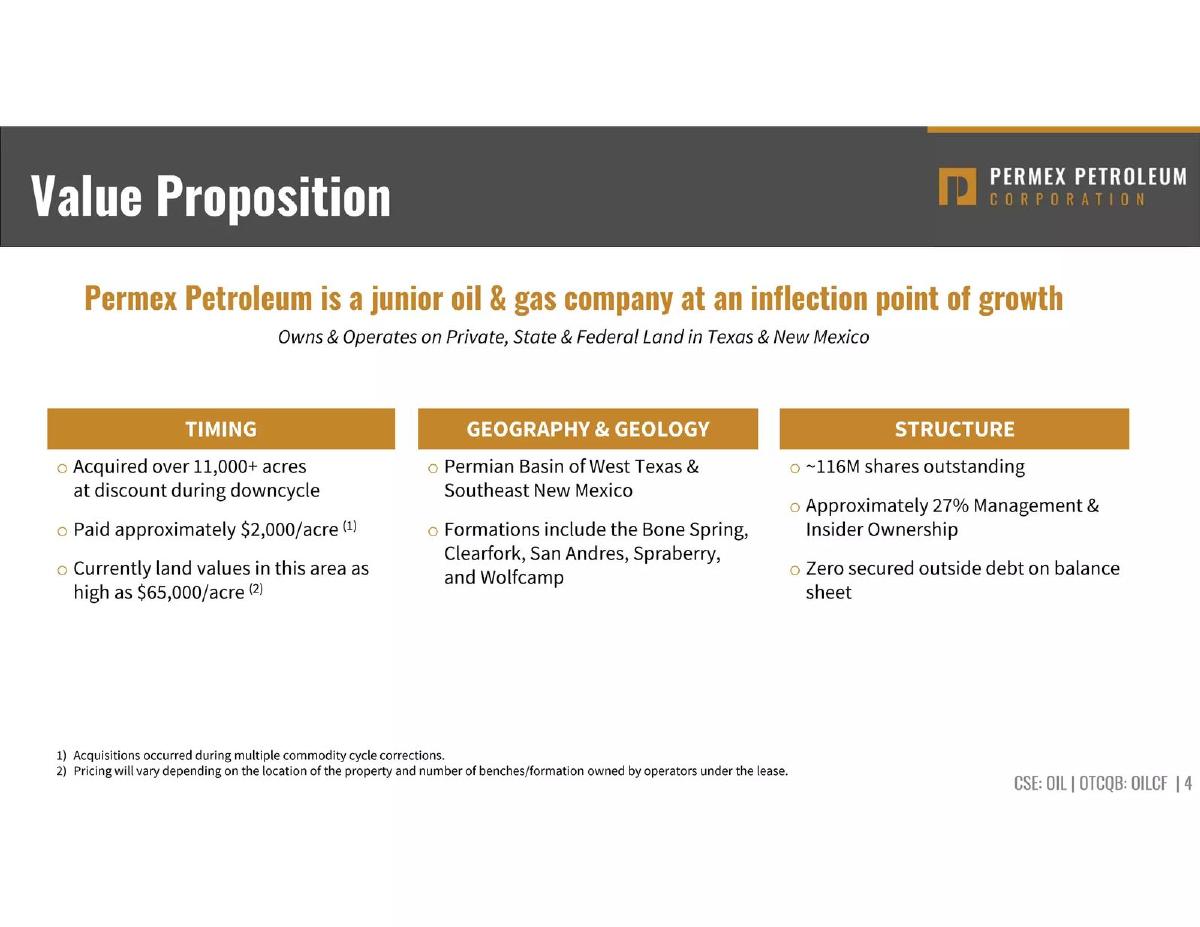
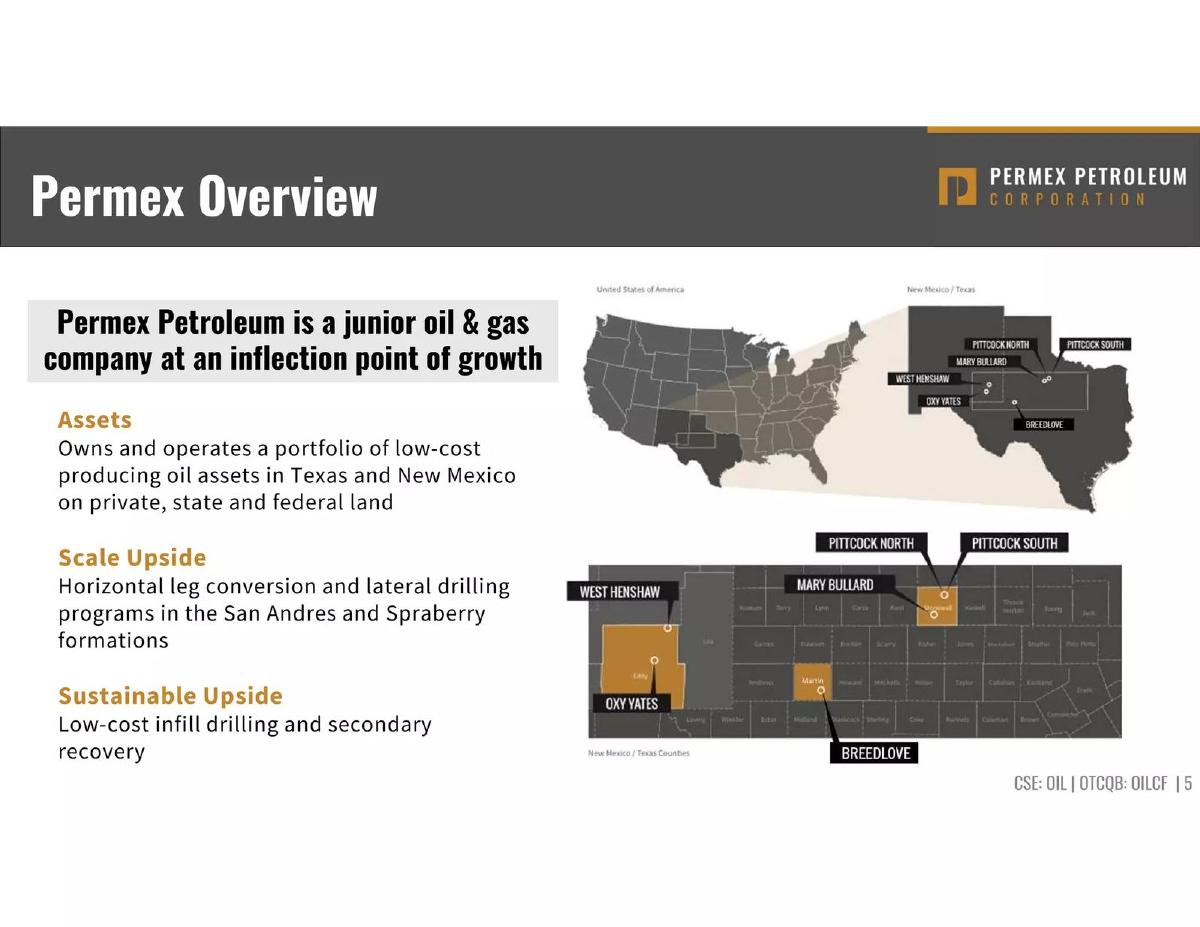
- The company operates on a mix of private, state, and federal land across the Permian Basin of West Texas and Southeast New Mexico (Slide 5).
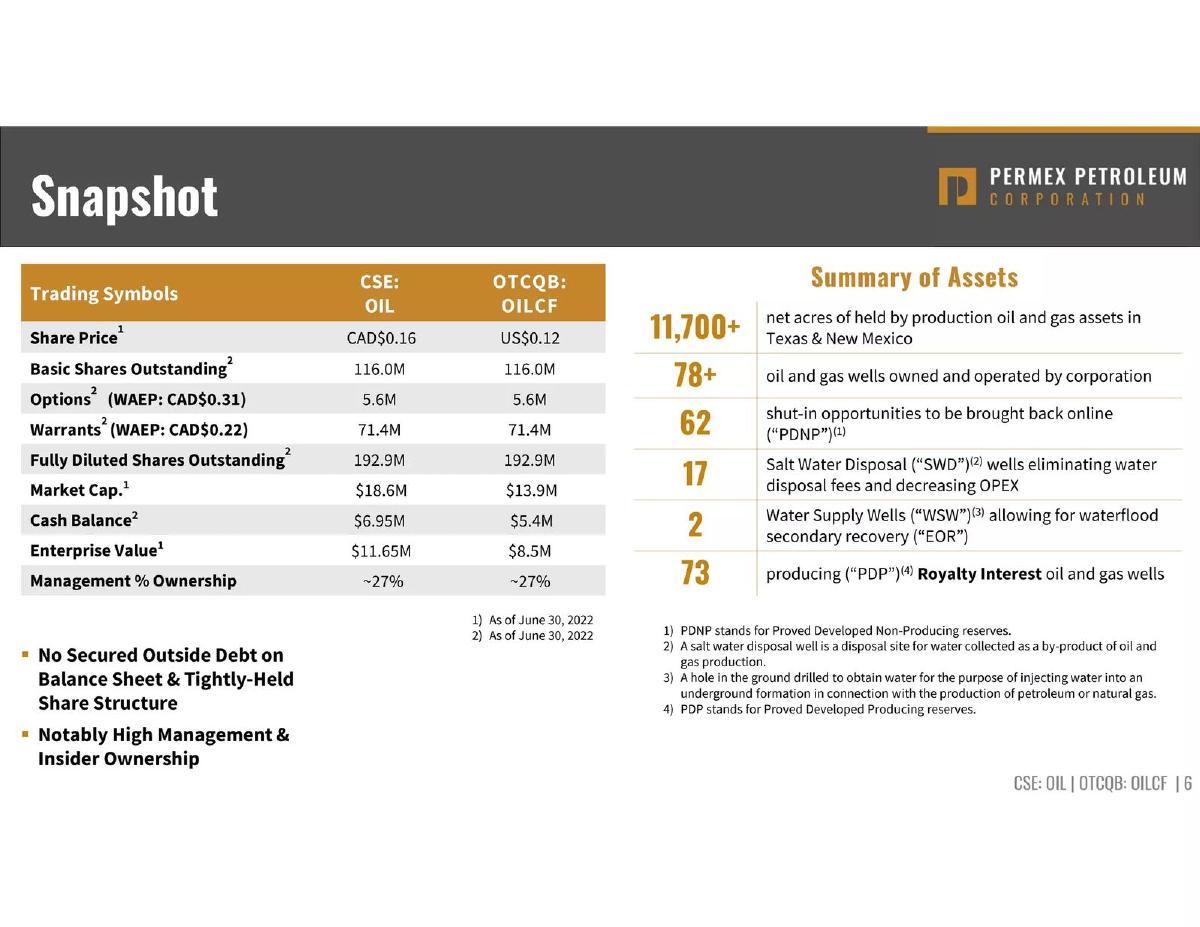
- Permex increased its total acreage to 11,700 acres in October 2021, representing a 290% increase since August 2021 (Slide 7).
- Total 2P reserves grew from 9.5 million barrels of oil equivalent (BOE) in 2020 to 24.5 million BOE in 2021 (Slide 7, 15).
- The company identifies a valuation discrepancy, trading at 0.04x EV/2P reserves compared to an industry peer average of 1.34x (Slide 15).
- Operational strategy includes royalty interests in 73 producing wells operated by majors like Chevron, ConocoPhillips, and EOG Resources (Slide 7, 19).
- The board and advisory team feature significant industry experience, including J.P. Bryan with over 50 years in oil and gas (Slide 13).
- Specific property plans include re-entering 20 shut-in wells and drilling 12+ new wells at the Pittcock North/South properties (Slide 9).
- The company is listed on the CSE under the symbol OIL and the OTCQB under OILCF (Slide 1).
Permex Petroleum: A Public Market Value Play in the Permian
The June 2022 investor presentation for Permex Petroleum Corporation is a classic example of a junior resource company pitch. Unlike tech startups that focus on user growth or ARR, Permex focuses on 'in-ground' value: acreage, reserves, and geological upside. The deck is designed to convince public market investors that the company is significantly undervalued relative to its asset base, particularly after a massive acreage acquisition in late 2021.
Slide 1: Title and Positioning
The cover slide establishes the company's identity as a listed entity (CSE: OIL | OTCQB: OILCF). The tagline, "Conservative Plan – Aggressive Approach," suggests a management style that balances fiscal responsibility with rapid asset acquisition. The background image of a pump jack reinforces the industrial, asset-heavy nature of the business.
Slide 3: Oil & Gas Disclosures
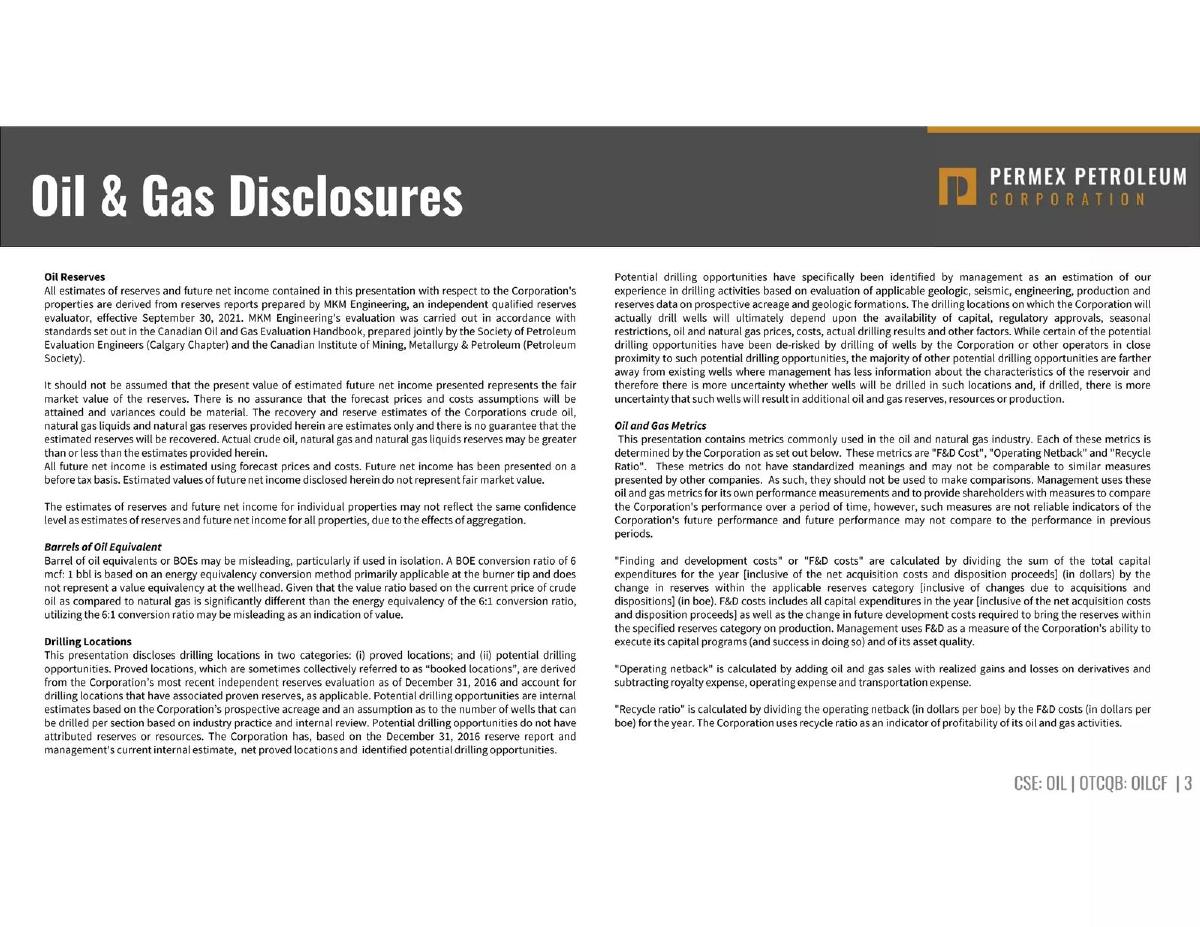
This is a mandatory regulatory slide for resource companies. It defines technical terms like BOE (Barrels of Oil Equivalent), F&D costs (Finding and Development), and Operating Netback. Crucially, it notes that reserves were evaluated by MKM Engineering, an independent qualified reserves evaluator. This slide serves to protect the company legally while providing the definitions necessary for an investor to interpret the subsequent data.
Slide 5: Permex Overview
This slide defines Permex as a "junior oil & gas company at an inflection point of growth." It maps out their assets across Texas and New Mexico. The value proposition is divided into three pillars: Assets (low-cost producing), Scale Upside (horizontal drilling), and Sustainable Upside (infill drilling and secondary recovery). The maps show a concentration in the Permian Basin, which is the most active oil field in the U.S.
Slide 7: Operational Progress
Slide 7 is the core 'momentum' slide. It details the 'Multi-Pronged Acquisition Strategy,' noting royalty interests in 73 wells. The most significant data point is the 'Transformational Purchase of Assets' in October 2021: 7,800+ acres that increased their total holdings by 290% to 11,700 acres. This acquisition is credited with increasing total reserves to approximately USD $285 million in PV-10 (present value at a 10% discount rate).
Slide 9: Stonewall County Assets
This slide zooms in on specific properties in Northwest Texas. It highlights the Pittcock North/South and Mary Bullard properties. The technical plan involves optimizing reservoirs through waterflood EOR (Enhanced Oil Recovery), re-entering 20 shut-in wells, and drilling 12+ new wells. This provides investors with a concrete 'to-do list' that management intends to execute to realize value.
Slide 11: Henshaw Property
Focusing on New Mexico, this slide identifies the Henshaw Property as a candidate for horizontal drilling. It sits on 1,880 net acres and targets highly sought-after formations like the Wolfcamp and Bone Springs. The inclusion of a detailed leasehold map (showing oil, shut-in, and injection wells) is standard for oil and gas decks to prove the physical footprint of the assets.
Slide 13: Directors & Advisory Board
In the junior resource sector, management pedigree is everything. This slide lists four directors and five technical advisors. The sheer volume of experience is the selling point here: J.P. Bryan (50+ years), Jay Lendrum (40+ years), and Wayne Schoen (40+ years). By listing former affiliations with majors like Gulf Canada, Amoco, and Shell, the company signals that it has 'big oil' expertise at the helm of a small-cap company.
Slide 15: Reserves – Valuation Comparable
This is the 'Ask' or 'Why Now' slide. It features two charts. The left chart shows 2P Reserves growing 172% to 24.5 million BOE in 2021. The right chart compares Permex’s Enterprise Value (EV) relative to those reserves against industry peers. It claims Permex trades at 0.04x EV/2P Reserves, while the industry average is 1.34x. This 20% decline in their multiple (despite rising reserves) is framed as a massive buying opportunity for investors.
Slide 19: Royalty Interest Summary
This table provides a breakdown of the 73 wells mentioned earlier. It lists high-profile operators like Marathon, ConocoPhillips, Apache, and Chevron. For a junior company, having interests in wells operated by these giants provides a layer of 'social proof' and technical validation, as these majors would not be drilling if the geology wasn't sound.
Slide 20: Contact Us
The final slide provides contact information for the company and its Investor Relations firm, MZ North America. It lists offices in Vancouver, Dallas, and Albuquerque, reflecting the cross-border nature of the company’s listing and operations.
What Permex Petroleum Does Well
The deck excels at technical transparency. In the oil and gas industry, investors look for third-party validation, and Permex consistently cites MKM Engineering and S&P Global Market Intelligence. The use of specific geological formation names (Wolfcamp, Clearfork, San Andres) speaks directly to the sophisticated energy investor who understands the production profiles of these specific zones.
The valuation comparable on slide 15 is a powerful tool. By showing a widening gap between reserve growth and share price valuation, the company creates a sense of urgency. It frames the investment not as a speculative bet on finding oil, but as a value play on oil that has already been found and audited.
What is Missing from the Deck
While the deck is strong on assets, it is light on detailed financial statements. There is no slide dedicated to the company's balance sheet, debt levels, or cash flow from operations. In a high-interest-rate environment or during periods of oil price volatility, an investor needs to know the company's 'burn rate' and debt maturity schedule, especially for a junior producer.
Furthermore, the deck lacks a clear timeline for the proposed drilling activities. While it mentions plans to drill 12+ wells, it does not specify the capital expenditure (CAPEX) required for these activities or the expected internal rate of return (IRR) for individual wells. Investors are left to guess the timing of the next production catalyst.
What a Founder Should Copy
Founders in asset-heavy industries should emulate the way Permex handles 'Social Proof.' By listing their royalty interests alongside industry titans like Exxon (XTO) and Chevron, they borrow the credibility of those larger organizations. If you are a small player in a large market, showing how your success is tied to the actions of market leaders is a smart way to de-risk the investment in the eyes of a skeptic.
Additionally, the 'Valuation Comparable' approach is highly effective for companies that feel the market is mispricing them. Instead of just saying "we are undervalued," Permex uses a specific metric (EV/2P Reserves) to prove it. Founders should identify the one or two metrics that define value in their specific niche and show how they stack up against the competition.
Frequently asked questions
- What is Permex Petroleum's primary geographic focus?
- According to slide 7, the company focuses exclusively on the Permian Basin of West Texas and Southeast New Mexico. This region is noted as the largest petroleum-producing basin in the United States. Their specific assets are located in counties such as Stonewall, Martin, and Howard in Texas, and Eddy County in New Mexico, targeting formations like the Clearfork, San Andres, and Wolfcamp.
- How has the company's reserve base changed recently?
- Slide 15 shows a significant upward trajectory in 2P (Proved + Probable) reserves. The company held 9.0 million BOE in 2018, which remained relatively flat through 2020 (9.5 million BOE). However, by 2021, reserves jumped 172% to 24.5 million BOE. Slide 7 attributes this growth to a 'transformational' purchase of 7,800 contiguous acres in October 2021.
- Who are the key operators for Permex's royalty interests?
- Permex holds royalty interests in 73 wells operated by major energy firms. Slide 19 provides a detailed summary, listing operators such as Marathon Oil Corporation (10 wells), ConocoPhillips (13 wells across multiple packages), EOG Resources (11 wells), and Double Eagle Energy (11 wells). This strategy allows Permex to benefit from production without the full overhead of direct operations on these specific sites.
- What is the management's technical background?
- The deck highlights a board and technical advisory team with deep legacy experience. Slide 13 lists directors like J.P. Bryan (50+ years experience, former CEO of Gulf Canada Resources) and Doug Urch (36+ years, former CFO of Bankers Petroleum). The Technical Advisory Board includes geologists and engineers with 20 to 40 years of experience each, including former roles at Amoco, BP, and Shell.
- What specific drilling opportunities does the company highlight?
- Slide 9 details the Stonewall County assets, specifically the Pittcock North/South properties, where they plan to optimize the reservoir by increasing water injection and drilling 12+ new wells. Slide 11 identifies the Henshaw Property in New Mexico as a candidate for horizontal drilling and waterflood EOR (Enhanced Oil Recovery), targeting the Wolfcamp and Bone Springs formations.