Schola's 12-slide pitch deck serves as a masterclass in beachhead strategy, focusing heavily on its dominance within the public charter school sector to secure a $10M Series A. The deck identifies a dual-sided pain point: families overwhelmed by school choice and schools struggling to meet enrollment goals. By reporting that 98% of its current clients are public charter schools (Slide 3), Schola demonstrates a concentrated, successful proof of concept. The narrative transition from a $327M Serviceable Addressable Market (SAM) in charters to a $21B Total Addressable Market (TAM) across all K-1…
Key takeaways
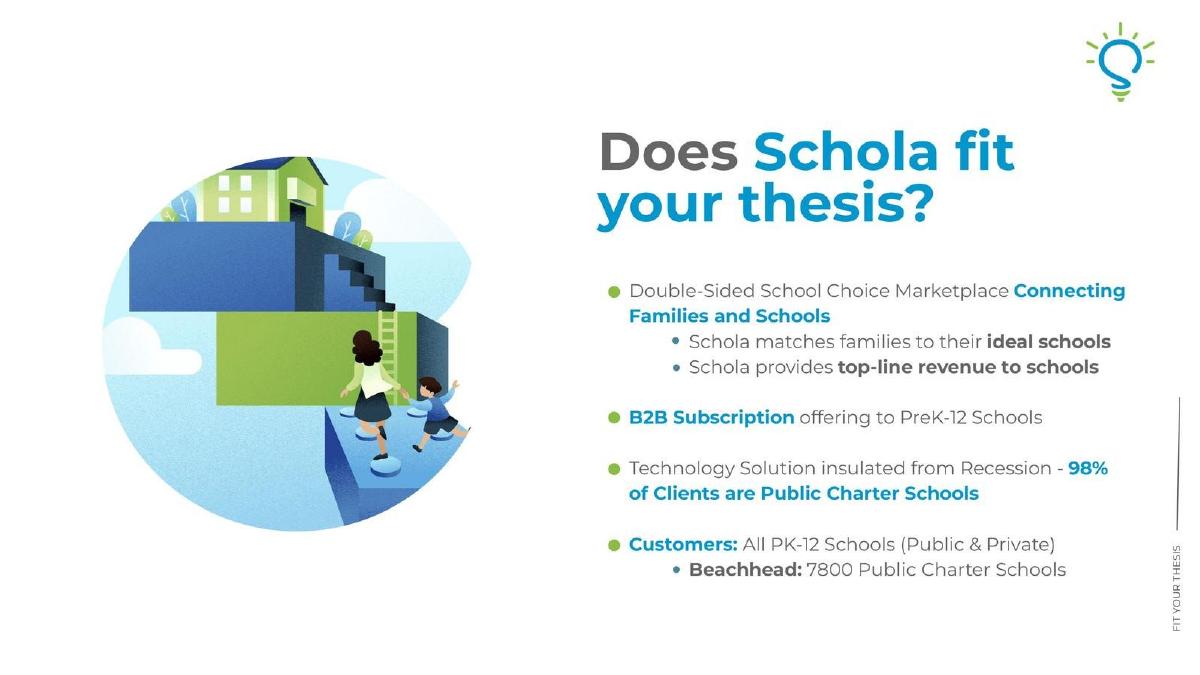
- The company positions itself as a recession-insulated technology solution because 98% of its current clients are public charter schools (Slide 3).
- Schola identifies its primary beachhead as the 7,800 public charter schools currently operating in the U.S. (Slide 3).
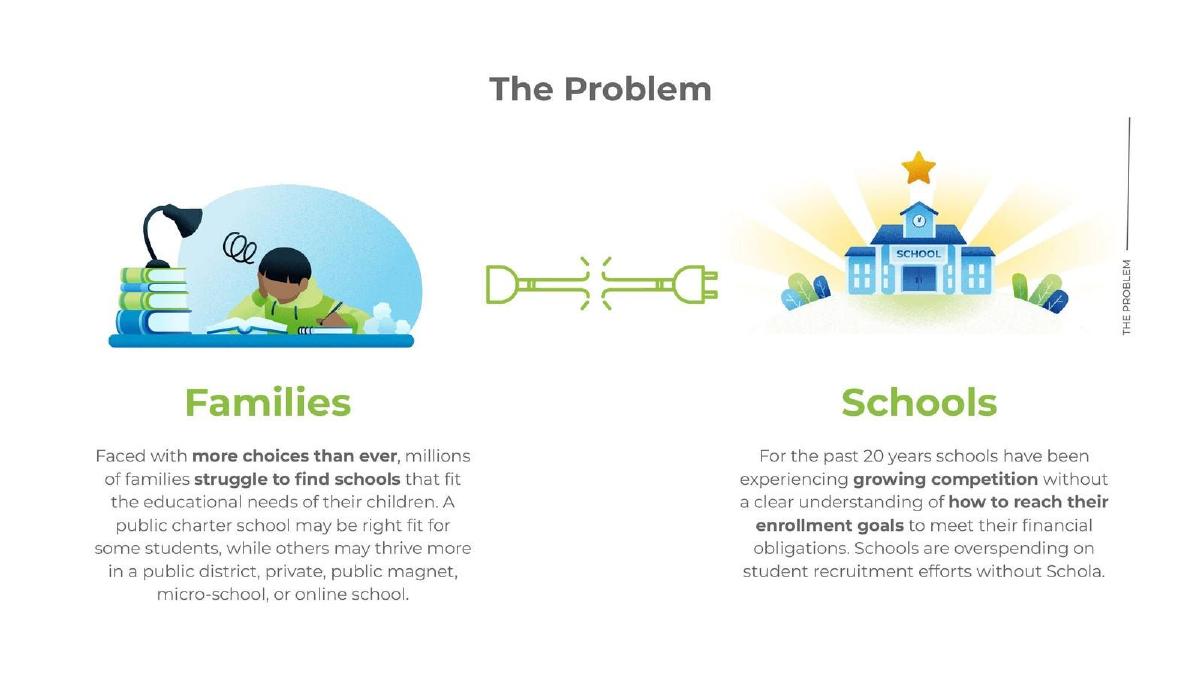
- The problem is framed as a double-sided inefficiency: families struggle with too many choices, while schools overspend on recruitment without clear data (Slide 5).
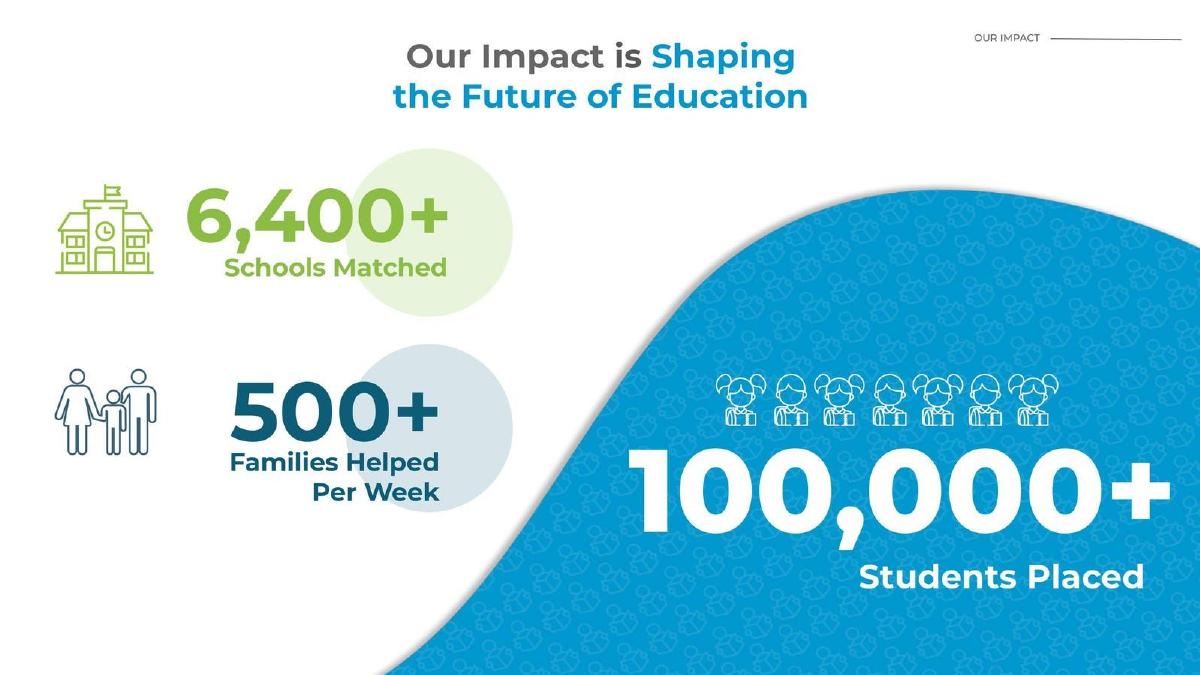
- Traction is highlighted by the placement of 100,000+ students and the matching of 6,400+ schools (Slide 9).
- The business model is a B2B subscription offering targeted at PreK-12 schools to provide top-line revenue through enrollment (Slide 3).
- Market sizing estimates the total recruitment and marketing spend across all U.S. K-12 schools at $21B (Slide 10).
- Schola aims to capture 40% of the charter school market, representing a $131M Serviceable Obtainable Market (SOM) (Slide 10).
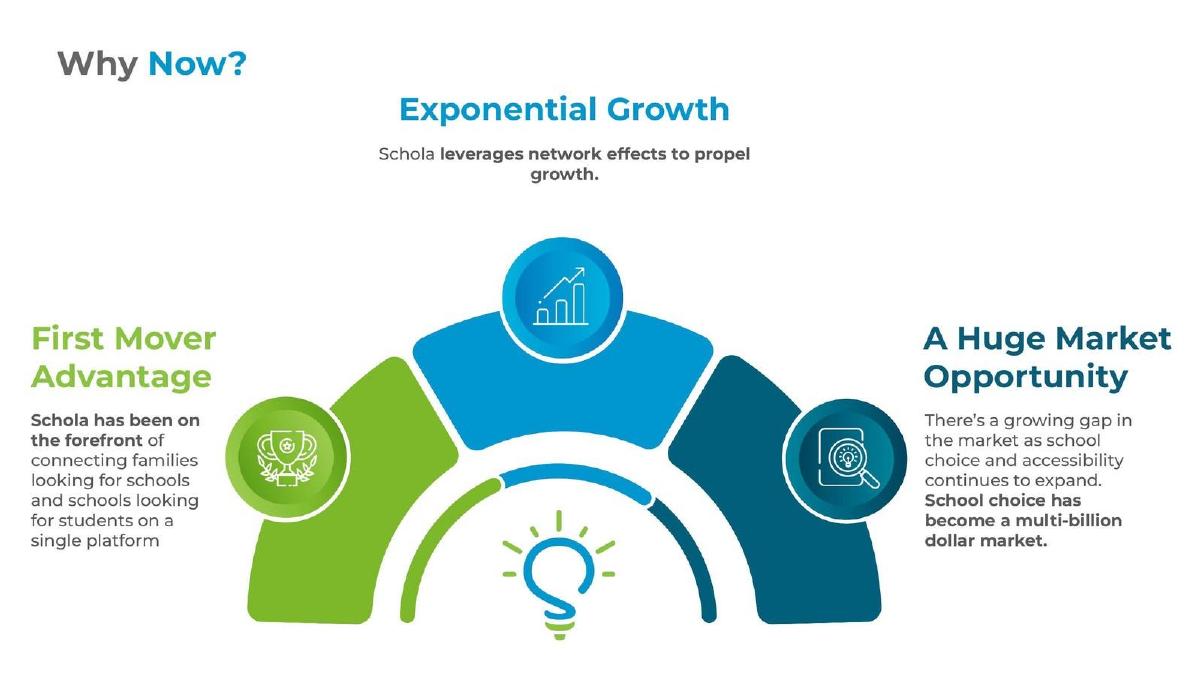
- The deck claims a 'First Mover Advantage' by being the first to put families and schools on a single platform (Slide 7).
Executive Summary: The $10M Series A Narrative
Schola’s pitch deck, used to secure a $10M Series A in 2024 as reported by Business Insider, is a lean 12-slide presentation that prioritizes market fit and traction over technical complexity. The company, headquartered in North America, operates in the Education sector, specifically focusing on the 'school choice' movement. By positioning itself as the connective tissue between families and schools, Schola addresses a fragmented market where recruitment spending is often inefficient. The deck’s strength lies in its clear identification of a beachhead market—public charter schools—and its ability to demonstrate significant scale with 100,000 students already placed.
Slide 1-2: Branding and Introduction
The deck opens with a clean, light blue aesthetic featuring a school building illustration and the tagline: 'Unlocking Every Child’s Full Potential. Brighter Minds = Brighter Future.' Slide 2 serves as a formal welcome, maintaining the blue and white color palette. These slides establish a professional, mission-driven tone suitable for the EdTech space, though they contain no hard data or value propositions.
Slide 3: The Thesis and Beachhead
Slide 3 is arguably the most important slide for an investor. It explicitly asks, 'Does Schola fit your thesis?' and provides four high-level bullet points. It defines the product as a 'Double-Sided School Choice Marketplace' and a 'B2B Subscription' for PreK-12 schools. Crucially, it notes that the solution is 'insulated from Recession' because 98% of clients are Public Charter Schools. It identifies a specific beachhead of 7,800 Public Charter Schools, signaling to investors that the company has a focused, repeatable go-to-market strategy before expanding to the broader K-12 market.
Slide 4: Founder and Team Overview
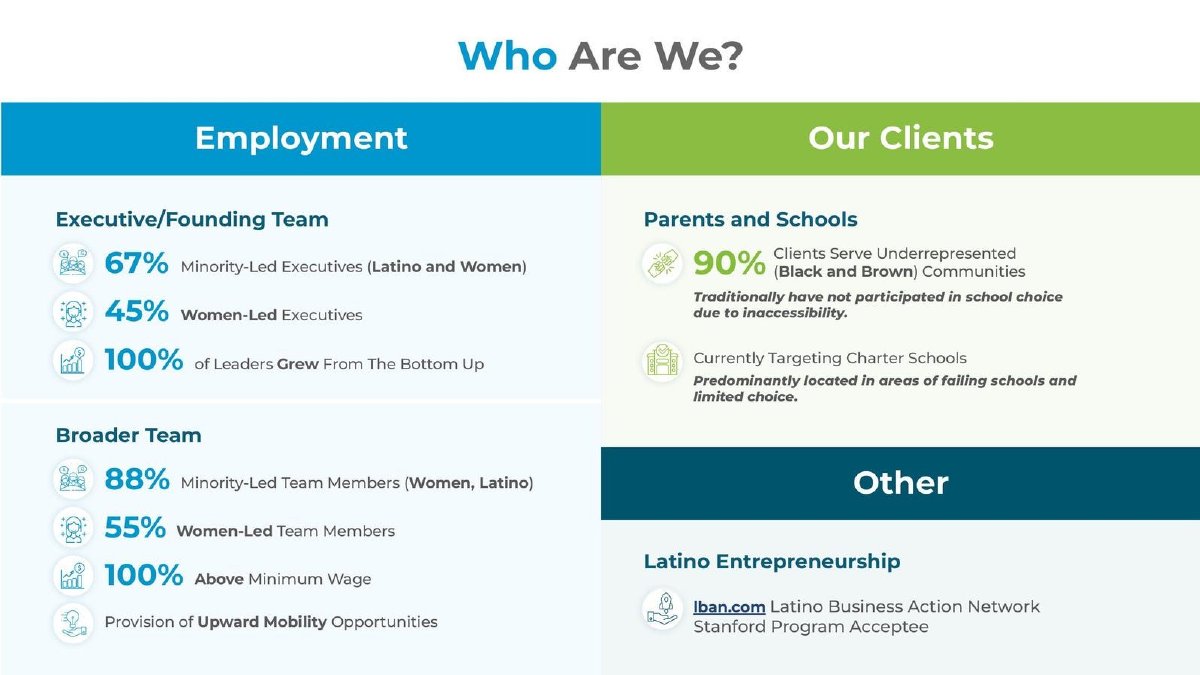
Slide 4 uses blue and green charts to present facts about the 'Schola makeup' and the founders. While the provided text is brief, this slide typically serves to establish the 'Why Us?' narrative. In a Series A deck, investors look for deep domain expertise in education or marketplace operations. The inclusion of charts suggests a data-driven leadership team.
Slide 5: The Problem Statement
Slide 5 breaks the problem down into two segments: Families and Schools. For families, the issue is 'more choices than ever' leading to a struggle to find the right fit among charter, district, private, magnet, and micro-schools. For schools, the problem is 'growing competition' and a lack of understanding regarding 'how to reach their enrollment goals.' The slide explicitly states that schools are 'overspending' on recruitment without Schola, framing the platform as a cost-saving and revenue-generating necessity.
Slide 6: The User Persona
Slide 6 features four students from different fields and schools. This is a classic 'persona' slide, humanizing the data by showing the diversity of educational needs the platform serves. It reinforces the idea that 'fit' is subjective and varied, requiring a sophisticated matching engine rather than a simple directory.
Slide 7: Why Now and Business Components
Slide 7 addresses the 'Why Now?' question using a semi-circular graphic. It cites three pillars: First Mover Advantage, Exponential Growth (leveraging network effects), and a Huge Market Opportunity. It notes that 'school choice has become a multi-billion dollar market,' positioning Schola as the primary beneficiary of this systemic shift in the American education landscape.
Slide 8: The Business Model
Slide 8 uses blue and green charts to detail the business model. While the exact pricing tiers are not listed in the text, the slide confirms the B2B subscription nature of the business. For a Series A, this slide needs to convince investors that the Lifetime Value (LTV) of a school subscription significantly outweighs the Cost of Acquisition (CAC), especially given the long sales cycles typical in the education sector.
Slide 9: Traction and Impact
Slide 9 provides the 'proof of life' for the marketplace. It reports three key metrics: 6,400+ schools matched, 500+ families helped per week, and a headline figure of 100,000+ students placed. The '100,000+' figure is the primary anchor for the deck’s credibility, suggesting that the platform has already achieved significant liquidity in its marketplace.
Slide 10: Market Sizing (TAM/SAM/SOM)
Slide 10 uses concentric circles to visualize the market. The Total Addressable Market (TAM) is cited as $21B, representing all K-12 recruitment and marketing dollars in the U.S. The Serviceable Addressable Market (SAM) is $327M, representing the 7,800 charter schools. The Serviceable Obtainable Market (SOM) is $131M, which Schola believes it can capture with a '40% of the charter school market' share. This is a realistic and well-reasoned market slide that shows a clear path to $100M+ in revenue just within the beachhead segment.
Slide 11-12: Growth Plans and Conclusion
Slide 11 outlines growth plans through three concentric circles, likely representing the expansion from charters to private schools and eventually to the broader public district market. Slide 12 closes with a city scene and the text 'brighter future,' mirroring the opening slide’s optimism.
What Works in the Schola Deck
Specific Beachhead Strategy: By identifying that 98% of their clients are charter schools, Schola avoids the 'boiling the ocean' trap. They show they have mastered a specific, high-intent niche before moving to the $21B broader market. This focus is highly attractive to Series A investors who want to see a repeatable sales motion.
Clear Value Proposition: The deck doesn't hide behind jargon. It states plainly that schools are overspending on recruitment and that Schola provides 'top-line revenue' by fixing enrollment. In the B2B world, 'we make you money' is always a stronger pitch than 'we provide a nice tool.'
Marketplace Liquidity: The metric of 100,000 students placed is a massive number for an EdTech startup. It proves that the 'matching' isn't just theoretical—it's happening at scale. The '500 families per week' metric also suggests consistent, ongoing usage rather than one-off seasonal spikes.
What Is Missing from the Schola Deck
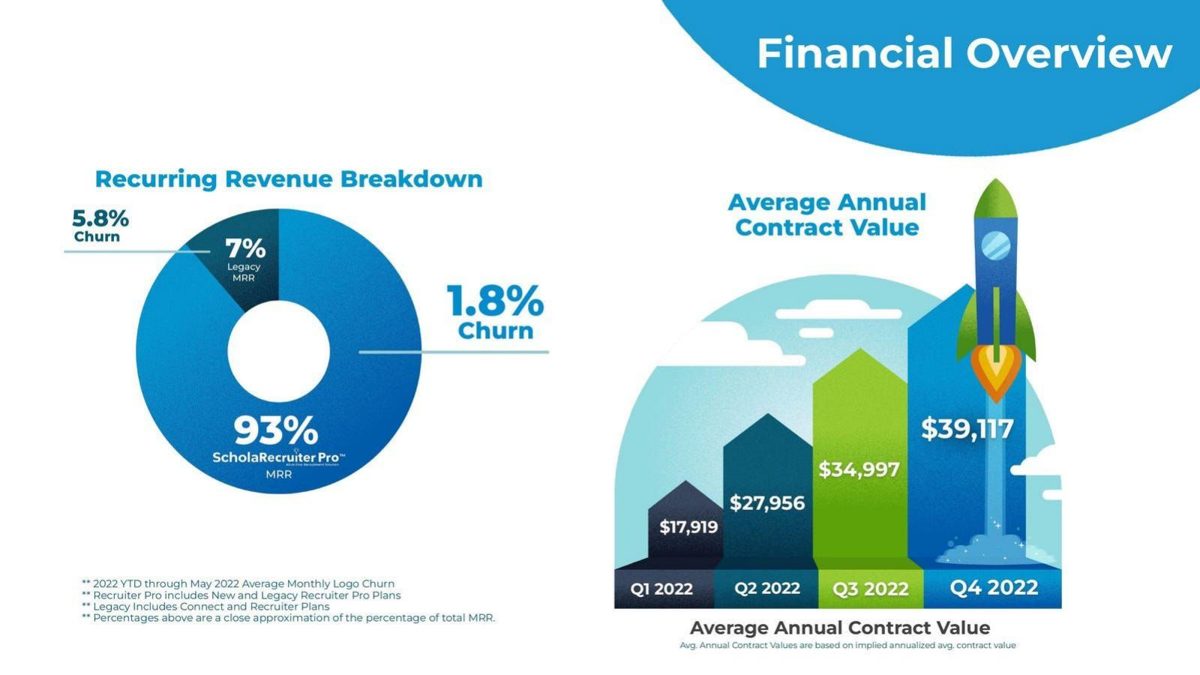
Unit Economics: While the deck mentions a B2B subscription model, it lacks specific data on Average Revenue Per User (ARPU), Churn, or LTV/CAC ratios. For a $10M raise, investors usually require a deep dive into the efficiency of the capital being deployed.
Competitive Landscape: The deck claims a 'First Mover Advantage' but does not name any competitors. In the school choice and enrollment space, there are established players and legacy CRM systems. Omitting a competitive matrix can sometimes make a founder look unaware of the market's complexity.
The 'Ask' and Use of Funds: The provided slide text does not include a specific 'Ask' slide detailing how much they are raising or how the $10M will be spent (e.g., % to sales, % to engineering). While this is often handled in a separate document or verbal pitch, its absence in the primary deck leaves the narrative unfinished.
Founder Takeaways: What to Copy
The 'Thesis' Slide: Slide 3 is a brilliant way to qualify an investor immediately. By listing the four reasons Schola fits a venture thesis (Marketplace, B2B Sub, Recession-Insulated, Beachhead), the founders force the investor to agree with the fundamental premises of the business before getting into the weeds.
Dual-Sided Problem Framing: If you are building a marketplace, copy Slide 5's approach. Don't just explain why the buyer needs you; explain why the seller is desperate too. Showing the 'broken connection' between the two sides makes the solution feel inevitable.
Conservative SOM: Many founders claim they will capture 1% of a $100B market, which feels arbitrary. Schola claims 40% of a $327M market. This feels much more achievable and grounded in their current 98% focus on that specific segment. It shows they understand their 'pond' and know how to dominate it.
Frequently asked questions
- What is Schola's core business model?
- Schola operates a double-sided marketplace that connects families with schools. According to Slide 3, the company generates revenue through a B2B subscription model offered to PreK-12 schools. The value proposition for schools is increased top-line revenue through improved student enrollment and more efficient recruitment spending compared to traditional methods.
- How does Schola define its target market?
- Schola uses a tiered market approach. As shown on Slide 10, their Total Addressable Market (TAM) is the $21B spent on K-12 recruitment in the U.S. Their Serviceable Addressable Market (SAM) is the $327M charter school segment, and their Serviceable Obtainable Market (SOM) is $131M, based on capturing 40% of that charter segment.
- What traction has Schola achieved to date?
- Slide 9 outlines significant traction metrics: the platform has matched over 6,400 schools and helped more than 500 families per week. Most notably, the company claims to have placed over 100,000 students into schools through its platform, providing a strong data point for the effectiveness of its matching algorithm.
- Why does Schola focus on public charter schools?
- Slide 3 notes that 98% of Schola's current clients are public charter schools. The company views this as a 'beachhead' strategy, targeting the 7,800 charter schools in the U.S. first. They argue this makes the business recession-insulated, as charter schools are publicly funded but operate with the competitive recruitment needs of private entities.
- What specific problem is Schola solving for schools?
- According to Slide 5, schools have faced growing competition for the past 20 years. Many schools lack a clear understanding of how to reach enrollment goals and are 'overspending on student recruitment efforts' without the data analytics or platform reach that Schola provides.