Scalestack’s 2023 Seed deck is a masterclass in identifying a specific, painful bottleneck within a crowded market. By focusing exclusively on the 'Target' stage of the sales funnel—which they argue remains 'archaic and underdeveloped'—the company differentiates itself from generic CRMs and sales engagement tools. The deck leans heavily on social proof, featuring a detailed two-slide case study on MongoDB that claims 'over $XXM in revenues' generated through the platform. While the financial data is redacted in this public version, the narrative clearly articulates a transition from manual, o…
Key takeaways
- The founders emphasize deep domain expertise, with CEO Elio Narciso noting his background as a 4X founder with 2 exits and experience at AWS (Slide 2).
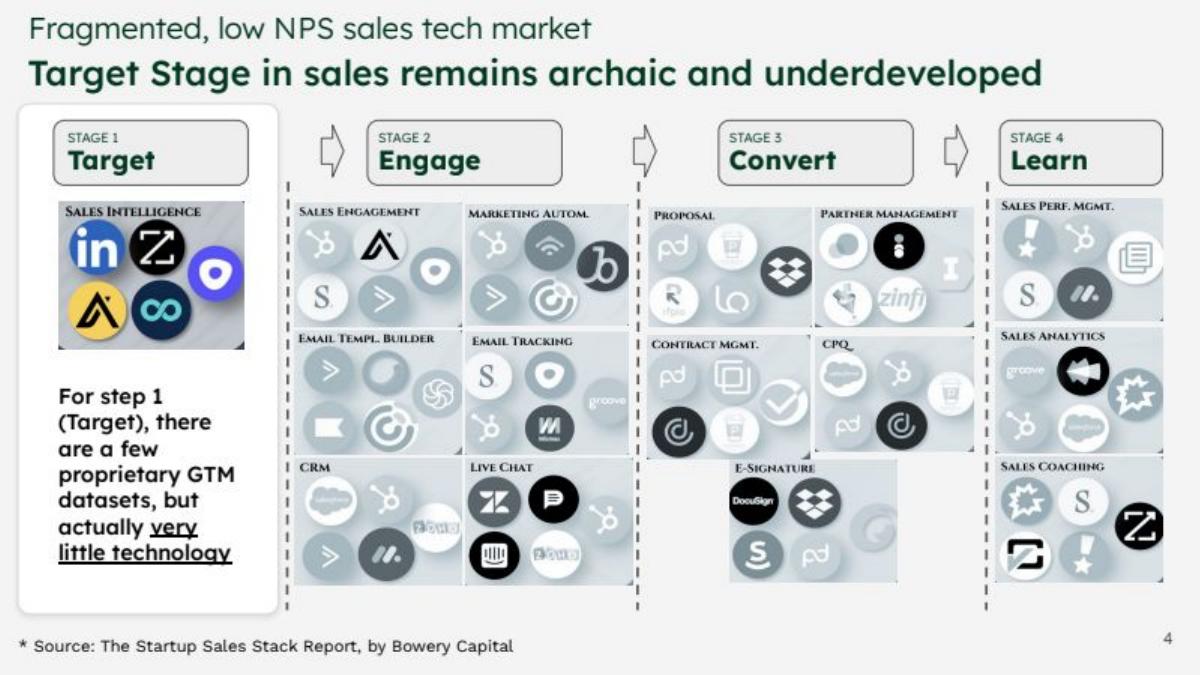
- Scalestack identifies a massive gap in the 'Target' stage of sales, noting that while many datasets exist, there is 'actually very little technology' to manage them (Slide 4).
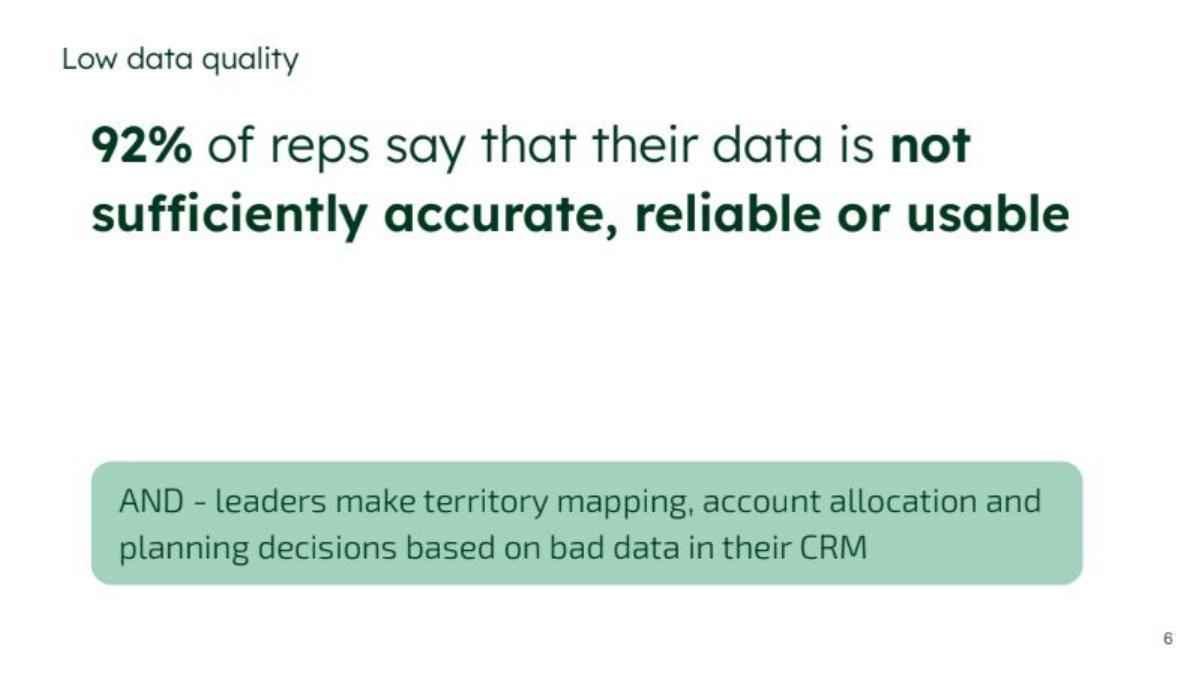
- The deck cites a significant pain point: 92% of sales reps report their data is not sufficiently accurate or usable (Slide 6).
- Social proof is a core pillar of the deck, highlighting MongoDB and Typeform as marquee customers (Slide 3).
- A specific customer story for MongoDB illustrates the shift from 'stale, inaccurate' offshore manual data to 'always fresh, well-prioritized data' (Slide 10).
- The platform's ROI is quantified through a testimonial claiming 'over $XXM in revenues' for MongoDB (Slide 11).
- Scalestack positions itself as 'middleware' in the AI stack, sitting between foundation models and external data sources (Slide 16).
- The market opportunity is segmented by company size, targeting an initial $2.6B market of B2B companies with 500+ employees (Slide 14).
Executive Summary and Team
Slides 1-2: The Foundation
Scalestack opens with a clean, minimalist title slide (Slide 1) that immediately defines the product: an "All-In-One AI-powered Sales Ops Platform." This is a high-level positioning statement that sets the stage for a technical but GTM-focused solution.
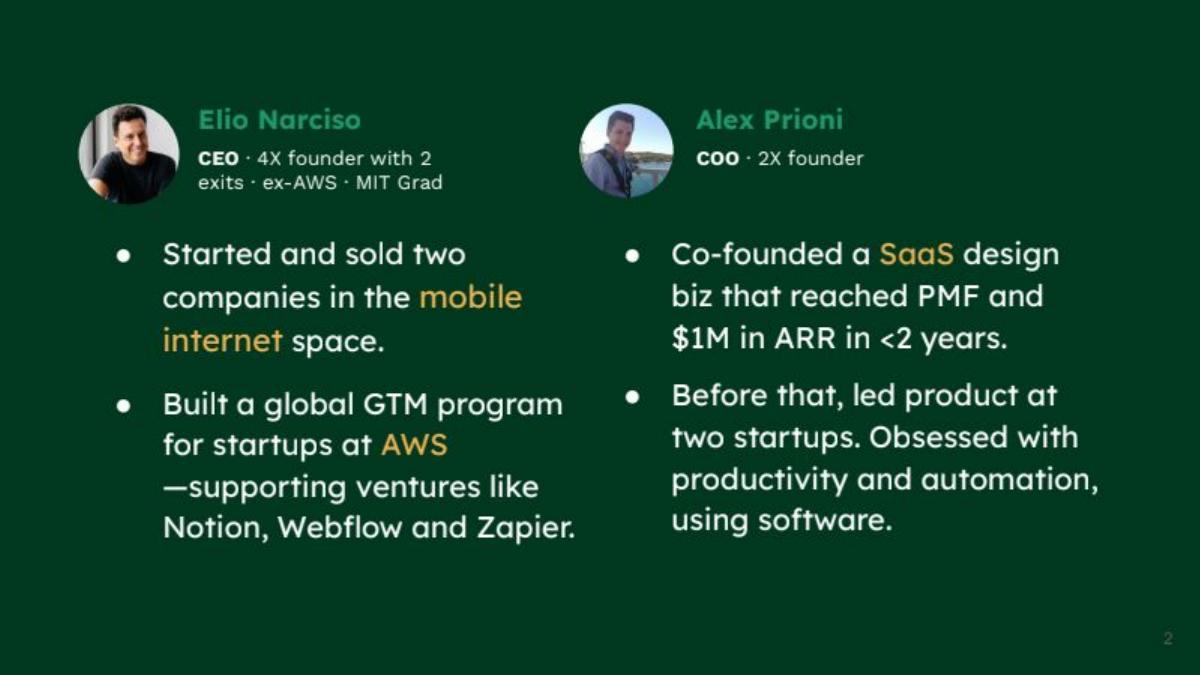
The team slide (Slide 2) is exceptionally strong for a Seed round. CEO Elio Narciso is introduced as a "4X founder with 2 exits" and a former AWS leader who built GTM programs for unicorns like Notion and Zapier. COO Alex Prioni complements this with a background as a "2X founder" who reached $1M ARR in less than two years at a previous SaaS venture. By highlighting both exit experience and specific GTM scaling experience at AWS, the founders establish immediate credibility in the Sales Ops space.
Traction and Market Pain
Slides 3-7: The Problem Landscape
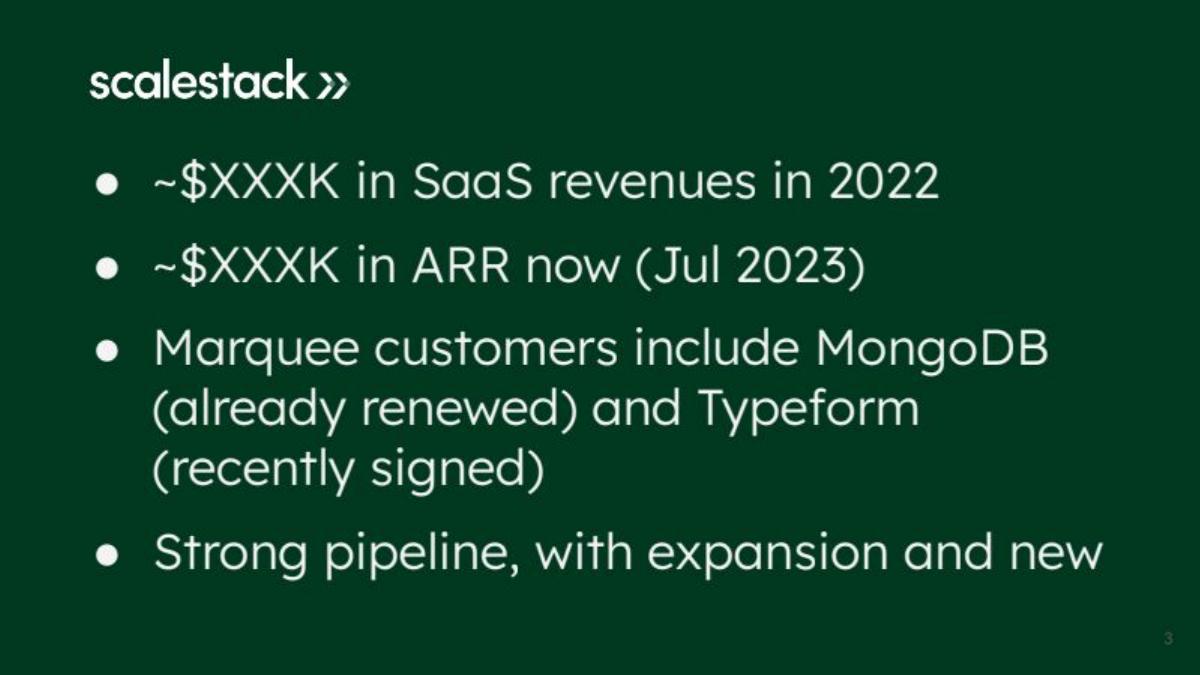
Slide 3 provides a high-level traction overview. While the specific revenue figures are redacted as "~$XXXXK," the slide names MongoDB (renewed) and Typeform (recently signed) as marquee customers. This early validation from enterprise-grade companies is a critical signal for investors.
The deck then moves into a sophisticated problem breakdown. Slide 4 uses a four-stage sales funnel (Target, Engage, Convert, Learn) to argue that while the later stages are saturated with tools, the "Target" stage remains "archaic and underdeveloped." They cite the Bowery Capital Startup Sales Stack Report to show that this stage lacks actual technology, relying instead on raw datasets.
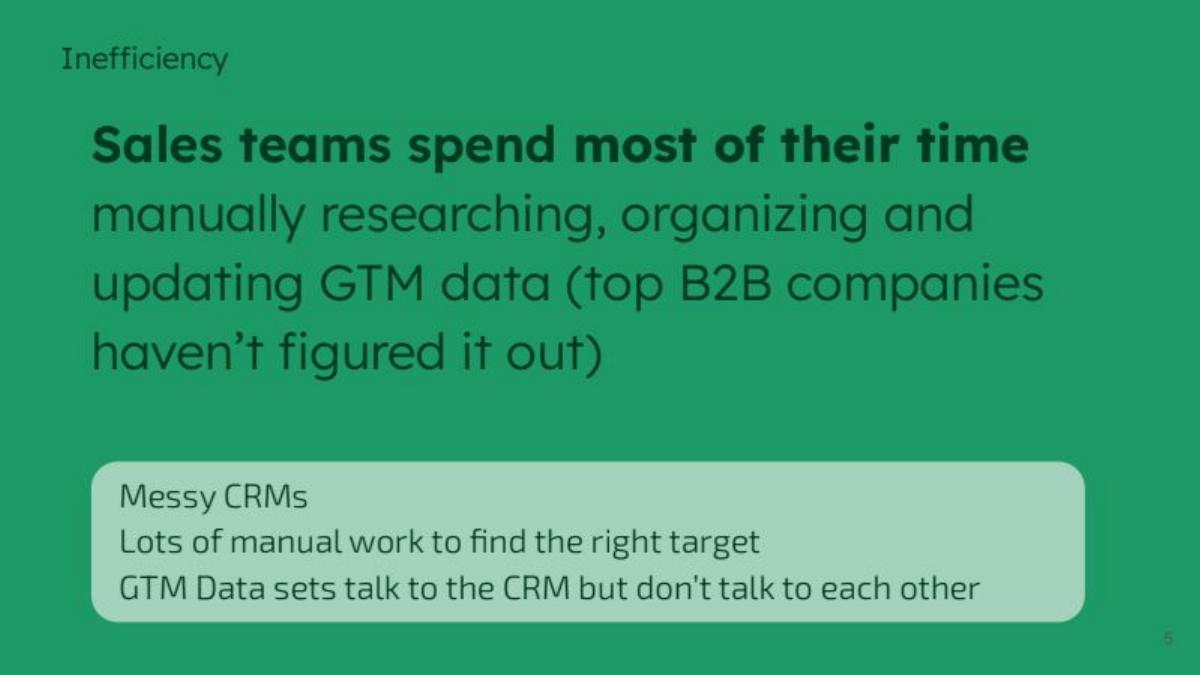
Slides 5 and 6 quantify the pain. Slide 5 highlights that sales teams are bogged down by manual research and "Messy CRMs." Slide 6 delivers a powerful punchline: 92% of reps say their data is not sufficiently accurate or usable. This identifies a clear gap between the availability of data and its utility. Slide 7 identifies the "worried buyer": Sales and Marketing Ops leaders who are "losing sleep" over pipeline generation and data curation.
The Solution and Product
Slides 8-13: AI-Driven Orchestration
The solution is introduced on Slide 8: Scalestack AI brings GTM data together, suggests prioritized actions, and helps reps execute sales plays with context. This is not just a database; it is an orchestration layer. Slide 9 reinforces this by stating that "Daily, >XK of reps across X customers are being more productive."
The deck spends two slides (10 and 11) on a MongoDB Customer Story . This is the heart of the deck's proof of concept. It contrasts the "Before" (offshore manual teams, stale data) with the "After" (unified view, automated integrations, fresh data). The quote from James Underhill, Senior Director of Sales Ops at MongoDB, claiming "over $XXM in revenues" is a definitive ROI statement that justifies the platform's cost.
Slides 12 and 13 provide a look at the product interface. They highlight "Universal APIs," "Data orchestration," and "AI-driven workload prioritization." Slide 13 specifically focuses on "GenAI for Sales," showing how the platform can find information about companies from sources like Apollo and Zoominfo and suggest actionable steps in the sales process. This positions Scalestack as a smart layer on top of existing data providers.
Market Size and Competition
Slides 14-16: Positioning for Scale
Slide 14 breaks down a $56B+ Total Market Opportunity . Refreshingly, the deck doesn't just claim a giant number; it segments the opportunity over time. They start with a $2.6B core market of 13K B2B companies with 500+ employees, then expand to mid-market and small businesses over a 5-year horizon. This shows a realistic, staged GTM strategy.
Slide 15 addresses differentiation. Scalestack positions itself against three categories: CRMs (where data goes to die), S&M Automation (which focuses on the bottom of the funnel), and Intelligence/Data Sets (which are generic and horizontal). Scalestack’s "Universal API" is the differentiator, creating custom datasets based on a specific company's ICP.
Slide 16 provides a "Positioning (AI perspective)" using a diagram of the Generative AI Stack. It defines Scalestack as "middleware" for sales ops. This is a crucial slide for 2023-era investors, as it explains exactly where the company sits in the rapidly evolving AI ecosystem—not as a foundation model, but as the orchestration layer that makes models useful for specific business actions.
The Future and The Close
Slides 17-19: Why Now?
Slide 17 provides the "Why Now?" argument, suggesting that every profession will have an AI Copilot within two years. They use GitHub Copilot as a benchmark, noting that developers using it completed tasks 55% faster. The implication is that Scalestack will do for sales what Copilot did for coding.
The deck concludes on Slide 18 with a simple "Join us!" and contact information. Notably, there is no slide detailing the specific investment amount, valuation, or use of funds in this version of the deck. Slide 19 is a standard promotional slide for the source library.
What Scalestack Does Well
Enterprise Validation: Using MongoDB as a primary case study is incredibly effective. It moves the conversation from "this might work" to "this works for one of the best sales organizations in tech." · Specific Problem Identification: By focusing on the "Target" phase and calling it "archaic," they avoid being seen as just another CRM or email sequencer. · Technical Positioning: Defining themselves as "middleware" in the AI stack (Slide 16) is a smart way to appeal to technical VCs who are wary of "wrapper" startups. · Founder-Market Fit: The team's background at AWS and in previous SaaS startups makes them the ideal candidates to solve a Sales Ops problem.
What is Missing from the Deck
The Ask: There is no mention of how much capital is being raised or what the specific milestones for the next 18 months are. · Unit Economics: While they mention ACV ranges on the market slide ($50K to $200K+), they don't provide their own current CAC, LTV, or payback periods. · Product Roadmap: The deck focuses heavily on the current state of the "Target" phase but doesn't detail what specific features are coming next to expand into the "Engage" or "Convert" phases. · Churn/Retention Data: While they mention MongoDB renewed, broader retention metrics across their "X customers" are absent.
What Other Founders Should Copy
The Funnel Gap Analysis: Slide 4 is a great example of how to visualize a crowded market and point to the one specific area that is underserved. · The "Before and After" Case Study: Slide 10 is a perfect template for a B2B case study. It clearly identifies the old way of doing things, the new way, and the resulting efficiency gains. · Staged Market Sizing: Instead of one giant TAM number, Slide 14 shows a realistic path to growth by segmenting the market by company size and time. · Strategic Use of Logos: Slide 9 uses customer logos not just for vanity, but to support the claim that the product is being used "Daily" by productive reps.
Frequently asked questions
- What is the primary problem Scalestack is solving?
- Scalestack addresses the inefficiency in the 'Target' phase of the sales process. According to Slide 5, sales teams spend most of their time manually researching and updating GTM data because existing datasets don't communicate with each other. This leads to 'Messy CRMs' and a situation where 92% of reps find their data unusable (Slide 6).
- How does Scalestack differentiate itself from competitors like ZoomInfo or Outreach?
- On Slide 15, Scalestack explains that CRMs are 'where data goes to die' and sales automation tools like Outreach focus on the bottom of the funnel. Unlike proprietary datasets like ZoomInfo, which are 'generic and horizontal,' Scalestack uses a universal API to combine multiple sources into custom datasets based on a company's specific Ideal Customer Profile (ICP).
- What evidence of product-market fit does the deck provide?
- The deck provides strong evidence through its customer list and case studies. Slide 3 mentions that MongoDB has already renewed and Typeform recently signed. Slides 10 and 11 provide a deep dive into the MongoDB relationship, showing a transition from manual offshore teams to automated orchestration, resulting in millions in revenue.
- What is Scalestack's long-term market vision?
- Scalestack views itself as part of the 'Generative AI Stack.' Slide 16 positions the company as 'middleware' that brings internal and 3rd party data together to power personal agents and copilots. They predict that within two years, every profession will have its own AI agent (Slide 17), and they intend to be the data engine for sales agents.
- Is the financial 'Ask' included in the deck?
- No, the provided slides do not include a specific 'Ask' or 'Use of Funds' slide. While the catalogue data indicates a $2.8M Seed round was raised in 2023, the deck itself concludes with a 'Join us!' call to action on Slide 18 without specifying the investment terms or capital requirements.