Cipher Skin’s Series A deck is a study in horizontal hardware application. By defining their market not by industry, but by geometry—'a world made of cylinders and flat surfaces'—they successfully bridged the gap between high-performance athletics and industrial infrastructure. The deck highlights their 'Digital Mirror' technology, which translates trillions of data points into 3D visualizations. While the deck is heavy on product vision and use cases, it relies on a 'Customer-Sponsored Co-Development' model to prove market fit, moving from 90-day pilots to multi-year data subscriptions. Desp…
Key takeaways
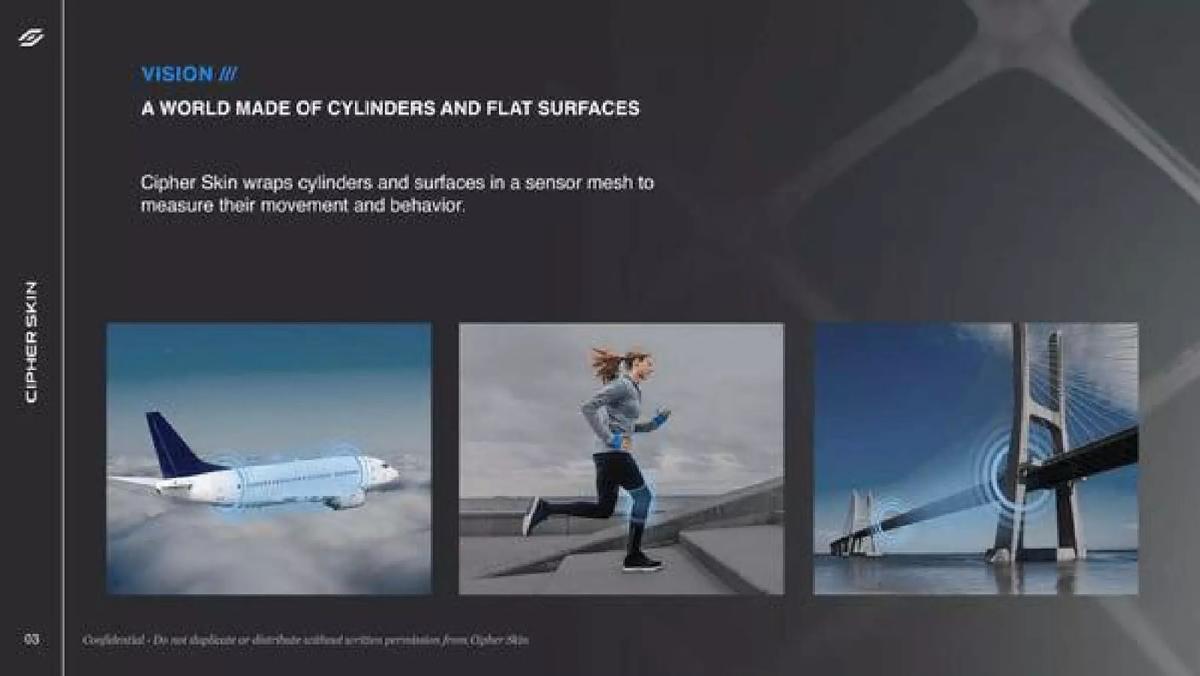
- The company defines its total addressable market through geometry, targeting any 'cylinders and flat surfaces' rather than a single vertical (Slide 3).
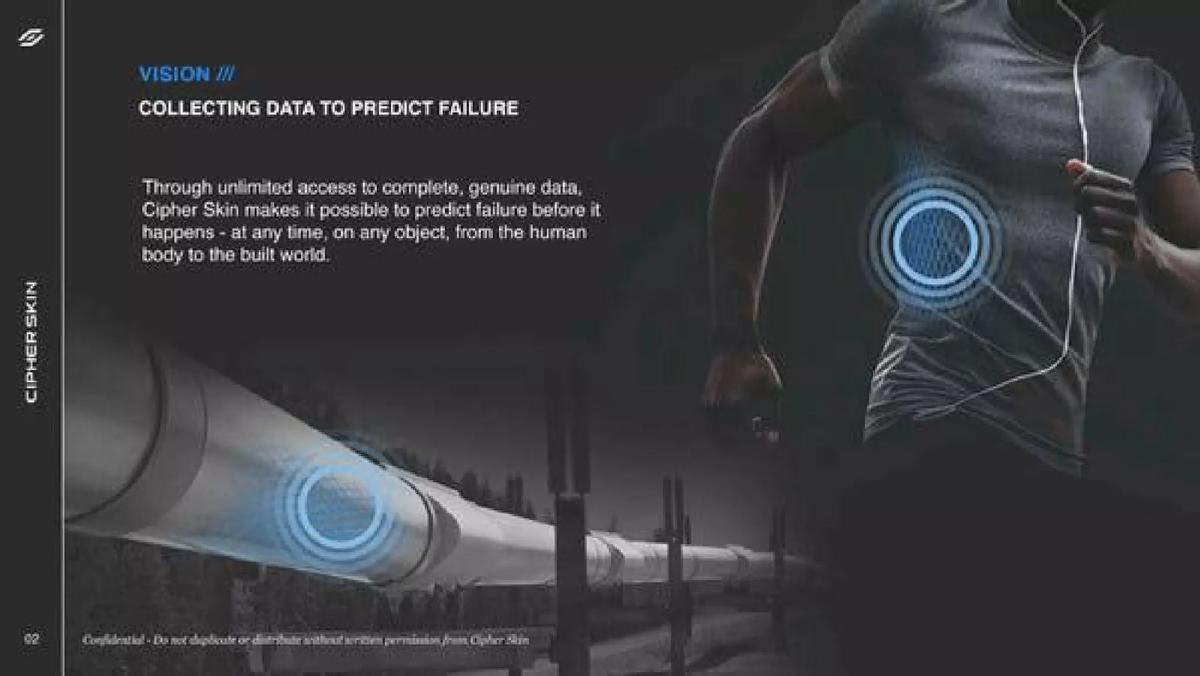
- Cipher Skin positions its value proposition as 'predicting failure' by capturing a complete picture of an object in time and space (Slide 5).
- The 'Digital Mirror' software is the core product interface, modeling movement in 3D to provide real-time representation (Slide 7).
- The go-to-market strategy relies on a 90-day 'Customer-Sponsored Co-Development' phase to convert partners into long-term subscribers (Slide 12).
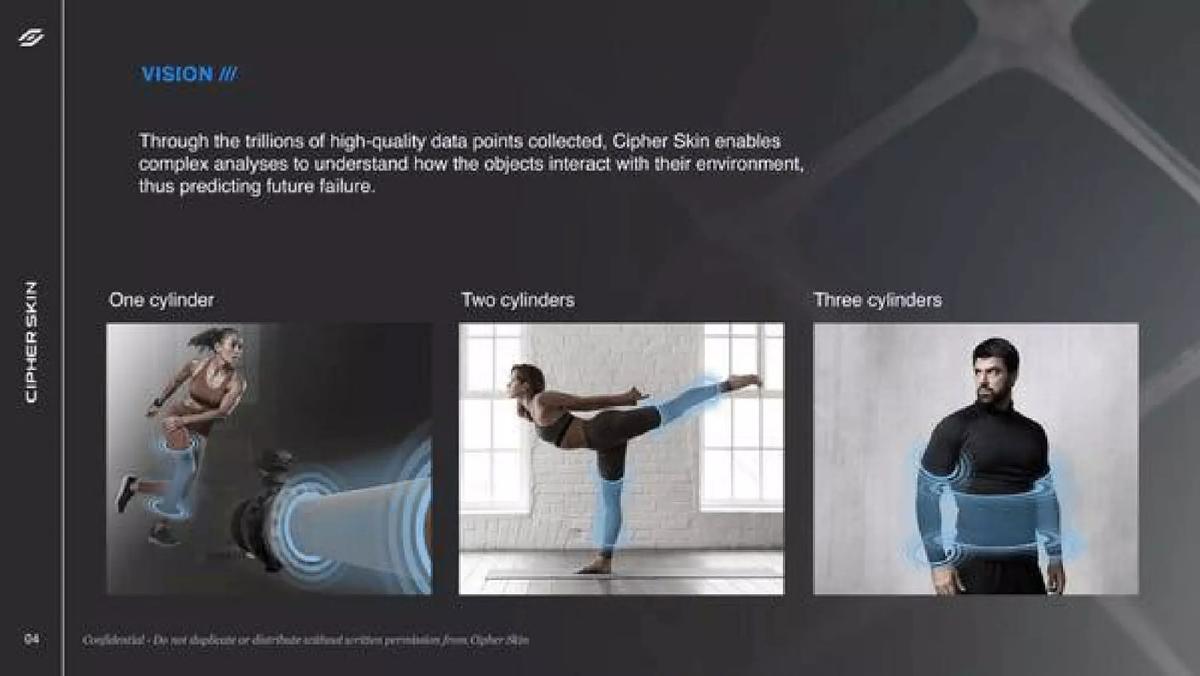
- The product roadmap is structured by complexity, moving from one cylinder (sleeves) to two (leggings) to three (tee-shirts) over 36 months (Slide 11).
- Industrial applications, such as the 'Pipe Sleeve' for breach detection, are presented alongside athletic recovery tools to demonstrate versatility (Slide 8).
- The team slide emphasizes deep academic and technical expertise, featuring a Chief Scientific Officer with a Ph.D. in heart rate variability (Slide 26).
- Funding allocation is explicitly mapped to specific engineering, marketing, and operational hires, including a 'Data Scientist' and 'Full Stack Software Engineer' (Slide 11).
Executive Summary: The Geometric Approach to IoT
Cipher Skin’s 2015 Series A deck is a compelling example of how to pitch a horizontal technology platform. Rather than pigeonholing themselves as a 'wearables' company or an 'industrial IoT' company, they framed their technology around the physical shapes it can monitor. By claiming a vision for 'a world made of cylinders and flat surfaces,' they effectively expanded their potential market to include everything from a human athlete's limb to an oil pipeline. This teardown explores how they used technical depth and a structured co-development model to raise $7.8 million.
Slide 1-3: The Vision and The Geometry
The deck opens with a high-contrast, dark aesthetic, immediately signaling a 'deep tech' or 'industrial' tone. The title slide (Slide 1) introduces the tagline: "Predicting failure with authentic data." This is a high-stakes value proposition that applies equally to a bridge collapsing or an athlete tearing an ACL.
Slide 3 is the most strategic slide in the deck. It defines their vision as "A world made of cylinders and flat surfaces." By showing three distinct images—an airplane fuselage, a runner's leg, and a bridge pylon—they visually demonstrate the versatility of their sensor mesh. This prevents the investor from thinking the company is 'just' a fitness tracker, which was a crowded and low-margin space in 2015.
Slide 5-7: The Problem and The Digital Mirror
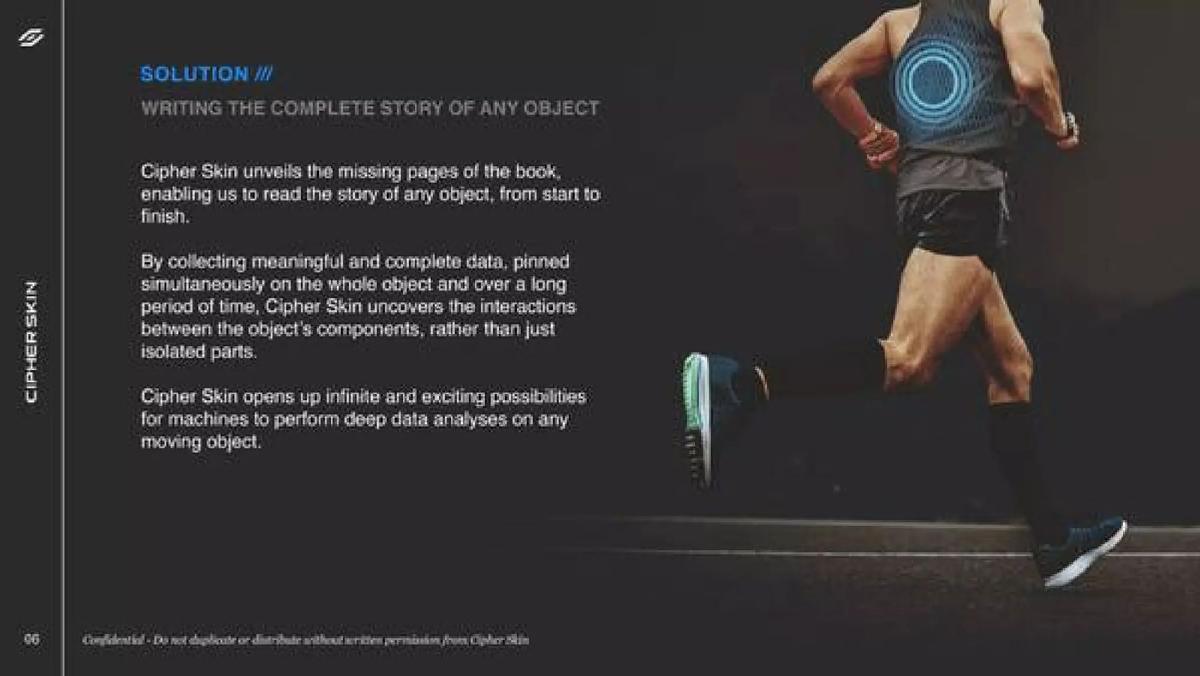
Slide 5 uses the metaphor of "A book with missing pages" to describe current data collection. They argue that existing technology can measure individual pieces of data but cannot capture a "complete picture of an object and its behavior, in time and space." This sets the stage for their solution: the sensor mesh.
Slide 7 introduces the "Digital Mirror™," their real-time data visualization software. The slide claims to collect "trillions of data points" which are transmitted wirelessly to model movement in 3D. The visual shows an iPad interface displaying heart rate, blood pressure, O2 saturation, and respiration rate, alongside a 3D wireframe of a runner. This slide bridges the gap between raw hardware (the mesh) and actionable insights (the software).
Slide 8 & 11: Product Versatility and The Roadmap
Slide 8 introduces the "Cipher Skin Smart Sleeve." Interestingly, they present two versions side-by-side: the "Knee BioSleeve" for training and recovery, and the "Pipe Sleeve" for pipe monitoring and breach detection. This is a bold move for a Series A company, as it suggests they are pursuing two very different sales cycles simultaneously. However, the underlying hardware is presented as identical, which justifies the dual focus.
Slide 11 provides the "Why Invest Now" logic. They break down their commercialization roadmap by the number of cylinders involved. Within 12 months, they aim for full commercialization of the sleeve (one cylinder). By 24 months, leggings (two cylinders). By 36 months, a tee-shirt (three cylinders). This is a clever way to communicate technical difficulty and manufacturing scaling. The right side of the slide details the use of Series A funds, specifically listing roles like "Data Scientist," "QA Engineer," and "Customer Success Manager."
Slide 12: The Business Model
One of the most critical slides for a hardware startup is the go-to-market strategy. Slide 12 outlines their "Customer-Sponsored Co-Development" model. It is a three-step process: purchase of a product package, a 90-day testing and feedback phase, and finally, a "multi-year customer partnership." The ultimate goal is to move the customer toward a "multi-year data subscription," which includes access to the "Cipher Cloud" and predictive analytics. This highlights a transition from a one-time hardware sale to a recurring SaaS-style revenue model.
Slide 13-22: Vertical Deep Dives
The deck then moves into specific use cases. Slide 13 focuses on "Athletics," listing sample sensor measurements such as "12-lead EKG," "Cutaneous Glucose," and "Electromyography." Slide 15 pivots to "Remote Patient Monitoring," emphasizing "Improved Patient Compliance." Slide 20 returns to the "Knee BioSleeve," detailing specific benefits like monitoring "range of motion" and "joint angular velocity."
Slide 21 introduces the "BioHelmet," a passive monitoring device to prevent thermal injuries (hyperthermia and hypothermia). This expands the product line beyond the mesh into specialized safety gear. Slide 22 previews the "BioShirt," reiterating the measurements from the athletics slide but applied to the upper body.
Slide 26-27: The Technical Team
The team slides (26 and 27) are heavy on academic credentials. Dr. James Heathers (CSO) is noted for his Ph.D. in heart rate variability and his work as a Research Scientist at Northeastern University. Dr. Guido Gioberto (Head of Engineering) is described as an expert in wearable technology with a Doctorate in Computer Science. The inclusion of an Electrical Engineer (Josh Altabet) with experience at Lockheed Martin adds further technical credibility. The team is balanced by Yasmin Mounajed (VP of Marketing), who brings experience in SaaS and global brand management.
What Works in This Deck
The Geometric Narrative: By framing the technology around 'cylinders,' the founders created a simple mental model for a complex hardware product. This allowed them to pitch multiple industries without appearing unfocused. · Visualizing the Invisible: The 'Digital Mirror' concept (Slide 7) is a powerful way to explain what happens to the 'trillions of data points.' It turns abstract data into a recognizable 3D UI. · Clear Use of Funds: Slide 11 doesn't just say 'hiring.' It lists the specific titles needed, from 'Mobile iOS Engineer' to 'Data Scientist,' giving investors a clear picture of the organizational gap the funding will fill. · The Co-Development Model: Acknowledging that hardware requires a pilot phase (Slide 12) shows maturity. It sets realistic expectations for the sales cycle while pointing toward a high-margin data subscription end-game.
What is Missing from This Deck
Competitive Landscape: There is no mention of other wearable companies or industrial sensor providers. In 2015, the wearable market was heating up, and failing to address competitors like Catapult Sports or industrial incumbents is a notable omission. · Unit Economics: While the business model mentions subscriptions, there are no details on the Cost of Goods Sold (COGS) for the sleeves or the expected Customer Acquisition Cost (CAC). · Traction Metrics: The deck mentions 'early partners' on Slide 12 but does not name them or provide data from successful pilots. Stating 'trillions of data points' is impressive, but stating '3 Fortune 500 pilots' would have been more persuasive. · The Ask: While the catalogue facts state they raised $7.8M, the deck itself (in the provided slides) does not state the specific dollar amount being sought or the valuation cap.
What a Founder Should Copy
The 'Why Invest Now' Slide: The way Cipher Skin mapped their product roadmap to time and technical complexity (Slide 11) is excellent. It shows a logical progression of the technology. · The Sample Measurement Lists: On slides 13, 15, and 22, they list exactly what the sensors can do. This removes ambiguity about the hardware's capabilities. · Consistent Branding: The deck uses a consistent dark theme with blue accents that feels 'high-tech.' The visual language of the 'mesh' is repeated across human and industrial photos, reinforcing the core technology. · The Hybrid Model: If you are a hardware founder, copy the 'Customer-Sponsored Co-Development' slide. It is the most honest and effective way to describe the path to revenue for a new physical product.
Frequently asked questions
- What is the core technology behind Cipher Skin?
- Cipher Skin utilizes a patented sensor mesh that wraps around objects to measure movement and behavior. This hardware layer feeds into their 'Digital Mirror' software, which models the data in 3D. According to Slide 7, the system collects trillions of data points to create a real-time representation of either the human body or industrial infrastructure like pipes.
- How does Cipher Skin plan to make money?
- The business model is a hybrid of hardware sales and data subscriptions. Slide 12 outlines a 'Customer-Sponsored Co-Development' process. It begins with a 90-day testing phase where customers purchase a product package. Successful pilots then convert into multi-year contracts involving data aggregation, management, and access to predictive analytics via the 'Cipher Cloud'.
- Which industries does the deck target?
- The deck is intentionally broad. It showcases applications in athletics (performance training and recovery on Slides 13 and 20), healthcare (remote patient monitoring on Slide 15), and industrial infrastructure (pipe monitoring and breach detection on Slide 8). They categorize these diverse fields under the umbrella of 'cylinders and flat surfaces'.
- What is the significance of the 'Cylinder' roadmap?
- Slide 11 uses the number of cylinders as a proxy for technical complexity and commercialization stages. The 12-month goal is the 'Smart Sleeve' (one cylinder), the 24-month goal is 'Leggings' (two cylinders), and the 36-month goal is a 'Tee-Shirt' (three cylinders). This provides a clear, geometric logic for their R&D progression.
- Does the deck include financial projections?
- The deck mentions a 'Detailed Proforma' on Slide 11 as part of the Series A funds allocation, but it does not display specific revenue targets, margins, or historical financial data within the provided slides. It focuses more on the 'Why Invest Now' timeline and the specific roles they intend to hire with the capital.