The Circle 2021 investor presentation, used for its proposed SPAC merger with Concord Acquisition Corp, outlines a vision of cryptocurrency as the foundational layer for global financial exchange. The deck is heavily quantitative, highlighting a 6,171% YTD CAGR in USDC circulation and a pro forma enterprise value of $4.5 billion. It positions Circle not just as a stablecoin issuer, but as a full-stack financial services platform including API services, yield products, and the SeedInvest equity crowdfunding marketplace. By benchmarking itself against payment giants like Visa and high-growth fi…
Key takeaways
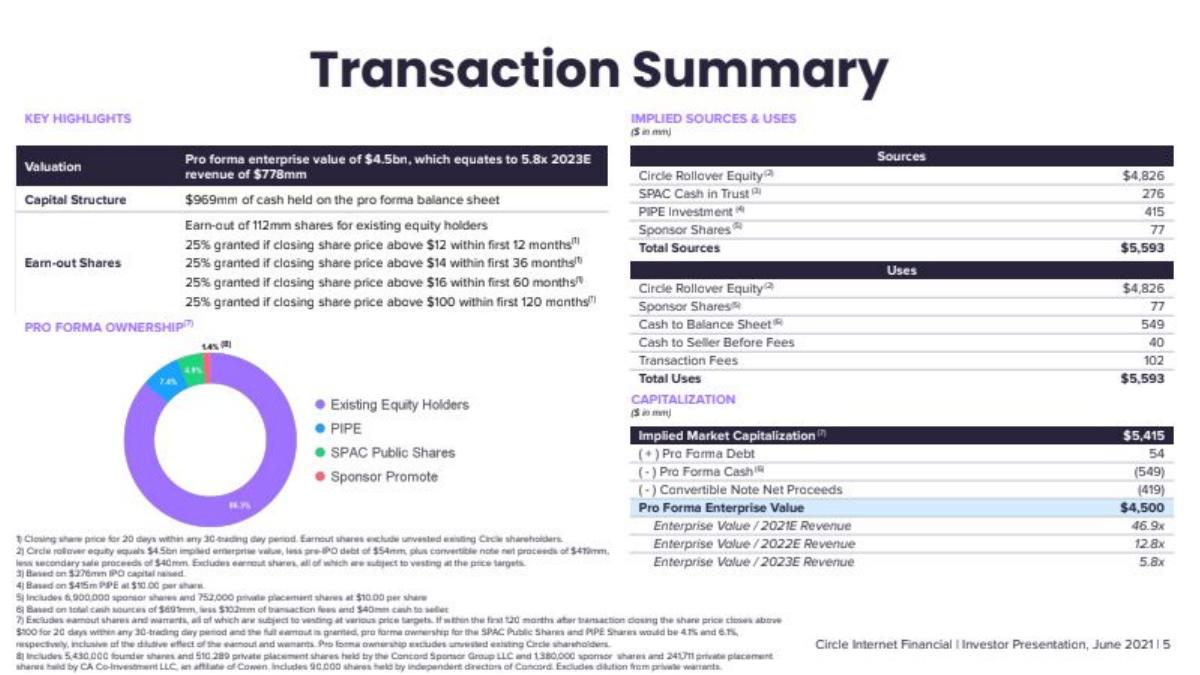
- The transaction summary on Slide 5 establishes a pro forma enterprise value of $4.5bn, representing 5.8x 2023E revenue.
- Circle reports massive traction on Slide 14, with $22.6B USDC in circulation and $640B transferred on-chain as of May 2021.
- The market opportunity is framed on Slide 16 as a subset of the $130tn M2 money supply and $35tn global payments market.
- Slide 19 details the product ecosystem, moving from the 'Free Circle Account' entry point to API and Yield services.
- Revenue is projected to scale aggressively on Slide 28, targeting $886 million by 2023, driven largely by TTS revenue and USDC interest income.
- The deck uses a 'Comparable Companies' framework on Slide 33 to bridge the gap between traditional payment networks (Visa) and digital-asset focused firms (Coinbase).
- Slide 35 argues for a valuation discount, showing Circle's 5.8x 2023E revenue multiple against Bill.com's 35.6x.
- A detailed share count summary on Slide 42 accounts for SPAC public shares, PIPE investors, and earn-out provisions.
The Macro Vision: The Internet of Value
Slides 1-10: Positioning and Team
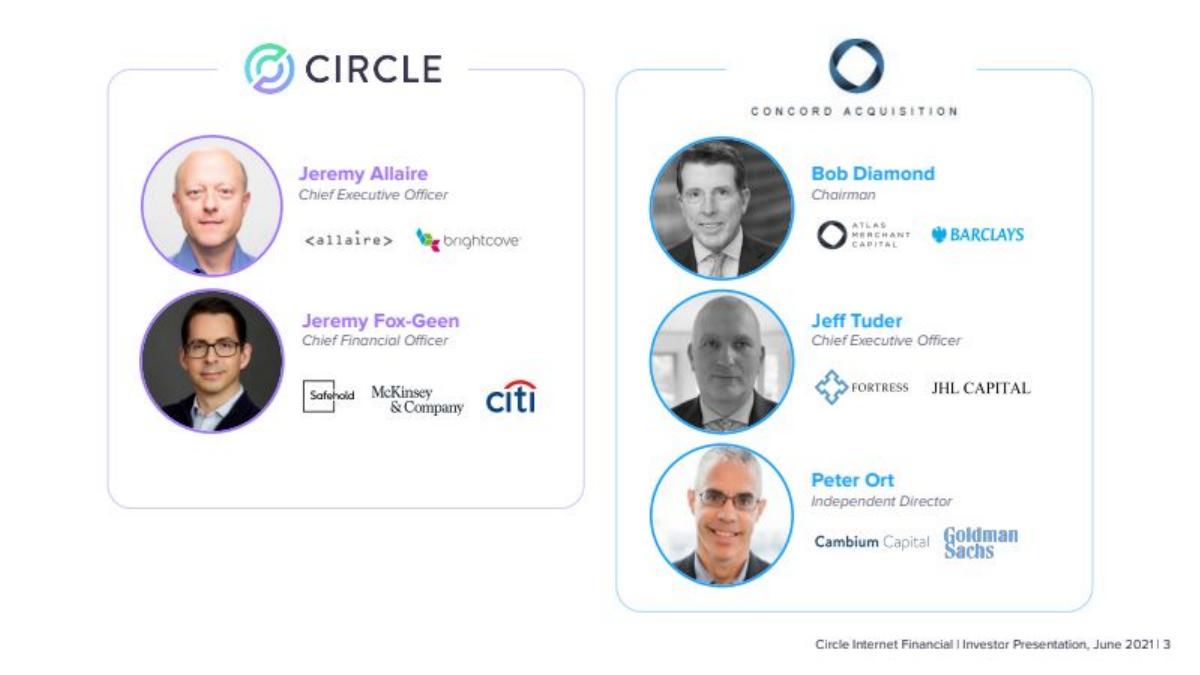
The presentation opens with a clear branding of Circle as a leader in the "Internet of Value." Slide 3 introduces the key players in the transaction, pairing Circle's leadership (Jeremy Allaire and Jeremy Fox-Geen) with the Concord Acquisition team, notably Chairman Bob Diamond, formerly of Barclays. This immediately signals to investors that this is a bridge between the new world of crypto and the established world of global banking.
Slide 5 provides the Transaction Summary , a critical component for any SPAC deck. It lists a pro forma enterprise value of $4.5bn , which it notes equates to 5.8x 2023E revenue . The sources of funds include $276m in SPAC cash and a $415m PIPE investment. This slide is dense with financial mechanics, including earn-out share tiers at $12, $14, $16, and $100 price targets, showing a long-term incentive structure for existing equity holders who retain 86.3% ownership.
The management team on Slide 7 is a "who's who" of fintech and regulatory expertise. By highlighting logos like Goldman Sachs, Citi, PayPal, and the World Economic Forum , Circle addresses the primary concern of institutional investors: whether the team has the maturity to handle the regulatory scrutiny of a public company. Slide 10 places Circle at the end of a historical timeline starting with Netscape in 1995, suggesting that the "Financial Value Exchange" is the next logical evolution of the internet, following communications, cloud agility, and mobile ubiquity.
The Core Product: USDC and the Circle Ecosystem
Slides 12-21: Traction and Use Cases
Slide 12 defines the "Foundation for Next-Gen Financial Services," centering on the commoditization of payments, financial inclusion, and the tokenization of real-world assets. The heart of the business, however, is revealed on Slide 14: Leading the Market in Growth & Adoption . The charts show USDC in circulation jumping from $0.7B in Q1 '20 to $22.6B by May '21 . This 6,171% YTD CAGR is the "hockey stick" graph that every investor wants to see, providing the quantitative proof of product-market fit.
Slide 16 attempts to quantify the Massive Market Opportunity . It compares the $2tn cryptocurrency market to the $130tn M2 Money Supply and the $35tn Global Payments market. This framing is essential; it suggests that Circle isn't just fighting for a share of the crypto pie, but is positioned to disrupt the entire global monetary system.
The product architecture is detailed on Slide 19. The "Free Circle Account" serves as the entry point for converting, minting, and redeeming USDC. From there, Circle upsells API Services (for embedding payments into apps) and Yield Services (earning interest on USDC). This "land and expand" strategy is further validated by the Accelerating Use Cases on Slide 21, featuring partnerships with Visa, Dapper Labs (NBA Top Shot), and FTX . The Visa integration is particularly noteworthy, as it mentions bridging digital currency to mainstream merchants via VisaNet.
Slide 23: The SeedInvest Acquisition
Circle highlights its acquisition of SeedInvest on Slide 23. This move is presented as a transformation of private capital markets. With $300M+ total raised and 500k+ unique investors, SeedInvest gives Circle a regulated platform for equity crowdfunding, further diversifying its revenue away from pure interest income and into marketplace fees.
Financials and Valuation Benchmarking
Slides 25-35: The Moat and the Numbers
Slide 25 argues that the Circle platform is "difficult to replicate," citing 7 years of KYC/AML compliance programs and deep domain expertise. This is the "moat" slide, intended to reassure investors that a bank cannot simply launch a competing stablecoin overnight and win.
The financial projections on Slide 28 are aggressive. Circle projects its account base to grow from 2,786 in 2021E to 30,084 in 2023E . Total revenue is expected to climb from $115 million to $886 million in the same period. Slide 30 outlines where the capital will go: significant expansion of Product and Engineering, scaling sales in EMEA, APAC, and LATAM, and "Regulatory & Risk Capital" required for licensing.
One of the most strategic parts of the deck is the Approach to Comparable Companies on Slide 33. Circle avoids being pigeonholed as just a "crypto company." Instead, it creates a Venn diagram overlapping Payment Networks (Visa) , High Growth Fintech (Adyen, Shopify) , and Digital-Asset Focused (Coinbase) . This allows them to justify their valuation by cherry-picking the best multiples from each sector. Slide 35 drives this home by showing that at 5.8x 2023E revenue, Circle is priced significantly lower than peers like Bill.com (35.6x) or Adyen (33.0x), presenting the SPAC as a "value play" in a high-growth sector.
The Fine Print: Projections and Risks
Slides 38-45: Detailed Forecasts and Risk Factors
Slide 38 breaks down the revenue growth by segment. TTS Revenue (Transaction & Treasury Services) is the largest projected driver, hitting $622M by 2023. This is followed by USDC Interest Income at $196M. This breakdown is vital because it shows that Circle's business model is not solely dependent on interest rates, which can be volatile.
Slide 40 provides a quarterly look at 2021, showing actual Q1 results ($17.3M revenue) and forecasts for the remainder of the year. This level of transparency is standard for a public filing but rare in private decks. Slide 42, the Share Count Summary , is a complex table that accounts for all possible dilution, including warrants and the 111.9 million earn-out shares. It shows a fully diluted share count of 676.5 million in the "Basic + Warrants + Earnout Case."
Finally, Slide 45 is a wall of text detailing Risk Factors . It covers everything from the regulatory uncertainty of USDC to the volatility of Bitcoin (which collateralizes their yield product) and the risks of decentralized finance (DeFi) protocols. This slide is a reminder that while the growth is massive, the company operates in a high-stakes, evolving legal landscape.
What Circle Does Well
The Circle deck is a masterclass in institutional framing . It takes a complex, often misunderstood technology (stablecoins) and translates it into the language of traditional finance. By using terms like "M2 Money Supply," "Treasury Services," and "KYC/AML Compliance," they bridge the gap for conservative investors. The use of third-party validation (Visa, World Bank, Reuters) throughout the deck adds a layer of credibility that many crypto startups lack.
The valuation benchmarking is also exceptionally clever. By positioning themselves against SaaS companies like Shopify and Bill.com rather than just other crypto exchanges, they shift the narrative from "volatile crypto play" to "high-growth infrastructure play." The inclusion of a detailed Transaction Summary and Share Count Summary provides the level of rigor expected in a public market entry.
What is Missing
Despite its 40+ slides, the deck is relatively light on unit economics . While we see total revenue projections, we don't see the specific margins on the TTS services or the exact cost of customer acquisition (CAC). There is also very little mention of competitors like Tether (USDT) or Paxos. In a teardown of a private seed deck, this would be a major red flag; in a SPAC deck, the focus is more on the macro story and the pro forma financials.
The deck also glosses over the technical risks of the various blockchains USDC lives on. While it mentions "interoperability" on Slide 25, it doesn't detail the risks associated with a major network failure or a smart contract vulnerability in the USDC minting process, other than in the generic risk factors at the end.
What a Founder Should Copy
The Timeline Slide: Slide 10 is a perfect example of how to place your company in a historical context. It makes your startup feel like an inevitable part of progress. · The Ecosystem Map: Slide 19 clearly shows how a "free" entry point leads to high-value paid services. This is a great way to visualize a B2B sales funnel. · The Comparable Companies Framework: If you are in a new or misunderstood category, use Slide 33's approach to define yourself as the intersection of established, high-performing industries. · Quantitative Traction: Slide 14's use of CAGR and total volume is the gold standard for showing momentum. If you have these numbers, lead with them. · Pedigree Alignment: Use Slide 7's approach of pairing executive photos with the logos of the prestigious institutions they came from to build immediate trust.
Frequently asked questions
- What was the valuation and deal structure for the Circle SPAC?
- According to Slide 5, the deal valued Circle at a pro forma enterprise value of $4.5 billion. This was supported by $276 million of SPAC cash in trust and a $415 million PIPE investment. The valuation represented a 5.8x multiple of the projected 2023 revenue of $778 million (net of interest sharing).
- How does Circle generate revenue according to the deck?
- Circle identifies three primary revenue streams on Slide 38: USDC Interest Income (projected at $196M by 2023), TTS (Transaction & Treasury Services) Revenue (projected at $622M), and SeedInvest Revenue (projected at $68M). A significant portion of the total revenue is derived from interest earned on the assets backing USDC.
- What are the key growth metrics for USDC mentioned?
- Slide 14 highlights explosive growth for USDC. As of May 31, 2021, USDC in circulation reached $22.6 billion, representing a year-to-date CAGR of 6,171%. Additionally, the historical on-chain transaction volume reached $640 billion by May 30, 2021, with a YTD CAGR of 3,050%.
- Who are the key members of the management team?
- Slide 7 lists a high-pedigree team led by Co-Founder & CEO Jeremy Allaire (formerly of Allaire and Brightcove). Other key executives include CFO Jeremy Fox-Geen (McKinsey, Citi), COO Elisabeth Carpenter (Brightcove), and Chief Strategy Officer Dante Disparte (Libra, FEMA). The team combines deep tech roots with traditional financial and regulatory experience.
- How does Circle compare itself to other fintech companies?
- On Slide 33, Circle positions itself at the intersection of three categories: Payment Networks (Visa, Mastercard), High Growth Payments/Software (Adyen, Shopify, Square), and Digital-Asset Focused (Coinbase, Silvergate). It claims the 'Circle advantage' is the ability to monetize treasury management and payment flows with network effects.