ACT360 Solutions positioned itself in 2015 as a 'multi-disciplinary angel group' turned corporate consolidator. The deck focuses heavily on a 'growth by acquisition' strategy, outlining a three-phase plan to consolidate ecosystems, vertically integrate, and diversify into new sectors. While the team slide lists experienced directors and advisors, the presentation is notably thin on operational details. It identifies specific existing assets like TestDEN and Learnhub but fails to provide any revenue figures, historical performance metrics, or a specific funding 'ask.' The deck serves more as a…
Key takeaways
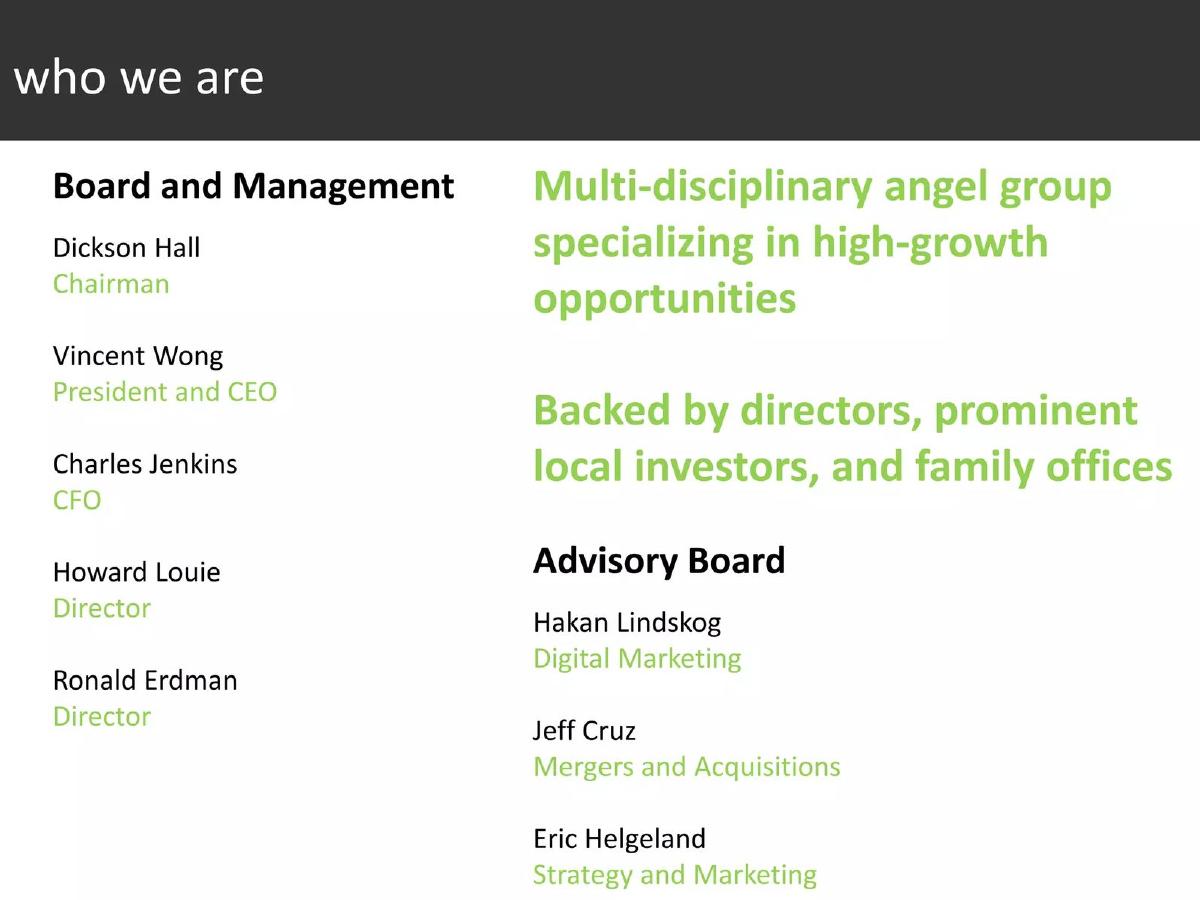
- The company defines itself as a multi-disciplinary angel group specializing in high-growth opportunities (Slide 2).
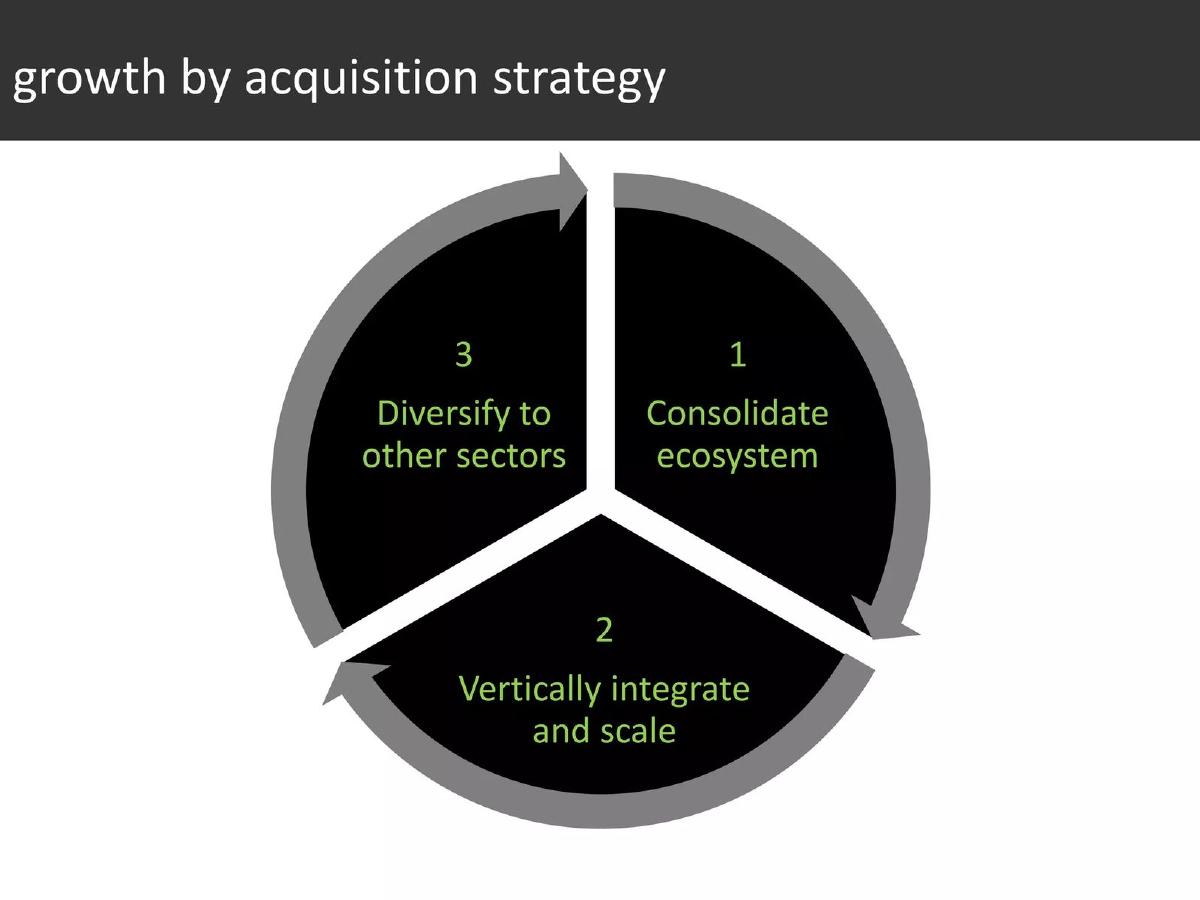
- The growth strategy is a three-step cycle: consolidate ecosystem, vertically integrate and scale, and diversify to other sectors (Slide 3).
- ACT360 uses a roll-up model to capture the value chain across four distinct verticals: Education, B2B Services, Consumer Services, and Home Services (Slide 4).
- Existing assets mentioned include the TestDEN Division and a Learnhub License within the Education vertical (Slide 4).
- The strategy relies on three 'growth catalysts': Asset Licensing, Partnerships, and Acquisitions (Slide 5).
- The deck targets three types of entities for acquisition: founder/operator businesses, PE/VC portfolio companies, and corporate divestitures or distressed assets (Slide 5).
- There is a complete absence of financial metrics, including revenue, EBITDA, or historical growth rates, across all slides.
- The deck does not include a slide detailing the specific capital requirement or 'ask' for the January 2015 round.
ACT360 Solutions: The Roll-Up Framework
The ACT360 Solutions investor presentation from January 2015 is a study in strategic abstraction. Rather than presenting a product-market fit narrative common in venture-backed startups, this deck presents a corporate development strategy. The company positions itself as a platform for growth, utilizing a roll-up model to consolidate fragmented service sectors. However, the lack of granular data makes it difficult to assess the actual health of the underlying assets.
Slide 1: Title Slide
The cover slide uses a high-contrast, black-and-white image of a modern office interior overlooking a city skyline (likely London, based on the architecture). The title "PLATFORM FOR GROWTH" is prominent, signaling that the company views itself as an infrastructure for scaling other businesses rather than a single-product entity. The date "January 2015" establishes the timeframe for this strategic outlook. The logo for "act 360 solutions" is positioned in the bottom right corner.
Slide 2: Who We Are
This slide introduces the leadership and governance structure. It categorizes the firm as a "Multi-disciplinary angel group specializing in high-growth opportunities." This is an unusual self-description for a company seeking investment, as it suggests they are investors themselves. Dickson Hall is listed as Chairman, Vincent Wong as President and CEO, and Charles Jenkins as CFO. The board includes Howard Louie and Ronald Erdman. The right side of the slide emphasizes that they are "Backed by directors, prominent local investors, and family offices." An advisory board is also highlighted, featuring specialists in Digital Marketing (Hakan Lindskog), M&A (Jeff Cruz), and Strategy (Eric Helgeland). This composition suggests a team built for deal-making and corporate oversight rather than technical product development.
Slide 3: Growth by Acquisition Strategy
Slide 3 utilizes a circular flow diagram to explain their three-step methodology. The cycle begins with 1. Consolidate ecosystem , moves to 2. Vertically integrate and scale , and concludes with 3. Diversify to other sectors . This is a classic private equity playbook. The goal is to buy smaller players in a fragmented market to gain market share, integrate them to improve margins through shared services or supply chain control, and then use the resulting cash flow to repeat the process in a new industry. The slide is purely conceptual and does not explain how they consolidate or what their "core competence" actually is.
Slide 4: Capturing Value Chain via Roll-up
This slide provides the most detail regarding the company's actual operations. It shows a hierarchy with ACT360 Solutions at the top, overseeing four "OCA" (likely Operating Company/Asset) units: Education , B2B Services , Consumer Services , and Home Services . Under Education, two specific assets are named: TestDEN Division and Learnhub License . For the other three verticals, the slide shows empty placeholders for "Tuck Under Traffic Source" acquisitions. The stated game plan is to "Apply core competence to other markets." The mention of "Traffic Source" and "Gross Margin Expansion" suggests that their core competence is likely digital marketing and lead generation—buying companies with good products but poor distribution and applying their marketing engine to them.
Slide 5: Growth Catalysts
Slide 5 breaks down the tactical ways they intend to expand. They categorize their targets into three buckets: Founder/operator businesses, PE/VC portfolio companies, and Corporate divestitures or distressed assets. They propose three methods of engagement:
Asset Licensing: Described as non-dilutive, intended to capture synergies with existing business units. · Partnerships: Also non-dilutive, aimed at applying core competence to new vertical markets. · Acquisitions: Focused on "exceptional businesses with technology and management," with a goal to "minimize dilution."
This slide reinforces the image of ACT360 as a financial and strategic holding company rather than an operator of a single brand.
Slide 6: Closing Slide
The final slide repeats the imagery and branding of the title slide, replacing the date with a contact email: investor.relations@act360.com . There is no summary of the investment opportunity, no mention of the total addressable market, and no closing argument regarding why an investor should reach out.
What ACT360 Solutions Does Well
The deck is visually clean and maintains a consistent professional tone. It clearly communicates a strategy . An investor looking at this deck knows exactly what the management team intends to do: they are going to buy companies, integrate them, and try to grow them through digital marketing (implied by the "traffic source" mentions). The team slide is also strong, showing a full C-suite and a specialized advisory board, which lends credibility to a strategy that requires significant M&A and marketing expertise.
What is Missing from the Deck
The omissions in this deck are significant and would likely prevent a professional investor from moving forward without a substantial supplemental data room. 1. Financial Performance: There is not a single dollar sign in the entire deck. For a company pursuing a roll-up strategy, the most important metrics are historical EBITDA growth, cost of acquisition (CAC) for their traffic sources, and the multiples paid for existing assets like TestDEN. Without these, the "Platform for Growth" is just a theory. 2. The Ask: The deck fails to state how much capital is being raised. Is this a $500k angel round or a $10M institutional round? The use of proceeds is vaguely implied as "acquisitions," but specific targets or a pipeline are not mentioned. 3. Market Validation: There is no mention of the size of the Education, B2B, or Home Services markets. The deck assumes the investor already agrees these are lucrative sectors for consolidation. 4. Competitive Landscape: Who else is rolling up these sectors? The deck presents ACT360 in a vacuum, ignoring other holding companies or strategic acquirers who might drive up the price of their targets.
Lessons for Founders
Founders can learn two distinct lessons from this teardown. First, clarity of strategy is vital . ACT360 does an excellent job of explaining how they intend to grow (Slide 3 and 4). If your business model involves complex layers or multiple subsidiaries, using clear diagrams to show the relationship between the parent and the assets is helpful. Second, strategy without data is just a pitch for a job . If you are asking for investment, you must provide the numbers that prove your strategy works. A roll-up deck that doesn't show the margin expansion achieved on the first acquisition (TestDEN, in this case) fails to prove the "core competence" the company claims to have. Always anchor your strategic claims in historical financial reality.
Frequently asked questions
- What is ACT360 Solutions' primary business model?
- Based on the deck, ACT360 Solutions operates as a roll-up vehicle or holding company. They acquire or license assets in specific verticals—primarily Education, B2B, and Consumer Services—with the goal of 'capturing the value chain.' Their model focuses on applying a core competence in traffic sourcing and gross margin expansion to disparate sectors to achieve scale through vertical integration.
- Which sectors does ACT360 Solutions target for acquisition?
- Slide 4 explicitly identifies four target verticals: Education, B2B Services, Consumer Services, and Home Services. At the time of the presentation, they appeared most active in Education, listing 'TestDEN Division' and 'Learnhub License' as existing components of their Education OCA (Operating Company/Asset), while the other three verticals were shown as frameworks for future 'tuck-under' traffic source acquisitions.
- Who are the key people leading ACT360 Solutions?
- The leadership team (Slide 2) consists of Dickson Hall (Chairman), Vincent Wong (President and CEO), and Charles Jenkins (CFO). They are supported by Directors Howard Louie and Ronald Erdman. The advisory board includes specialists Hakan Lindskog (Digital Marketing), Jeff Cruz (Mergers and Acquisitions), and Eric Helgeland (Strategy and Marketing).
- What is missing from the ACT360 Solutions investor deck?
- The deck is missing almost all standard quantitative data. There are no slides covering financial performance, market size (TAM/SAM/SOM), unit economics, or a competitive landscape analysis. Most importantly, there is no 'Ask' slide detailing how much money they are raising, the valuation, or the specific use of proceeds beyond the general strategy of buying more companies.
- How does ACT360 plan to achieve growth without dilution?
- Slide 5 outlines their 'growth catalysts,' noting that Asset Licensing and Partnerships are 'non-dilutive' ways to capture synergies and enter new vertical markets. For actual Acquisitions, the company states a goal to 'minimize dilution,' suggesting they may use debt, cash flow from existing operations, or specific deal structures rather than pure equity issuance to fund their roll-up strategy.