Owlr's 10-slide deck from 500 Startups Batch 19 is a masterclass in identifying a massive, underserved market segment. While premium brands like Nest and Canary dominate the headlines, they only represent 5% of the market. Owlr targets the remaining 95%—the 'sh!##y' commodity cameras that suffer from painful setups and terrible security. With 250,000+ households and 1 million+ cameras already on their platform, Owlr proves that there is a massive appetite for a unified, secure, and user-friendly software layer. The deck's strength lies in its clear contrast between the polished 5% and the neg…
Key takeaways
- Owlr identifies a massive market opportunity by targeting the 95% of IP cameras that are not premium brands like Nest or Canary (Slide 4).
- The company has achieved significant early traction with over 250,000 households and 1 million cameras connected (Slide 2).
- Owlr addresses three core pain points for commodity cameras: painful setup, difficulty of use, and terrible security (Slide 5).
- The platform maintains high user satisfaction across multiple hardware brands, with ratings between 4.3 and 4.6 stars (Slide 6).
- Owlr has established partnerships or interest from 6 out of the top 10 camera manufacturers following CES 2017 (Slide 7).
- The deck highlights a strategic acquisition or partnership with 'no-ip', bringing 24 million existing users and approximately $1.5 million in ARR (Slide 8).
- The founding team possesses strong technical credentials with backgrounds from Stanford, Purdue, and companies like PayPal, Oracle, and IBM (Slide 9).
- The deck defines a $7.3 billion service market opportunity for their software-first approach (Slide 2).
Owlr Pitch Deck Teardown: The 95% Opportunity
Owlr's pitch deck for 500 Startups Batch 19 is a concise, high-impact presentation that focuses on a clear market inefficiency. By ignoring the high-end, integrated hardware-software plays like Nest, Owlr positions itself as the essential software layer for the rest of the world's cameras.
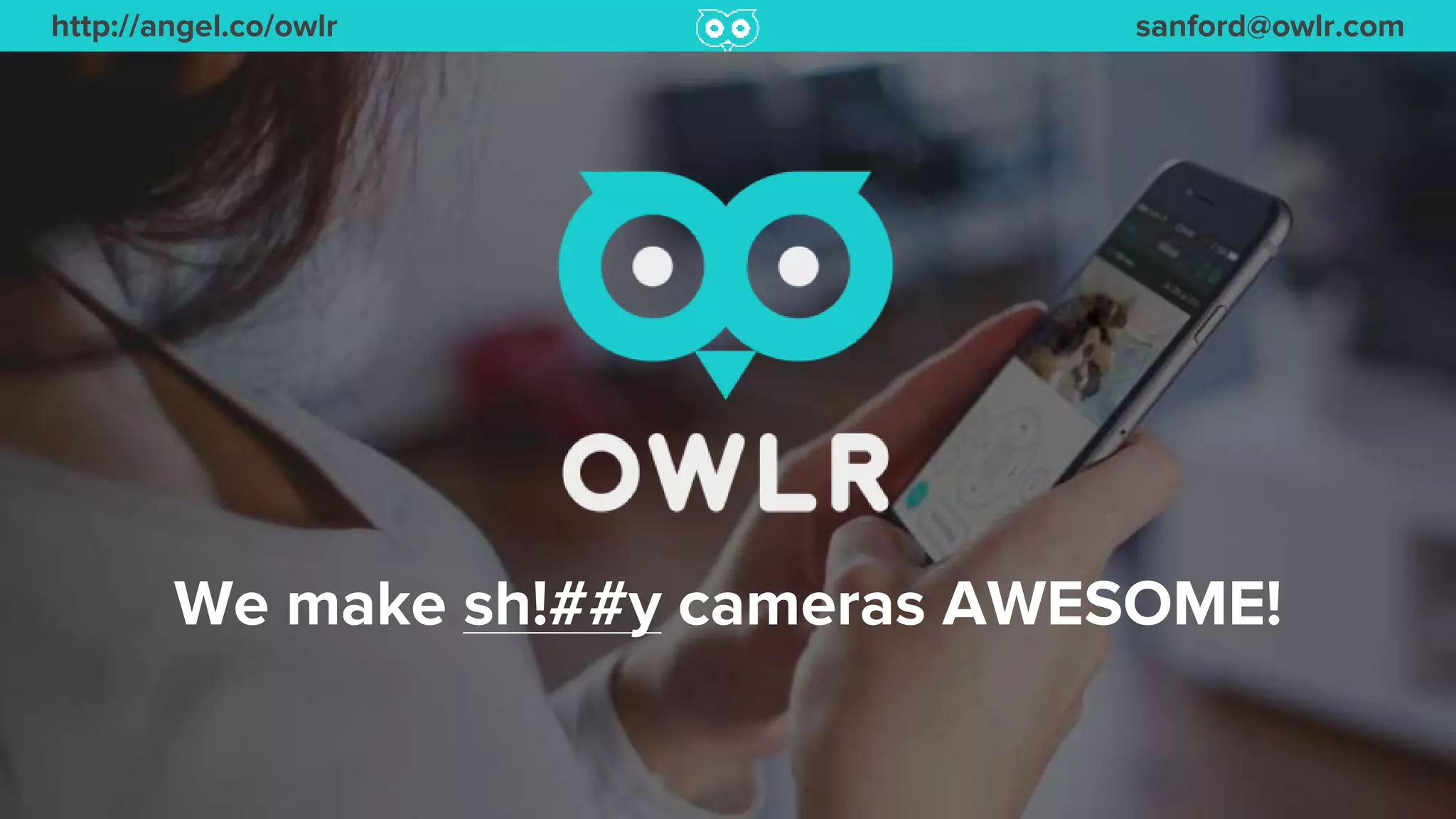
Slide 1: Title Slide
The deck opens with a bold, irreverent hook: "We make sh!##y cameras AWESOME!" This immediately identifies the problem space—low-quality hardware—and Owlr's role as the solution. The branding is clean, featuring a distinctive owl logo, and includes contact information for the CEO, Sanford Dickert, and a link to their AngelList profile.
Slide 2: Traction and Market Size
Slide 2 delivers a powerful one-two punch of traction and opportunity. It lists 250,000+ households and 1 million+ cameras, proving that the product has already found a significant audience. It also defines the "service market" at $7.3 billion, giving investors a sense of the total addressable market for their software-based approach.
Slide 3: The 5% Premium Market
This slide features the logos and products of Canary, Nest, and Netgear. It sets the stage for the competitive landscape, showing the polished, expensive options that most people associate with the smart home camera market.
Slide 4: The 95% Commodity Market
This is the "aha!" moment of the deck. It contrasts the previous slide by showing a sea of logos from manufacturers like Foscam, D-Link, Axis, and Amcrest. It claims these brands represent 95% of the market, highlighting the massive scale of the underserved segment Owlr is targeting. This visual effectively illustrates the fragmentation and the opportunity for a unifying platform.
Slide 5: The Problem
Owlr identifies three specific pain points for the 95% market: "Painful Setup," "Difficult to Use," and "Terrible Security." The use of news clippings about hacked baby monitors and web outages adds a sense of urgency and real-world consequence to the security problem, which is a major concern for IoT devices.
Slide 6: User Satisfaction
To prove their software works across different hardware, Slide 6 shows high user ratings (4.3 to 4.6 stars) for Owlr's interface when used with Foscam, Axis, and D-Link cameras. This validates that their software significantly improves the user experience of these "commodity" devices.
Slide 7: Industry Validation
Following CES 2017, Owlr claims that 6 out of the top 10 camera manufacturers are engaged with them. This is a strong indicator of B2B interest and potential for pre-installation or official partnerships, which would be a major growth lever.
Slide 8: The No-IP Strategic Advantage
This slide introduces a major asset: a relationship with 'no-ip'. With 24 million users and ~$1.5 million in ARR, this represents a massive distribution channel and a solid financial foundation. For a startup, having access to such a large, relevant user base is a significant competitive advantage.
Slide 9: The Team
The team slide features CEO Sanford Dickert and CTO Chris Jenkins. Their credentials are impressive, with degrees from Stanford and Purdue, and experience at top-tier tech companies like PayPal, Oracle, and IBM. The inclusion of Willow Garage, a legendary robotics research lab, further bolsters their technical authority in the IoT and robotics space.
Slide 10: Conclusion and Contact
The final slide reiterates the key traction metrics—250,000+ households, 1 million+ cameras, and the $7.3 billion market—while providing contact details. The owl logo now has heart-shaped eyes, a playful touch that suggests user love for the product.
What Works in This Deck
Clear Market Segmentation: The distinction between the 5% premium market and the 95% commodity market is the deck's strongest point. It clearly defines who they are NOT competing with and where the real volume lies.
Strong Traction: Leading with 1 million+ cameras connected is a powerful way to demonstrate product-market fit and technical scalability.
Strategic Partnerships: The mention of 'no-ip' and the 24 million users it brings is a massive de-risking factor for investors, showing a clear path to scale and revenue.
Technical Credibility: The team's background in robotics and engineering from prestigious institutions and companies provides the necessary confidence that they can solve the complex security and interoperability challenges of the IP camera market.
What Is Missing
Business Model Details: While the deck mentions a $7.3 billion service market and ~$1.5 million ARR from 'no-ip', it doesn't explicitly detail how Owlr itself makes money. Is it a subscription model, a freemium app, or a B2B licensing play?
The 'Ask': As a Demo Day deck, it's common to omit the specific funding ask, but for a standard pitch, the amount being raised and the intended use of funds would be essential.
Unit Economics: There is no mention of customer acquisition cost (CAC) or lifetime value (LTV), which are critical for understanding the long-term viability of the business.
Product Roadmap: The deck focuses on what has been achieved but doesn't provide a clear vision for what's next. Will they expand into other IoT categories, or deepen their security features?
What a Founder Should Copy
The '95% vs 5%' Framework: If you are entering a market dominated by a few high-profile players, use this visual strategy to show the massive, underserved segment you are targeting.
Leading with Traction: Don't bury your best numbers. Owlr puts their most impressive stats on the second slide, immediately grabbing the audience's attention.
Visualizing the Problem: Using real-world examples, like the news clippings of hacked cameras, makes the problem tangible and urgent for investors.
Focusing on a Single, Clear Message: The entire deck is built around the idea of making "sh!##y cameras awesome." Every slide supports this core narrative, making the pitch easy to remember and communicate.
Frequently asked questions
- What is Owlr's core value proposition?
- Owlr provides a unified, secure, and user-friendly software interface for the 'commodity' IP camera market. As stated on Slide 1, their goal is to 'make sh!##y cameras AWESOME!' by solving the common issues of difficult setup, poor user experience, and weak security that plague 95% of the cameras on the market (Slide 4 and 5).
- How much traction does Owlr have?
- At the time of this deck, Owlr had significant traction, reporting over 250,000 households and more than 1 million cameras connected to their platform (Slide 2). Additionally, Slide 8 mentions a connection to 'no-ip' involving 24 million users and approximately $1.5 million in Annual Recurring Revenue (ARR).
- Who are Owlr's main competitors according to the deck?
- The deck distinguishes between the '5%' premium market and the '95%' commodity market. Premium competitors include Canary, Nest, and Netgear (Slide 3). The commodity market, which Owlr targets, includes brands like Foscam, Axis, D-Link, Amcrest, Samsung, and others (Slide 4).
- What is the background of the Owlr founding team?
- The team is led by CEO Sanford Dickert, who holds degrees from Purdue and Stanford, and CTO Chris Jenkins, who has a background in CS and Robotics. Their collective experience includes stints at high-profile companies and institutions like Stanford, Accenture, PayPal, Oracle, IBM, and Willow Garage (Slide 9).
- What is the 'no-ip' mention on Slide 8?
- Slide 8 highlights a relationship with 'no-ip', a well-known dynamic DNS provider. The slide lists 24 million existing users and ~$1.5M ARR. This suggests a significant strategic partnership or acquisition that provides Owlr with a massive user base and immediate revenue stream to fuel their growth in the IP camera space.