OurSong's 15-slide Seed deck is a masterclass in market timing and positioning. Raised in 2022 during a period of significant NFT market volatility, the company leaned into the 'anti-crypto' sentiment of the time to pitch a mass-market alternative. By highlighting that 99.8% of OpenSea collections never sold a unit (Slide 5) and that the current market only reaches 200 million wallets (Slide 6), OurSong positioned itself as the gateway for the 5 billion non-crypto internet users. The deck emphasizes accessibility through mobile-first design, local language support, and fiat-friendly payment r…
Key takeaways
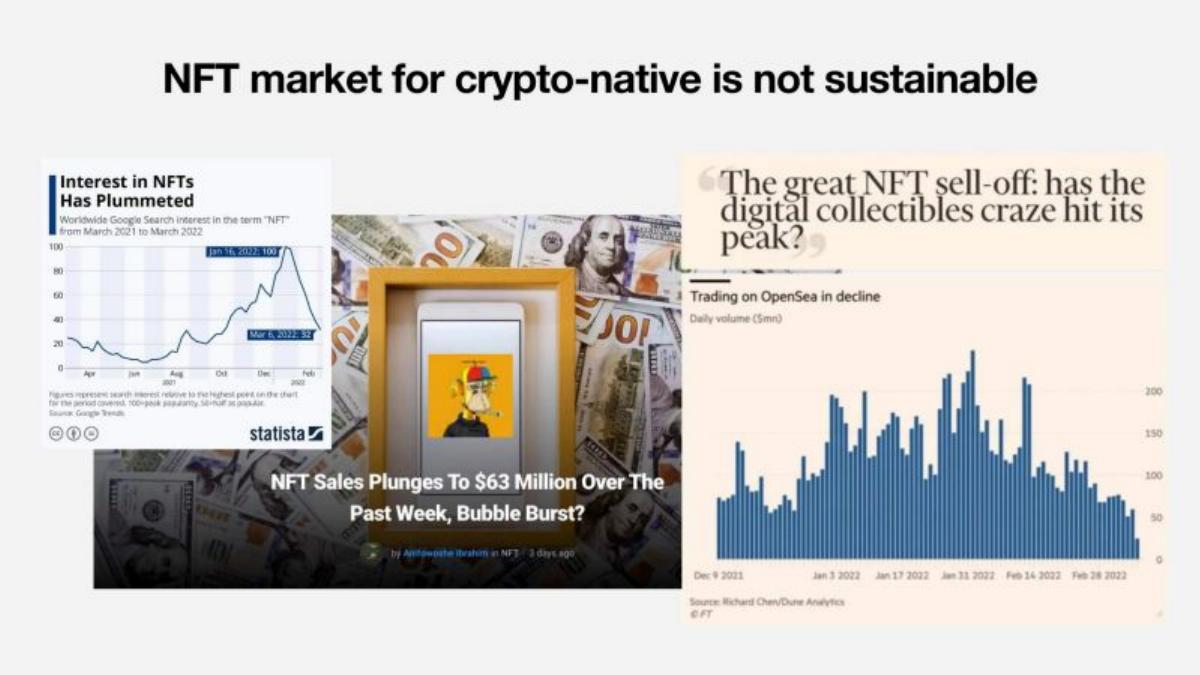
- The deck opens by aggressively critiquing the existing NFT market, citing plummeting Google search interest and declining OpenSea volumes (Slide 2).
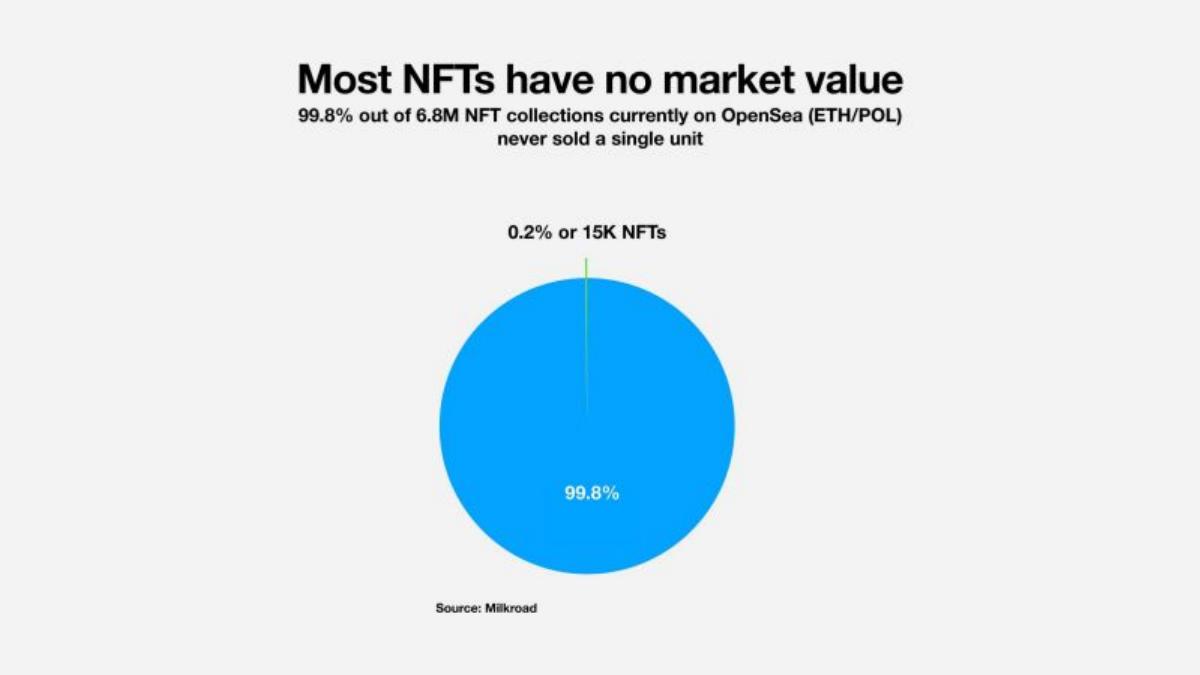
- A stark pie chart reveals that only 0.2% of the 6.8M NFT collections on OpenSea ever sold a single unit (Slide 5).
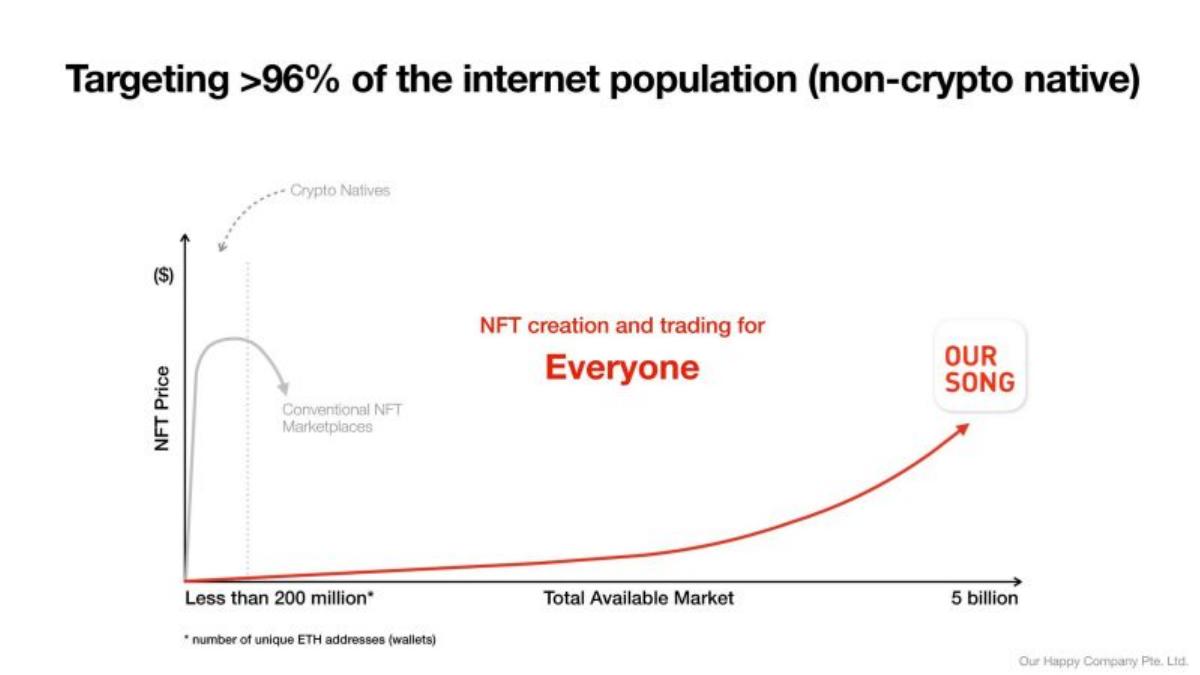
- OurSong targets the 96% of the internet population that is non-crypto native, aiming for a total available market of 5 billion users (Slide 6).
- The platform removes technical barriers by supporting Apple IAP, Google IAP, and Credit/Debit cards alongside USDC (Slide 8).
- The product is positioned as a 'fan pass' that unlocks exclusive video messages and private chatrooms, moving away from pure speculation (Slide 11).
- The deck showcases diverse use cases, including the 'world's first NFT fried chicken' from a Taiwanese restaurant (Slide 12).
- The founding team is high-profile, including 12-time Grammy winner John Legend and Kevin Lin, a co-founder of Twitch (Slide 15).
- The deck completely omits a financial 'Ask' slide, unit economics, or a detailed roadmap for the $7.5M raise.
The Macro Argument: Why the Current NFT Market is Broken
Slides 1-5: The Problem of Crypto-Exclusivity
OurSong begins its deck not with its own product, but with a scathing indictment of the NFT market as it existed in early 2022. Slide 1 sets the mission: "Unleash the value of everyone's creativity by making it universally accessible and tradable." The emphasis on "everyone" is the core thesis of the pitch.
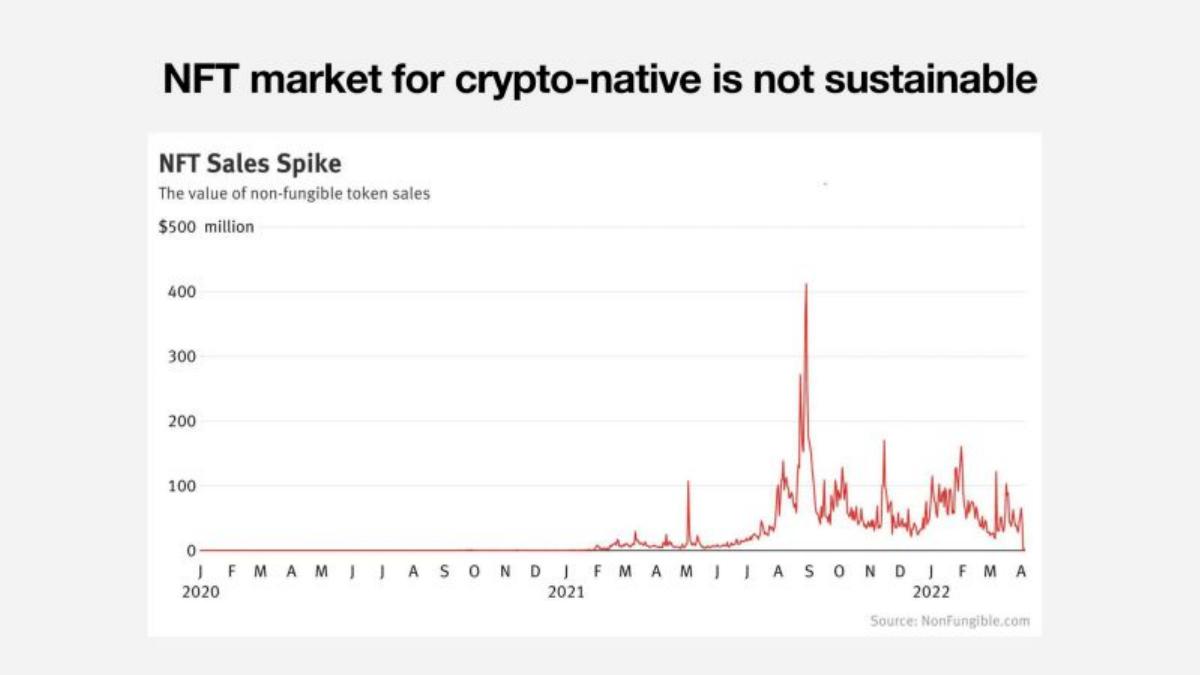
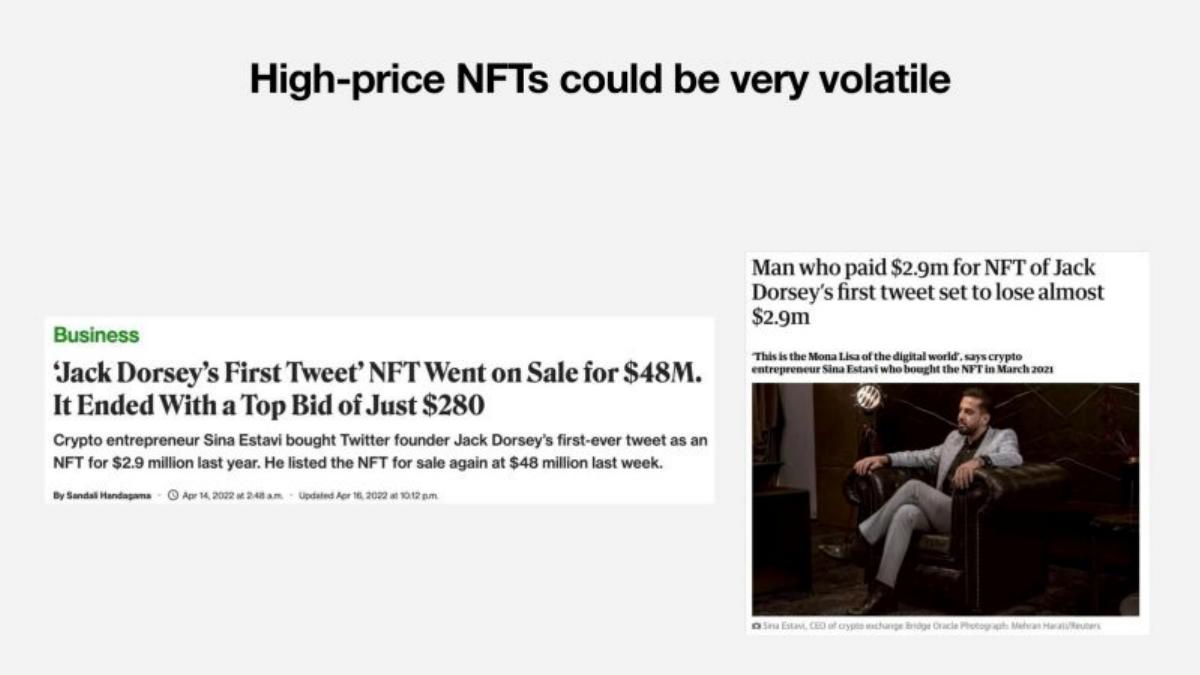
Slides 2 and 3 use external data from Statista, Google Trends, and the Financial Times to argue that the "NFT market for crypto-native is not sustainable." They highlight that search interest plummeted from a peak in January 2022 to a relative score of 32 by March 2022. Slide 4 drives the point home regarding volatility, citing the famous Jack Dorsey first-tweet NFT which was purchased for $2.9 million but later saw a top bid of just $280.
The most effective slide in this section is Slide 5, which uses data from Milkroad to show that 99.8% of the 6.8 million NFT collections on OpenSea never sold a single unit. By framing the existing market as a tiny, speculative bubble where 15,000 NFTs represent the only successful transactions, OurSong creates a massive opening for a platform that can reach the other 99.8%.
The Solution: NFTs for the Other 96%
Slides 6-9: Accessibility and Infrastructure
Slide 6 transitions from the problem to the opportunity. It features a graph showing the "Total Available Market" of 5 billion internet users compared to the "less than 200 million" unique Ethereum addresses. OurSong positions itself at the far right of this growth curve, targeting the 96% of the internet population that is non-crypto native.
The deck then outlines how it will achieve this accessibility. Slide 7 highlights a "Mobile-First experience" supported in English, Chinese, Bahasa Indonesia, and Japanese. This indicates a strong initial focus on the Asian market, which is reinforced by later slides. Slide 8 is perhaps the most important for investors: it shows that users can transact via Apple IAP, Google IAP, and Credit/Debit cards. By removing the need for a crypto wallet, OurSong removes the primary friction point for mainstream adoption.
Slide 9 lists the supported blockchains: Ethereum, Binance, ThunderCore, and Polygon. This shows technical flexibility, though the deck does not explain the specific benefits of each for the end-user.
Product and Use Cases: From Speculation to Utility
Slides 10-12: Redefining the NFT
Slide 10 serves as a conceptual bridge, moving "From Scarcity (Speculation) to Collectible, Utility & Community." It shows logos of mainstream brands like Pizza Hut, Sony Music, and Warner Music, suggesting that the future of NFTs lies in brand engagement rather than Bored Ape-style profile pictures.
Slide 11 provides the first look at the app interface. It describes the creation process as "Super fast, Crazy easy," allowing users to turn audio, video, images, or 3D objects into an NFT "Vibe" in seconds. The slide also introduces the concept of "NFT as fan pass," where ownership unlocks exclusive video messages and private chatrooms. This is a pivot toward the "Social SaaS" model, where the NFT is a key to a community rather than just a trading card.
Slide 12 showcases a specific, localized success story: the "World's first NFT fried chicken" by Shiyun, a Taiwanese fried chicken shop. This slide is intended to prove that the technology can be applied to mundane, real-world businesses to drive viral engagement and sales, moving beyond the high-art or high-finance niches.
Traction and Team: The Power of Celebrity and Experience
Slides 13-15: Global Launch and Founding Pedigree
Slide 13 highlights international marketing efforts, specifically an "Anime x Music" campaign in Japan. This reinforces the regional focus suggested in the language slide. Slide 14 focuses on the global launch, featuring headlines from Billboard, Bloomberg, and Forbes regarding John Legend’s involvement as a co-founder. This gives the project immediate mainstream credibility and a built-in marketing engine.
The deck concludes with Slide 15, the team slide. This is a heavy-hitting group for a Seed round. Beyond John Legend, the co-founders include Chris Lin (CEO of KKBOX, a major Asian music streaming service), Ken Cheung (formerly of Facebook and Warner Music), and Kevin Lin (a co-founder of Twitch). The team’s collective experience spans music, social media, and live streaming, which aligns perfectly with the product’s goal of building "social followings and digital communities."
What OurSong Does Well
Strong Market Narrative: The deck does an excellent job of using the 2022 crypto downturn as a tailwind rather than a headwind. By pointing out the flaws in the current market, they make their "simple" solution look like the only logical path forward. · Clarity of Purpose: The focus on the "non-crypto native" is consistent throughout every slide, from payment methods to language support to use cases. · Team Credibility: For a consumer social app, having the co-founder of Twitch and a global superstar like John Legend is a significant competitive advantage that the deck highlights effectively.
What is Missing from the OurSong Deck
The Ask: There is no slide indicating how much money the company is looking to raise or what the valuation expectations are. While we know from the catalogue facts that they raised $7.5M, a founder using this as a template should remember to include a clear call to action. · Business Model: The deck never explains how OurSong makes money. Do they take a transaction fee? Is there a subscription for creators? Is it an ad-supported model? This is a major omission for a Seed round. · Unit Economics: There is no mention of the cost to acquire a user (CAC) or the lifetime value (LTV) of a "Vibe" creator. In a mobile-first model where Apple and Google take 30% of In-App Purchases, these economics are crucial. · Competition: The deck ignores other social NFT platforms or Web2 platforms (like Instagram or TikTok) that were also integrating digital collectibles at the time.
Founder Lessons
Use Data to Frame the Problem: Slide 5’s use of the "99.8% failure rate" on OpenSea is a brilliant way to make a competitor look like a niche player while positioning your own company as the mass-market solution. · Show, Don't Just Tell, Accessibility: Instead of just saying "it's easy to use," Slide 8 shows the logos of Apple Pay and Google Play. This immediately communicates to an investor that the technical hurdles of crypto have been solved. · Leverage Local Success for Global Proof: The fried chicken example on Slide 12 might seem small, but it provides a concrete, relatable use case that proves the platform works for non-celebrities and small businesses.
Frequently asked questions
- How does OurSong differentiate itself from OpenSea?
- OurSong differentiates itself by focusing on the 'non-crypto native' user. While OpenSea requires a crypto wallet and targets the 200 million existing wallet holders, OurSong uses mobile-first design and standard In-App Purchases to target the 5 billion general internet users. Slide 11 shows they view NFTs as 'fan passes' for community access rather than just speculative assets.
- What payment methods does the platform support?
- According to Slide 8, the platform supports Apple In-App Purchases (IAP), Google IAP, Credit/Debit cards, and USDC tokens. This multi-rail approach is designed to allow users to transact without needing to manage a traditional crypto wallet or seed phrase, which is a significant barrier to entry for mainstream consumers.
- Which blockchains is OurSong built on?
- Slide 9 indicates that OurSong supports four mainstream blockchains: Ethereum, Binance Smart Chain, ThunderCore, and Polygon. This multi-chain approach suggests a focus on scalability and lower transaction fees, particularly through the use of Layer 2 or alternative Layer 1 solutions like Polygon and ThunderCore.
- Who are the key members of the founding team?
- The team (Slide 15) is a mix of tech and entertainment veterans. It includes CEO Chris Lin (formerly KKBOX Group), John Legend (12-time Grammy winner), Ken Cheung (formerly FB, Warner Music, Tencent), and Kevin Lin (Co-founder of Twitch). This composition suggests a strategy rooted in creator partnerships and social platform scaling.
- What is missing from this pitch deck?
- The deck is notably missing several standard venture components. There is no 'Ask' slide detailing how much capital is being raised or how it will be spent. It also lacks a business model slide explaining how the company generates revenue, a competitor matrix, and any specific growth metrics or user traction data beyond qualitative press clippings.