OWLR’s 2016 Seed deck is a masterclass in identifying a market gap created by premium incumbents. While Nest and Canary focused on high-end, proprietary hardware, OWLR targeted the '95%' of the market using off-the-shelf IP cameras from brands like Foscam and D-Link. The deck highlights significant early traction, claiming over 1 million cameras connected across 250,000+ households. By positioning themselves as the software layer that fixes 'painful setup' and 'terrible security,' OWLR successfully raised $240,000. However, the deck is notably light on financial specifics, omitting a clear re…
Key takeaways
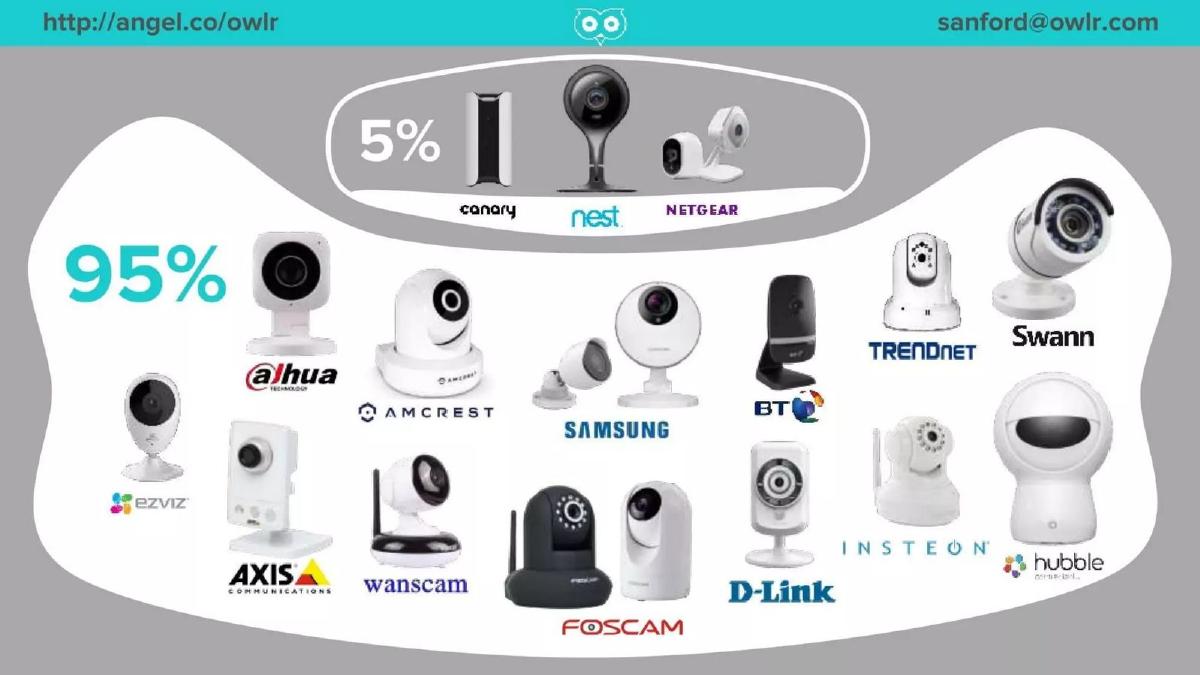
- OWLR identifies a massive market opportunity in the 95% of IP cameras that are not premium brands like Nest or Canary (Slide 4).
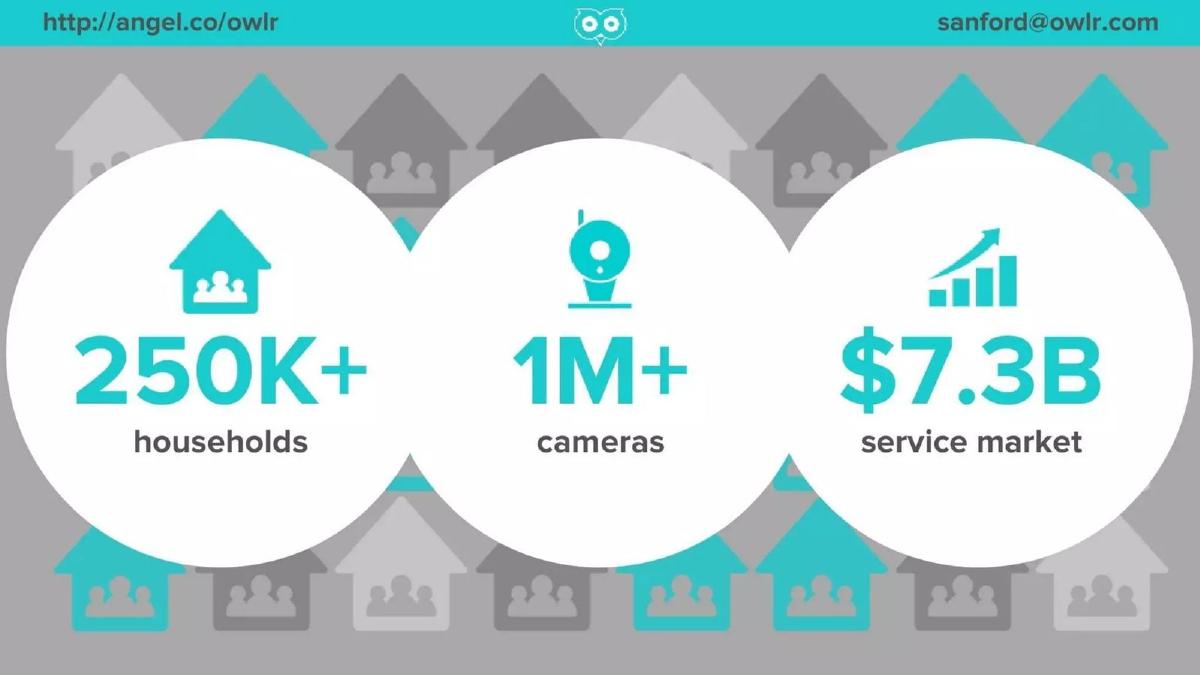
- The company demonstrates significant early traction with 250,000+ households and 1M+ cameras already on the platform (Slide 2).
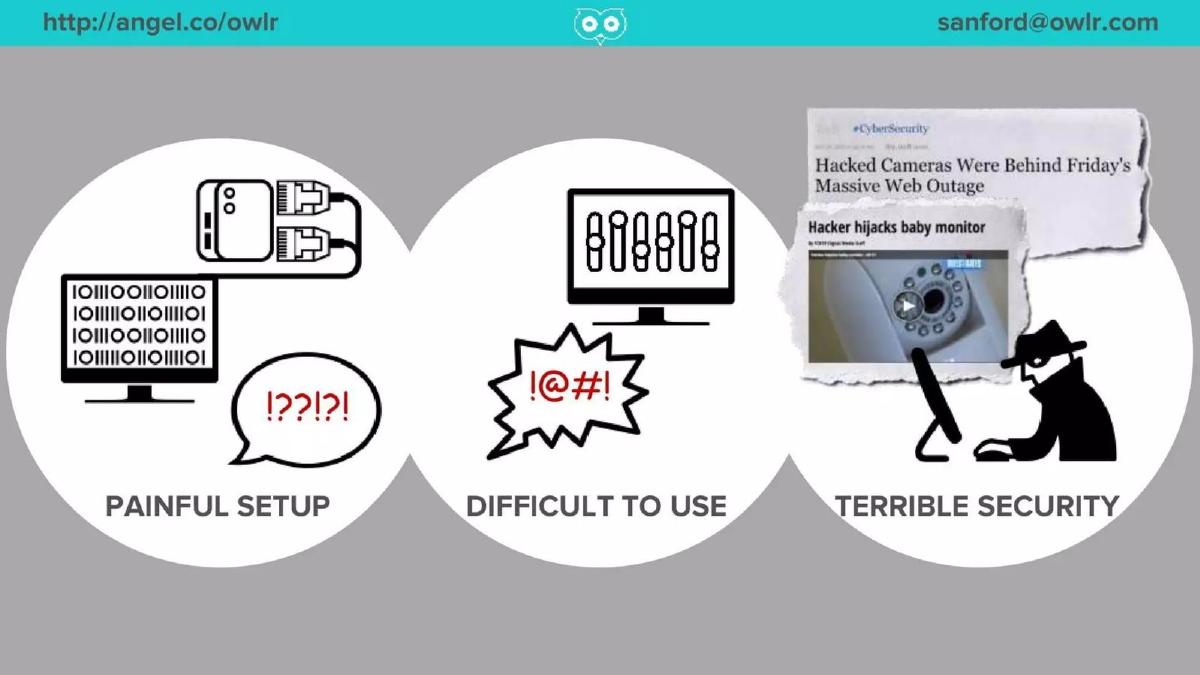
- The deck highlights three core user pain points: painful setup, difficulty of use, and terrible security (Slide 5).
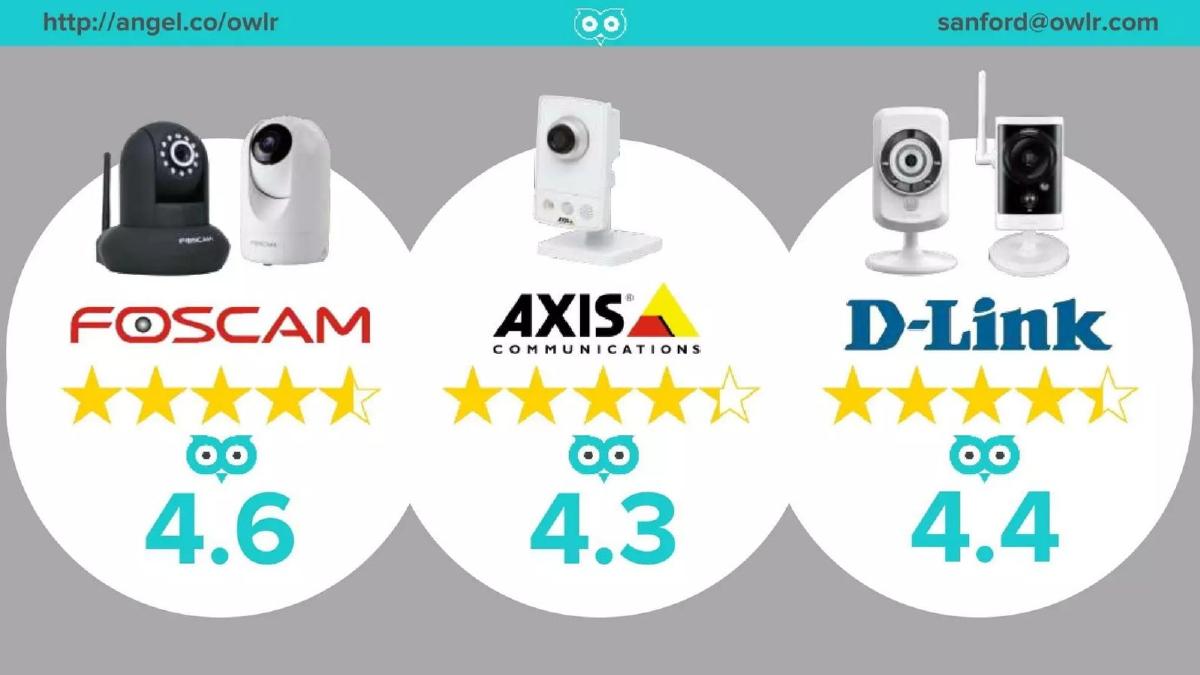
- OWLR uses high third-party ratings (4.3 to 4.6 stars) for specific camera brands to validate their software's efficacy (Slide 6).
- The founders possess strong technical backgrounds with degrees from Purdue and Stanford and experience at companies like PayPal, Oracle, and IBM (Slide 9).
- The deck references a partnership or integration with No-IP, citing access to 24M existing users and ~$1.5M ARR (Slide 8).
- The total addressable service market is estimated at $7.3B (Slide 2).
- The deck lacks a formal financial 'ask' or a detailed breakdown of how the raised funds will be spent.
The Strategy of the Software Overlay
OWLR Technologies entered the market at a time when 'Smart Home' was synonymous with expensive, closed-ecosystem hardware. Their 2016 pitch deck represents a pivot away from the hardware wars, focusing instead on the millions of 'dumb' or 'difficult' IP cameras already in consumers' homes. By positioning themselves as the universal remote for home security, OWLR focused on the software experience rather than the manufacturing margins.
The Hook and the Market Gap (Slides 1-4)
Slide 1: The Cover. The deck opens with a bold, slightly irreverent tagline: "We make sh!##y cameras AWESOME!" This immediately identifies the company's value proposition. They aren't building a new camera; they are fixing the ones people already bought. The imagery of a mobile app controlling a camera feed reinforces the 'palm of your hand' accessibility mentioned in their company description.
Slide 2: Traction and Market. OWLR leads with its strongest suit: scale. They claim 250K+ households and 1M+ cameras . This is a massive number for a Seed-stage company and immediately validates that there is a demand for a third-party camera manager. They also define the "service market" at $7.3B , signaling that while the app might be free, the revenue opportunity lies in value-added services.
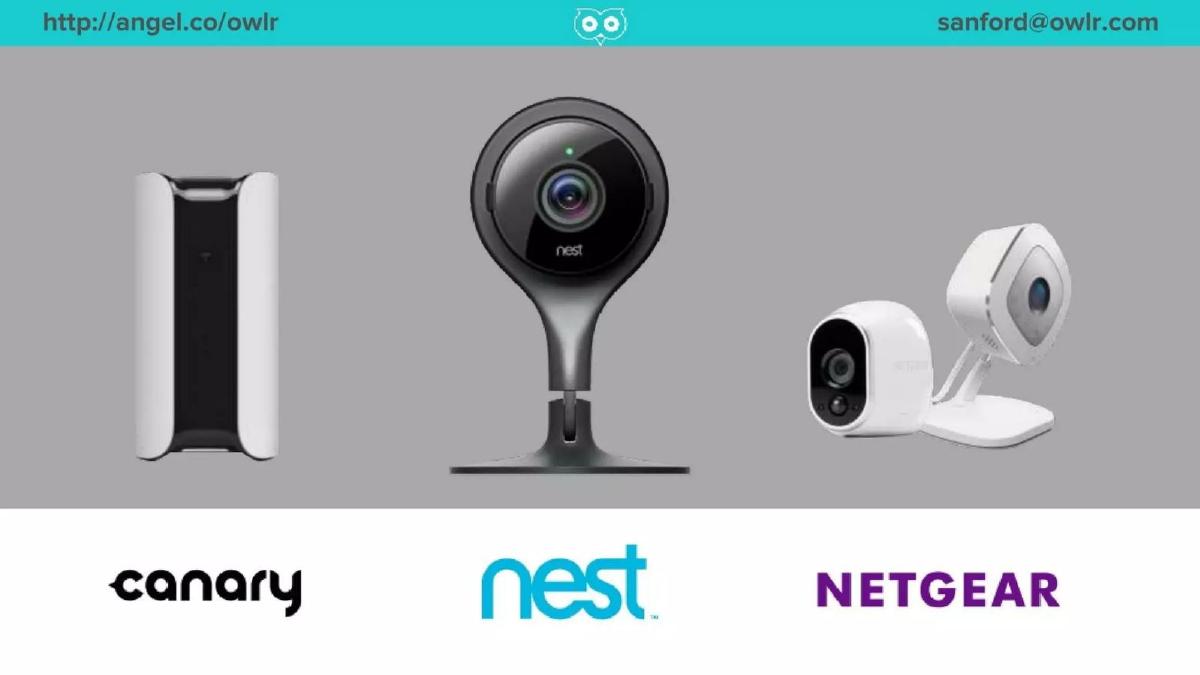
Slide 3 & 4: The 5% vs. 95% Problem. These slides are the strategic heart of the deck. Slide 3 shows the premium incumbents: Canary, Nest, and Netgear. Slide 4 then reveals that these brands only represent 5% of the market. The remaining 95% is a chaotic sea of brands like Foscam, D-Link, Amcrest, and Swann. OWLR’s genius is in realizing that the 95% have terrible software, and those users are 'homeless' in terms of a good digital experience.
Identifying the Pain Points (Slides 5-6)
Slide 5: The Problem Statement. OWLR categorizes the user frustration into three buckets: Painful Setup , Difficult to Use , and Terrible Security . They use a newspaper clipping about hacked baby monitors to drive home the security risk—a major concern in 2016 when IoT security was frequently in the headlines. By solving these three things, OWLR moves from a 'nice-to-have' utility to a critical security layer.
Slide 6: Social Proof and Quality. This slide is interesting because it uses star ratings (4.3 to 4.6) alongside the logos of Foscam, Axis, and D-Link. It implies that when these cameras are used with OWLR software, they achieve high user satisfaction. It’s a clever way to show that their software 'upgrades' the hardware experience without OWLR having to own the hardware supply chain.
Momentum and Distribution (Slides 7-8)
Slide 7: Industry Recognition. A simple slide noting that "After CES 2017... 6/10 of the top camera manufacturers" were in some form of dialogue or alignment with them. This suggests that the hardware manufacturers themselves realize their software is a weakness and see OWLR as a potential partner rather than a competitor.
Slide 8: The No-IP Connection. This slide features the logo for No-IP , a popular dynamic DNS provider. It lists 24M existing users and ~$1.5M ARR . In the context of the IP camera market, No-IP is a standard tool used by hobbyists to access cameras remotely. By highlighting this, OWLR is showing they understand the technical plumbing of their target market and likely have a direct line to millions of power users.
The Team and the Vision (Slides 9-10)
Slide 9: The Founders. The team slide is strong on technical pedigree. CEO Sanford Dickert and CTO Chris Jenkins are shown with playful owl plushes, but their credentials are serious: Stanford, Purdue, PayPal, Oracle, IBM, and Willow Garage . This balance of 'fun' branding and 'enterprise' experience is designed to reassure investors that the founders can handle the complex networking challenges of supporting hundreds of different camera protocols.
Slide 10: Conclusion. The final slide repeats the traction metrics (250K+ households, 1M+ cameras) over a backdrop of London, where the company appears to be based (given the Shard and Gherkin buildings in the background). It provides a clear contact email, though notably, it still lacks a specific funding request.
What Works in the OWLR Deck
The 95% Narrative: Most startups try to compete with the giants. OWLR wins by pointing out that the giants are only fighting over a tiny slice of the pie, leaving the vast majority of the market underserved. · Massive Early Traction: Having 1 million cameras on the platform at the Seed stage is an incredible feat. It proves that the 'painful setup' problem was real enough for people to seek out an alternative. · Clear Value Proposition: The deck never wanders. It is about making existing cameras better through software. Every slide supports this single mission. · Technical Credibility: The founders' backgrounds in robotics and computer science from top-tier institutions like Stanford and Purdue provide the necessary 'right to play' in the IoT space.
What is Missing from the OWLR Deck
The Business Model: While the deck mentions a "$7.3B service market," it doesn't explain how OWLR actually makes money. Are they charging for cloud storage? Is it a freemium model? This is a major omission for a Seed round. · The Competition: They identify Nest and Canary as the '5%,' but they don't mention other software-only aggregators or the manufacturers' own attempts to improve their apps. · The Ask: There is no slide detailing how much capital they are raising, the valuation they are seeking, or what the 'milestones' are for the next 18 months. · Unit Economics: With 1 million cameras, the server and bandwidth costs for video relay could be significant. The deck doesn't touch on the cost of supporting this massive user base.
What a Founder Should Copy
The 'Anti-Incumbent' Strategy: If you are entering a market with a dominant player (like Nest), don't try to out-Nest them. Find the segment of the market they are intentionally ignoring and build for them. · Bold Taglines: "We make sh!##y cameras AWESOME" is memorable. It tells the investor exactly what the product does in five words. · Visualizing the Gap: Slide 4, which shows the small circle of premium brands vs. the large field of budget brands, is a perfect visual representation of a market opportunity. · Leading with Traction: If you have numbers as good as 250,000 households, put them on Slide 2. Don't make the investor wait until the end of the deck to realize you have a product people are actually using.
Frequently asked questions
- What is the core problem OWLR is solving?
- OWLR addresses the fragmentation and poor user experience of the non-premium IP camera market. While brands like Nest offer good software, they only represent 5% of the market. The other 95% consists of 'off-the-shelf' cameras that suffer from difficult setup processes, unintuitive interfaces, and significant security vulnerabilities. OWLR provides a unified software layer to make these cameras 'awesome.'
- How much traction did OWLR have at the time of this deck?
- According to Slide 2 and Slide 10, OWLR had already reached over 250,000 households and had more than 1 million cameras connected to its platform. This level of organic growth for a Seed-stage startup is exceptionally high and serves as the primary proof of product-market fit in the presentation.
- Who are the founders and what is their background?
- The company was led by CEO Sanford Dickert and CTO Chris Jenkins. Dickert holds an MSEE and EngREE from Stanford and a BSCEE from Purdue. Jenkins holds a BSc in CS/Robotics. Their collective experience includes stints at major tech firms and research institutions such as PayPal, Oracle, IBM, Accenture, and Willow Garage.
- What is the significance of the 'No-IP' slide?
- Slide 8 mentions 'No-IP' with 24 million existing users and approximately $1.5 million in ARR. While the deck doesn't explicitly detail the nature of the relationship, it implies a strategic partnership or acquisition target that provides OWLR with a massive distribution channel and an immediate footprint in the IP networking space.
- What is missing from the OWLR pitch deck?
- The deck is missing several standard components: a specific 'Ask' slide (how much they are raising and on what terms), a detailed business model explaining exactly how they monetize the free app, a competition matrix beyond just the premium hardware brands, and a roadmap for future product development.