MapMe’s seed deck is a masterclass in using a 'wedge' product to prove a larger market thesis. The company began with a single, highly successful project—the Israeli Startup Map—which generated 20,000 unique users and significant press coverage. This traction serves as the primary evidence for their broader platform play: a self-service map builder for any passionate community. The deck effectively balances social proof with a clear product vision, categorizing users into Organizers, Contributors, and Users to explain their crowdsourced data model. While it lacks detailed financial projection…
Key takeaways
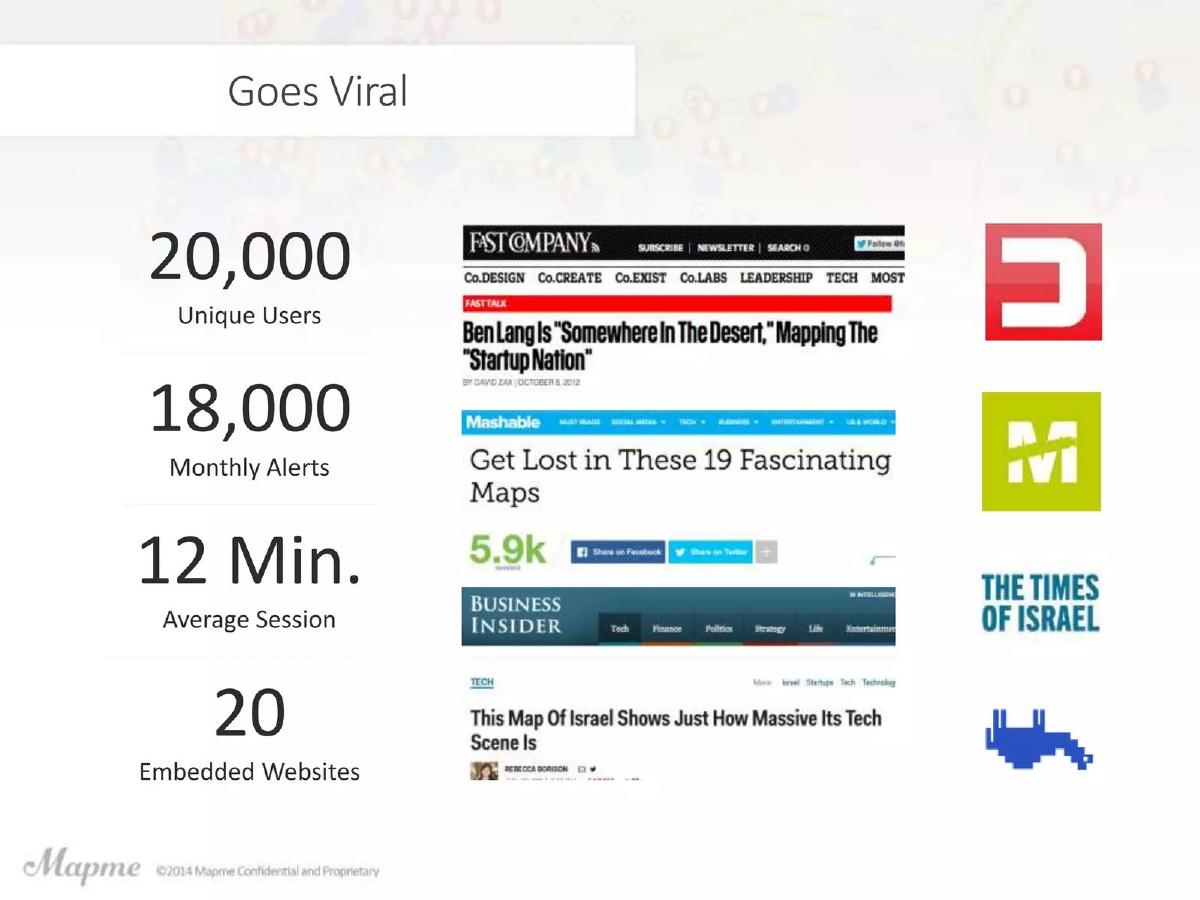
- The 'Israeli Startup Map' served as the proof of concept, reaching 20,000 unique users (Slide 3).
- The product achieved high engagement with an average session duration of 12 minutes (Slide 3).
- The business model is multi-faceted, proposing revenue from data sales, referral programs, SaaS subscriptions, and targeted advertising (Slide 11).
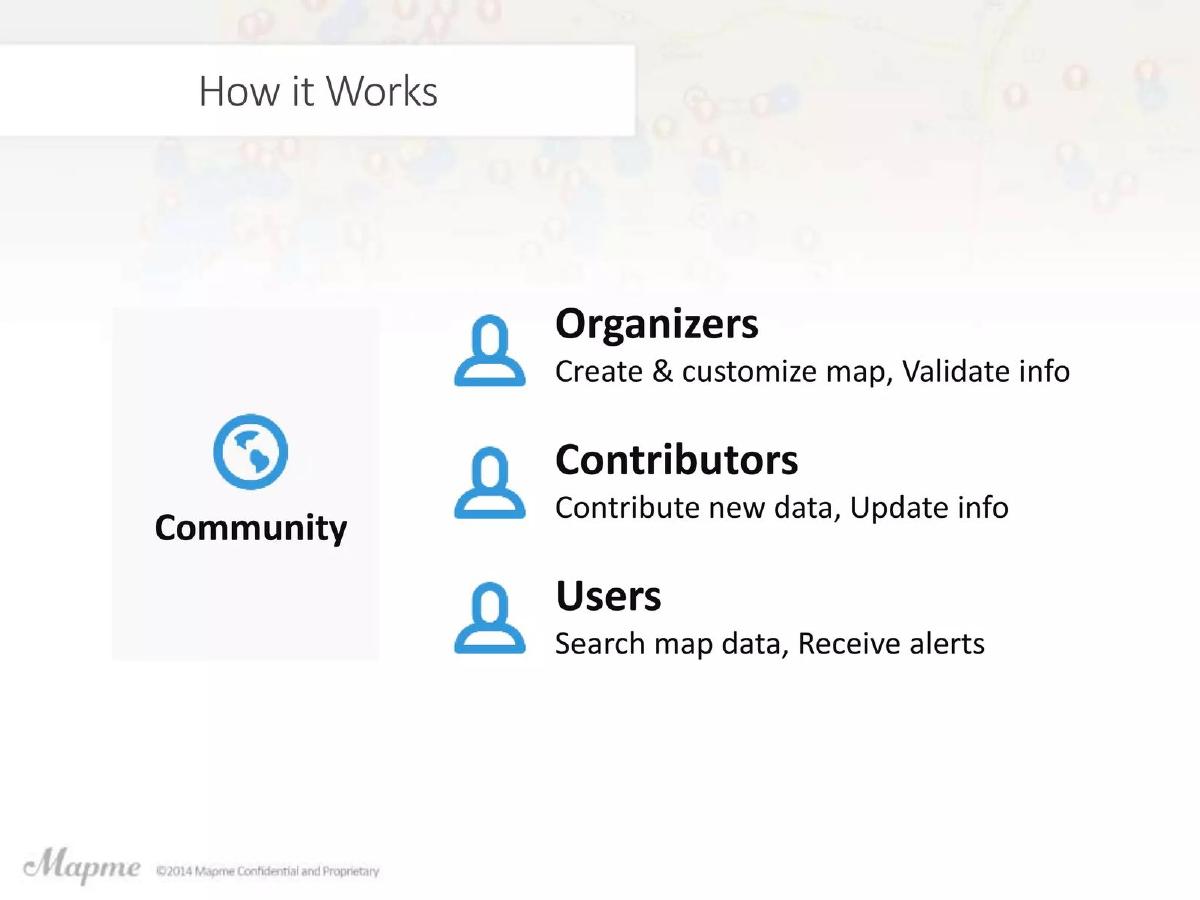
- The team defines three distinct user roles: Organizers, Contributors, and Users, to explain their data validation loop (Slide 6).
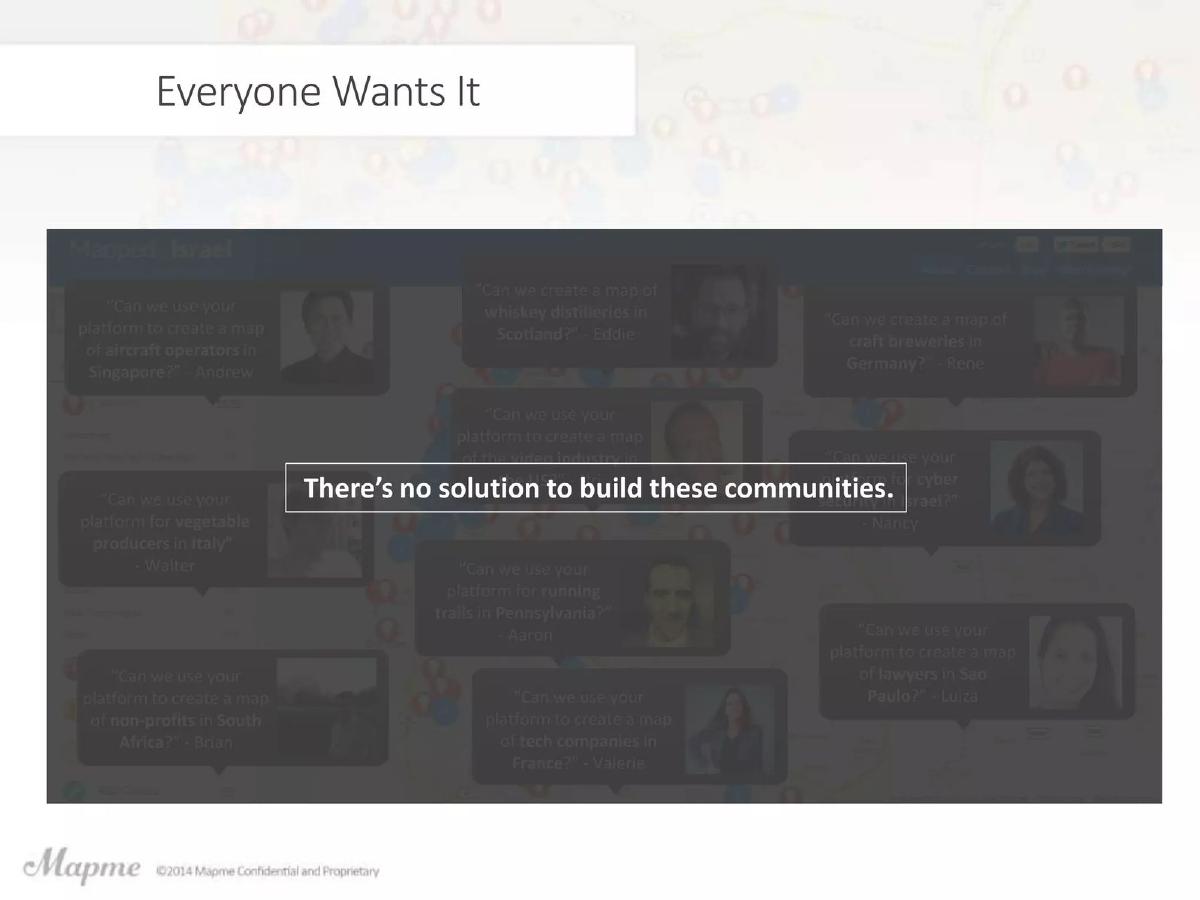
- Inbound demand was demonstrated through a collage of requests for maps ranging from whiskey distilleries to tech companies (Slide 4).
- The roadmap focuses on transitioning from manual pilots to a self-service platform by March 2015 (Slide 12).
- The founders have a strong pedigree with logos from Business Insider, LivePerson, and Yotpo on the team slide (Slide 13).
- The funding ask is specific: $1M to build the self-service version of the platform (Slide 14).
The MapMe Teardown: Turning a Viral Project into a Platform
MapMe is a SaaS platform designed to allow users to create interactive, community-driven maps. This 14-slide deck was used to raise a $1M seed round. The narrative follows a classic 'traction-first' approach, where the founders use a successful side project to justify the need for a scalable platform. Below is a slide-by-slide breakdown of how they presented their case.
The Hook: Proven Traction (Slides 1-4)
Slide 1: Title The deck opens with a simple logo on a faded map background. It is clean and minimalist, though it lacks a one-sentence value proposition on the cover.
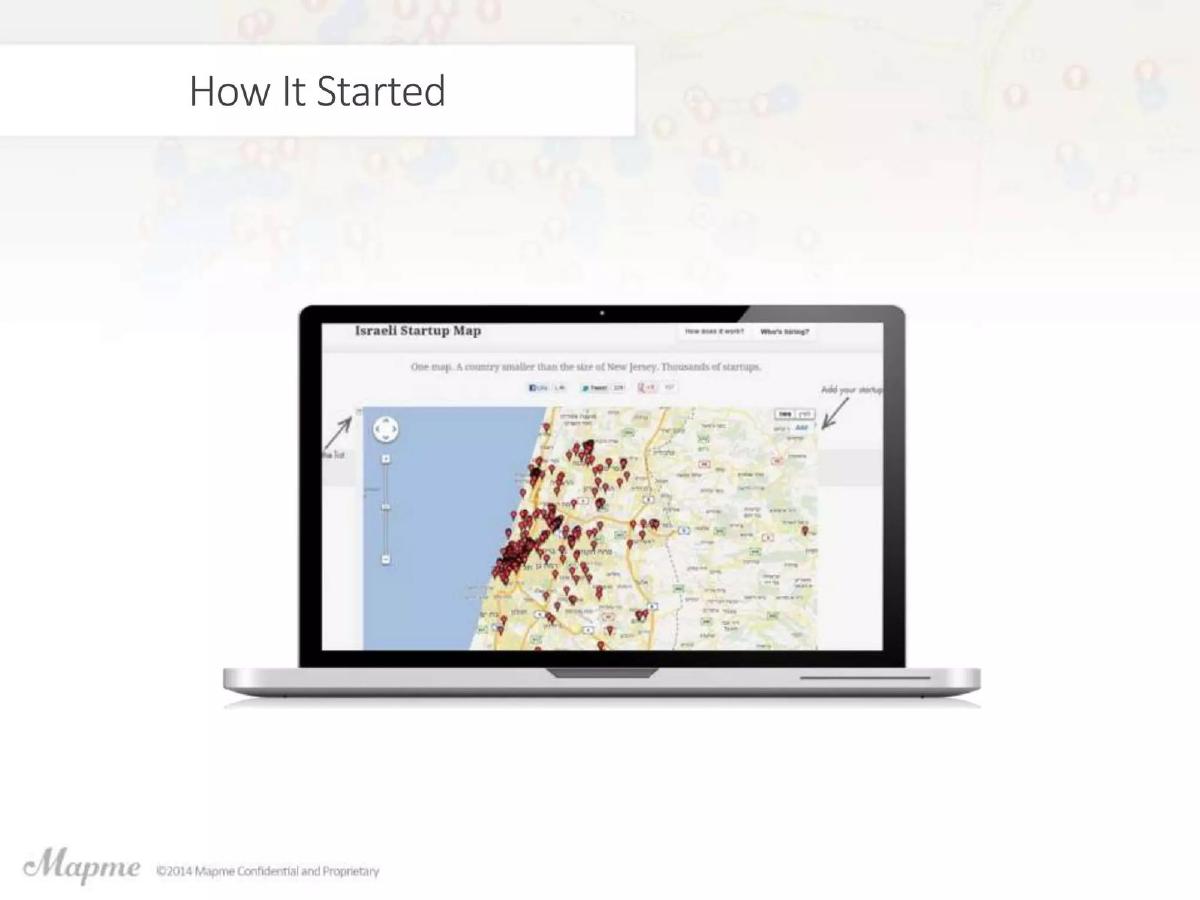
Slide 2: How It Started The founders introduce the 'Israeli Startup Map.' This is a critical slide because it establishes that the product isn't just an idea—it is already live in a specific niche. The visual shows a laptop displaying a map of Israel crowded with pins, captioned 'One map. A country smaller than the size of New Jersey. Thousands of startups.'
Slide 3: Goes Viral This is the 'Proof of Concept' slide. It lists impressive metrics: 20,000 unique users, 18,000 monthly alerts, and a 12-minute average session. It also features logos from Fast Company, Mashable, and Business Insider. The 12-minute session time is the standout figure here, as it indicates the map is a destination, not just a utility.
Slide 4: Everyone Wants It To prove market pull, MapMe shows a dark-overlay slide with quotes from potential users. Requests include maps for 'whiskey distilleries in Scotland,' 'craft breweries in Germany,' and 'non-profits in South Africa.' The central text states: 'There’s no solution to build these communities.' This effectively transitions the deck from a single map project to a global platform opportunity.
The Solution and Product Mechanics (Slides 5-8)
Slide 5: Mission Statement The company defines itself as a 'Platform that empowers passionate people to build, launch and grow Community Maps.' This is the first time the broader vision is explicitly stated.
Slide 6: How it Works MapMe breaks down its ecosystem into three personas: Organizers (who create and validate), Contributors (who add data), and Users (who consume data). This explains their 'moat'—crowdsourced data that stays fresh because the community maintains it.
Slide 7: Value This slide reiterates the benefits for each persona. Organizers get branding and revenue; Contributors get exposure; Users get 'actionable data.' It’s a bit repetitive of Slide 6 but reinforces the incentive structure of the platform.
Slide 8: Demo Time A placeholder for a video demo on a tablet. In a live pitch, this is where the founders would show the ease of use of the map builder.
Market Strategy and Business Model (Slides 9-11)
Slide 9: Go-To Market The strategy is split into Pre-launch and Post-launch. Pre-launch focuses on pilot maps (Yoga, Bitcoin, 3D Printing) and generating 500 organizer leads. Post-launch relies on 'highly viral' product features and social sharing. It’s a standard organic growth playbook for a SaaS tool.
Slide 10: Market Potential Instead of a TAM/SAM/SOM chart with billions of dollars, MapMe uses a visual gallery. They show images representing a 'Vineyard Map of France,' 'Hiking Map of the Rockies,' and 'Cheese Map of Belgium.' This helps investors visualize the sheer variety of niches they can occupy.
Slide 11: Business Model Opportunities The deck lists four revenue pillars: Data (selling unique datasets), Referral Program (CTAs on map pins), SaaS (freemium/premium features), and Targeted Advertising . By listing four options, they show flexibility, though they don't commit to which one will be the primary driver.
The Team and The Ask (Slides 12-14)
Slide 12: Timeline The roadmap shows the journey from May 2012 (the original Israeli map) to a projected 'Discovery Engine' in November 2015. The key milestone is the 'Self Service Platform' in March 2015, which is what the funding will facilitate.
Slide 13: Team The team slide is strong. It features Ben Lang (CEO), Philippe Lang (COO), and Amir Zucker (CTO), along with advisor Ariel Finkelstein. The logos associated with the team—Business Insider, Yotpo, LivePerson, and Wibiya—suggest a group with significant experience in scaling and exiting tech companies.
Slide 14: Seeking The final slide is the ask: '$1M to build our self service platform.' It includes Ben Lang’s direct contact information. It is a clear, no-nonsense conclusion.
What Works in This Deck
The 'Wedge' Strategy: By starting with the Israeli Startup Map, they proved that people want to use and contribute to these maps. This de-risks the 'will people use it?' question. · Persona Definition: Clearly defining Organizers vs. Contributors helps investors understand how the data is actually generated without the company having to hire thousands of data entry clerks. · Visual Examples: Slide 10 (Market Potential) does a great job of making a generic 'map builder' feel specific and exciting through diverse use cases. · Team Pedigree: The inclusion of well-known tech logos on the team slide provides immediate credibility for a seed-stage company.
What Is Missing
Competitive Landscape: There is no mention of Google, Mapbox, or even simple directory builders. Investors would naturally ask why a community wouldn't just use a Google My Maps link. · Unit Economics: While they list 'Business Model Opportunities,' there are no projections on CAC (Customer Acquisition Cost) or expected LTV (Lifetime Value). · Technical Moat: The deck doesn't explain if there is any proprietary technology behind the map rendering or data validation. It feels like a 'UI/UX' play rather than a 'Deep Tech' play. · Current Revenue: The deck doesn't state if the pilot maps or the Israeli map are currently generating any income.
What a Founder Should Copy
The 'Inbound Request' Slide: Slide 4 is a powerful way to show product-market fit. If you have emails or tweets from people asking for your product, screenshot them and put them in the deck. · Engagement Metrics: Highlighting '12-minute average session' is much more impressive than just 'total hits.' It shows the product is sticky. · Clear Persona Roles: If your business relies on a multi-sided marketplace or community, use the format on Slide 6 to explain who does what. It simplifies complex operations. · Direct Ask: Don't be vague on the final slide. MapMe states exactly how much they want and exactly what they will use it for (building the self-service platform).
Frequently asked questions
- What was the primary traction metric used in the MapMe deck?
- MapMe relied heavily on the success of their initial project, the Israeli Startup Map. They cited 20,000 unique users, 18,000 monthly alerts, and 20 embedded websites. Most impressively, they highlighted a 12-minute average session duration, which is exceptionally high for a web-based map tool, suggesting deep user engagement with the content.
- How does MapMe plan to make money?
- The deck outlines four revenue streams: selling unique community-sourced data to large platforms like Facebook or Yahoo; a referral program where maps include calls-to-action (e.g., 'apply to job'); a SaaS freemium model for private maps and custom branding; and highly targeted advertising based on the specific niche of the map.
- Who is the target audience for MapMe's platform?
- MapMe targets 'passionate communities.' The deck provides examples such as vineyard owners in France, hikers in the Rockies, cheese enthusiasts in Belgium, and graffiti artists in NYC. They position the tool for 'Organizers' who want to build and brand a community around a specific geographic interest.
- Does the deck include a competitive analysis?
- No. The deck completely omits a competitive landscape slide. It does not mention established players like Google My Maps, Mapbox, or Esri. Instead, it focuses on the 'community' and 'crowdsourcing' aspect as a unique differentiator, claiming there is 'no solution to build these communities' currently available.
- What is the 'Self-Service Platform' mentioned in the ask?
- At the time of the pitch, MapMe appeared to be operating as a managed service or a series of manual pilots. The $1M investment was specifically earmarked to build a self-service platform (launched March 2015 per the timeline) that would allow any user to create and manage their own map without direct intervention from the MapMe team.