OrderCircle's 2015 seed deck is a study in extreme minimalism. Spanning 20 slides (though essentially a 10-slide deck repeated), it focuses heavily on the 'B2C vs. B2B' gap. By contrasting the ease of Shopify with the archaic world of fax machines and manual sales reps, the company successfully framed a clear problem. With $10k in MRR and 72 brands on board at the time of the pitch, the deck relied on early momentum rather than complex financial modeling. However, the total absence of a team slide, a clear 'Ask,' or a detailed roadmap makes it a risky template for modern founders. It served i…
Key takeaways
- The deck uses a direct comparison between B2B and B2C to highlight market neglect (Slide 2).
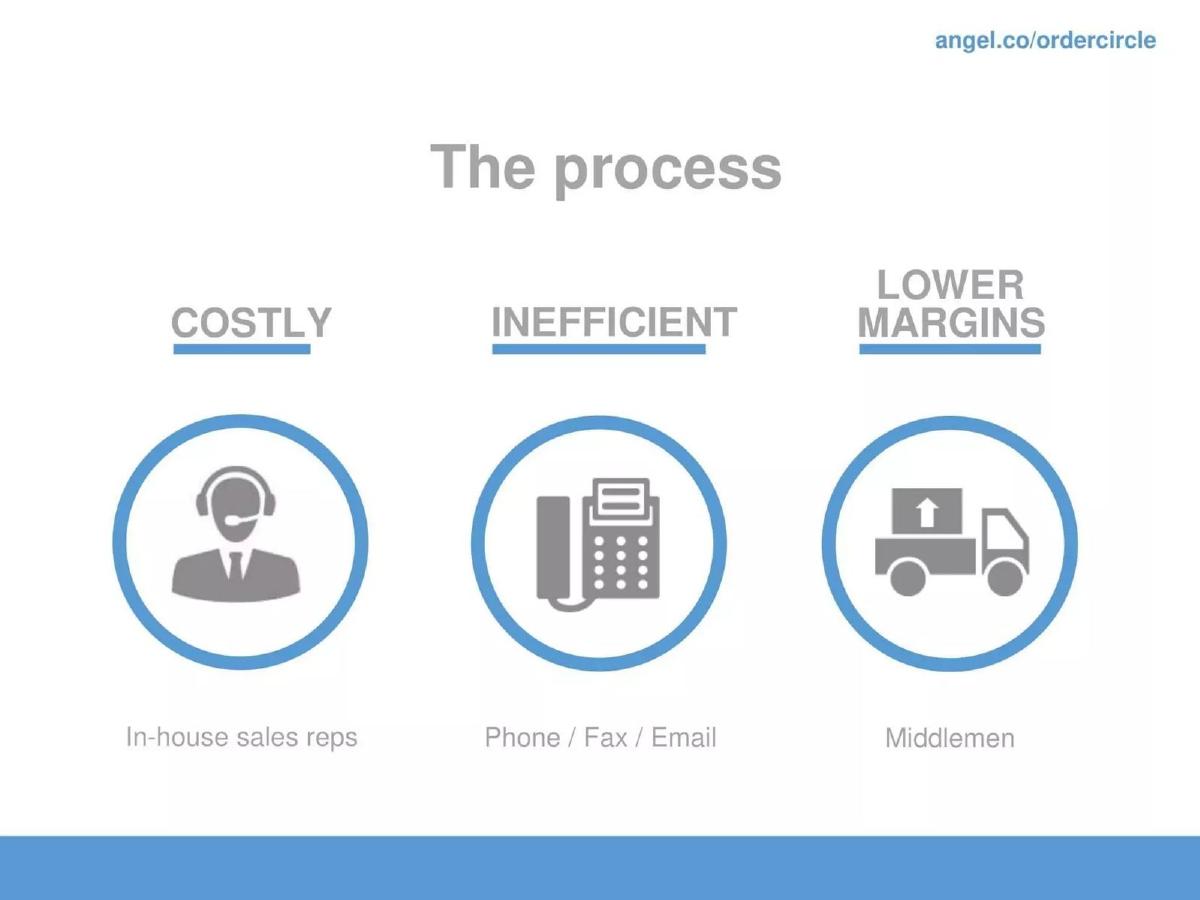
- It identifies three core pain points in the current B2B process: Costly sales reps, inefficient communication (fax/email), and margin-eroding middlemen (Slide 3).
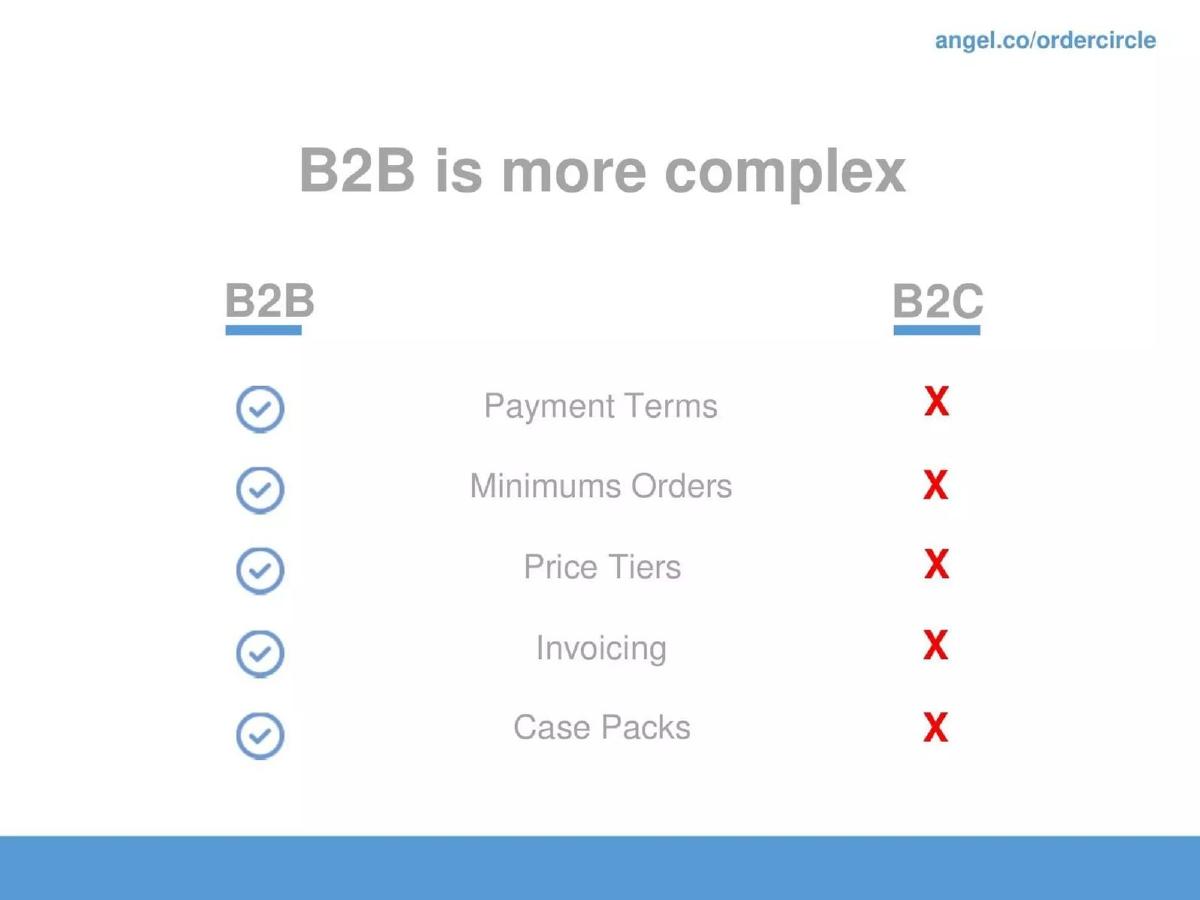
- A checklist on Slide 4 explicitly defines B2B complexities like Payment Terms and Minimum Orders that B2C platforms lack.
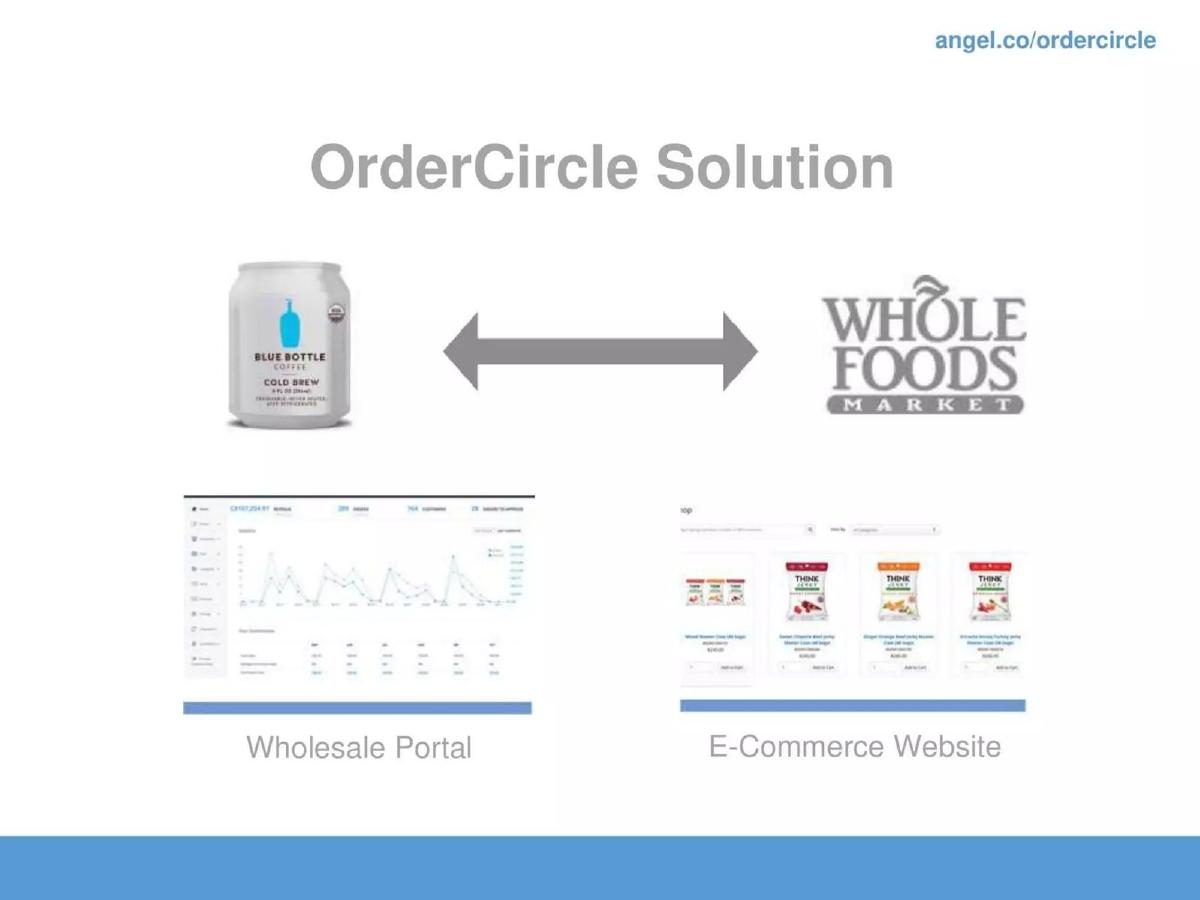
- The solution is presented as a dual-facing product: a Wholesale Portal for the brand and an E-Commerce Website for the retailer (Slide 6).
- The company claims a 'Savings of 30%' for its ecosystem participants (Slide 7).
- Market size is estimated at a $900 Billion B2B volume for 2016 (Slide 8).
- Traction is clearly stated as $10K MRR with 72 brands and 18k retailers (Slide 9).
- The deck completely omits a team slide, competitive analysis, and a specific funding ask (Slides 1-20).
The Shopify for B2B: A Minimalist Seed Deck
OrderCircle’s 2015 pitch deck is a fascinating artifact from a time when 'B2B e-commerce' was just starting to be recognized as a massive, underserved category. The deck is incredibly lean, relying on high-level concepts and early traction rather than granular data. While it successfully raised $125,000, it leaves many questions unanswered—questions that a modern VC would likely demand answers to before writing a check.
The Problem and the Gap (Slides 1-4)
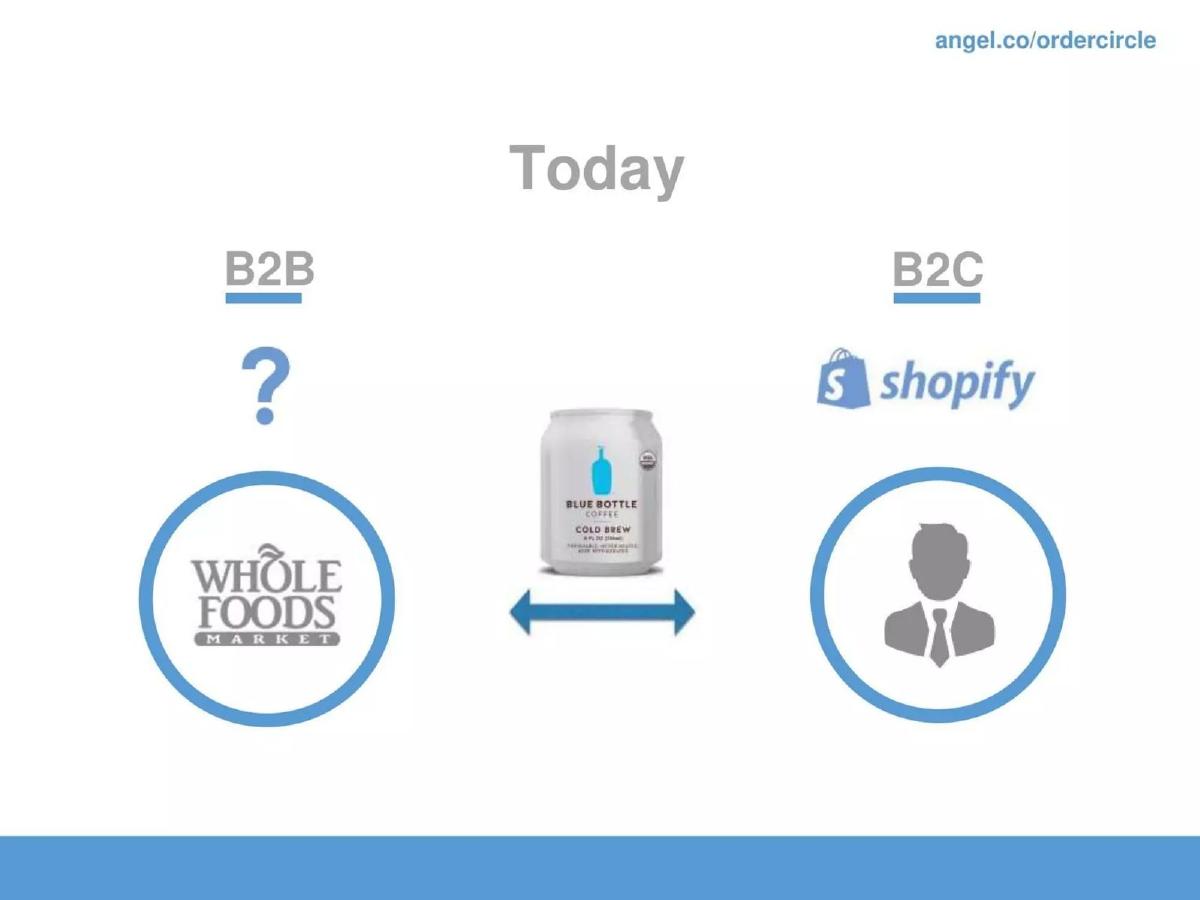
Slide 1 introduces the company with a simple tagline: "Bringing the efficiency of e-commerce to B2B wholesale." This immediately sets the stage for a 'consumerization of IT' play. Slide 2 , titled "Today," uses a visual metaphor to show the gap. On the B2C side, there is Shopify; on the B2B side (represented by Whole Foods), there is a question mark. This is a classic 'X for Y' positioning strategy.
Slide 3 breaks down "The process" into three negative outcomes: Costly (in-house sales reps), Inefficient (Phone / Fax / Email), and Lower Margins (Middlemen). By grouping these, OrderCircle argues that the current way of doing business isn't just slow—it's actively hurting the bottom line. Slide 4 provides the technical justification for why a standard B2C cart won't work. It lists five features B2B needs that B2C doesn't: Payment Terms, Minimum Orders, Price Tiers, Invoicing, and Case Packs. This slide is crucial because it defends their 'moat' against Shopify itself.
The Solution and Ecosystem (Slides 5-7)
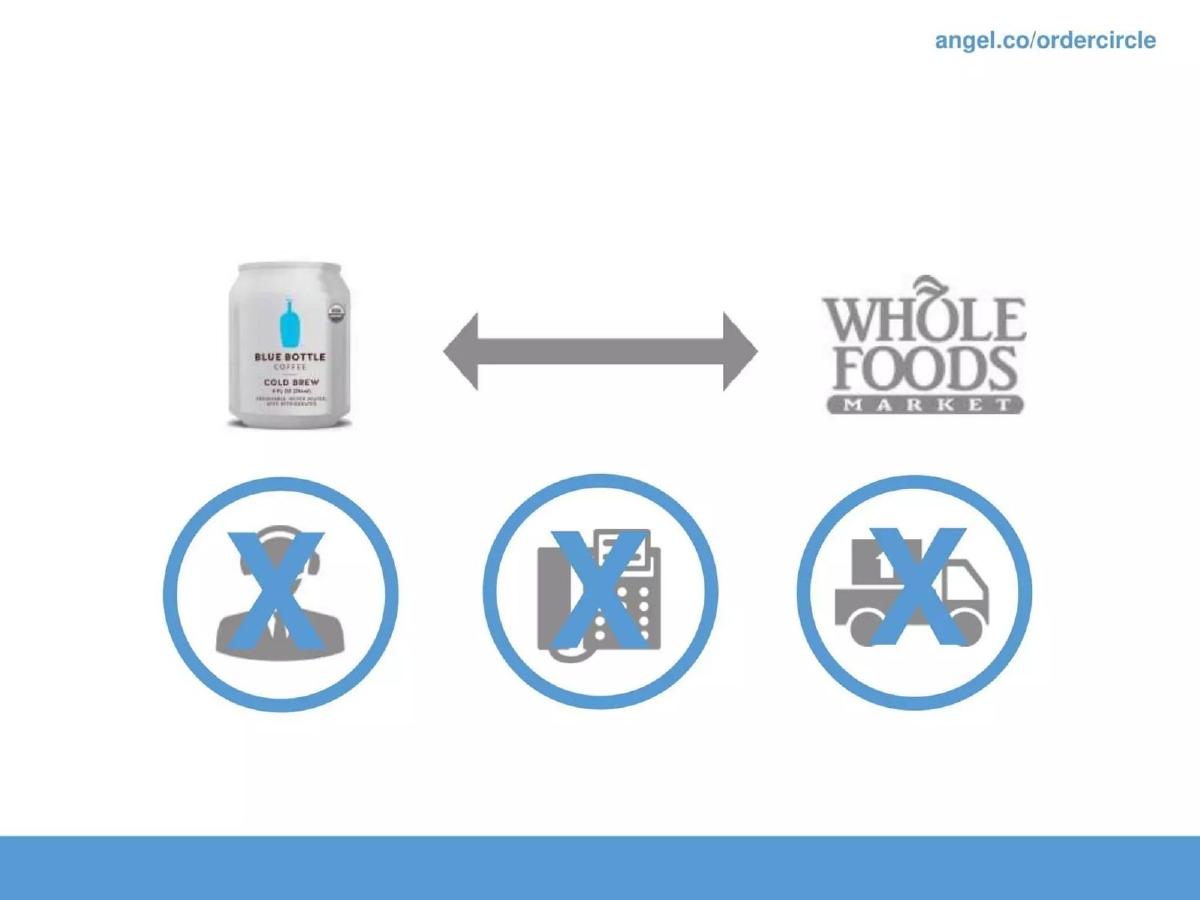
Slide 5 is a transition visual, showing the removal of the sales rep, the fax machine, and the truck (middleman) from the equation between a brand (Blue Bottle) and a retailer (Whole Foods). Slide 6 then introduces the "OrderCircle Solution," which consists of two parts: a Wholesale Portal for the brand to manage data and an E-Commerce Website for the retailer to place orders. The screenshots are small but suggest a clean, modern UI.
Slide 7 , titled "Our Ecosystem," is where the deck attempts to show product-market fit. It displays logos of brands (Think Jerky, etc.) and major retailers (Starbucks, Costco, Neiman Marcus). The central claim here is a "Savings of 30%." While the deck doesn't explain exactly how that 30% is calculated, it serves as a powerful anchor for the value proposition.
Market Size and Traction (Slides 8-10)
Slide 8 addresses "The Market" with a simple map of the USA and a figure: "900 Billion B2B volume in 2016." This is a top-down market sizing approach, which is generally less favored than bottom-up, but for a $125k raise, it establishes that the ceiling is high enough to matter.
Slide 9 is the most important slide in the deck: Traction. It lists 72 Brands, 18k Retailers, and $10K MRR. The accompanying line graph shows MRR growing from approximately $2,000 in March to $10,000 in October. This 5x growth over seven months is the primary reason this deck was fundable. It proves that despite the simple slides, there was a real product that people were paying for. Slide 10 is a contact slide, which is then followed by a full repetition of the deck in slides 11-20.
What Works
Clear Contrast: The deck does an excellent job of explaining why B2B is different from B2C. By listing specific features like 'Price Tiers' and 'Net Terms,' they prove they understand the customer's pain points better than a generic e-commerce provider. · Visual Simplicity: There is almost no 'wall of text' in this deck. A busy investor can flip through these 10 unique slides in 30 seconds and understand exactly what the business does. · Traction-First: Ending the unique portion of the deck on a $10k MRR figure with a clear growth trend is a strong way to close. It moves the conversation from 'what if' to 'how do we scale this.'
What is Missing
The Team: This is the most glaring omission. In a seed round, investors are primarily betting on the founders. There is no mention of who built the software, their background in wholesale, or their ability to scale a sales team. · The Ask: The deck never states how much money they are looking for or what they plan to do with it. While the catalogue facts state they raised $125k, a pitch deck should ideally outline the milestones that the new capital will help achieve. · Competition: The deck acts as if OrderCircle is the only solution in the 'question mark' space. In reality, B2B e-commerce was already a crowded field in 2015 with players like Handshake, NuORDER, and Joor. Ignoring them can make a founder look uninformed. · Unit Economics: While $10k MRR is great, there is no mention of Customer Acquisition Cost (CAC) or Lifetime Value (LTV). For a SaaS business, these metrics are vital to prove the model is sustainable.
What a Founder Should Copy
The 'Complexity Checklist': Slide 4 is a perfect way to explain a niche product. If you are building a tool for a specific industry, use a checklist to show exactly why general-purpose tools fail to meet the industry's unique requirements. · The 'Before and After' Visuals: Slides 3 and 5 work together to show a transformation. Showing the 'clutter' of the old process and the 'cleanliness' of the new one is a persuasive psychological tool. · Focus on Savings: If your product is a utility or a back-office tool, lead with the percentage of savings. OrderCircle’s '30% savings' claim is the strongest hook in their ecosystem slide.
Final Analysis
OrderCircle’s deck is a 'traction deck.' It doesn't need to be beautiful or exhaustive because the numbers—72 brands and $10k MRR—do the heavy lifting. However, for most founders, especially those in more competitive markets or seeking larger checks, this level of minimalism is risky. The lack of a team slide and a competitive landscape analysis are 'red flag' omissions in a standard venture process. This deck likely functioned as a visual aid for a conversation rather than a standalone document sent via email. It succeeded in its context, but it represents the bare minimum of what a seed deck should contain.
Frequently asked questions
- How much did OrderCircle raise with this deck?
- According to the catalogue facts, OrderCircle raised $125,000 in a Seed round in 2015. This is a relatively small amount for a seed round, which explains why the deck could afford to be minimalist and omit deep financial projections or a complex roadmap.
- What is the primary value proposition offered to brands?
- The deck focuses on efficiency and margin protection. Slide 7 claims a 'Savings of 30%' by removing the need for in-house sales reps, manual processing (phone/fax/email), and middlemen. It essentially promises to digitize the manual labor of wholesale ordering.
- Why does the deck repeat itself after slide 10?
- Slides 11 through 20 are exact duplicates of slides 1 through 10. This is likely a formatting error in the uploaded version or a 'looping' deck designed for a kiosk or background presentation where the slides cycle continuously during a talk.
- Is there a team slide in the OrderCircle pitch deck?
- No. The deck contains no information about the founders' backgrounds, technical expertise, or previous successes. The only name mentioned is Zahi Darwazeh on the title and contact slides. This is a significant omission for a seed-stage company.
- What traction did the company have at the time of the pitch?
- Slide 9 shows a Monthly Recurring Revenue (MRR) of $10,000. The company also reported having 72 brands and 18,000 retailers in their ecosystem, with a growth chart showing a steady climb from March to October.