Orange Slice’s deck is a textbook example of the 'less is more' philosophy in early-stage fundraising. With only seven slides, the company avoids the clutter of traditional market sizing and competitive landscapes to focus entirely on a specific use case and the technical 'unlock' that makes it possible. By framing the problem through a simple 'Imagine you are selling' narrative, they demonstrate immediate utility. The deck relies heavily on the founders' backgrounds—specifically experience at Ramp and J.P. Morgan—to bridge the gap between a simple product premise and a $5.3M investment. It i…
Key takeaways
- The deck uses a minimalist 7-slide structure, omitting traditional sections like TAM, Competition, and Financials (Slides 1-7).
- The value proposition is framed as becoming the 'dominant platform for buying signals' (Slide 1).
- A concrete hypothetical example—selling Voice AI agents to companies hiring customer service reps—is used to explain the product (Slides 2-4).
- The core technical differentiator is identified as 'LLM web scraping' (Slide 5).
- The product focuses on 'Temporal Signals,' such as new location openings or RFP activity, rather than static database info (Slide 6).
- Founder Kishan Sripada cites experience at Ramp, growing from $0 to $1B+ ARR in ~6 years (Slide 7).
- Founder Vihaar Nandigala highlights a previous startup exit at age 19 and M&A experience at J.P. Morgan (Slide 7).
- The deck includes a Y Combinator logo, signaling participation in the accelerator program (Slide 7).
The Power of the Minimalist Narrative
Orange Slice’s 7-slide deck is a masterclass in narrative efficiency. In an era where pitch decks often bloat to 20+ slides filled with speculative TAM (Total Addressable Market) charts and complex competitive matrices, this deck takes the opposite approach. It identifies a single, massive pain point in sales—finding the right time to reach out—and proposes a single technical solution. According to publisher reports, this streamlined approach helped the company secure $5.3M in Seed funding in 2025.
Slide 1: The Vision Statement
The deck opens with a bold claim: "the dominant platform for buying signals." The branding is clean, featuring a high-quality image of a person holding an orange. This slide establishes the company's ambition immediately. They aren't just building a tool; they are building a "dominant platform." By focusing on "buying signals" rather than "leads" or "data," they position themselves in the high-value intent category of sales tech.
Slides 2-4: The Hypothetical Use Case
Orange Slice uses a three-slide sequence to explain their product through a simple analogy. Slide 2 sets the stage: "Imagine you are selling: Voice AI customer service agents." Slide 3 introduces the logic: "We find when companies are: Hiring customer service Reps." Slide 4 closes the loop by labeling this discovery a "Buying Signal."
This is an effective way to bypass technical jargon. Instead of explaining how an LLM parses a job board, they show the result : if a company is hiring humans for a role, they are a prime target for an AI agent that automates that role. It is a logical, easy-to-digest value proposition that requires zero prior knowledge of the product's backend.
Slide 5: The Technical Unlock
Slide 5 is the shortest but perhaps most important slide for an AI-era investor: "LLM web scraping is the unlock." This slide answers the "Why now?" question. Web scraping has existed for decades, but it was historically rigid and struggled with unstructured data. By stating that LLMs are the "unlock," Orange Slice is telling investors that they are leveraging new technology to solve an old problem (data extraction) in a way that wasn't possible two years ago.
Slide 6: Defining Temporal Signals
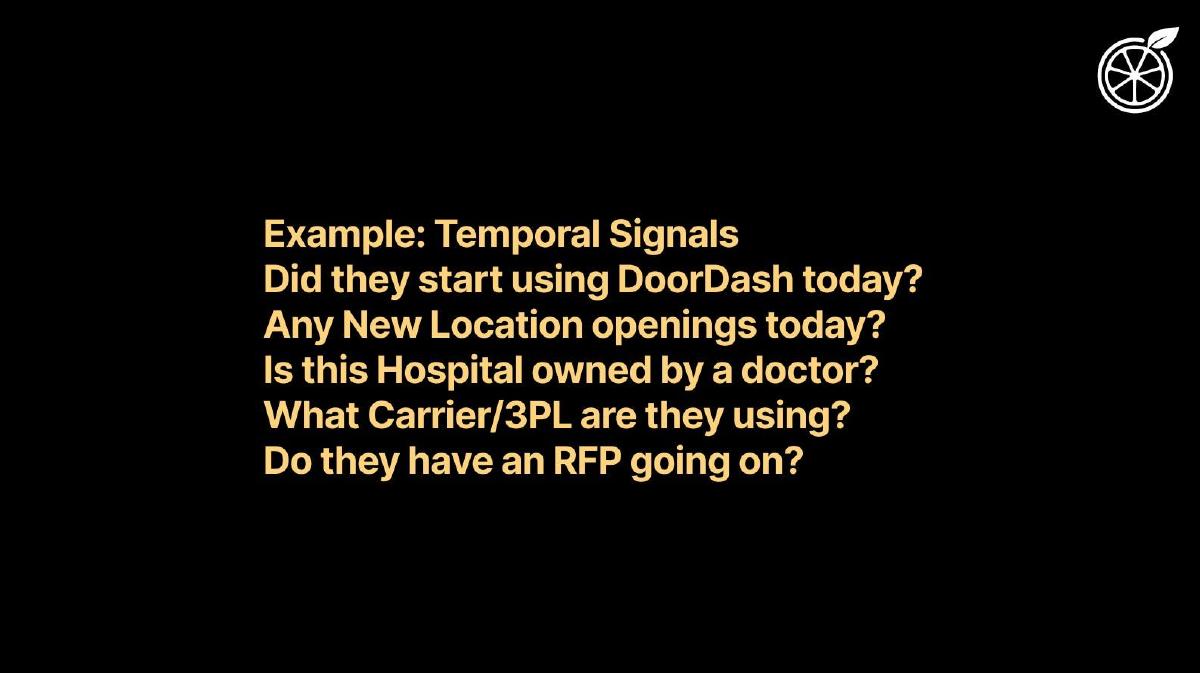
Slide 6 provides concrete examples of what the platform can actually find. They call these "Temporal Signals." The slide lists five specific questions the AI can answer by scanning the web:
Did they start using DoorDash today? · Any New Location openings today? · Is this Hospital owned by a doctor? · What Carrier/3PL are they using? · Do they have an RFP going on?
These examples are crucial because they demonstrate the breadth of the product. It’s not just for tech companies; it applies to logistics (3PL), healthcare (Hospitals), and retail (New Locations). It suggests a product that can generate highly specific, actionable spreadsheets for almost any sales team.
Slide 7: The Pedigree (Our Story)
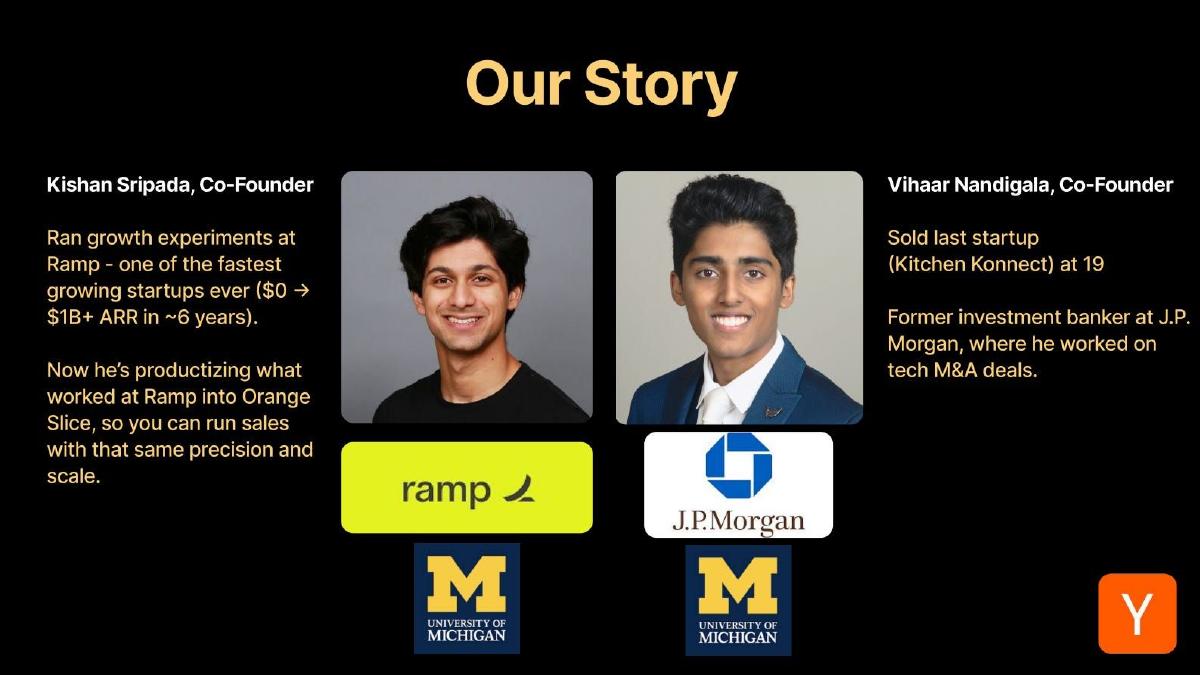
The final slide, "Our Story," is where the $5.3M valuation likely found its footing. The founders, Kishan Sripada and Vihaar Nandigala, present a formidable combined resume. Sripada's experience at Ramp—specifically mentioning the growth from "$0 -> $1B+ ARR in ~6 years"—is a massive signal to investors. He isn't just a developer; he saw the inside of a rocket ship and claims to be "productizing what worked at Ramp."
Nandigala complements this with an entrepreneurial exit at age 19 (Kitchen Konnect) and a background in tech M&A at J.P. Morgan. The inclusion of the University of Michigan and Y Combinator logos rounds out a "blue chip" founder profile. In early-stage investing, the team is often more important than the product, and this slide maximizes that leverage.
What Works in the Orange Slice Deck
Clarity of Purpose: Within the first 30 seconds of reading, an investor knows exactly what this company does: they find reasons for salespeople to call prospects. There is no ambiguity.
The 'Ramp' Association: By explicitly linking the product's methodology to Ramp’s growth engine, the founders provide a proven blueprint for success. Investors love "the [Successful Company] for [New Industry]" or "the tool that powered [Successful Company]."
Focus on 'Temporal' Data: Most sales databases (like ZoomInfo or Apollo) are static. By focusing on "today" (used twice on Slide 6), Orange Slice differentiates itself as a real-time engine rather than a stale database.
What is Missing from the Orange Slice Deck
Market Size (TAM): There is no mention of how big the sales intelligence market is. While most VCs know this is a multi-billion dollar space, the omission of a TAM slide is a bold choice that assumes the investor is already sold on the category.
Competition: The deck does not mention competitors like Clay, 6sense, or Apollo. In a crowded AI sales prospecting market, not addressing how they differ from existing "signal" platforms is a significant gap.
Business Model and Traction: There is no mention of how much the product costs, how many customers they have, or their current revenue. As a Seed deck, it is possible they are pre-revenue, but even a mention of design partners or pilot programs would have added weight.
The 'Ask': The deck does not state how much money they are looking to raise or what they plan to do with the funds. While this information is often shared in the email body or the meeting, its absence from the deck makes it a pure narrative piece rather than a complete business proposal.
Founder's Guide: What to Copy
Use the 'Imagine' Framework: If your product is technical, use Slides 2-4 as a template. Don't explain the code; explain the scenario. "Imagine you have X problem... we find Y... that equals Z value."
Identify Your 'Unlock': Every AI startup needs a "Why Now?" slide. Orange Slice’s Slide 5 is perfect. It identifies the specific technological shift (LLMs) that makes their previously impossible product possible today.
Lead with Your Best Stats: On the team slide, don't just list your titles. List the most impressive number associated with your previous work. Sripada didn't just "work at Ramp"; he was there for the "$0 to $1B+ ARR" journey. That specific figure is what sticks in an investor's mind.
Keep it Visual: The deck uses a consistent black background with high-contrast yellow and white text. It looks modern, professional, and is easy to read on a mobile device—which is where many VCs first view decks.
Final Analysis
Orange Slice’s deck is a high-conviction bet on founder pedigree and a clear technical hook. It succeeds not by being comprehensive, but by being memorable. It leaves the investor with two key thoughts: "This team knows how to scale" and "LLMs finally make web data useful for sales." For a Seed round, those two thoughts are often worth $5.3M.
Frequently asked questions
- Why is the Orange Slice deck so short?
- At the Seed stage, especially for YC-backed companies with high-pedigree founders, the goal is often to sell a 'vision' and a 'secret.' Orange Slice focuses entirely on their unique technical unlock (LLM scraping) and their team's ability to execute, rather than padding the deck with generic market research that investors in the AI space likely already know.
- Does the deck explain how the technology works?
- Only at a high level. Slide 5 identifies 'LLM web scraping' as the unlock. It suggests that Large Language Models allow the platform to interpret unstructured web data to find specific 'temporal signals' that traditional scrapers or static databases like ZoomInfo might miss, though it does not detail the underlying architecture.
- What is a 'Temporal Signal' in this context?
- As shown on Slide 6, temporal signals are time-sensitive events. Examples include a company starting to use a specific software (DoorDash), opening a new physical location, or initiating an RFP (Request for Proposal). These signals suggest a higher intent to buy than simple demographic data.
- Is there a business model or pricing slide?
- No. The deck completely omits unit economics, pricing tiers, and go-to-market strategy. It functions as a 'teaser' or a narrative hook, relying on the strength of the founders' 'Story' (Slide 7) to carry the weight of the business's potential viability.
- How important is the Ramp mention on the team slide?
- Extremely. Ramp is one of the fastest-growing B2B SaaS companies in history. By stating that Kishan Sripada is 'productizing what worked at Ramp,' the founders are borrowing the credibility of a multi-billion dollar success story to validate their own sales methodology.