OptimHire’s 10-slide Seed deck presents a concentrated attack on the traditional recruitment agency model. By positioning itself as a 'risk-free outcome-based' ecosystem, the company targets the $600B global recruiting industry with a specific focus on the $11B mid-to-senior IT role segment. The deck leans heavily on comparative value propositions, claiming to reduce hiring costs by 80% and accelerate recruitment speed by 10x. While the deck lacks a formal 'Ask' slide or detailed financial projections, it compensates with a strong founder-market fit narrative, highlighting a CEO with two exit…
Key takeaways
- The company claims to slash recruitment costs by 80% and accelerate hiring by 10x (Slide 2).
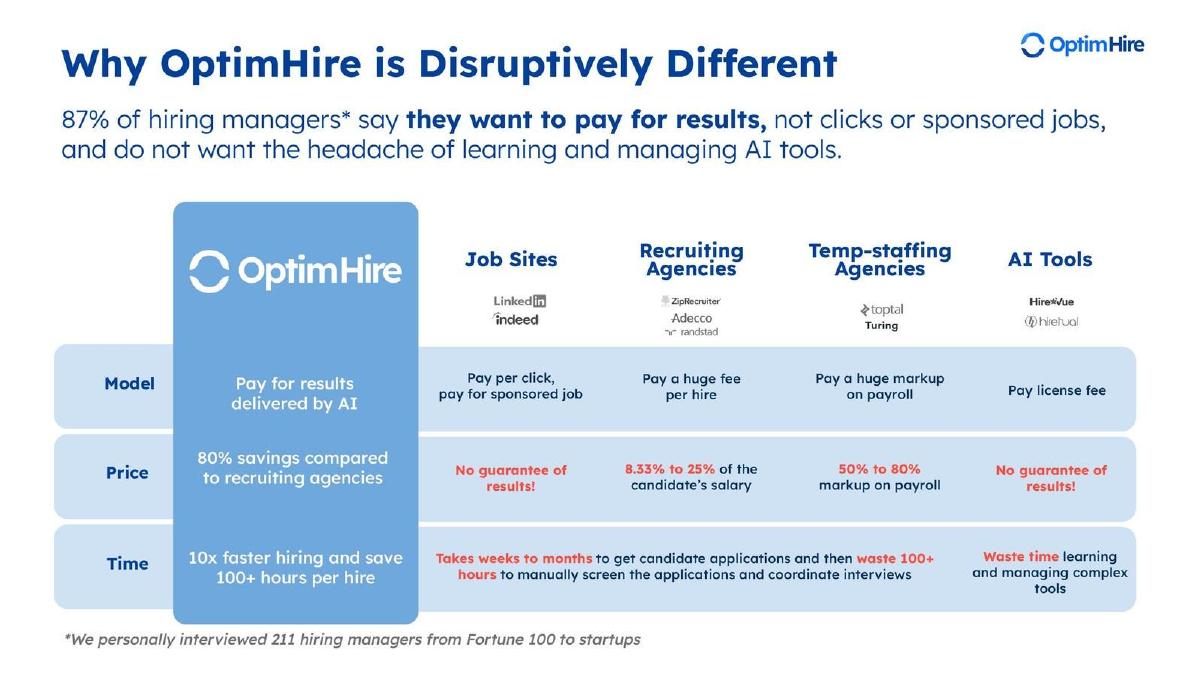
- OptimHire differentiates itself from job sites and agencies by using a 'Pay for results delivered by AI' model (Slide 3).
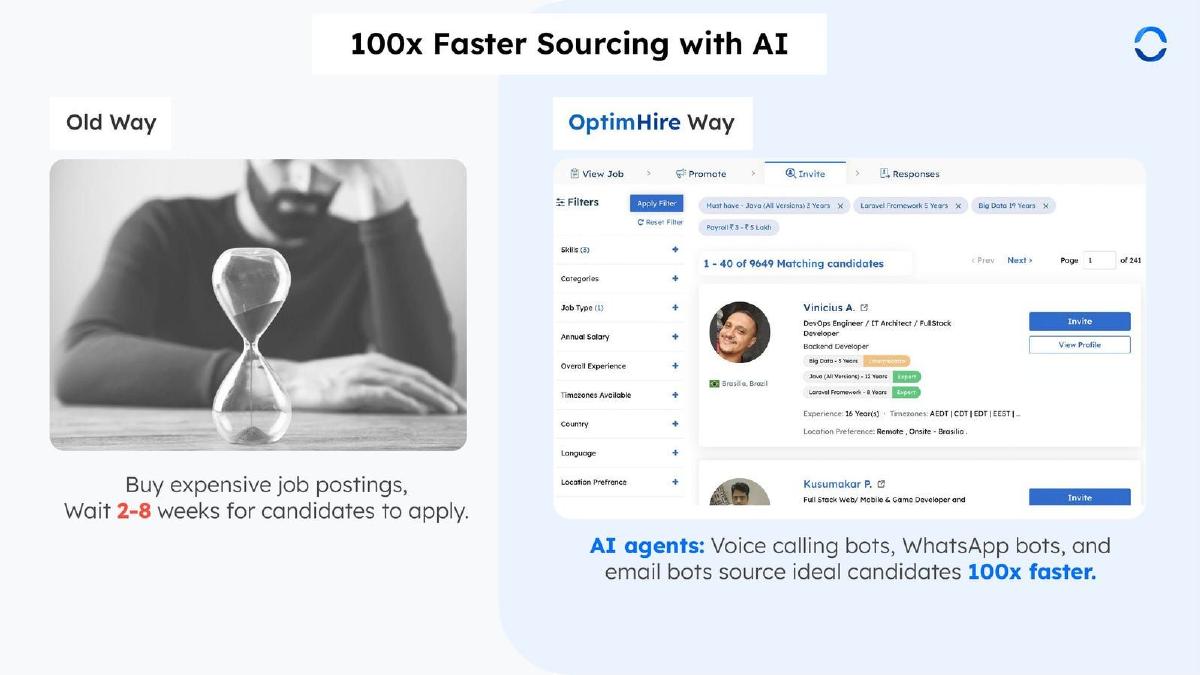
- The platform utilizes AI agents, including voice calling bots and WhatsApp bots, to source candidates 100x faster than manual methods (Slide 4).
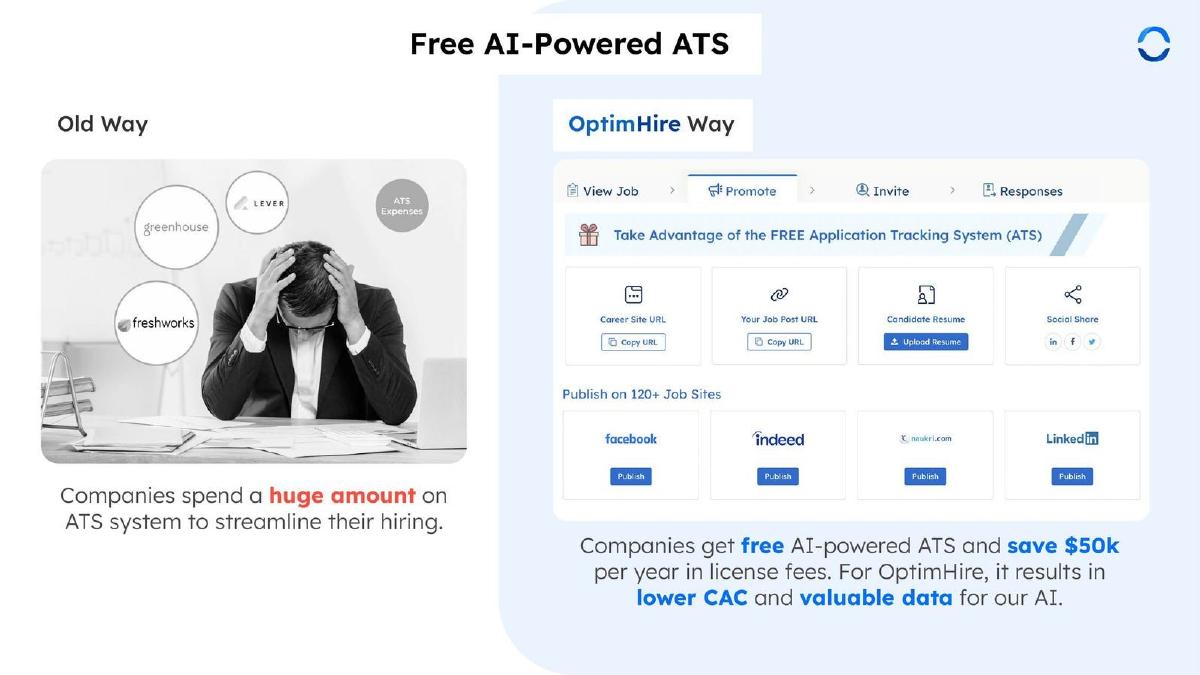
- A free AI-powered ATS is used as a strategic tool to lower CAC and gather valuable training data (Slide 6).
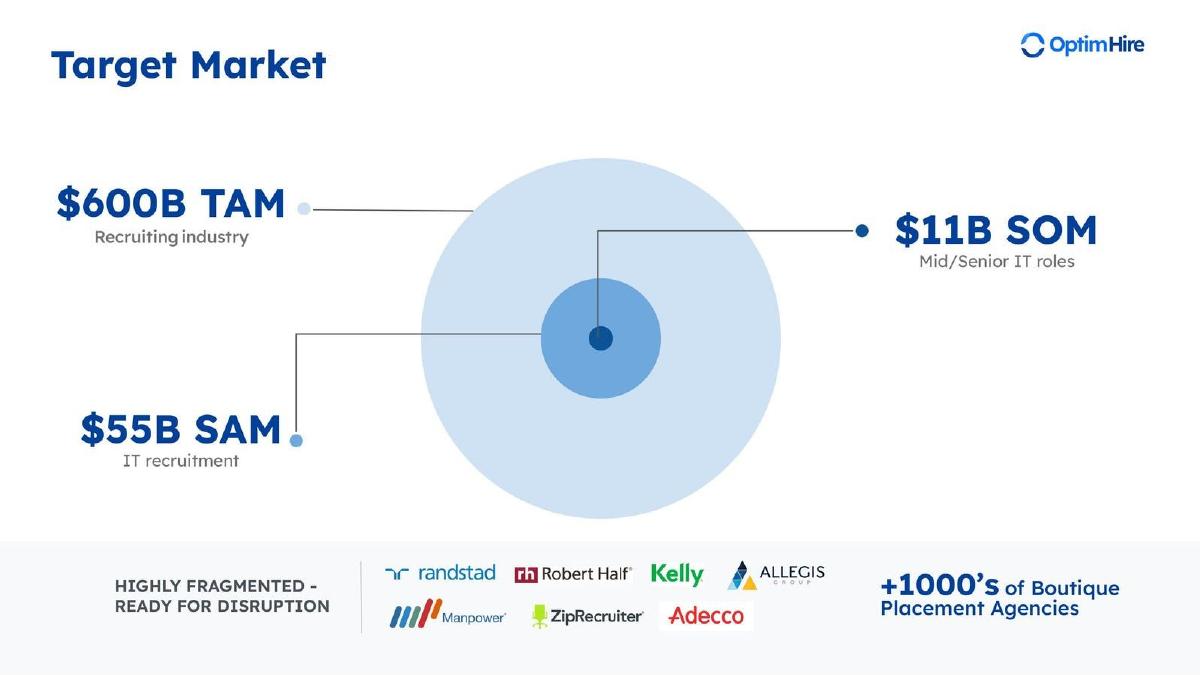
- The total addressable market (TAM) is cited at $600B, with a specific Serviceable Obtainable Market (SOM) of $11B for IT roles (Slide 8).
- CEO Lakshmi M Kodali is a 3x founder with 2 exits who previously bootstrapped a company to $15M (Slide 9).
- The deck identifies a specific pain point where 87% of hiring managers want to pay for results rather than clicks (Slide 3).
- The 'External Team' slide lists high-profile investors including Omar Hamoui of Mucker Capital and Brad Zions of Pitbull Ventures (Slide 10).
OptimHire Pitch Deck Analysis
OptimHire’s 10-slide deck is a study in aggressive value proposition positioning. Reported by Business Insider to have raised a $5M Seed round in 2025, the North American HR tech startup uses this presentation to frame the recruitment industry as a fragmented, inefficient market ripe for AI-driven disruption. The deck avoids the fluff of many modern AI pitches, focusing instead on the 'Old Way' vs. 'OptimHire Way' comparison to justify its bold claims of 80% cost reduction.
Slide 1-2: The Vision and Value Proposition
The deck opens with a clean title slide introducing OptimHire as 'The First Risk-Free Outcome based AI-powered Hiring Ecosystem.' Slide 2 immediately doubles down on this, stating their core metrics: slashing costs by 80% and accelerating recruitment by 10x. By leading with these numbers, the company sets a high bar for the rest of the presentation to prove how these efficiencies are achieved.
Slide 3: Competitive Differentiation
Slide 3 is perhaps the most important slide in the deck. It features a detailed comparison table against four categories: Job Sites (LinkedIn, Indeed), Recruiting Agencies (ZipRecruiter, Adecco), Temp-staffing Agencies (Toptal, Turing), and AI Tools (HireVue). OptimHire claims that 87% of hiring managers want to pay for results , citing a personal survey of 211 managers. The slide highlights that while agencies charge 8.33% to 25% of a candidate's salary, OptimHire offers 80% savings. This slide effectively identifies the 'headache' of managing complex AI tools and the financial risk of pay-per-click models as the primary pain points they solve.
Slide 4: AI-Driven Sourcing
Slide 4 focuses on the top-of-funnel recruitment process. It contrasts the 'Old Way'—expensive job postings and 2-8 week wait times—with the 'OptimHire Way.' The company claims their AI agents (voice, WhatsApp, and email bots) can source candidates 100x faster . The slide includes a UI mockup showing a candidate search interface with filters for skills, salary, and experience, emphasizing the speed and volume of matching candidates (9649 matches shown in the mockup).
Slide 5: Screening and Scheduling Automation
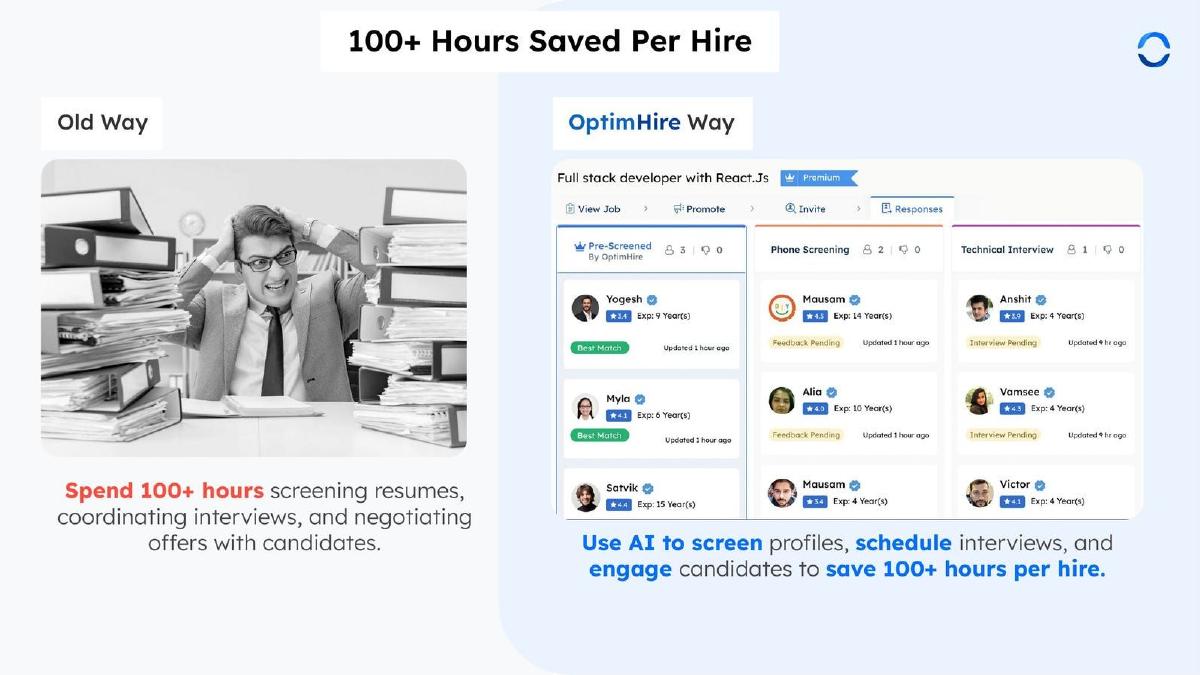
Moving further down the funnel, Slide 5 addresses the manual labor of recruitment. It claims to save 100+ hours per hire by using AI to screen profiles and schedule interviews. The UI mockup shows a kanban-style board with columns for 'Pre-Screened,' 'Phone Screening,' and 'Technical Interview.' This visualizes the platform as a full-stack replacement for the manual coordination typically handled by human recruiters.
Slide 6: The Trojan Horse Strategy (Free ATS)
Slide 6 introduces a strategic move: a 'Free AI-Powered ATS.' The slide argues that companies currently spend 'huge amounts' on systems like Greenhouse, Lever, and Freshworks (up to $50k per year in license fees). By offering this for free, OptimHire achieves two goals: lower Customer Acquisition Cost (CAC) and the collection of valuable data for their AI . This is presented as a win-win that builds a data moat while removing the financial barrier to entry for new clients.
Slide 7: The Outcome Summary
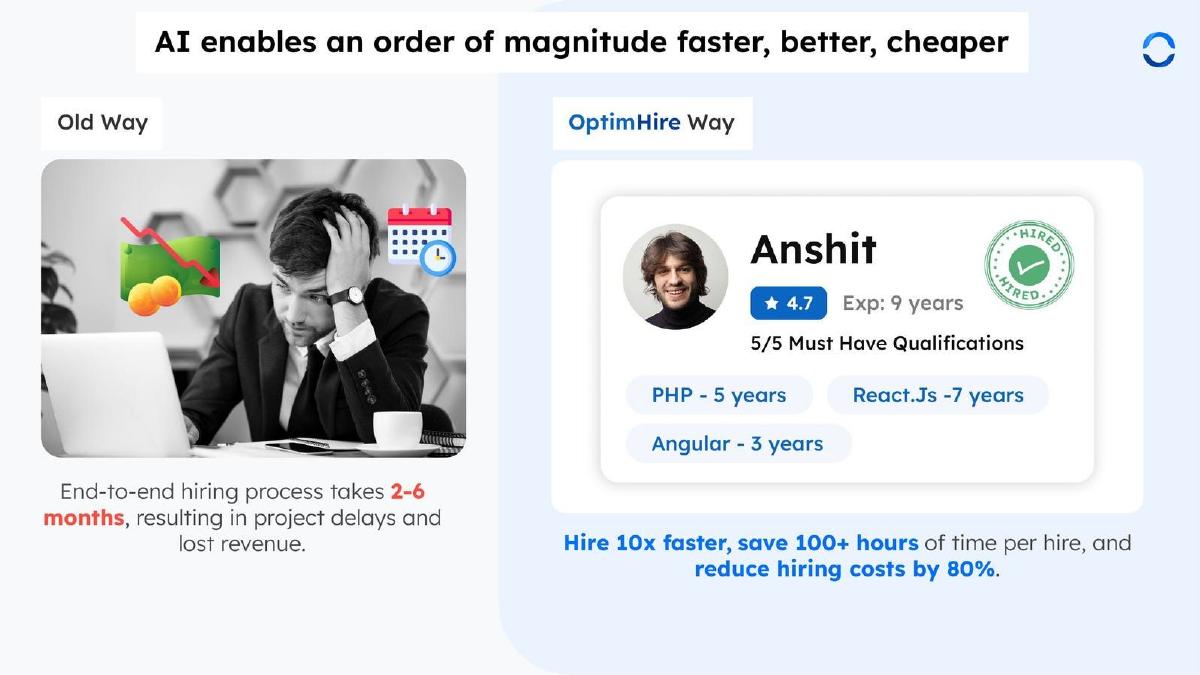
Slide 7 serves as a summary of the 'Order of Magnitude' improvements. It contrasts a 2-6 month hiring process that results in lost revenue with the OptimHire process. It reiterates the 10x speed, 100+ hours saved, and 80% cost reduction. This slide acts as a bridge between the product features and the market opportunity.
Slide 8: Market Opportunity
Slide 8 quantifies the opportunity. It cites a $600B TAM for the recruiting industry, a $55B SAM for IT recruitment, and an $11B SOM for mid/senior IT roles. The slide lists major competitors like Randstad, Robert Half, and Kelly, describing the market as 'Highly Fragmented - Ready for Disruption.' This framing suggests that even a small percentage of the SOM represents a massive revenue opportunity.
Slide 9: The Founding Team
The team slide (Slide 9) focuses on experience and stability. CEO Lakshmi M Kodali is highlighted as a 3x founder with two exits and a history of bootstrapping a company to $15M. A key piece of narrative here is that Lakshmi and CTO Pavan Kumar Rao are childhood friends who have built three companies together over 15 years. This reduces the 'founder conflict' risk that often worries Seed-stage investors. The inclusion of Mustafa Hussain (ex-Google) and Ashutosh Vyas (author and sales coach) rounds out the leadership team.
Slide 10: The External Team (Investors)
The final slide lists their 'External Team,' which serves as social proof. It features partners from Mucker Capital, Pitbull Ventures, Citta Capital, and SparkLabs . Notably, Omar Hamoui is listed as a partner at Mucker and the founder of AdMob. This slide serves to validate the company's potential through the pedigree of its early backers.
What Works in the OptimHire Deck
Clear Comparison: The 'Old Way' vs. 'OptimHire Way' format is used consistently, making the value proposition easy to digest. · Specific Metrics: The deck doesn't just say they are 'better'; it claims specific figures like 80% cost savings and 100x faster sourcing. · Strategic Moat: Explaining why they offer a free ATS (for data and lower CAC) shows sophisticated business thinking beyond just selling a tool. · Founder-Market Fit: The CEO's 15 years in IT placement and previous exits provide the necessary credibility for a Seed round.
What is Missing from the OptimHire Deck
The Ask: There is no slide stating how much money they are raising or the terms of the round. · Use of Funds: The deck does not explain how the $5M will be spent (e.g., engineering, sales, marketing). · Traction Data: While the product is explained, there are no slides showing current revenue, number of active customers, or growth month-over-month. · Unit Economics: There is no mention of LTV (Lifetime Value) or the actual price point for their 'pay for results' model. · Roadmap: The deck focuses on the current product but doesn't outline future features or expansion plans beyond IT roles.
What Founders Should Copy
The Competitive Matrix: Slide 3 is a masterclass in how to position against different types of competitors (agencies vs. software) on a single slide. · Visualizing the UI: The mockups in Slides 4, 5, and 6 are clean and directly support the claims made in the text. · Highlighting Long-Term Partnerships: If you have a long history with your co-founder, explicitly stating it (as seen on Slide 9) is a powerful way to de-risk the investment. · Focusing on the SOM: Instead of just claiming a $600B market, OptimHire identifies a specific $11B niche where they can win first.
Frequently asked questions
- What is OptimHire's primary business model?
- OptimHire operates on an outcome-based model, which they describe as 'Pay for results delivered by AI.' Unlike traditional job sites that charge per click or agencies that charge high percentage-based fees, OptimHire focuses on delivering successful hires. They also offer a free AI-powered ATS to companies to reduce their customer acquisition costs and build a proprietary data moat for their AI models.
- How does OptimHire use AI in the recruitment process?
- The deck highlights the use of AI agents, specifically voice calling bots, WhatsApp bots, and email bots, to automate the sourcing and screening process. These tools are claimed to source candidates 100x faster than the 'old way' of manual job postings. The AI also handles interview scheduling and candidate engagement to save over 100 hours per hire.
- What specific market segment is OptimHire targeting?
- While the deck notes a $600B total recruiting industry, it identifies a $55B Serviceable Addressable Market (SAM) in IT recruitment. Their immediate Serviceable Obtainable Market (SOM) is $11B, specifically targeting mid and senior-level IT roles. This focus allows them to compete against both large agencies like Randstad and thousands of boutique placement firms.
- Who are the key members of the founding team?
- The team is led by CEO Lakshmi M Kodali, a 3x founder with two exits and a background in IT placement. He is joined by CTO Pavan Kumar Rao; the two are childhood friends who have built three companies together over 15 years. The leadership also includes VP of Sales Ashutosh Vyas and VP of Operations Mustafa Hussain, who has experience at Google.
- What is missing from the OptimHire pitch deck?
- The deck is notably missing several standard components: a slide detailing the specific amount being raised (the 'Ask'), a breakdown of how funds will be used, and a slide showing current revenue or growth traction. It also lacks detailed unit economics or a long-term financial roadmap, focusing instead on the product's value proposition and the team's pedigree.