ORBCOMM’s May 2019 investor deck serves as a blueprint for scaling a hardware-enabled service business through strategic acquisitions. By transitioning from a 25-year-old M2M pioneer to a comprehensive Industrial IoT (IIoT) provider, the company demonstrates how to integrate hardware, 11 different satellite and cellular networks, and SaaS applications into a single platform. The deck leans heavily on social proof, showcasing a 'world-class' customer list including Walmart, Caterpillar, and Maersk. While it lacks specific internal financial performance metrics or a clear 'ask' in the provided…
Key takeaways
- ORBCOMM positions itself as a 25-year pioneer in M2M technology that evolved into a modern IIoT leader (Slide 3).
- The product ecosystem is built on three pillars: hardware sensors, 11 connectivity networks, and SaaS/mobile applications (Slide 5).
- A detailed M&A timeline from 2000 to 2017 illustrates a 'Build, Buy, Partner' strategy to achieve scale (Slide 7).
- The company boasts a massive enterprise customer base including blue-chip names like Walmart, USPS, and Lockheed Martin (Slide 9).
- Market sizing relies on a 2017 BCG estimate projecting the IIoT market to grow from $63B in 2015 to $267B by 2020 (Slide 11).
- The transportation strategy covers all asset classes—Road, Sea, Rail, and Intermodal—integrated into a single platform (Slide 13).
- Connectivity is a key differentiator, utilizing a network-agnostic approach combining Geostationary and Low-Earth Orbit satellites (Slide 15).
- Acquisitions are quantified by 'Subscriber Opportunity,' such as the 200,000+ subscribers gained via WAM Technologies (Slide 17).
Introduction: The Evolution of a Pioneer
The ORBCOMM Investor Overview from May 2019 is a comprehensive look at a company that has successfully navigated the transition from legacy telecommunications to modern Industrial IoT (IIoT). The deck is structured to show scale, reliability, and a dominant market position. It doesn't just sell a product; it sells a decades-long history of connectivity expertise.
Slide 1: Title and Visual Hook
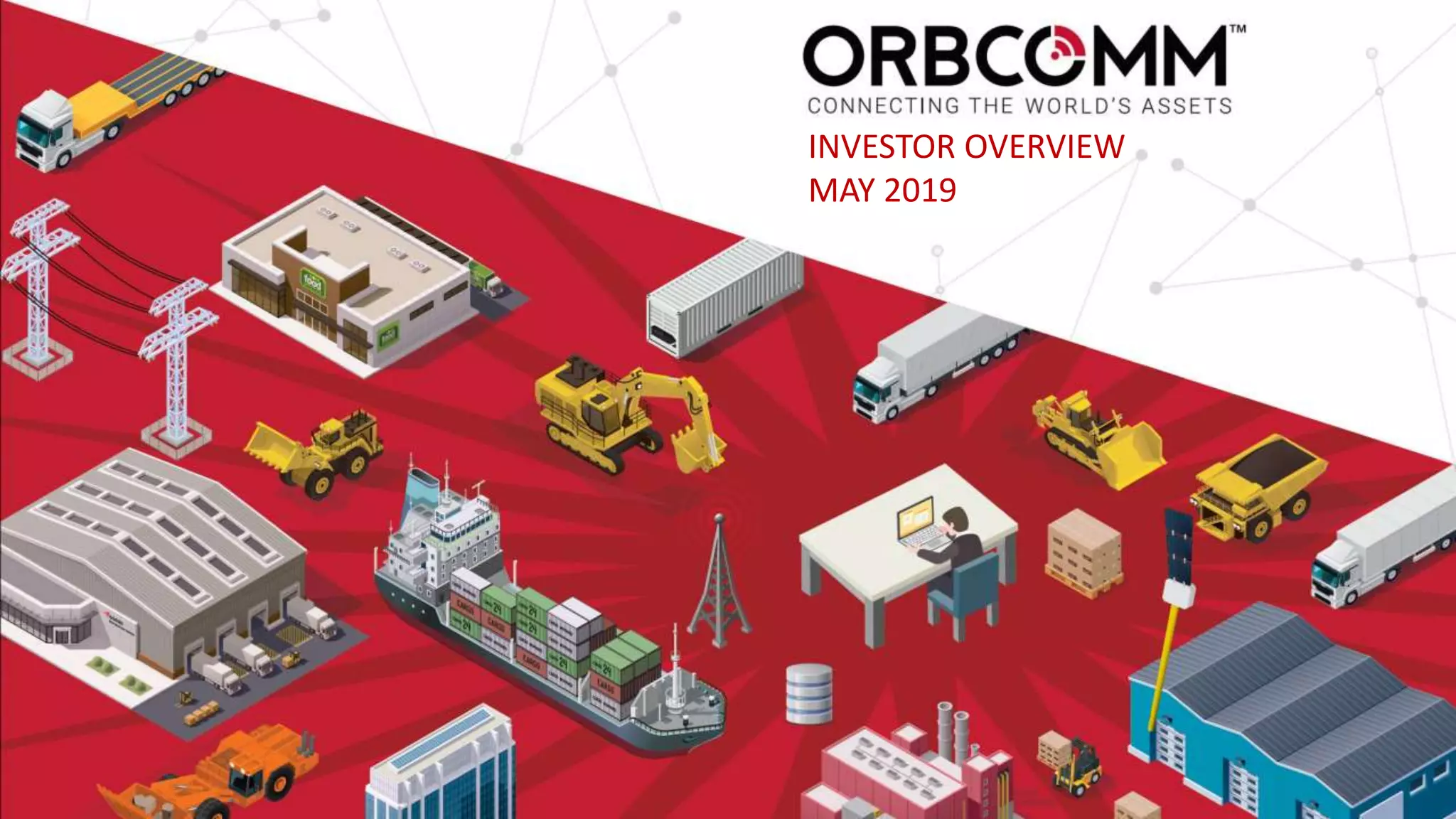
The cover slide sets the stage with the tagline "Connecting the World's Assets." The background graphic is an isometric illustration of various industrial sectors—shipping, construction, trucking, and warehousing—all connected to a central hub. This immediately communicates the breadth of their reach without needing a single line of descriptive text.
Slide 3: ORBCOMM'S Evolution
This slide establishes the company's pedigree. It notes that 25 years ago, ORBCOMM was a pioneer in Machine-to-Machine (M2M) communication. By stating they were connecting assets "long before the Internet of Things became a common term," they are positioning themselves as the experienced incumbent rather than a risky startup. The slide transitions this history into their current offering: the industry's broadest array of Industrial IoT solutions designed to improve ROI.
Slide 5: Components to Complete IoT Solutions
Here, the deck breaks down the technical stack into three digestible pillars. First, hardware: devices and sensors to track and control assets. Second, connectivity: 11 different networks for satellite and cellular coverage. Third, software: SaaS and mobile applications for remote monitoring. By showing a laptop and a smartphone running their interface, they emphasize that their complex backend results in a user-friendly frontend for the customer.
Slide 7: The Race to Scale
This is arguably the most important slide for an investor. It visualizes the company's growth trajectory through a "Build, Buy, Partner" strategy. The timeline starts in 2000 with the OG1 satellite network and moves through nearly two decades of milestones. Key highlights include entering the AIS business in 2008, partnering with AT&T in 2015, and a flurry of acquisitions between 2011 and 2017. This slide proves that ORBCOMM is an aggressive consolidator in a fragmented market.
Slide 9: A World-Class Customer Base
Slide 9 is a "logo soup" slide, but it is exceptionally high-quality. It includes global giants like Walmart, Caterpillar, Maersk, UPS, and Lockheed Martin. The sheer variety of logos—ranging from Domino's Pizza to the Government of Canada—demonstrates that their technology is sector-agnostic and capable of handling diverse enterprise requirements. This serves as massive social proof for potential investors.
Slide 11: The Industrial IoT Market Opportunity
To justify the investment, ORBCOMM points to external validation. Citing a 2017 Boston Consulting Group (BCG) estimate, the slide shows the IIoT market growing from $63 billion in 2015 to $267 billion in 2020. The text highlights that companies are seeking end-to-end solutions to reduce costs and support new business models. It identifies transportation, logistics, and utilities as the three largest sectors, which aligns perfectly with ORBCOMM's core competencies.
Slide 13: Serving All Transportation Asset Classes
This slide zooms in on their strongest vertical: transportation. Using a circular graphic, it shows how they cover Road (flatbeds, reefers, fleet vehicles), Sea (containers), Rail (cars), and Intermodal (chassis). The key takeaway here is the integration: all these disparate assets are "visible in a single platform." This is a powerful value proposition for logistics companies that operate across multiple modes of transport.
Slide 15: Network Agnostic Satellite Connectivity
Slide 15 addresses the technical moat. ORBCOMM differentiates itself by not being tied to a single network type. They compare Geostationary (GEO) networks, which offer sub-30 second latency and large payloads, with Low-Earth Orbit (LEO) networks, which provide better urban coverage and lower costs. By offering both, ORBCOMM claims to provide the "best combination of geographic coverage" and "regulatory authorizations" in the industry.
Slide 17: Expansion via Strategic Acquisitions
The final slide in this set provides the data behind the M&A strategy shown earlier. It lists nine major acquisitions between 2011 and 2017, detailing the sector (e.g., cold chain, heavy equipment) and the "Subscriber Opportunity." For instance, the acquisition of WAM Technologies in 2015 brought in over 200,000 subscribers. This slide quantifies the growth and shows how each acquisition added a specific piece to the ORBCOMM puzzle, such as "driver safety" via the inthinc and Blue Tree Systems deals in 2017.
What Works in This Deck
Clarity of Evolution: The deck does an excellent job of explaining how a 25-year-old company remains relevant. By framing their history as a foundation for modern IoT, they build trust.
M&A Transparency: Most decks hide the details of their acquisitions. ORBCOMM puts them front and center, showing exactly how they bought their way into market leadership. This demonstrates a sophisticated management team that knows how to deploy capital.
Vertical Depth: The breakdown of the transportation sector (Slide 13) is highly effective. It shows that they understand the nuances of the industry, from refrigerated trailers to intermodal chassis.
What Is Missing
Financial Performance: While the deck mentions "subscriber opportunities," it lacks hard financial data in the provided slides. There are no revenue charts, EBITDA margins, or churn rates. For a 2019 investor overview, these omissions are significant, though they may have been included in the 9 slides not provided in this set.
Unit Economics: There is no mention of the Average Revenue Per User (ARPU) or the cost to acquire a subscriber (CAC). In a hardware-plus-SaaS model, these metrics are vital for understanding long-term profitability.
The Ask: The deck ends without a clear call to action or a statement of what they are looking for from investors (e.g., capital for more M&A, debt restructuring, etc.).
Founder Takeaways
Leverage Your History: If your company has been around for a while, don't hide it. Use your longevity as a sign of stability and deep domain expertise, just as ORBCOMM did on Slide 3.
Visualize the Ecosystem: If you have a complex product, use a slide like Slide 5 to break it down into simple pillars. Investors need to understand the 'what' before they can care about the 'how much.'
Show, Don't Just Tell, Your Scale: The M&A timeline on Slide 7 is a brilliant way to show momentum. Even if you haven't acquired companies, you can use a similar format to show product launches, major partnerships, or geographic expansions.
Focus on the 'Single Pane of Glass': In the IoT and SaaS space, the ability to integrate multiple data sources into one platform is a huge selling point. ORBCOMM's emphasis on their "single platform" (Slide 13) is a strategy every enterprise software founder should emulate.
Frequently asked questions
- What is ORBCOMM's core value proposition according to the deck?
- ORBCOMM positions itself as the provider of the industry's broadest array of industrial IoT solutions. They emphasize a 'single platform' approach that integrates hardware, multiple network connectivity options (satellite and cellular), and advanced asset analytics to improve ROI for enterprise customers across transportation, heavy equipment, and government sectors.
- How does ORBCOMM differentiate its satellite connectivity?
- The company uses a 'network agnostic' strategy. As shown on slide 15, they combine Geostationary networks (like Inmarsat) for high payloads and marine advantages with their own Low-Earth Orbit (LEO) network for urban canyon coverage and lower costs. They claim this combination provides the best geographic coverage and fastest service in the market.
- What role does M&A play in ORBCOMM's growth strategy?
- M&A is central to their 'Race to Scale.' Between 2011 and 2017, the company acquired at least ten companies, including StarTrak, SkyWave, and Blue Tree Systems. These acquisitions were used to enter new verticals like cold chain logistics, maritime tracking, and driver safety, while simultaneously expanding their subscriber base.
- Which industries does ORBCOMM target most aggressively?
- While they serve many sectors, the deck highlights transportation and logistics as primary. Slide 13 specifically details their reach across Road (trucks, trailers), Sea (containers), Rail (cars), and Intermodal (chassis) asset classes. They also list significant customers in retail, energy, and government defense.
- What market data does the deck use to justify its growth potential?
- ORBCOMM cites a Boston Consulting Group (BCG) estimate from 2017. This data projects the Industrial IoT market to grow at a massive scale, reaching $267 billion by 2020. The deck argues that IoT is 'utterly transformative' for non-technology companies, positioning ORBCOMM as the essential partner for this transition.