VERDIS presents a technical solution to the environmental and economic waste of gas flaring. By utilizing a proprietary cobalt-rhenium catalyst, the company claims to boost diesel output from the industry standard of 45-50% to 94% (Slide 3). The deck emphasizes modularity, offering 'VERDIS Mobile' units that can be transported on three standard trucks to remote or small-scale deposits (Slide 4). While the deck is heavy on process schematics and technical specifications, it outlines a clear business model involving equipment sales, technology licensing, and long-term leasing (Slide 7). The pre…
Key takeaways
- The company identifies a $20B+ unexploited market for small-to-medium sized gas flares (Slide 2).
- Their proprietary catalyst reportedly increases diesel output to 94%, significantly higher than the 45-50% range of traditional methods (Slide 3).
- The resulting synthetic diesel is 'ultra-clean' with 0% sulfur and 0% aromatics, featuring a Cetane number of 78 compared to the normal spec of 43 (Slide 3).
- The product roadmap includes three scales: Mobile (1 MMSCFD), Fixed (4 MMSCFD), and SPP (25+ MMSCFD) (Slide 4).
- The 'VERDIS Mobile' unit is designed for rapid deployment, transportable via three standard trucks (Slide 4).
- Revenue streams are diversified across equipment sales, licensing, maintenance (estimated at 15% of annual yield value), and leasing (Slide 7).
- The company cites global flaring waste at approximately 3 trillion SCF annually, valued at over $30 billion (Slide 8).
- Technical partnerships are mentioned with Suez Environmental and Aker Solutions for specific regional projects like Inuvik (Slide 6).
Executive Summary: The Modular GTL Opportunity
VERDIS enters the energy sector with a specific focus on Gas-to-Liquids (GTL) technology, aiming to solve the problem of gas flaring. Flaring—the burning of natural gas associated with oil extraction—is both an environmental hazard and a massive economic waste. The VERDIS deck argues that while large-scale GTL exists, the small-to-medium market remains underserved. By providing modular, high-efficiency units, VERDIS intends to capture value from gas that would otherwise be wasted.
Slide 1: Title and Mission
The cover slide is minimalist, featuring the VERDIS logo and the clear value proposition: "We Convert Flared Gas Into Ultra-Clean Diesel." This immediately establishes the company's sector and primary output, avoiding vague tech jargon in favor of a direct industrial application.
Slide 2: Market Prioritization
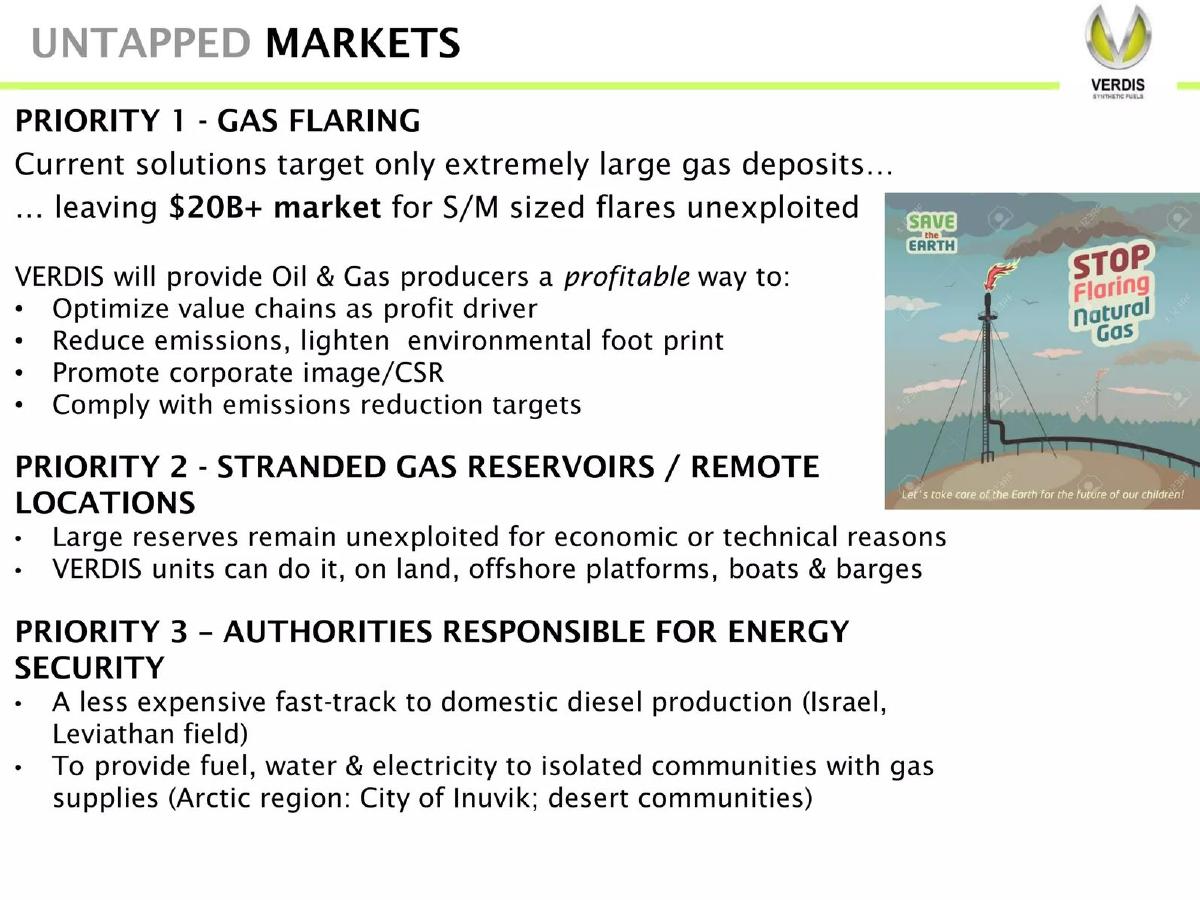
This slide breaks down the target markets into three priorities. Priority 1 is Gas Flaring, where they claim current solutions leave a "$20B+ market for S/M sized flares unexploited." They position the product as a way for producers to optimize value chains and comply with emissions targets. Priority 2 focuses on stranded gas reservoirs in remote locations, noting that units can operate on land, offshore platforms, or barges. Priority 3 addresses energy security, specifically mentioning the Leviathan field in Israel and isolated communities like Inuvik in the Arctic as potential sites for domestic diesel production.
Slide 3: Technical Competitive Advantage
VERDIS leans heavily into its chemistry here. The slide details a "proprietary cobalt-rhenium catalyst" used in their Fischer-Tropsch process. The key metric provided is a boost in diesel output from the industry standard of 45-50% to 94% . The slide includes a carbon number frequency distribution graph to support this claim. The resulting fuel is described as "Paraffinic Synthetic Diesel" with 0% Sulfur and 0% Aromatics , and a Cetane number of 78, which is significantly higher than the normal spec of 43. The core message is that their diesel is "vehicle ready" directly from the reactor with no further refining required.
Slide 4: Product Roadmap and Scalability
The roadmap is defined by capacity rather than dates. Three tiers are presented:
VERDIS Mobile: 1 MMSCFD capacity, producing 100 BBD (15,900 L). It is transportable on three standard trucks. · VERDIS Fixed: 4 MMSCFD capacity, producing 400 US BBD (63,600 L). Transported in several trucks for fixed locations. · VERDIS SPP (Small Petrochemical Plant): 25+ MMSCFD capacity, producing 2500 US BBD (397,500 L) for large-scale flaring sites.
A visual comparison at the bottom shows the visual clarity of their synthetic diesel versus conventional No. 2 diesel fuel.
Slide 5: Offshore GTL Process Schematic
This is a highly technical engineering slide showing the V-CPOX Reactor and the flow through separators, air coolers, and the FT Plate Reactor. The slide claims the offshore solution achieves a "50% fewer unit operations" compared to standard setups, resulting in a lighter footprint and lower operating temperatures and pressures. This is clearly intended for technical due diligence rather than a general audience.
Slide 6: Case Study - Inuvik's Energy Challenge
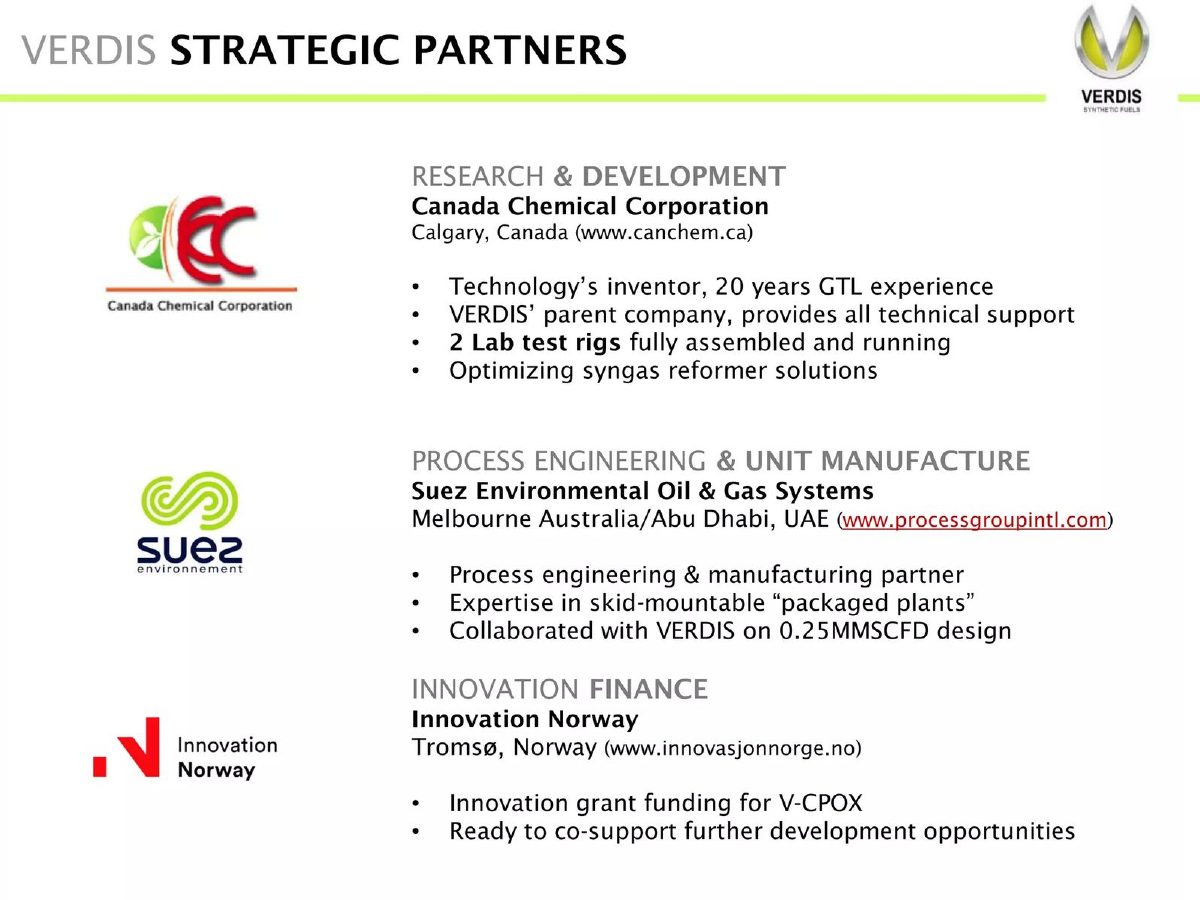
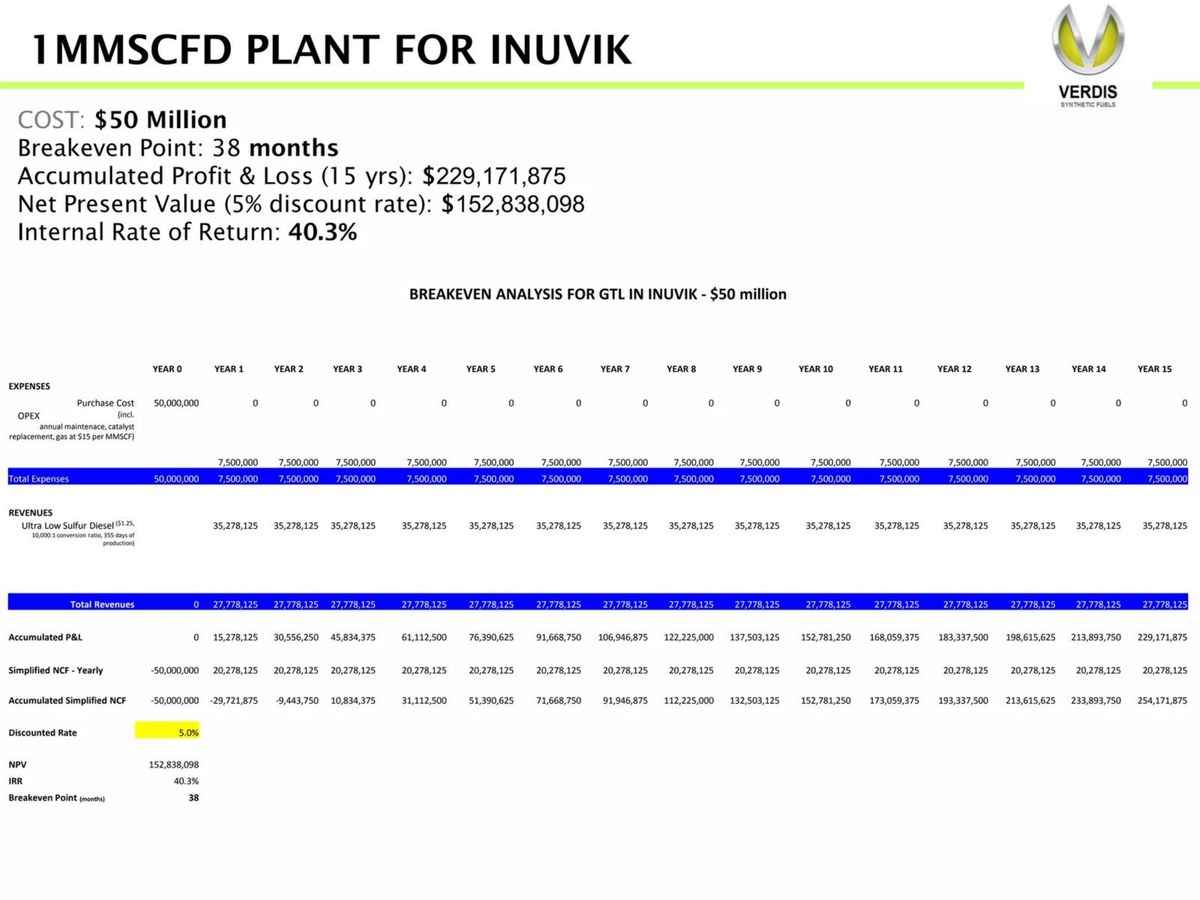
The deck uses the City of Inuvik as a concrete example of their application. It lists Aker Solutions and Suez Environnement as partners for design and winterization. Interestingly, this slide lists several "Possible Sources of Co-Funding," including the Government of Canada and Innovation Norway , suggesting that these projects are in the proposal or early partnership phase rather than fully funded operations.
Slide 7: The Business Model
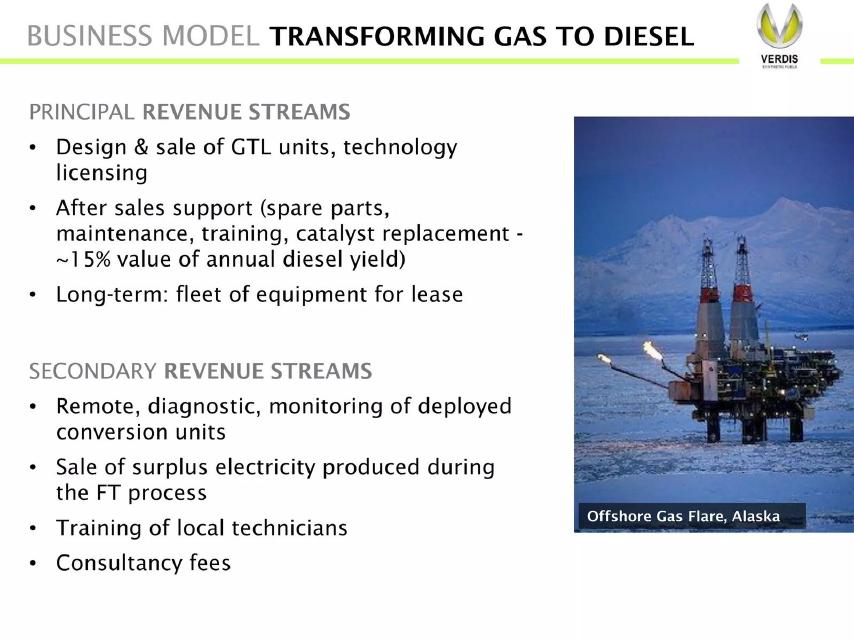
VERDIS outlines a multi-pronged revenue strategy. Principal Revenue Streams include the sale of GTL units and technology licensing, plus after-sales support. They estimate maintenance and catalyst replacement will generate revenue equal to ~15% of the annual diesel yield value . Long-term, they plan to offer a fleet of equipment for lease. Secondary Revenue Streams include remote diagnostics, sale of surplus electricity produced during the process, and consultancy fees. This indicates a shift from a pure OEM (Original Equipment Manufacturer) model to a service-oriented recurring revenue model.
Slide 8: Benefits of Commercialization
This slide summarizes the macro-economic and environmental impact. It quantifies the global waste: ~3 trillion SCF (150 billion cubic meters) of natural gas wasted annually, worth over $30 billion . It also highlights the potential for high-tech employment , estimating that 5-10 engineering jobs are created per R&D center, with additional teams needed for field maintenance. The slide includes a rendering of a VERDIS-branded truck, reinforcing the mobile nature of the solution.
Slide 9: Detailed Process Schematic
Another technical diagram, this one focuses on the land-based process. It tracks the path from compressed air and gas feed through the Reformer (operating at 800°C), through water knockouts and the FT Reactor (operating at 200-215°C), finally resulting in Ultra-Low Sulfur Diesel . The schematic includes a tail gas recycle loop to maximize efficiency.
Slide 10: Product Collection and Footprint
The final slide in this set provides physical dimensions for a 10-25 BBD Layout , citing a footprint of 15m L x 7m W x 11m H . It notes that the system is modular and can be scaled up to 100 BBD by adding more vertical FT reactors. The slide concludes with an operational target of 350 days of uptime per year , suggesting a high degree of reliability in the design.
What Works in the VERDIS Deck
The deck is exceptionally clear about its technical differentiation . By focusing on the specific catalyst performance (94% yield) and the physical footprint of the units, VERDIS answers the "how" and "where" of their business very effectively. The use of a specific case study (Inuvik) helps ground the abstract technology in a real-world problem. Furthermore, the business model slide shows a sophisticated understanding of the industrial lifecycle, moving beyond just selling hardware to capturing value through maintenance and licensing.
What is Missing from the VERDIS Deck
Based on the 10 slides provided, there are several critical omissions:
The Team: There is no slide introducing the founders, engineers, or leadership. In a deep-tech/hard-tech play, the pedigree of the scientists and engineers is paramount. · Financial Projections: While they mention a $20B market, there are no company-specific revenue targets, margins, or break-even analyses. · The Ask: The deck does not state how much capital is being raised or what the specific use of funds will be. · Current Traction: While they mention "possible" partners and sources of funding, there is no clear statement of existing contracts, letters of intent (LOIs), or pilot results. · Competition: The deck mentions that "current solutions target only extremely large gas deposits," but it does not name or analyze direct competitors in the modular GTL space.
Founder's Playbook: What to Copy
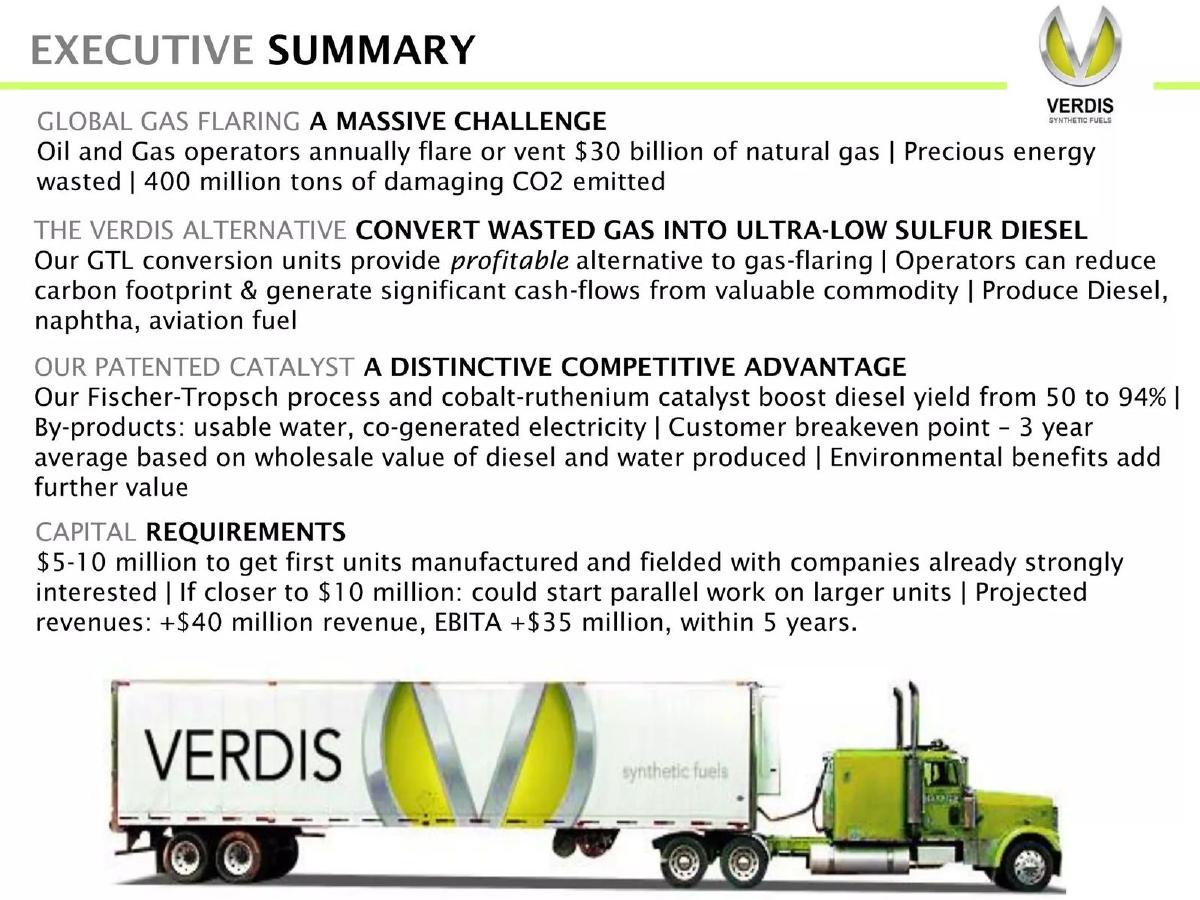
Founders in the industrial or climate tech space should take note of how VERDIS quantifies the cost of the problem . By citing the $30 billion value of wasted gas and the 400 million tons of CO2, they create a sense of urgency. The modular approach to product tiers (Mobile vs. Fixed vs. Plant) is also a strong strategy for hardware startups, as it shows a path from a Minimum Viable Product (the mobile unit) to a large-scale industrial solution. Finally, the detailed schematics are appropriate for this specific audience; when pitching to energy investors, showing that you have solved the engineering flow is often more important than a flashy marketing slide.
Frequently asked questions
- What is the core technology behind VERDIS?
- VERDIS utilizes a Fischer-Tropsch (FT) process enhanced by a proprietary cobalt-rhenium catalyst. This chemical reaction converts methane (CH4) into paraffinic synthetic diesel and water. According to Slide 3, this specific catalyst allows for a 94% diesel output, eliminating the need for further refining and producing a fuel with zero sulfur or aromatics.
- How does VERDIS differentiate itself from large-scale GTL competitors?
- While traditional Gas-to-Liquids (GTL) solutions target extremely large deposits, VERDIS focuses on the 'untapped' small-to-medium sized flares. Slide 4 highlights their 'VERDIS Mobile' unit, which handles 1 MMSCFD (Million Standard Cubic Feet per Day). This modular, truck-mounted approach allows them to monetize stranded gas deposits that are economically unfeasible for larger plants.
- What are the primary revenue drivers for the business?
- The business model (Slide 7) relies on three principal streams: the design and sale of GTL units/technology licensing, after-sales support (including spare parts and catalyst replacement valued at ~15% of annual diesel yield), and long-term equipment leasing. Secondary streams include remote monitoring, sale of surplus electricity, and consultancy fees.
- What environmental impact does the company claim?
- VERDIS positions itself as a CSR and emissions reduction tool. Slide 8 states that their commercialization helps reduce the 400 million tons of CO2 released annually by gas flaring and venting. By converting this waste into usable fuel, they aim to turn an environmental liability into a profit driver for oil and gas producers.
- Does the deck mention specific geographic opportunities?
- Yes, Slide 2 and Slide 6 mention specific locations. They identify the Leviathan field in Israel for domestic diesel production and the City of Inuvik in the Arctic region. For the Inuvik project, they list potential co-funding sources including the Government of Canada, Northwest Territories Power Corporation, and Innovation Norway.