Venyoo’s pitch deck presents a solution for large-scale indoor navigation, targeting stadiums, theme parks, and hospitals where GPS typically fails. The company positions itself as more than a map, offering a data analytics layer that helps venues understand customer behavior and unlock new revenue streams through personalized advertising. While the deck showcases impressive 'deep interest' from major sports leagues and partners, it relies heavily on future projections, forecasting a jump from $593,978 in Year 1 revenue to over $23 million by Year 5. The product is versatile, offered as both…
Key takeaways
- The company identifies a dual problem: venues lack customer behavior data, and customers struggle to navigate large spaces or find friends (Slide 3).
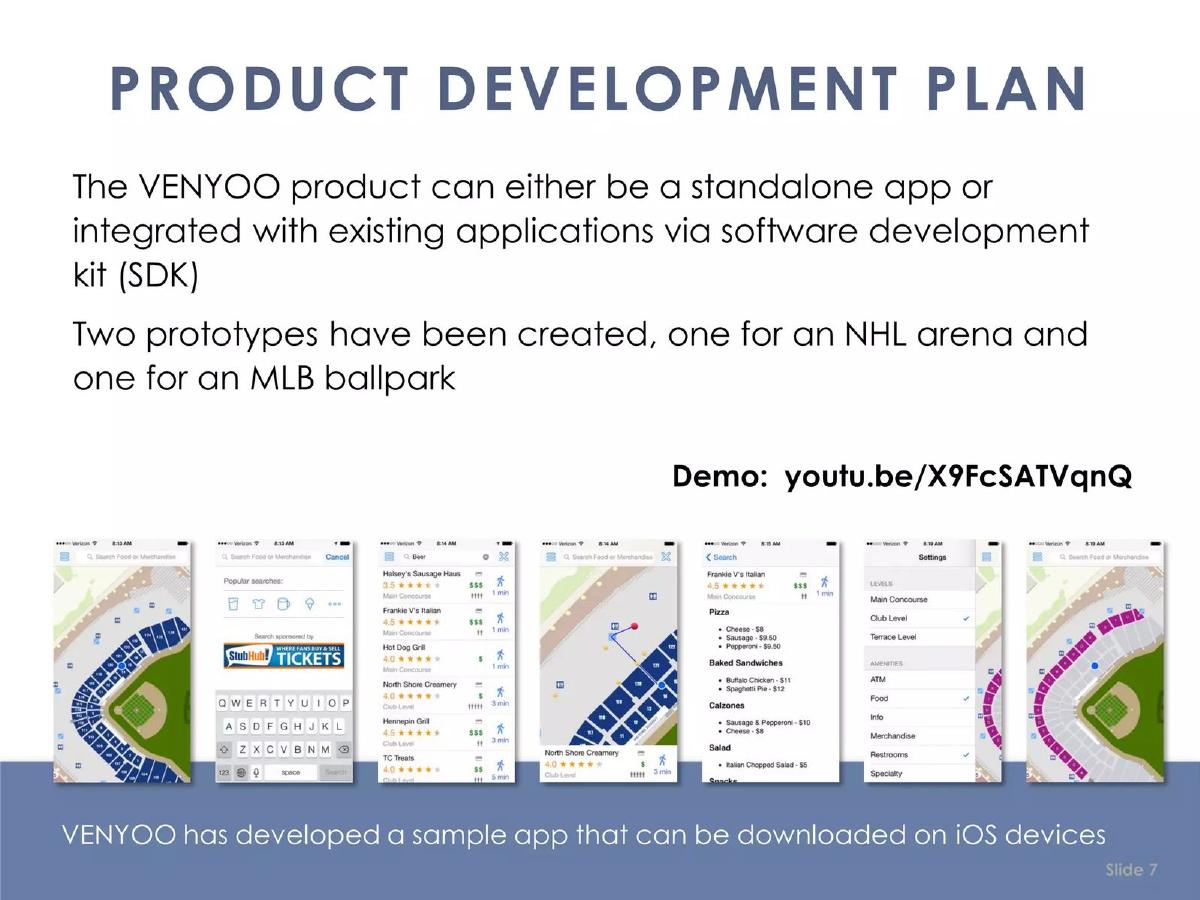
- Venyoo offers two integration paths: a standalone mobile app or a Software Development Kit (SDK) for existing venue applications (Slide 7).
- Two functional prototypes were completed by the time of the deck: one for an NHL arena and one for an MLB ballpark (Slide 7).
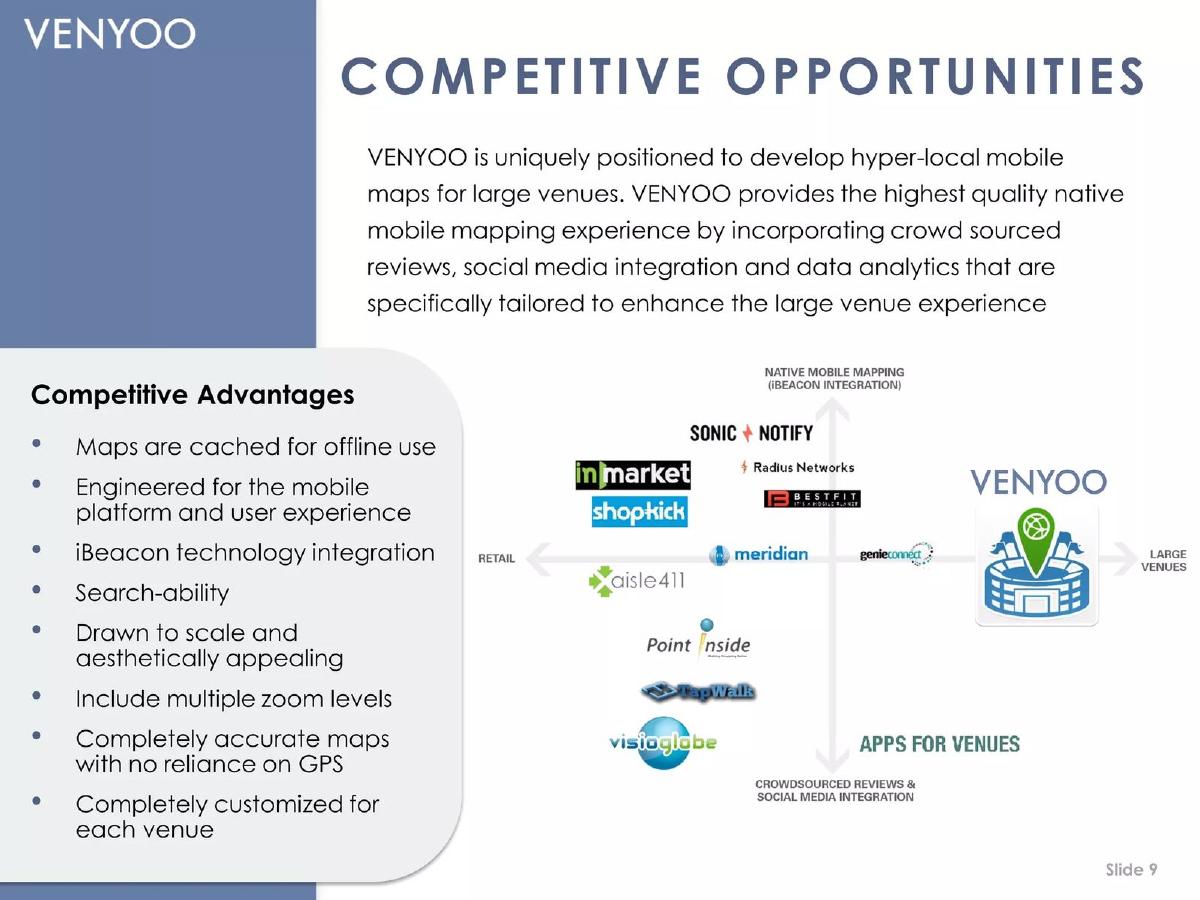
- The competitive strategy relies on iBeacon integration and offline map caching to outperform GPS-dependent rivals (Slide 9).
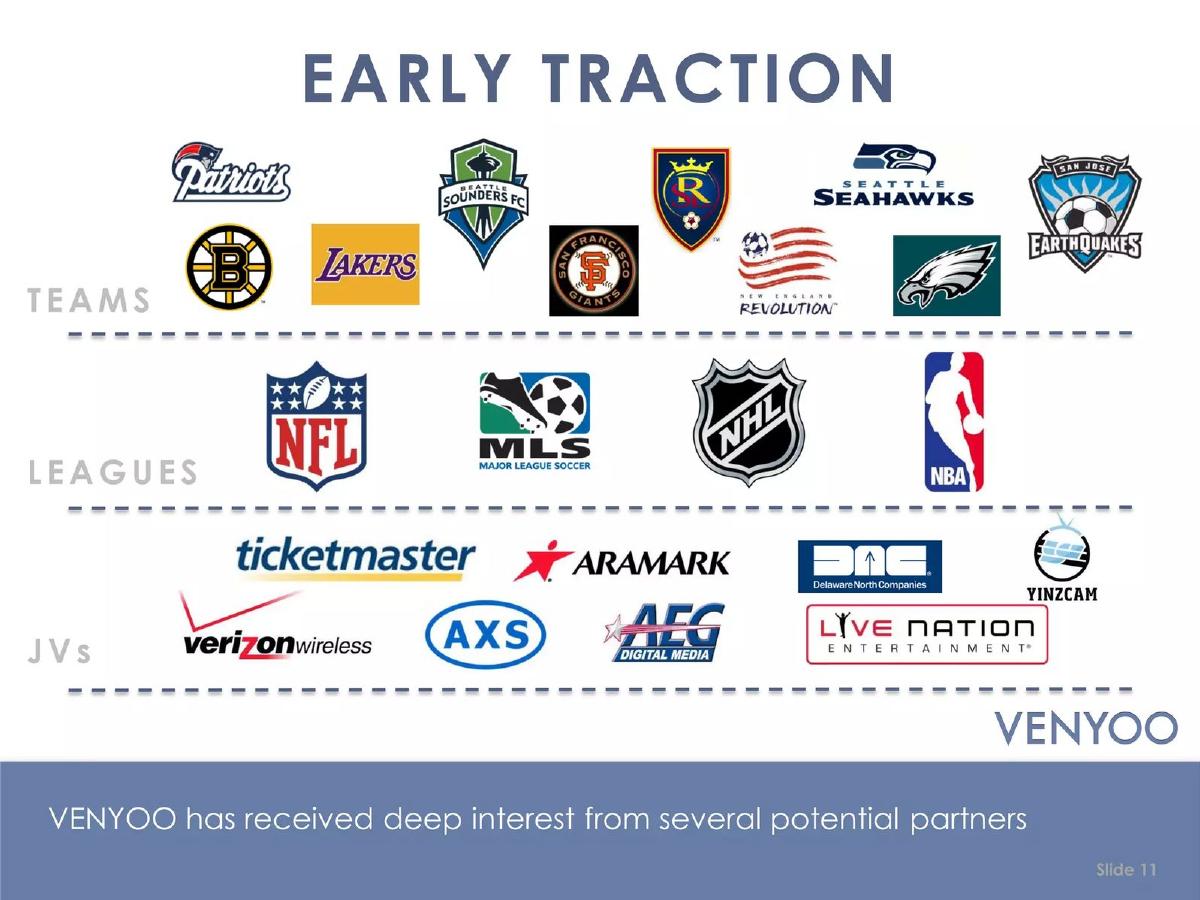
- Traction is presented as 'deep interest' from high-profile entities including the NFL, NBA, and Ticketmaster, though specific contract statuses are not defined (Slide 11).
- Revenue is diversified across three streams: Venue Subscriptions, Data Subscriptions, and Monthly Ads (Slide 13).
- Financial projections estimate reaching 182 venues and $23,750,510 in total revenue by Year 5 (Slide 13).
- The deck omits a formal 'Ask' slide, leaving the desired investment amount and valuation unstated in the provided materials.
Slide 1: Title Slide
The opening slide introduces Venyoo with the tagline "Custom mobile maps for venues." It identifies the founders as Scott Larson and Tim Brennan. The visual features a stylized stadium icon with a green location pin, establishing the brand's focus on location-based services within large-scale architecture. A copyright date of 2014 is visible in the bottom left corner.
Slide 3: The Problem
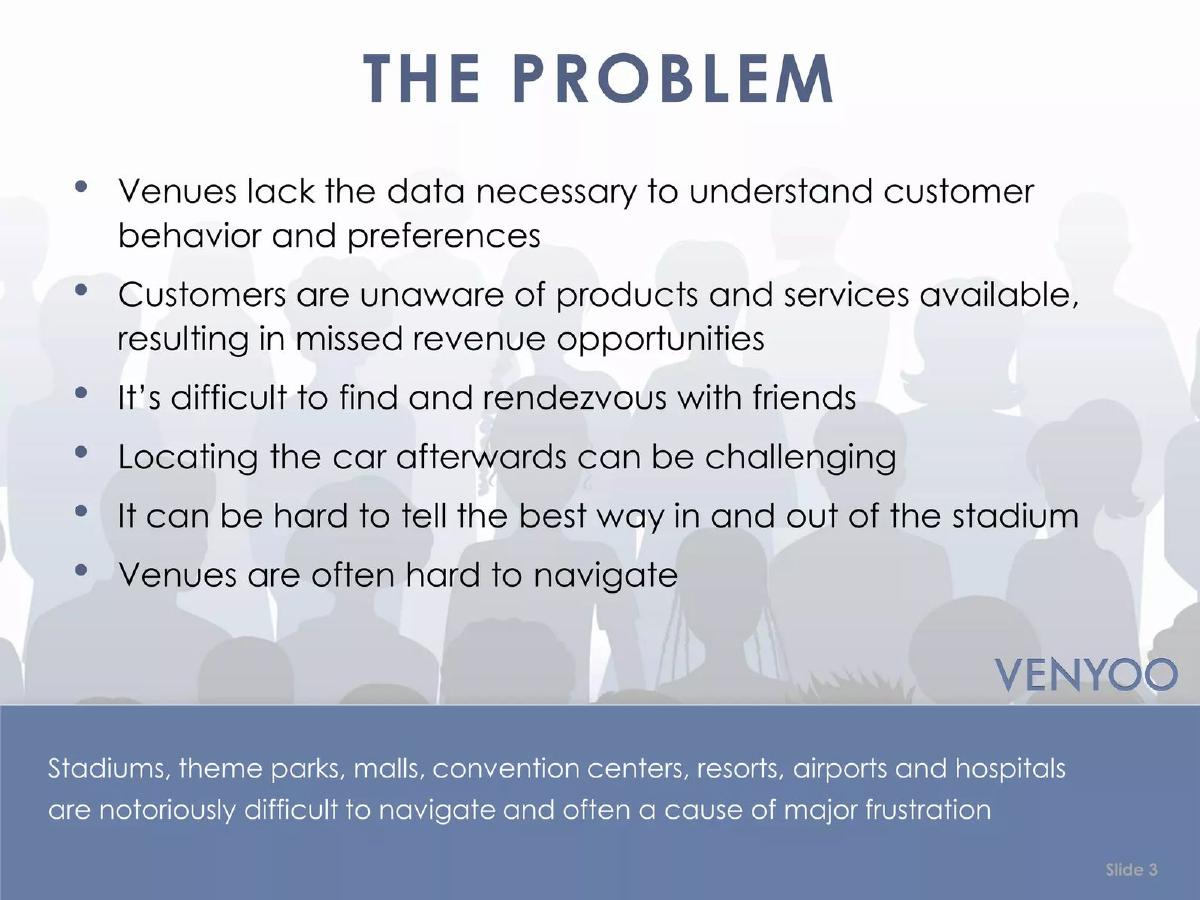
Venyoo breaks the problem down into two perspectives: the venue and the customer. For venues, the primary issue is a lack of data to understand customer behavior, leading to missed revenue. For customers, the slide lists several points of friction: difficulty finding friends, locating parked cars, identifying the best entry/exit points, and general navigation challenges. A footer note emphasizes that stadiums, theme parks, malls, convention centers, resorts, airports, and hospitals are "notoriously difficult to navigate."
Slide 5: The Venue Solution
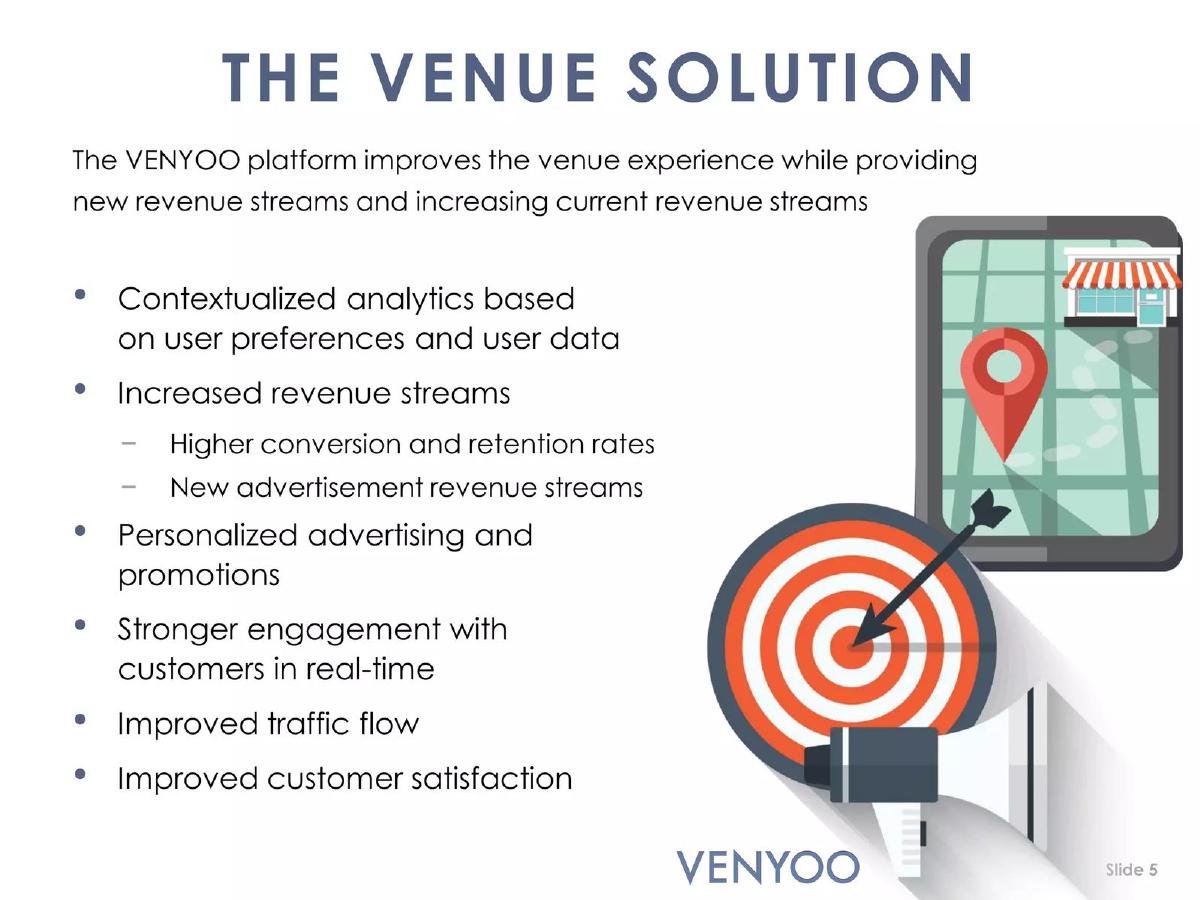
This slide pivots to the value proposition for the B2B customer (the venue). The Venyoo platform is described as a tool to improve the experience while providing new revenue streams. Key features include contextualized analytics based on user data, personalized advertising, and improved traffic flow. The slide suggests that by solving navigation, the venue gains "stronger engagement with customers in real-time," which translates to higher conversion and retention rates.
Slide 7: Product Development Plan
Slide 7 provides technical context and current status. The product is offered via two methods: a standalone app or an SDK for integration into existing apps. The company highlights that two prototypes are already functional—one for an NHL arena and one for an MLB ballpark. A series of seven screenshots shows the user interface, which includes searchable food and merchandise lists (with prices like "Cheese - $8"), map views of stadium tiers, and integration with Ticketmaster/StubHub for ticket sales. The slide also includes a YouTube link for a demo.
Slide 9: Competitive Opportunities
The competitive landscape is presented via a 2x2 matrix. The axes measure "Retail vs. Large Venues" and "Native Mobile Mapping vs. Apps for Venues." Venyoo places itself in the top-right quadrant (Native Mobile Mapping for Large Venues). Listed competitive advantages include offline map caching, iBeacon technology integration (removing reliance on GPS), and maps that are "drawn to scale." Competitors mentioned include Meridian, Point Inside, and Aisle411.
Slide 11: Early Traction
This slide is a logo wall divided into three categories: Teams, Leagues, and JVs (Joint Ventures). It features high-profile logos including the New England Patriots, LA Lakers, NFL, NBA, Ticketmaster, and Live Nation. The text at the bottom clarifies that Venyoo has "received deep interest" from these potential partners. It is important to note that the slide does not claim signed contracts or active deployments for all these logos, using the softer term "interest" instead.
Slide 13: Profit & Loss
The final slide in the set provides a five-year financial projection. The company projects growing from 10 venues in Year 1 to 182 venues in Year 5. The revenue breakdown shows a shift in dominance; while Venue Subscriptions are the largest early driver, Data Subscriptions and Monthly Ads scale significantly by Year 5. Total Revenue is projected to grow from $593,978 (Year 1) to $23,750,510 (Year 5). Gross Profit is projected to turn positive in Year 3 ($1,954,595) after two years of losses.
What Venyoo Does Well
The deck excels at identifying a clear, relatable pain point. Anyone who has attended a major sporting event or tried to find a specific gate at an airport understands the frustration of poor indoor navigation. By framing this not just as a convenience for the user, but as a data-gathering and revenue-generating tool for the venue, Venyoo creates a compelling B2B case.
The inclusion of the SDK option is a strategic strength. Large venues often already have their own branded apps; by offering an SDK, Venyoo lowers the barrier to entry, allowing venues to add mapping functionality without forcing their fans to download a separate application. The competitive matrix also does a good job of explaining why standard GPS (like Google Maps) is insufficient for these specific environments.
What is Missing from the Deck
The most significant omission in the provided slides is a clear "Ask." There is no mention of how much capital the founders are seeking, the intended use of funds, or the valuation. Without this, the deck functions more as a sales presentation than a fundraising tool.
Furthermore, while the founders' names are listed on the title slide, there is no team slide detailing their backgrounds, previous exits, or technical expertise. In early-stage investing, the team is often as important as the product. The traction slide is also somewhat ambiguous; "deep interest" is a vague term that could range from a casual introductory email to a signed Letter of Intent (LOI). Investors generally prefer to see a clear distinction between a pipeline and actual paying customers.
Founder Takeaways
Solve for two masters: If your product has a B2B2C model, ensure your deck explains the value for both the end-user (navigation) and the paying customer (data and ad revenue). · Address technical hurdles early: Venyoo correctly identifies that GPS fails indoors and proactively explains their use of iBeacons and caching to solve this. · Offer integration flexibility: Providing both a standalone app and an SDK allows you to capture both small venues that need a turnkey solution and large enterprises that want to maintain their own app ecosystem. · Be specific about traction: Avoid vague terms like "deep interest." If you have a pilot, call it a pilot. If you have a signed contract, state the contract value. · Don't forget the 'Why You': A slide detailing the team's specific expertise in mapping, sports, or data analytics would have significantly strengthened this pitch.
Frequently asked questions
- What is Venyoo's core product offering?
- Venyoo provides custom mobile maps specifically designed for large venues like stadiums, malls, and hospitals. Unlike standard GPS apps, Venyoo uses iBeacon technology and cached maps to provide accurate indoor navigation. The product is available as a standalone iOS app or as an SDK that venues can integrate into their own existing mobile applications to track user behavior and deliver targeted ads.
- How does Venyoo plan to make money?
- According to Slide 13, the business model relies on three primary revenue sources. First, 'Venue Subscriptions' for the mapping service itself. Second, 'Data Subscriptions,' where venues pay to access analytics on customer movement and preferences. Third, 'Monthly Ads,' which involves revenue sharing or direct sales of personalized promotions delivered to users in real-time as they navigate the venue.
- Who are Venyoo's main competitors?
- Slide 9 identifies several competitors categorized by their focus. In the retail space, they list Aisle411, InMarket, and Shopkick. In the venue-specific mapping space, they name Meridian, Point Inside, and Visioglobe. Venyoo differentiates itself by focusing on 'Large Venues' and incorporating social features like crowdsourced reviews and social media integration alongside native iBeacon mapping.
- What kind of traction did the company have at the time of this deck?
- The company claims 'deep interest' from a wide array of professional sports teams (Patriots, Lakers, Giants) and leagues (NFL, NBA, NHL). They also list joint venture interests from major industry players like Ticketmaster, Live Nation, and Verizon Wireless. Additionally, Slide 7 notes that two prototypes for NHL and MLB venues were already developed and available for demo.
- What are the financial projections for the company?
- Venyoo projected significant growth over a five-year period. In Year 1, they estimated $593,978 in revenue with a gross loss of $704,546. By Year 3, they projected turning profitable with $1,954,595 in gross profit. By Year 5, the deck forecasts $23,750,510 in total revenue and $8,535,793 in gross profit, driven by a footprint of 182 venues.