Estate Media’s 16-slide pitch deck secured a $1.6M seed round in 2024 by positioning the company at the intersection of real estate and the creator economy. The deck argues that traditional real estate media is either too dry or too niche, leaving a gap for a high-reach, entertaining, and informative platform. By leveraging a talent network with over 25 million followers—including stars from 'Million Dollar Listing' and 'Selling Sunset'—Estate Media presents a low-CAC distribution model. The business is structured into three divisions: Studios (IP), Agency (brand partnerships), and Ventures (…
Key takeaways
- Estate Media claims a total reach of 25M+ followers across its talent network (Slide 3).
- The company operates through three distinct divisions: Studios, Agency, and Ventures (Slide 3).
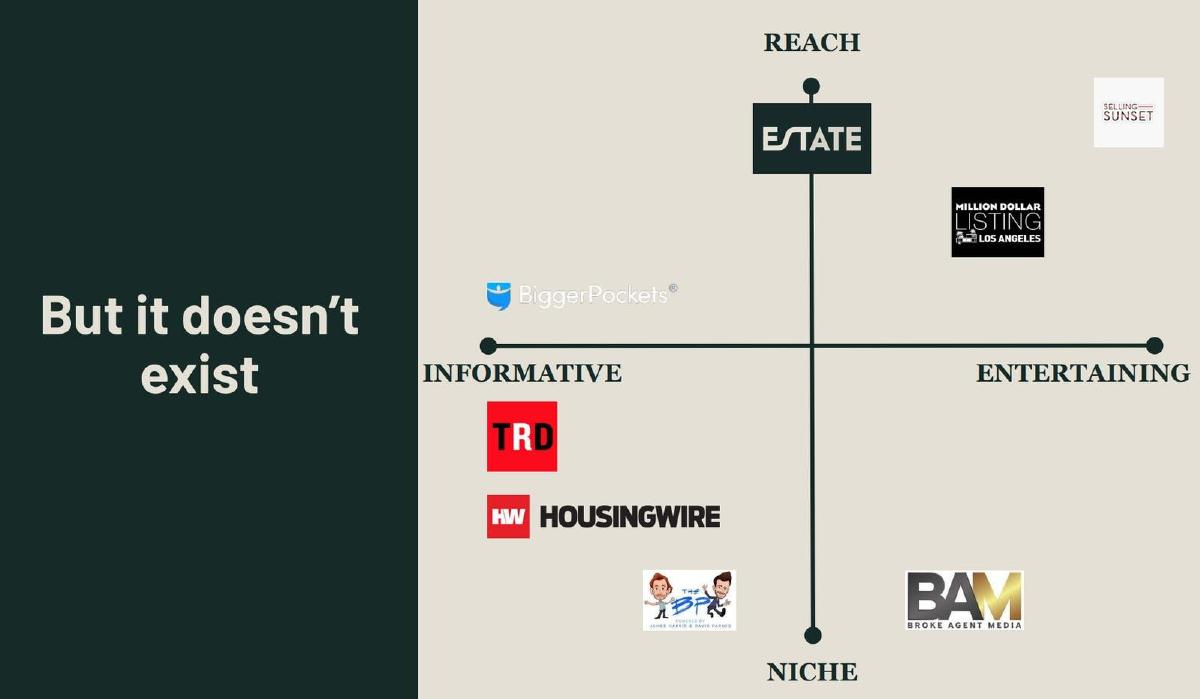
- A competitive matrix positions Estate Media as the only player high in both 'Reach' and 'Informative/Entertaining' balance (Slide 2).
- The talent roster includes high-profile TV agents like Josh Flagg (1.4M followers) and Maya Vander (1.5M followers) (Slide 5).
- A case study details a $75K sponsorship from the National Association of Mortgage Brokers (NAMB) for a five-part series (Slide 4).
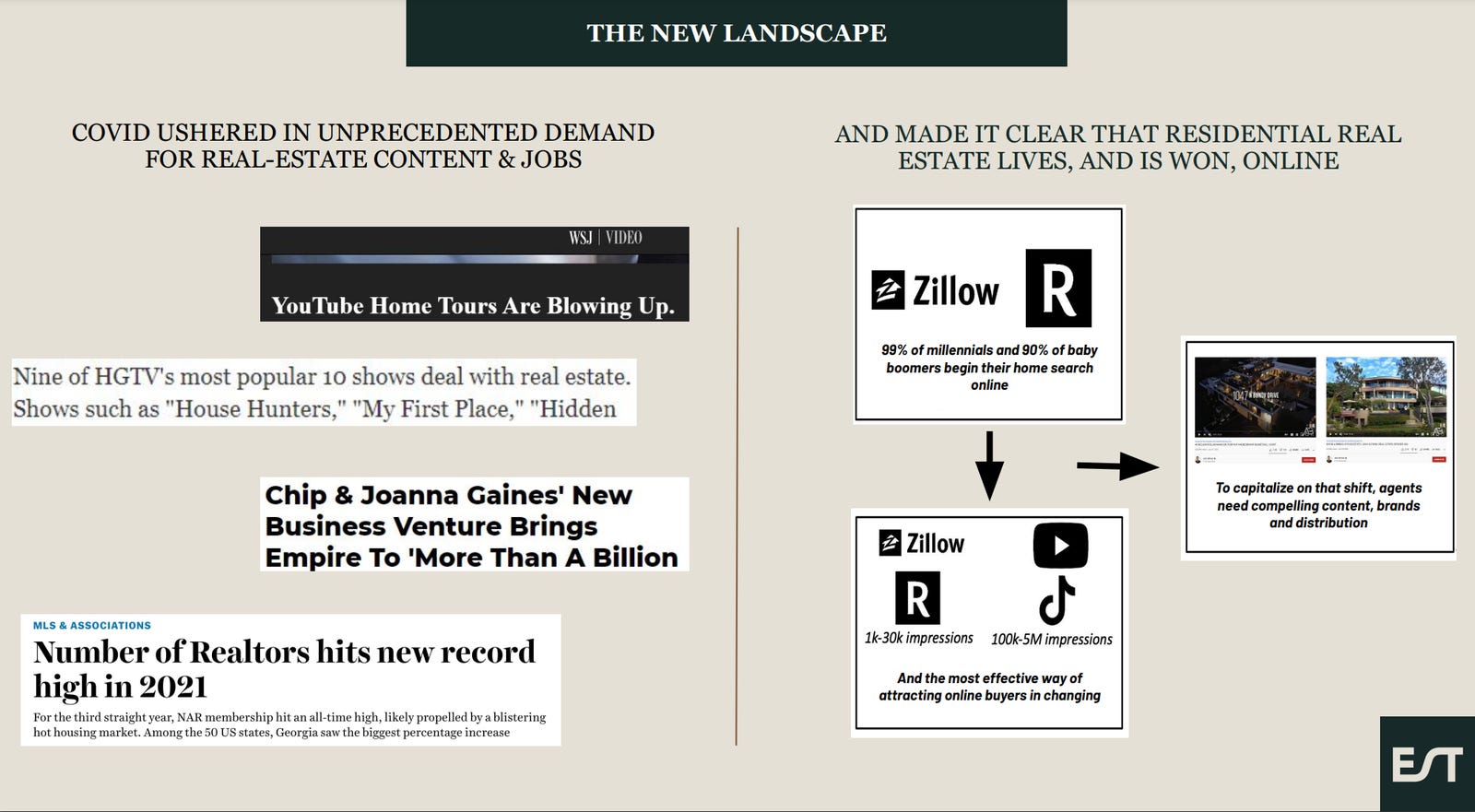
- The deck highlights a shift in consumer behavior, noting that 99% of millennials begin their home search online (Slide 1).
- Founder Griff O’Brien brings media experience from CNN, Snapchat, and Roku, having exited his first startup at age 20 (Slide 8).
- Co-founder Josh Flagg provides industry credibility with $3B+ in career sales and a starring role on MDLLA (Slide 8).
The New Landscape: Real Estate as Content
Slide 1: Market Shift
Estate Media opens with a 'New Landscape' slide that establishes the macro-environment. It cites the COVID-19 pandemic as a catalyst for 'unprecedented demand' for real estate content. The slide uses several external validation points: YouTube home tours 'blowing up,' HGTV's dominance in cable ratings, and the Gaines' billion-dollar empire. Crucially, it notes that the number of Realtors hit a record high in 2021. The right side of the slide illustrates a shift from traditional search (Zillow/Realtor.com) to social discovery (YouTube/TikTok), claiming that agents now need 'compelling content, brands and distribution' to survive.
Slide 2: Competitive Positioning
The competitive matrix uses two axes: Reach (Niche vs. High Reach) and Content Type (Informative vs. Entertaining). Estate Media places itself in the top-center, claiming high reach while balancing information and entertainment. Competitors like The Real Deal (TRD) and HousingWire are labeled as informative but niche. Shows like 'Selling Sunset' and 'Million Dollar Listing' are high reach and entertaining but, by implication, not informative. This slide attempts to carve out a 'blue ocean' where Estate Media is the only player providing high-reach 'edutainment.'
Slide 3: The Three-Pillar Model
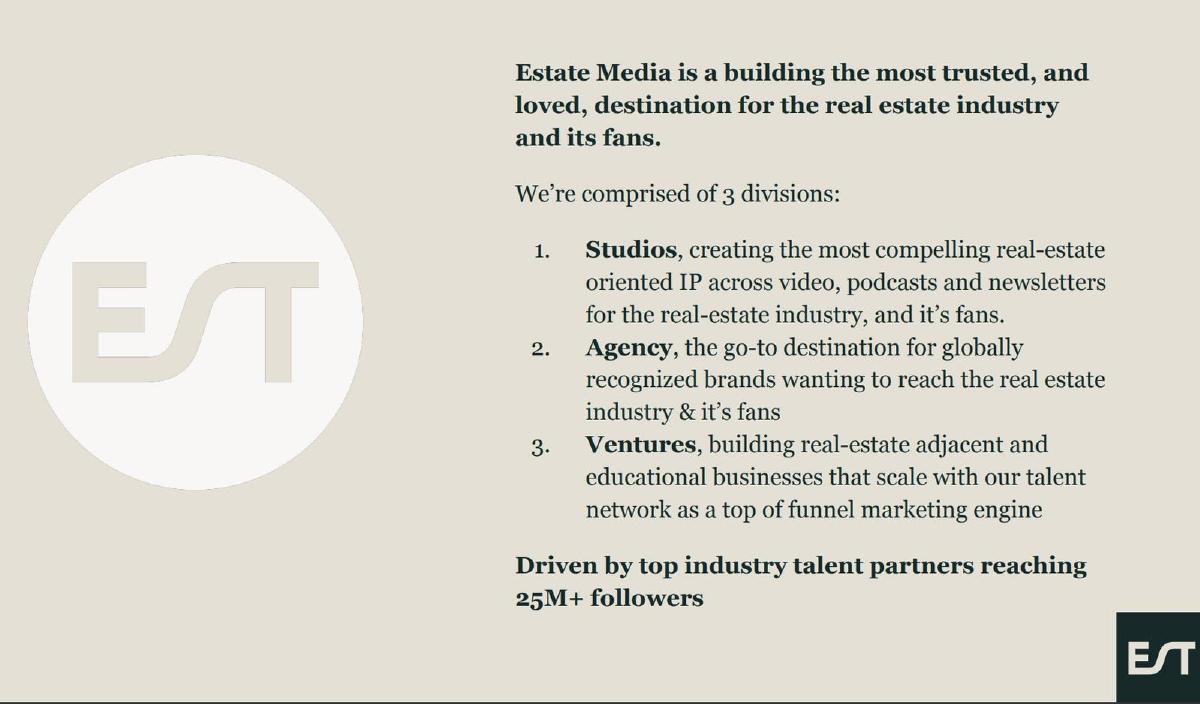
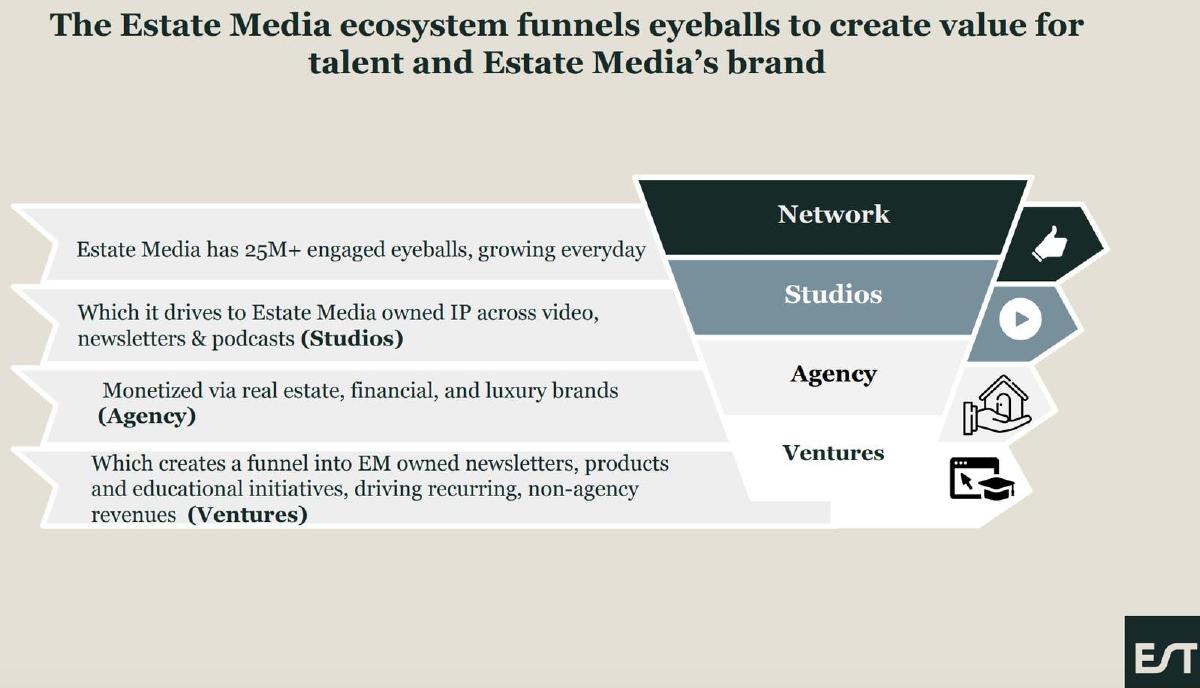
This slide defines the company's operational structure. Estate Media is 'comprised of 3 divisions': Studios (creating IP like video and podcasts), Agency (a destination for brands to reach the industry), and Ventures (building educational businesses). The slide concludes with a significant metric: their talent partners reach over 25 million followers. This establishes the company as a platform rather than just a production house.
Slide 4: Case Study - The Mortgage Series
To prove the business model, Slide 4 walks through a specific execution. They produced a five-part series on 'Becoming a Mortgage Broker' featuring Margot Ettedgui. The National Association of Mortgage Brokers (NAMB) paid $75,000 for the series and speaking engagements. The slide claims this content served as a top-of-funnel engine that eventually led to a 'six-figure referral deal' with a mortgage tech company. This is a critical slide because it demonstrates that the company can monetize both through service fees (sponsorships) and performance (referrals).
Slide 5: The Anchor Talent
Estate Media leans heavily on its 'Top Agents.' This slide features Josh Flagg (1.4M followers), Tracy Tutor (442K followers), and Maya Vander (1.5M followers). By showcasing stars from major reality TV franchises (Million Dollar Listing and Selling Sunset), the company is signaling that it has already secured the 'A-list' of real estate influencers, creating a high barrier to entry for potential competitors.
Slide 6: The Rising Stars
Complementing the anchor talent, Slide 6 introduces five 'Rising Stars' with follower counts ranging from 50K to 450K. This includes niche experts like Sarah Scheper ('LA’s Go To Realtor for Pro Athletes') and Ricky Carruth ('Alabama’s Top Broker and Coach'). This variety suggests that Estate Media isn't just about Hollywood glamour; it’s building a network that covers different geographies and professional sub-niches.
Slide 7: Team Identity
Slide 7 is a simple branding transition slide featuring the 'EST' logo and the text 'ALL ON OUR TEAM.' It serves to reinforce the collective power of the influencers mentioned in the previous slides before moving into the executive team bios.
Slide 8: The Founders
The final slide in the provided sequence details the three co-founders. Griff O’Brien (CEO) brings the media distribution expertise, citing experience at CNN, Snapchat, and Roku. Andrew Shanfeld provides the financial and investment background as the founder of Carolwood Equities. Josh Flagg provides the industry credibility and the initial distribution spark. The pedigree here is strong, covering the three essential bases for this specific business: content distribution, capital/operations, and industry influence.
What Works in the Estate Media Deck
The Distribution Advantage: The most compelling part of this deck is the 25 million follower figure. In an era where Customer Acquisition Cost (CAC) is a primary concern for investors, Estate Media presents a model where distribution is 'baked in.' By partnering with established personalities, they bypass the expensive phase of building an audience from scratch.
Clear Monetization Pathways: Unlike many media startups that rely solely on 'advertising,' Estate Media clearly outlines a multi-revenue stream approach. The case study on Slide 4 is particularly effective because it shows a progression from a $75k sponsorship to a six-figure referral deal, suggesting high LTV (Lifetime Value) for their brand partners.
Founder-Market Fit: The combination of a media executive (O'Brien) and the industry's most recognizable face (Flagg) is a classic 'dream team' for a personality-driven media play. It addresses the two biggest risks: 'Can they make good content?' and 'Do they actually know the real estate business?'
What Is Missing from the Estate Media Deck
The Financials: There are no slides detailing revenue projections, burn rate, or historical growth. While the case study shows a $75k win, investors would want to see how many of those deals are in the pipeline and what the margins look like on production versus agency services.
The Ask: The deck (as provided) does not include a slide stating how much money they are raising or what the valuation is. According to publisher-reported facts, they raised $1.6M, but the deck itself leaves the investor guessing about the terms and the specific milestones this capital will unlock.
Technology and Scalability: The 'Ventures' division is mentioned as a way to scale, but there is little detail on what these 'educational businesses' actually are. Is it a SaaS platform? A course marketplace? Without more detail, the Ventures arm feels more like a concept than a product.
What Founders Should Copy
The Competitive Matrix: Slide 2 is a masterclass in positioning. Instead of the standard 'check-box' comparison, it uses axes that highlight the specific gap in the market. It makes the existence of the company feel like a logical necessity rather than just another media site.
The Talent-First Approach: If you are building in the creator economy, your 'Team' isn't just your employees; it's your creators. Estate Media gives their influencers as much real estate in the deck as the founders, which is the correct way to value assets in this industry.
The Case Study Flow: Using a flow chart to explain a deal (Slide 4) is much more effective than a bulleted list. It allows the investor to visualize the journey from 'Content Creation' to 'Revenue Generation,' making a complex media business feel tangible and repeatable.
Frequently asked questions
- What is Estate Media's primary business model?
- Estate Media operates a three-pillar model: a Studio for original IP (video, podcasts, newsletters), an Agency for brand partnerships, and a Ventures arm for educational businesses. This allows them to monetize through sponsorship, lead generation, and direct-to-consumer educational products, all fueled by their internal influencer network.
- How does Estate Media differentiate itself from competitors like Zillow or HGTV?
- According to Slide 2, Estate Media occupies a unique quadrant of high reach and high entertainment value. They argue that platforms like Zillow are utility-focused, while HGTV is purely entertainment. Estate Media aims to bridge the gap by providing 'edutainment' that is both informative for professionals and engaging for fans.
- Who are the key people behind the company?
- The founding team consists of Griff O’Brien (CEO, formerly of CNN and Snapchat), Andrew Shanfeld (President of Carolwood Equities), and Josh Flagg (Real estate star with $3B+ in sales). This combination provides a mix of media distribution expertise, private equity backing, and industry-specific star power.
- What evidence of traction is provided in the deck?
- Traction is demonstrated through a case study on Slide 4, where the company produced a five-part series for the National Association of Mortgage Brokers. This engagement resulted in a $75K payment and a six-figure referral deal with a mortgage tech company, proving the platform's lead-generation capabilities.
- What is missing from the Estate Media pitch deck?
- The deck is notably missing a slide detailing the specific investment 'Ask' and the intended use of funds. It also lacks a roadmap for future growth, detailed unit economics, and long-term financial projections, focusing instead on the current talent roster and high-level market trends.