Etherisc’s 8-slide deck from 2017 serves as a functional demonstration of decentralized insurance protocols rather than a traditional financial pitch. The company highlights two live use cases: flight delay insurance (launched at Devcon2) and crop insurance, both utilizing a parametric model where payouts are triggered automatically by data. The deck emphasizes technical feasibility, showcasing Solidity code snippets and a workflow that automates policy administration, claims management, and asset management. While it successfully establishes the founders' deep expertise in risk management an…
Key takeaways
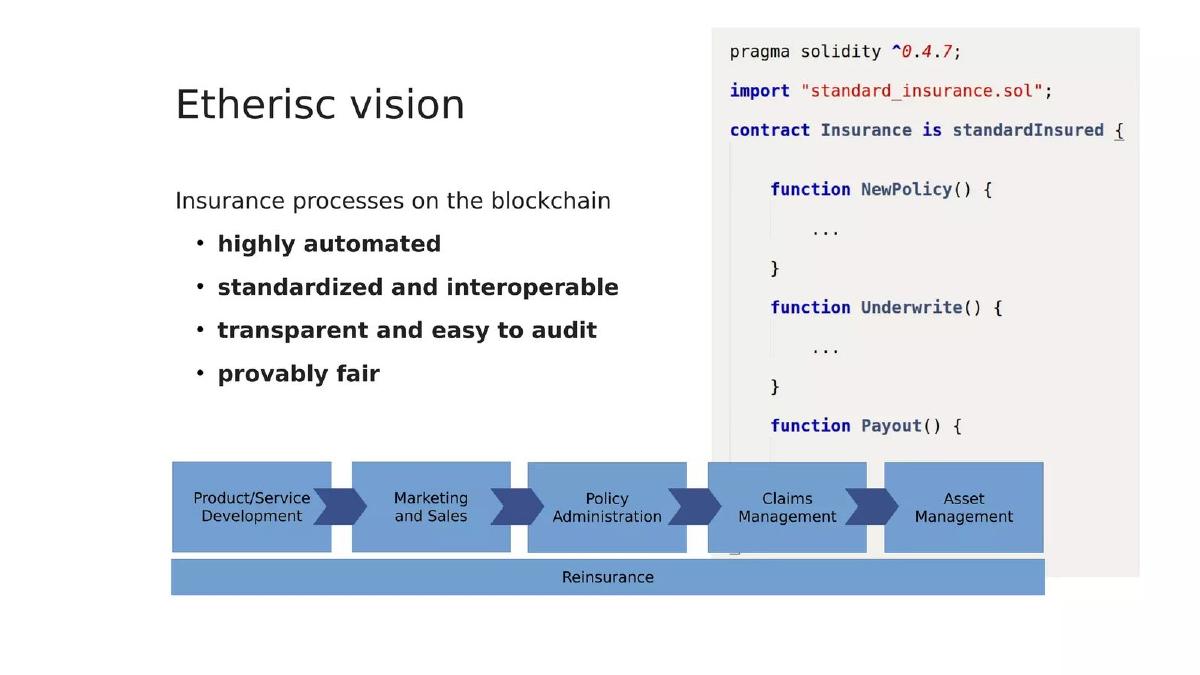
- The vision centers on making insurance processes highly automated, transparent, and provably fair using blockchain technology (Slide 2).
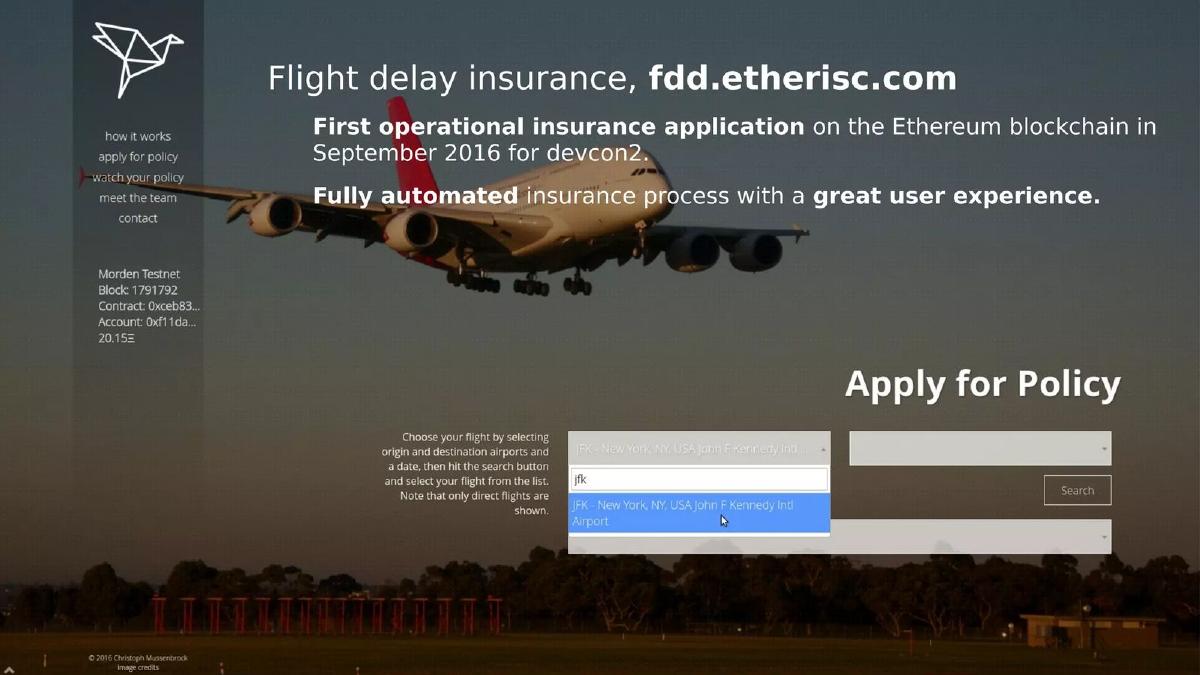
- Etherisc claims to have launched the first operational insurance application on Ethereum in September 2016 for Devcon2 (Slide 3).
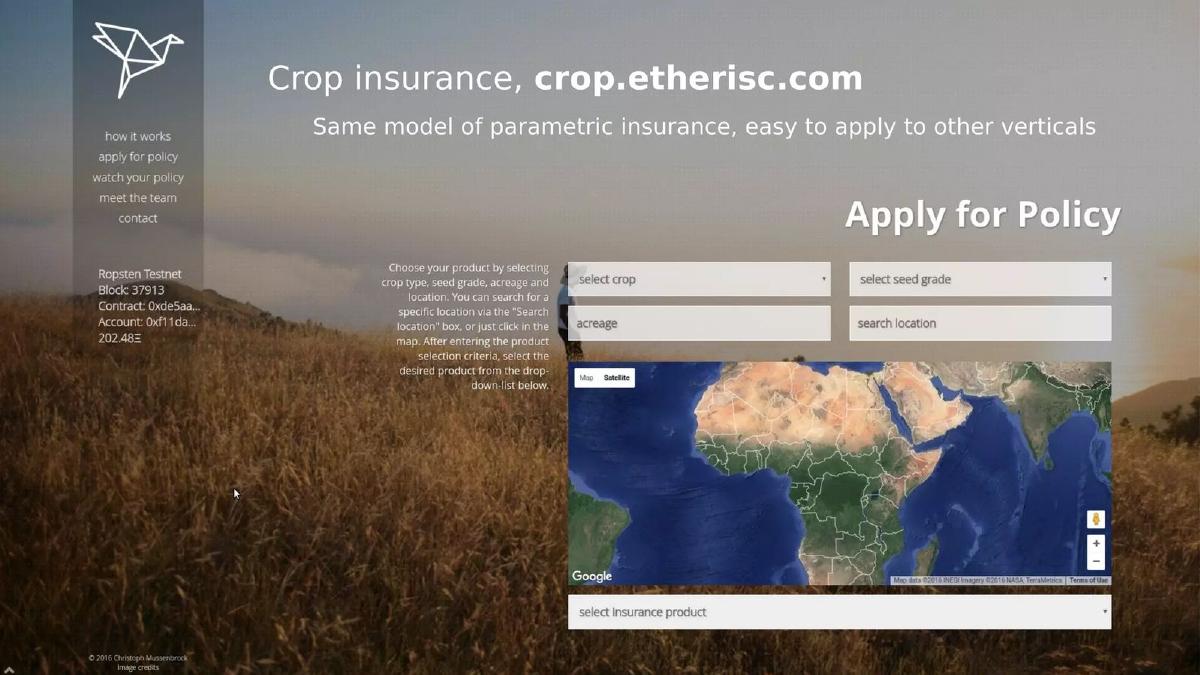
- The product strategy relies on parametric insurance, which is easily adaptable across different verticals like aviation and agriculture (Slide 4).
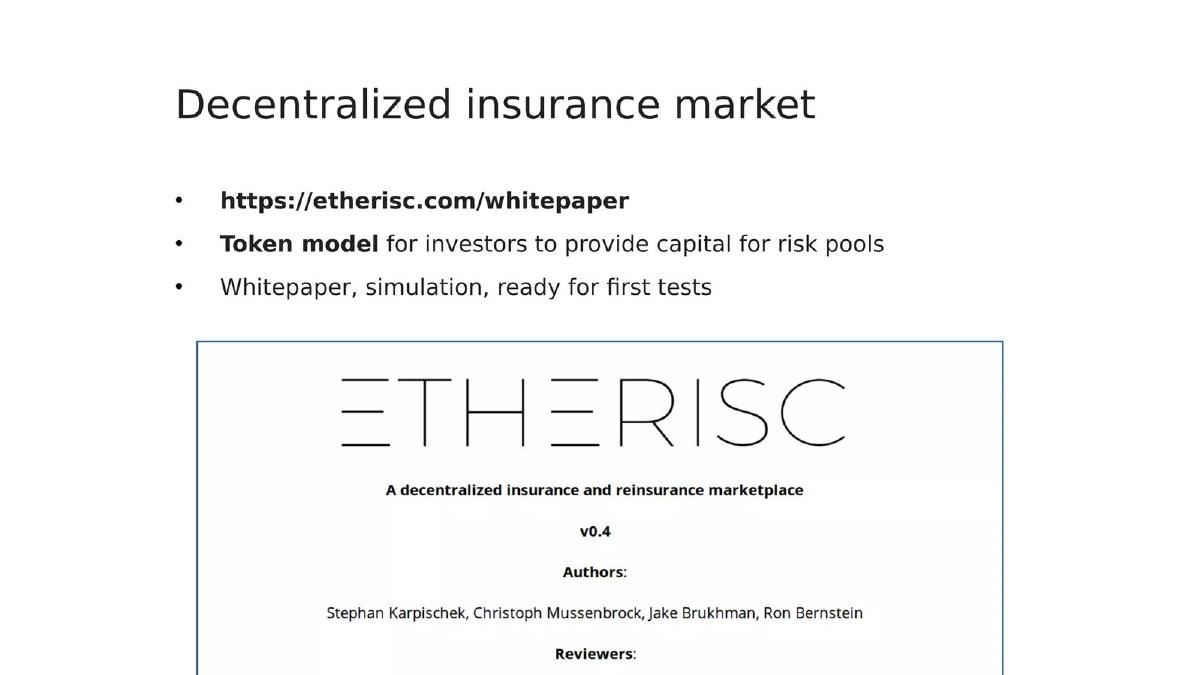
- The business model involves a token system where investors provide capital for risk pools (Slide 5).
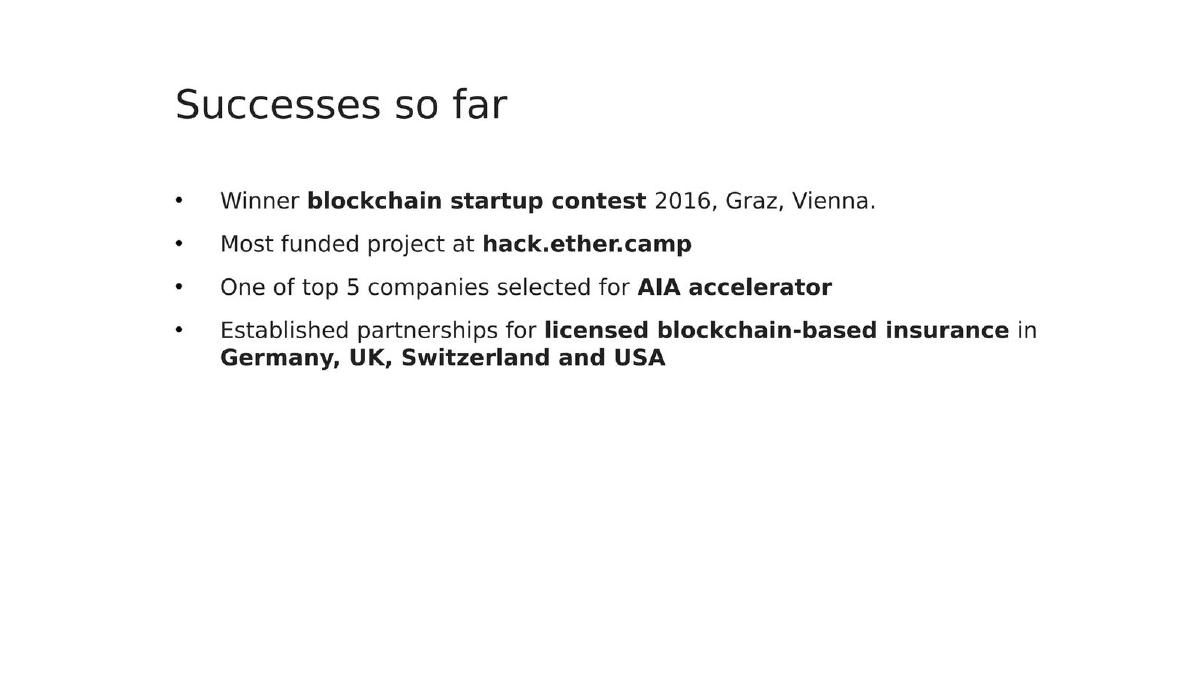
- Traction is demonstrated through winning the 2016 Blockchain Startup Contest and being selected for the AIA accelerator (Slide 6).
- The founding team possesses significant domain expertise, including a former CEO of a risk management firm and a former UBS blockchain analyst (Slide 7).
- The deck omits critical investment data, including the amount of capital sought, valuation, and revenue targets.
- Technical architecture is prioritized, with Slide 2 explicitly showing a smart contract structure with functions for NewPolicy, Underwrite, and Payout.
Etherisc: The Decentralized Insurance Protocol
Etherisc presented this 8-slide deck at BlockShow Europe in Munich on April 6, 2017. At the time, the blockchain space was shifting from experimental tokens to functional decentralized applications (dApps). This deck is less of a financial pitch and more of a technical manifesto for how the insurance industry could be restructured using smart contracts. It focuses heavily on the 'how'—specifically the automation of risk pools and parametric triggers—while leaving the 'how much' (the financial ask) to the whitepaper mentioned on Slide 5.
Slide 1: Title Slide
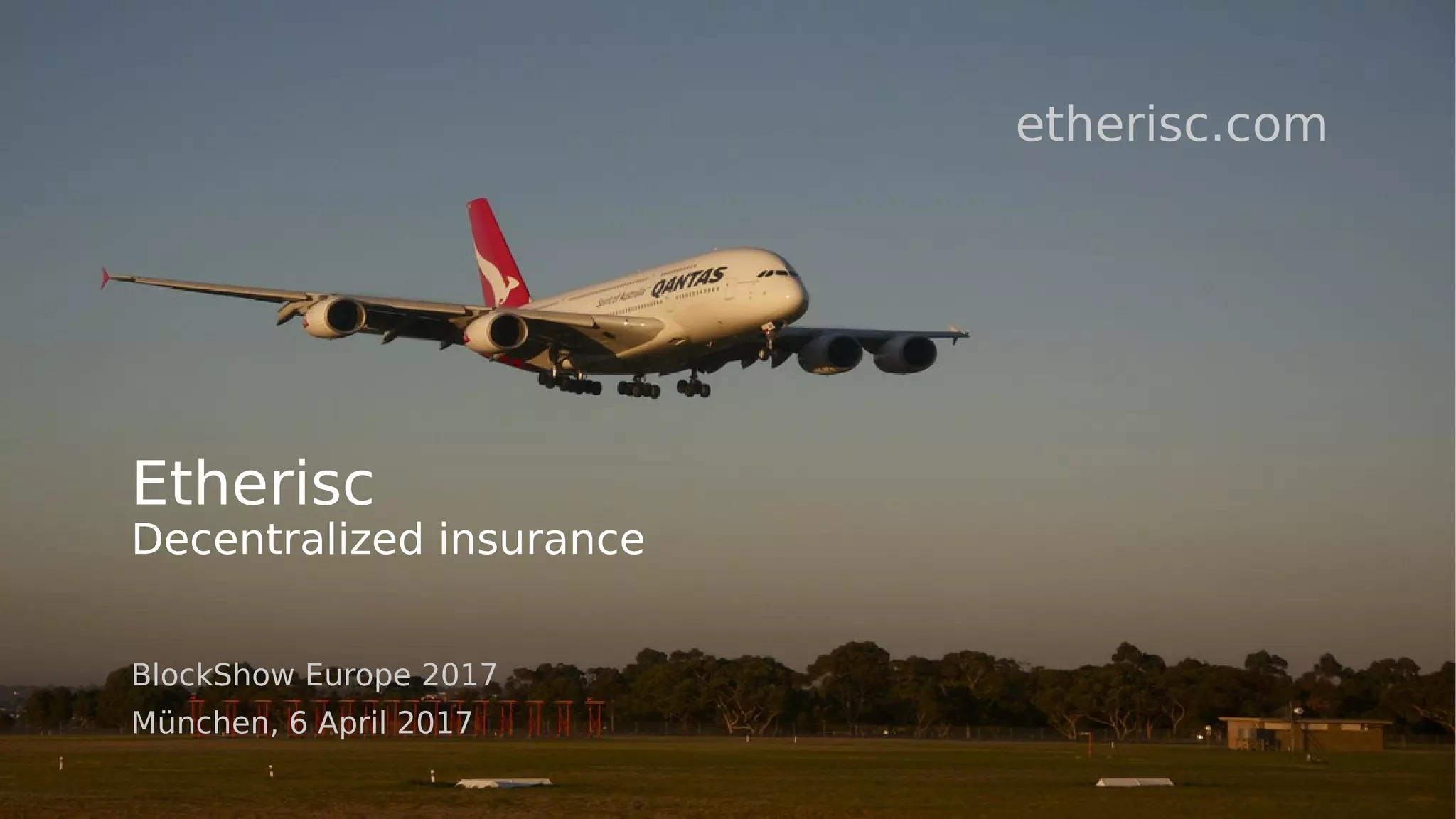
The title slide is minimalist, featuring a Qantas A380 in flight. This visual choice immediately anchors the abstract concept of 'decentralized insurance' to a real-world industry: aviation. The slide identifies the event (BlockShow Europe 2017) and the date (6 April 2017). The URL etherisc.com is prominently displayed, establishing the brand early.
Slide 2: Etherisc Vision
Slide 2 defines the company's core value proposition. It lists four pillars for insurance processes on the blockchain: highly automated , standardized and interoperable , transparent and easy to audit , and provably fair . To the right, a code snippet in Solidity (pragma solidity ^0.4.7) shows the skeleton of an insurance contract. This is a high-signal move for a technical audience, proving that the vision is backed by actual development. Below the text, a flow chart illustrates the insurance value chain—from Product Development to Asset Management—all supported by a horizontal 'Reinsurance' bar, suggesting that the blockchain will handle the entire lifecycle of a policy.
Slide 3: Flight Delay Insurance (fdd.etherisc.com)
This slide introduces Etherisc's first live product. It claims to be the 'First operational insurance application on the Ethereum blockchain' launched in September 2016. The slide shows a screenshot of the user interface where a user can search for a flight (specifically JFK airport). The text emphasizes a 'fully automated insurance process' and a 'great user experience.' By highlighting a specific, functional URL, Etherisc moves from theory to proof-of-concept, showing that they have already solved the technical hurdles of connecting off-chain flight data to on-chain smart contracts.
Slide 4: Crop Insurance (crop.etherisc.com)
Slide 4 demonstrates the scalability of the Etherisc model. By showing a second vertical—crop insurance—the founders argue that their parametric model is 'easy to apply to other verticals.' The slide includes a UI mockup featuring a Google Maps integration and dropdowns for crop type, seed grade, and acreage. This slide is critical because it shows that Etherisc is not just a 'flight delay' company, but a platform for any insurance product that can be triggered by objective data (like weather or satellite imagery).
Slide 5: Decentralized Insurance Market
This slide serves as the 'Business Model' and 'Documentation' slide. It points to a whitepaper (v0.4) authored by Stephan Karpischek, Christoph Mussenbrock, Jake Brukhman, and Ron Bernstein. The key takeaway here is the 'Token model for investors to provide capital for risk pools.' This explains the liquidity side of the marketplace: investors can stake capital to back insurance risks in exchange for returns. It positions Etherisc as a marketplace rather than a traditional carrier that holds all the risk on its own balance sheet.
Slide 6: Successes So Far
Traction is summarized in four bullet points. Etherisc highlights winning the 'blockchain startup contest 2016' and being the 'Most funded project at hack.ether.camp.' Perhaps most importantly for regulatory credibility, they mention established partnerships for 'licensed blockchain-based insurance' in Germany, the UK, Switzerland, and the USA. In the highly regulated insurance industry, these geographic mentions act as a proxy for legal due diligence and progress.
Slide 7: Founders
The team slide focuses on the two primary founders, providing deep professional context. Christoph Mussenbrock is highlighted as a former CEO with 'many years of work experience in banking and insurance in Germany' and a master's in mathematics. Stephan Karpischek is presented as a former business analyst for blockchain at UBS with a PhD from ETH Zurich. The inclusion of LinkedIn URLs and specific mentions of their academic theses (formal software verification and IoT mobile applications) reinforces the technical and domain authority of the leadership.
Slide 8: Contact
The final slide repeats the imagery from the cover and provides contact details: an email address, a Twitter handle (@etherisc), and a Gitter chat link. Gitter was a popular developer communication tool in 2017, further signaling that Etherisc was targeting a developer and early-adopter community.
What Etherisc Does Well
Proof of Execution: By showing two different functional websites (fdd.etherisc.com and crop.etherisc.com), the deck proves the team can build and deploy complex dApps. · Domain Expertise: The founders' backgrounds in traditional banking (UBS) and risk management (parcIT) directly address the 'why you' question. They aren't just crypto enthusiasts; they are insurance professionals. · Technical Transparency: Including actual Solidity code on Slide 2 is a bold move that appeals to the 'BlockShow' audience, signaling that the project is open and verifiable. · Vertical Scalability: Moving from flight delays to crop insurance effectively demonstrates that their 'parametric' engine is a horizontal platform.
What is Missing from the Deck
The Ask: There is no slide stating how much capital the company is looking to raise or the terms of the investment. · Market Size: The deck assumes the audience knows the insurance market is large. It provides no data on the Total Addressable Market (TAM) for the specific verticals they are entering. · Competition: There is no mention of other blockchain insurance projects (like Nexus Mutual, which was emerging around the same time) or traditional insurtech competitors. · Financial Projections: The deck is silent on revenue models. While it mentions a 'token model,' it doesn't explain how the company itself stays solvent or what the projected volume of premiums might be. · Roadmap: There is no timeline for future product launches or regulatory milestones beyond the 'successes so far.'
Lessons for Founders
Show, Don't Just Tell: If you have a working product, screenshots and URLs are more powerful than a dozen bullet points about 'potential.' Etherisc’s use of actual UI mockups makes the project feel real. · Lead with Authority: In a complex industry like insurance, your pedigree matters. Etherisc correctly emphasized their founders' deep institutional experience to balance the 'radical' nature of blockchain. · Modular Design: The way Etherisc presented their 'parametric model' as a template that can be applied to different industries is a great way to show a massive vision without losing focus on the initial product. · Use Technical Signals Wisely: If you are pitching at a technical conference (like BlockShow), including code or architectural diagrams can build instant rapport with the audience. However, if this were a pitch to a generalist VC, those elements might need to be moved to an appendix.
Frequently asked questions
- What is the core product offered by Etherisc?
- Etherisc offers a decentralized insurance and reinsurance marketplace. As of the deck's publication, they had developed two specific applications: a flight delay insurance tool (fdd.etherisc.com) and a crop insurance tool (crop.etherisc.com). Both products use a parametric model, meaning they rely on objective data triggers to automate the underwriting and payout processes without manual claims adjustment.
- How does Etherisc use blockchain technology?
- The company uses Ethereum-based smart contracts (specifically Solidity) to automate the entire insurance value chain. This includes product development, marketing, policy administration, claims management, and asset management. By moving these processes to a decentralized ledger, they aim to make insurance 'provably fair' and 'easy to audit' while reducing the overhead costs associated with traditional insurance providers.
- What evidence of market traction does the deck provide?
- Etherisc highlights several early-stage successes, including winning the 2016 Blockchain Startup Contest in Graz/Vienna and being the 'most funded project' at hack.ether.camp. They were also selected as one of the top five companies for the AIA accelerator and claim to have established partnerships for licensed blockchain-based insurance in the UK, Germany, Switzerland, and the USA.
- Who are the founders and what is their background?
- The founders are Christoph Mussenbrock and Stephan Karpischek. Mussenbrock is the former CEO of parcIT GmbH, which provided risk management solutions to German banks. Karpischek is a former business analyst for blockchain innovation at UBS with a PhD from ETH Zurich. Their backgrounds combine traditional financial risk management with academic and professional blockchain expertise.
- What is missing from this pitch deck for a venture investor?
- The deck is missing several standard slides required for a formal investment round. There is no 'Ask' slide detailing how much money they are raising or how it will be spent. It lacks a 'Market Size' (TAM/SAM/SOM) slide, a 'Competitor' analysis, and any 'Financial Projections' or 'Unit Economics' regarding how the platform generates revenue or scales its user base.