EventSlice is an event planning marketplace that aims to streamline the process of finding and booking venues and professionals. The deck relies heavily on early proof-of-concept data from Austin, Texas, where the company secured 59 venue listings and 110 service listings. A key differentiator claimed by the company is its integrated booking and payment engine, features that competitors like Eventective and The Knot reportedly lacked at the time of this deck's creation. While the market opportunity is framed as a massive $350B industry, the deck transitions quickly from local success to ambit…
Key takeaways
- The US Event Market is valued at over $350B, with venues accounting for the largest share at $300B (Slide 4).
- EventSlice achieved 3,391 users and 10 events booked with $0 marketing spend, relying entirely on organic traffic (Slide 6).
- Early supply-side traction in Austin includes 59 venues and 110 services (Slide 6).
- The company spent less than $1,000 on social promoted posts and business reply card printing during its initial phase (Slide 6).
- EventSlice positions itself against competitors like Eventective and Eventup by offering a 'Booking Engine' and 'Payment Engine' which others lack (Slide 8).
- Expansion plans target Dallas, Houston, and Las Vegas as the next geographic milestones (Slide 5).
- The platform strategy includes building 'CRM lite' functionality and a scheduling solution to increase marketplace trust (Slide 7).
- Market sub-sectors identified include Music & Lighting ($25B), Photography ($9B), and Catering ($8B) (Slide 4).
Introduction and Value Proposition
Slide 1: Title Slide
The deck opens with a standard title slide featuring the EventSlice logo and the tagline: "The new way to find and book events." The imagery uses a stack of polaroid-style photos showing a set dinner table in a rustic venue, immediately signaling that the company operates in the hospitality and events space. The branding is consistent with a consumer-facing marketplace.
Slide 2: Product Interface
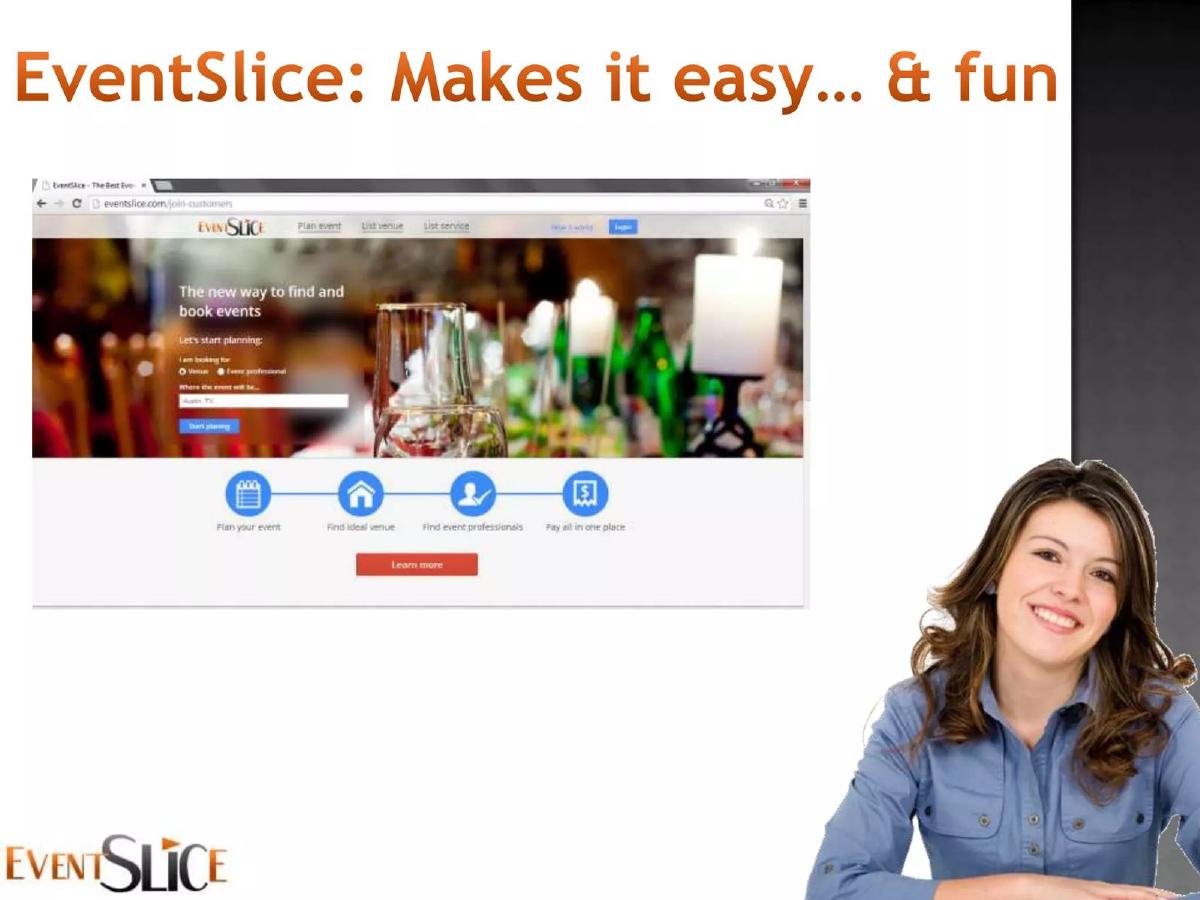
Slide 2 introduces the user interface under the heading "EventSlice: Makes it easy... & fun." A screenshot of the website shows a search-centric landing page where users can select between a "Venue" or "Event professional" and enter a location (the example shown is Austin, TX). Below the search bar, a four-step process is outlined: Plan your event, Find ideal venue, Find event professionals, and Pay all in one place. This slide establishes the platform as an end-to-end solution rather than a simple directory.
Business Model and Strategy
Slide 3: Building the Business
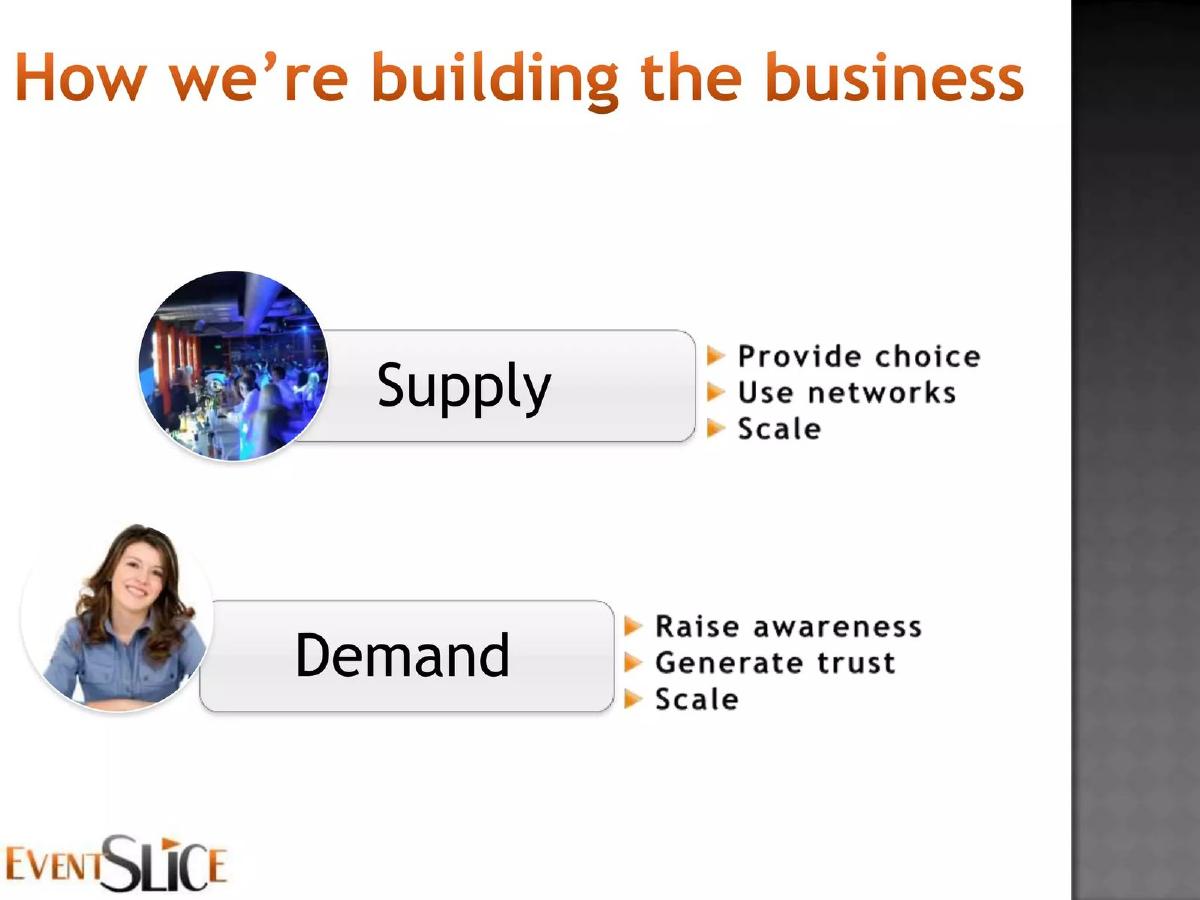
Titled "How we’re building the business," this slide breaks down the marketplace dynamics into Supply and Demand. For Supply, the strategy is to "Provide choice," "Use networks," and "Scale." For Demand, the focus is on "Raise awareness," "Generate trust," and "Scale." The slide is high-level and lacks specific tactical details on how these networks will be accessed or how trust will be generated, serving more as a conceptual framework for the slides that follow.
Market Opportunity
Slide 4: Market Size
Slide 4 quantifies the opportunity, stating the "US Event Market >$350B." The slide provides a breakdown of various sub-sectors: Venue ($300B), Music & Lighting ($25B), Photography ($9B), Catering ($8B), Floral ($7B), Equipment ($2B), Misc. ($1B), and Event Planning ($6B). By highlighting that venues represent the vast majority of the spend, the deck justifies why venue discovery is a central pillar of their product.
Traction and Execution
Slide 5: Geographic Penetration
This slide, "Early penetration in Austin," provides raw numbers for their initial test market. It lists 28 Venues, 9 Music & Lighting providers, 2 Photographers, 7 Caterers, 2 Florists, 7 Equipment providers, 9 Misc. services, and 10 Event Planners. The bottom of the slide lists the next targets for expansion: Dallas, Houston, and Las Vegas. This shows a clear intent to replicate the Austin model in other high-density event cities.
Slide 6: Proof of Viability
Slide 6 is the primary traction slide, titled "Early successes proves viability." It lists 3,391 users and 10 events booked. The most notable claim here is "$0 spend" for the initial user acquisition, attributed to organic traffic. A second section notes that for their Austin focus, they spent " Titled "Now.. It’s time to expand our reach," this slide outlines three pillars of growth. First, expanding listings beyond Austin to build marketplace trust. Second, focusing on bookings by kicking off event planning and building "in network" transactions. Third, platform development, which includes "Expanded listing functionality," a "Scheduling solution," and "CRM lite functionality." This indicates the company plans to move deeper into the workflow of the vendors they host.
Slide 8: Competitive Landscape
The slide "It’s not like we’re alone" uses a feature comparison matrix. EventSlice compares itself to Eventective, Eventup, The Knot, BrideRush, Jellifi, GigSalad, and GigMasters. The matrix tracks four features: Professional Listings, Venue Listings, Booking Engine, and Payment Engine. EventSlice is the only company with checkmarks in all four columns, specifically highlighting the lack of booking and payment capabilities in their competitors. This is their primary argument for why they can disrupt established players.
Slide 9: Appendix/Transition
Slide 9 is a simple transition slide labeled "Back Up." In a typical pitch setting, this would precede additional data slides, financial models, or technical architecture diagrams that were not included in this nine-slide selection.
What Works and What is Missing
What Works
The deck is highly focused on a single, clear value proposition: moving the event industry from discovery to transaction. By highlighting the "Booking Engine" and "Payment Engine" as their unique selling points, they identify a specific gap in the market occupied by older, directory-style competitors. The traction data from Austin, while small in absolute terms (10 bookings), is presented effectively as a low-cost proof of concept. The market size breakdown on Slide 4 is also useful, as it explains the strategic importance of focusing on venues due to their $300B dominance in the sector.
What is Missing
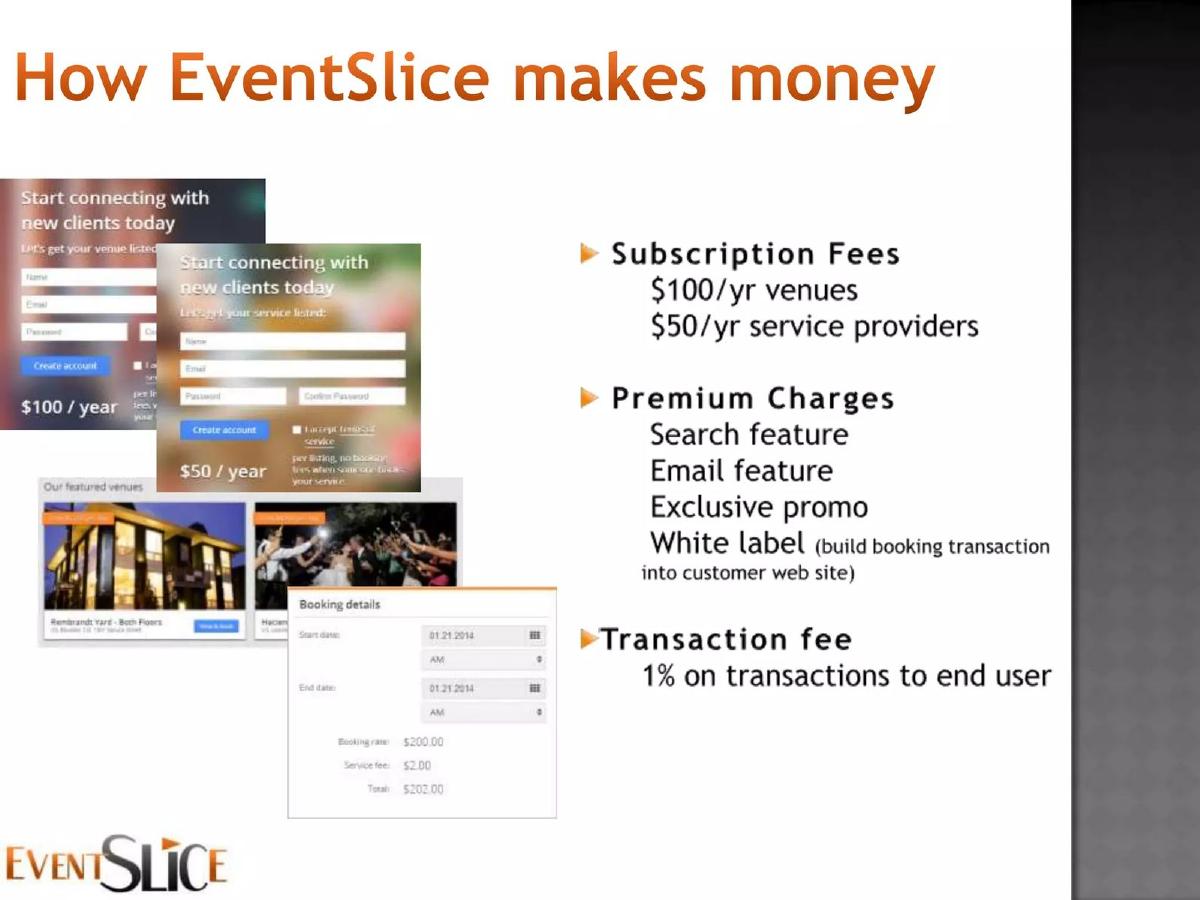
The most significant omission in this set of slides is the Team slide. In early-stage fundraising, the pedigree and experience of the founders are often as important as the traction. There is also no mention of the business model in terms of take rates or listing fees; while they mention a "Payment Engine," they do not specify if they take a percentage of the transaction. Furthermore, there is no slide detailing the "Ask"—how much money they are raising and what the specific milestones for that capital will be. Finally, the deck lacks a clear explanation of the "CRM lite" features, which could be a significant technical undertaking that requires more justification.
Founder Takeaways
Focus on the Transaction: If you are entering a crowded market (like event planning), don't just build another directory. EventSlice correctly identifies that the "friction" in the market isn't just finding a vendor, but booking and paying them. Highlighting your ability to close the loop on a transaction is a strong way to differentiate against incumbents.
Local to National Strategy: The deck demonstrates the value of winning a single city before trying to win a country. By showing specific numbers for Austin (59 venues, 110 services), the founders prove they can achieve the necessary density for a marketplace to function. Investors generally prefer a proven local model over a shallow national one.
Capital Efficiency as a Metric: Mentioning that 3,000+ users were acquired with $0 spend is a powerful statement. It suggests that the product has a natural pull or that the founders are exceptionally good at organic SEO/marketing. If you have similar metrics, they should be front and center in your traction slide.
Frequently asked questions
- What is the primary value proposition of EventSlice?
- EventSlice aims to be the 'new way to find and book events' by consolidating the planning, discovery, and payment phases into a single platform. Unlike traditional directories that simply list professionals, EventSlice emphasizes its integrated booking and payment engines, which allow users to handle transactions directly through the site rather than just finding contact information for external negotiation.
- How did EventSlice acquire its first 3,000+ users?
- According to slide 6, the company achieved its initial user base of 3,391 people through purely organic traffic and word-of-mouth. They explicitly state a '$0 spend' for this user acquisition, though they later mention a small expenditure of less than $1,000 for social media promoted posts and physical printing like business reply cards to support their Austin-focused marketing efforts.
- What geographic areas is the company targeting for growth?
- The company started with a concentrated focus on Austin, Texas. Slide 5 outlines the next phase of their expansion strategy, which targets three major cities: Dallas, Houston, and Las Vegas. This suggests a regional 'hub-and-spoke' growth model, focusing on high-volume event markets in the Southern and Western United States before attempting a full national rollout.
- How does EventSlice differentiate itself from established players like The Knot?
- On slide 8, EventSlice uses a competitive matrix to show that while incumbents like The Knot, BrideRush, and Eventective have professional and venue listings, they lack a 'Booking Engine' and a 'Payment Engine.' EventSlice claims to be the only player in their set that offers all four components, moving the platform from a discovery tool to a transactional marketplace.
- What technical features are planned for the platform's future?
- Slide 7 details the platform's roadmap, which includes expanding listing functionality beyond basic information. Key additions include a scheduling solution to manage event dates and 'CRM lite' functionality. These features are intended to help service providers manage their business on the platform, thereby increasing the 'trust' and stickiness of the marketplace for both supply and demand sides.