Ricotio's pitch deck outlines an ambitious five-stage roadmap to evolve from a wholesale aggregator into a full-stack e-commerce infrastructure provider, including logistics, warehousing, and payment processing. The company targets the then-growing trade corridor between the EU and Russia, citing a Russian e-commerce growth rate of 20%-40% per year (Slide 5). While the deck excels at explaining complex operational hierarchies and incentive mechanisms—such as a 50/50 commission split between back-office and front-office functions (Slide 15)—it suffers from a lack of concrete financial data. Th…
Key takeaways
- The company positions itself as the 'Standard Oil' of e-commerce, aiming for total vertical integration across the value chain (Slide 3).
- Ricotio identifies a specific market opportunity in the Russian e-tail turnover, which was forecasted to reach $20 billion by 2015 (Slide 5).
- The business model relies on a five-stage development logic, moving from wholesale aggregation to building a proprietary payment system (Slide 3).
- The platform targets a wide range of stakeholders, including manufacturers, wholesalers, e-store developers, and brick-and-mortar stores (Slide 7).
- A detailed operational structure is proposed, dividing the company into Front Office, Back Office, and Development Office across multiple locales (Slide 13).
- The 'Target Incentive Mechanism' specifies a 10% share for local partners and a 50% allocation for back-office costs, including taxes and profit (Slide 15).
- The deck includes screenshots of a 'beta' version of the platform for both suppliers and buyers, indicating some level of product development (Slide 11).
- The team is distributed across three entities: Ricotio OU (Estonia), RicoDe UG (Germany), and RicoRus Ltd. (Russia) (Slide 17).
Slide-by-Slide Analysis
Slide 1: Title and Positioning
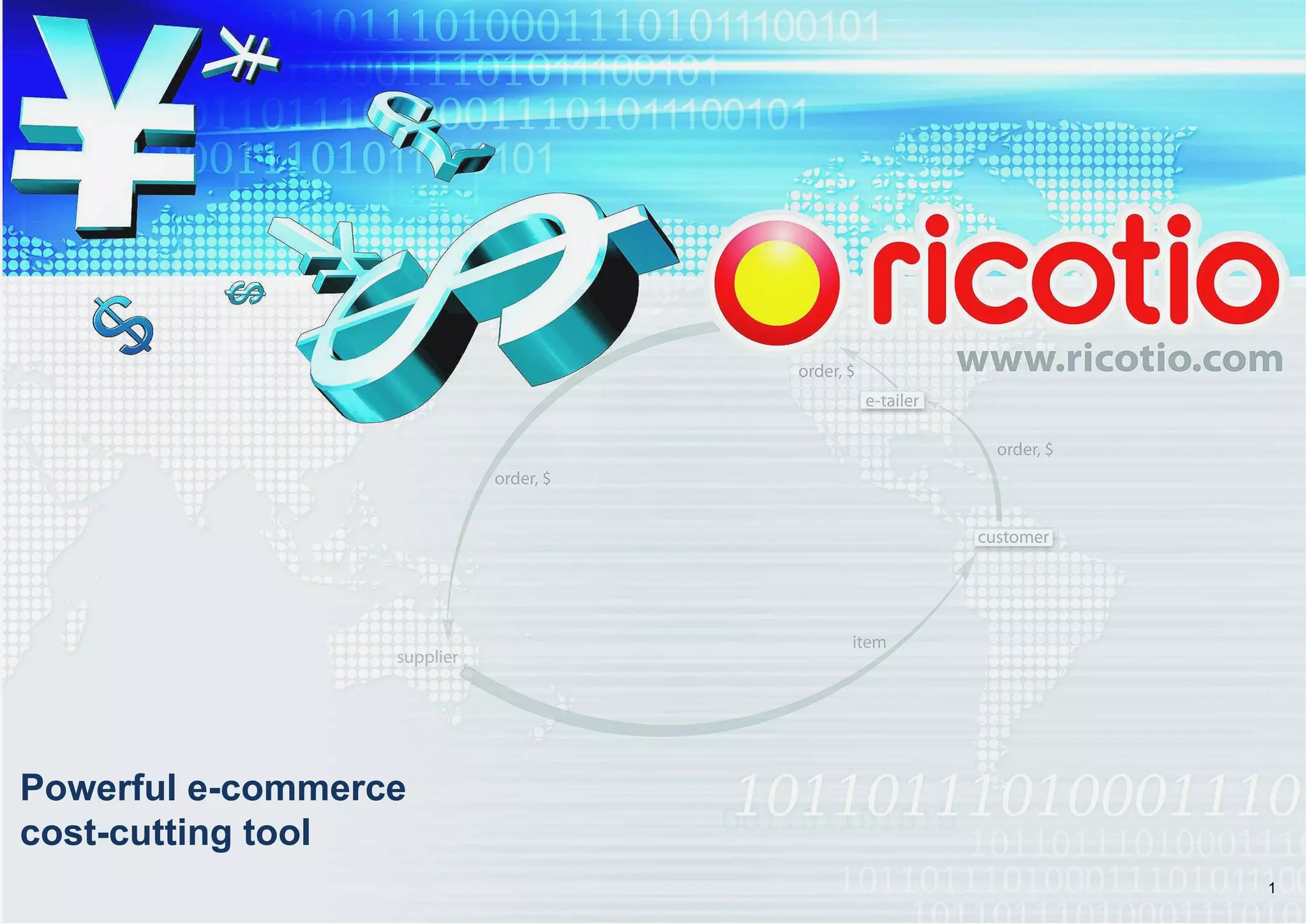
The cover slide introduces Ricotio with the tagline "Powerful e-commerce cost-cutting tool." The visual design features 3D currency symbols (Yen, Dollar, Euro) and a world map, emphasizing the international nature of the business. A circular diagram shows the flow between supplier, e-tailer, customer, and item, establishing the company as a facilitator of trade. The URL www.ricotio.com is prominently displayed.
Slide 3: Vision and Development Logic
This slide defines Ricotio's long-term ambition by comparing itself to the Standard Oil Company. The goal is vertical integration. The slide outlines a five-stage evolution: 1. Wholesale aggregator, 2. Logistics operator, 3. Warehousing and fulfillment, 4. Web-based retail platform (CRM/SaaS), and 5. Payment processing. A nested oval diagram visualizes how each stage builds upon the previous one, starting from the core Ricotio brand.
Slide 5: Market Indicators
Ricotio provides a market comparison between Russia and the EU. It notes that the Russian e-commerce market is growing at 20%-40% per year, with a forecast to reach $20 billion by 2015. In contrast, the EU market is described as the largest in the world with a 17% growth rate. The slide positions Ricotio as the provider for goods and technology moving from the EU to Russia. Data is attributed to "Datainsight" and "retailgazette.co.uk."
Slide 7: Clients and Offers
A complex circular diagram maps out the various stakeholders Ricotio serves. These include manufacturers (seeking international promotion), wholesalers (seeking new sales channels), small/medium e-tailers (seeking free additional assortment), and starting entrepreneurs (seeking full logistics services). The slide also mentions logistics companies, brick-and-mortar stores, and auctioneers as potential clients, detailing specific benefits for each.
Slide 9: Key Features
This slide lists the functional capabilities of the platform. It highlights a "simple working environment" with 2-click item uploads, automatic data exchange via XML and CSV, and custom legal document formats (invoices, bills) tailored to local laws. Security features are also mentioned, such as safe transactions through local branches and a money-back guarantee for shipment denials. Payment methods include wire transfer, PayPal, and Visa/Mastercard.
Slide 11: Product Interface (How it Works)
Ricotio displays screenshots of its "beta" platform, showing separate interfaces for Suppliers and Buyers. The process is described in three steps: filling in a company profile, signing contracts according to local regulations, and setting up automated data exchange. The screenshots show a dashboard with icons for orders, profile, documents, messages, warehouses, and statistics. Green checkmarks indicate the five core sections necessary for managing customer needs.
Slide 13: Operational Structure
This slide details the organizational hierarchy. It is divided into three main blocks: Front Office (responsible for customer acquisition and partner management), Back Office (handling finance, legal, IT, and tech support), and the Development Office (focused on e-commerce integration and new features). A matrix on the right shows how responsibility is distributed among product categories (Commodity groups A, B, C) and geographies (Locales 1, 2, 3).
Slide 15: Target Incentive Mechanism
This is a technical breakdown of the company's financial flow. It uses a pie chart to show the distribution of Ricotio's commission fee: 50% to the Back Office (for taxes and profit), 40% to the Front Office, and 10% to Local Partners. The Front Office funds are further broken down into order processing (30%), marketing (50%), and referral bonuses (20%). It also illustrates how bonuses are shared when a supplier and e-tailer belong to different locale teams.
Slide 17: Contacts
The final slide provides contact information for three regional leads, each associated with a specific legal entity and flag: Alexey Belinskiy for Ricotio OU (Estonia), Christian Boas for RicoDe UG (Germany), and Alexey Meshalkin for RicoRus Ltd. (Russia). Phone numbers, email addresses, and Skype IDs are provided, along with the languages spoken by each representative.
What Ricotio Does Well
The deck is exceptionally thorough in explaining the operational mechanics of a complex, multi-jurisdictional business. By breaking down the incentive structures (Slide 15) and the operational hierarchy (Slide 13), the founders demonstrate a deep understanding of the friction points in cross-border trade. They aren't just proposing a website; they are proposing a legal and financial framework for international drop-shipping.
The strategic roadmap on Slide 3 is also a strength. It provides a clear logical progression for the company's growth, moving from a low-asset aggregator model to a high-moat infrastructure and payments model. This gives investors a sense of the long-term "terminal value" the founders are aiming for, rather than just a short-term arbitrage play.
What is Missing from the Deck
The most glaring omission is the Financial Ask and Use of Funds . There is no slide indicating how much money the company is seeking or what that capital will be used for. Without this, the deck functions more as a business plan summary than a fundraising tool.
Furthermore, there is a lack of Traction Metrics . While Slide 11 shows a beta product, there are no figures regarding current transaction volume, number of active suppliers, or revenue generated to date. The market data on Slide 5 is purely external and does not reflect Ricotio's specific performance within that market. Finally, there is no Competition Slide . In the crowded e-commerce and logistics space, failing to acknowledge competitors or explain a specific competitive advantage (beyond "cost-cutting") is a significant oversight.
Founder Takeaways: What to Copy
Detailed Incentive Mapping: Founders building marketplace or platform businesses should emulate Slide 15. Clearly showing how every dollar of commission is split between operations, marketing, and profit helps de-risk the business model in the eyes of an analyst. It shows that the unit economics have been thought through at a granular level.
Phased Growth Strategy: The "Development Logic" on Slide 3 is an excellent way to present a big vision without appearing unrealistic. By breaking the "Standard Oil" ambition into five digestible stages, the founders show they have a plan for the "crawl, walk, run" phases of startup growth. This helps manage investor expectations regarding capital intensity and time-to-market for various features.
Stakeholder-Specific Value Props: Slide 7 is a great example of how to map a platform's value to multiple different user personas. Instead of a generic "we help everyone," the slide lists specific, tangible benefits for manufacturers versus small e-tailers. This level of specificity is crucial for proving product-market fit across a diverse ecosystem.
Frequently asked questions
- What is Ricotio's core value proposition?
- Ricotio describes itself as a 'powerful e-commerce cost-cutting tool' and an international drop-shipping service. Its primary goal is to act as a bridge for goods and technology moving from the European Union to the Russian market, providing the infrastructure necessary for cross-border trade, including logistics, data exchange, and legal documentation.
- How does Ricotio plan to scale its operations?
- The company follows a five-stage vertical integration strategy. It starts as a wholesale aggregator to identify profitable routes, then builds a logistics operator, followed by a warehousing network, a web-based retail platform (CRM/SaaS), and finally, its own payment processing system. This is modeled after the vertical integration of the Standard Oil Company.
- What specific markets is the company targeting?
- The deck focuses heavily on the Russian and European markets. It notes that Russia's e-commerce market was growing at 20%-40% annually, while the EU market was growing at 17%-19%. The strategy is to leverage the EU's large e-commerce base to supply the rapidly growing but relatively small Russian market.
- What is the proposed revenue and incentive model?
- Ricotio uses a 'Target Incentive Mechanism' where the commission fee is split: 50% goes to the back office (covering taxes, transactions, and profit), 40% to the front office (for order processing and marketing), and 10% to local partners. They also feature referral bonuses for 'supplier hunters' and 'buyer hunters'.
- Who are the key people behind Ricotio?
- The contact slide lists three key individuals: Alexey Belinskiy (Estonia), Christian Boas (Germany), and Alexey Meshalkin (Russia). Each represents a different regional legal entity, suggesting a localized approach to managing the cross-border logistics and legal requirements of the platform.