The BBGS investor deck, dated February 2022, pitches a sustainable approach to Bitcoin mining by leveraging excess green energy to achieve a zero-carbon footprint. The company utilizes a sophisticated 'Asset Co' and 'Op-co' structure, where investors fund the hardware (Asset Co) and an operating entity (BBGS) manages the technical execution in exchange for a production split. With active projects in Kazakhstan and the Democratic Republic of the Congo, and a pipeline spanning 18 countries, BBGS aims to produce Bitcoin at a sub-$20k cost. The deck emphasizes institutional-grade governance and a…
Key takeaways
- The company employs a dual-entity structure where 'Asset Co' owns the machines and 'Op-co' handles operations (Slide 2).
- BBGS claims a production cost of sub-$20k per Bitcoin with a zero carbon footprint using excess green energy (Slide 4).
- The market opportunity is framed by $15bn generated by miners in 2021, a 206% increase over 2020 (Slide 5).
- Operations are currently active in Kazakhstan and the Democratic Republic of the Congo (RDC) (Slide 8).
- The company has advanced discussions to secure an additional 300MW+ of excess renewable energy (Slide 8).
- A specific production waterfall shows that 85% of net production goes to the Asset Co, with 1% dedicated to social impact (Slide 9).
- The team includes a Business Development lead who is an official adviser to the French government on foreign trade (Slide 7).
- The financial model projects a reserve of 800 BTC by December 2025 based on 'scenario 1' hypotheses (Slide 10).
Executive Summary: The Institutional Green Mining Play
The BBGS (Big Block Green Services) deck, dated February 2022, represents a specific era of Bitcoin mining where environmental, social, and governance (ESG) concerns became a primary hurdle for institutional capital. The deck is structured not as a typical software startup pitch, but as an infrastructure project proposal. It focuses heavily on the 'how' of the operation—specifically the legal and operational separation of assets from management—and the 'where' of the energy sourcing.
Slide 1: Title and Visual Identity
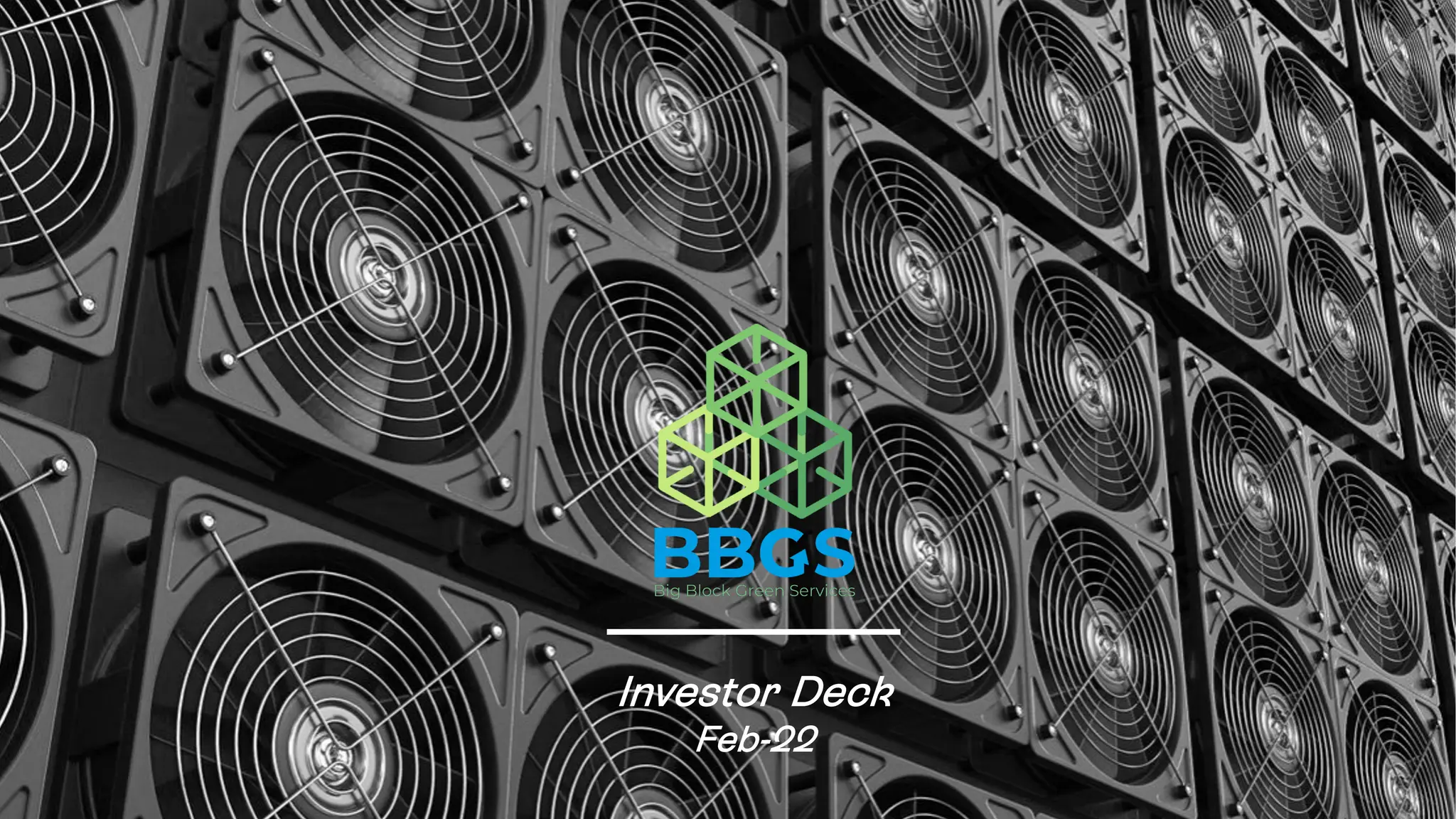
The cover slide establishes a professional, industrial tone. It features a black-and-white close-up of cooling fans, typical of ASIC mining rigs. The logo for Big Block Green Services (BBGS) uses a green and blue geometric cube motif, signaling both blockchain technology and environmental consciousness. The date 'Feb-22' places this deck at a time when Bitcoin was trading significantly higher than its eventual 2022 lows, providing context for the 'sub-20k' production cost mentioned later.
Slide 2: The Asset Co vs. Op-co Structure
This is perhaps the most important slide for a sophisticated investor. BBGS outlines a 'Transaction perimeter' that isolates investor capital within an 'Asset Co.' Key details include:
Minimum Ticket: €100k, targeting Private Placement and High Net Worth Individuals (HNWI). · Metayage Contract: A term borrowed from sharecropping, where the Asset Co provides the machines and the Op-co (BBGS) manages them. · Revenue Split: The Op-co gives 85% of its production (net of electricity) back to the Asset Co. · Advisors: The slide lists roles for Investment Banks, Legal/Compliance advisors, and Strategic/Technical advisors, though specific firm names are not mentioned on this slide.
Slide 3 & 4: The Sustainability Thesis
BBGS spends two slides addressing the 'Bitcoin energy problem.' Slide 3 uses a 'Fact vs. Myth' format to argue that Bitcoin's energy consumption is a feature of its security, not a bug, and that the industry is rapidly switching to renewables. Slide 4 delivers the core value proposition: "BBGS produces (mining) a bitcoin at sub-20k$ price with a ZERO carbon footprint by leveraging green energy produced in excess." The use of the word 'excess' is strategic; it implies the company is helping grid stability by consuming power that would otherwise be wasted, rather than competing with residential or industrial needs.
Slide 5: Market Opportunity
The deck quantifies the mining sector using 2021 data. It cites $15bn generated by miners in 2021 and highlights a 206% rise in revenue compared to 2020. This slide serves to validate the scale of the industry for investors who might still view crypto mining as a niche or 'hobbyist' activity.
Slide 6: Technical Infrastructure (ASICS)
This slide defines Application-Specific Integrated Circuits (ASICs) for the uninitiated, calling them "crypto mining machines." It lists several major vendors under "Current Discussions," including Bitmain, MicroBT, Canaan, Innosilicon, and Bit-tech. This indicates that BBGS is hardware-agnostic and maintains multiple supply chain relationships to mitigate procurement risk.
Slide 7: The Team
The team slide emphasizes international experience and government relations. Sebastien Gouspillou (CEO) is noted for his background in green agri-forestry. Théophile Perrot (Business Development Central Asia) is highlighted as an "Official Adviser to the French government on foreign trade matters" and an adviser to the Tajik government on Bitcoin mining. This level of political connectivity is a significant de-risking factor for mining operations, which are often subject to sudden regulatory shifts.
Slide 8: Global Footprint and Pipeline
BBGS shows geographic diversification, which is critical in mining to avoid single-point-of-failure risks (like the China mining ban). Current operations: Kazakhstan and RDC (Democratic Republic of the Congo). Future Pipeline: 18 countries across 3 continents. The slide claims advanced discussions to secure 300MW+ of additional excess renewable energy, providing a clear path for scaling the capital deployed by the Asset Co.
Slide 9: The Production Waterfall
This slide provides a granular breakdown of how a single Bitcoin reward is distributed. It is a highly transparent look at the unit economics:
Gross Production: 100% · Energy Costs: -18% · Net Production: 82% · Mining Fees: -12% · Social Contribution: -1% · Final Asset Co Retrieval: 69% of the gross reward.
This 69% 'take-home' for the Asset Co is the figure investors will use to calculate their internal rate of return (IRR) against the cost of the hardware.
Slide 10: Projections
The final slide in this selection shows a growth curve for a Bitcoin reserve. It projects that by December 2025, the model could generate an 800 BTC reserve . It is important to note the disclaimer "with scenario 1 hypothesis," though the specific parameters of that scenario (hashrate difficulty, BTC price, etc.) are not detailed on this specific slide.
What BBGS Does Well
The deck excels at structural transparency . By clearly defining the Asset Co/Op-co split and providing a waterfall chart for the production rewards, BBGS speaks the language of institutional finance rather than crypto-hype. The focus on 'excess' energy and 'zero carbon' directly addresses the largest institutional barrier to entry for Bitcoin: ESG mandates. Furthermore, the team's government advisory roles provide a layer of perceived regulatory moat that most mining startups lack.
What is Missing from the Deck
While the 10 slides provided are dense with information, several key pieces are missing for a final investment decision. There is no depreciation schedule for the ASIC hardware; mining rigs have a finite lifespan and declining efficiency as the network hashrate increases. The deck also lacks a sensitivity analysis —how does the 800 BTC projection change if the Bitcoin network difficulty doubles or if energy prices in Kazakhstan rise? Finally, while the minimum ticket is €100k, the total target raise for the Asset Co is not stated in these slides.
Founder's Guide: What to Copy
Founders in capital-intensive industries should emulate the Metayage/Asset-Light model shown on Slide 2. By separating the risky operational entity from the asset-owning entity, you make the investment much more palatable to conservative capital. Additionally, the waterfall chart on Slide 9 is a masterclass in building trust through transparency; it shows exactly where every cent (or satoshi) goes before the investor gets paid, which preempts questions about hidden management fees or operational bloat.
Frequently asked questions
- What is the investment structure proposed by BBGS?
- BBGS uses a 'Metayage' contract model. Investors contribute capital to an 'Asset Co' (minimum €100k ticket). This Asset Co provides the mining hardware to the 'Op-co' (BBGS). In return, the Op-co returns 85% of the Bitcoin production, net of electricity costs, back to the Asset Co. This separates the ownership of the physical assets from the operational risks of the mining farms.
- How does BBGS address the environmental concerns of Bitcoin mining?
- The deck explicitly counters the narrative that Bitcoin mining is environmentally destructive. Slide 3 and 4 argue that mining is transitioning to renewables. BBGS specifically targets 'excess' green energy—power that would otherwise go to waste—to achieve a zero-carbon footprint. This positioning is central to their 'Big Block Green Services' branding.
- Where are the company's current and future operations located?
- According to Slide 8, BBGS has active mining farms in Kazakhstan and the Democratic Republic of the Congo (RDC). Their expansion pipeline is ambitious, citing projects in negotiation across 18 countries and 3 continents, with a goal to secure over 300MW of additional power capacity between Q1 2022 and Q1 2023.
- What are the projected returns for investors?
- While the deck does not guarantee a specific ROI in fiat currency, Slide 10 projects the accumulation of a Bitcoin reserve. Under their 'scenario 1' hypothesis, they forecast reaching a reserve of 800 BTC over a three-year period (ending late 2025). The waterfall on Slide 9 shows investors (via Asset Co) receive 69% of the total gross production after all fees and costs.
- Who is leading the BBGS team?
- The team is led by CEO Sebastien Gouspillou, who has experience in green agri-forestry. Notable members include Théophile Perrot, a French government adviser on Bitcoin mining, and Adrien Gombert, the CTO who previously built a mining farm in France. The team combines expertise in IT infrastructure, civil engineering, and international business development.