Intersailclub is a travel marketplace designed to simplify the process of booking sailing trips by offering cabin-level reservations and themed cruises. The deck identifies a significant friction point in the traditional charter market: the difficulty of forming a full travel group and the perceived high cost of private yacht rentals. By aggregating offers and providing a user-friendly interface with map-based discovery, Intersailclub positions itself against broader competitors like Click&Boat and Zizoo by specializing in cabin cruises and specific 'experiences.' The financial roadmap is agg…
Key takeaways
- The company identifies three core problems: the frustration of forming travel groups, a messy market of charter companies, and the myth that sailing is expensive (Slide 4).
- The product features a map-based search interface for Italy and other Mediterranean locations, allowing users to visualize specific sailing routes (Slide 10).
- Intersailclub differentiates itself from competitors like Sailsquare and Zizoo by offering a full suite of services including cabin cruises, day cruises, and small ship cruises (Slide 13).
- Customer demographics show a majority female user base at 61.4%, with 'Singles' making up the largest booking segment at 40.6% (Slide 16).
- The roadmap projects significant scaling, aiming for 68.9 million in revenue and 327,392 cabins by 2023 (Slide 19).
- Historical data from 2018 shows a 19% repeat client rate, suggesting some level of product-market fit (Slide 19).
- Future growth is predicated on an 'Agency Affiliation Programme' and an 'Open Market Place' to expand supply (Slide 22).
- The deck concludes with a focus on 'Growth driven design,' emphasizing marketing experiments and data-driven decision-making (Slide 25).
Executive Summary
Intersailclub is a niche travel marketplace focusing on the nautical tourism sector. The deck positions the company as a solution to the high barriers of entry associated with traditional yacht charters. By focusing on cabin-level bookings and themed experiences, the company targets a demographic of solo travelers and couples who are currently underserved by the 'entire boat' rental model. The deck relies heavily on visual product demonstrations and aggressive growth projections to make its case.
Slide 1: Title Slide
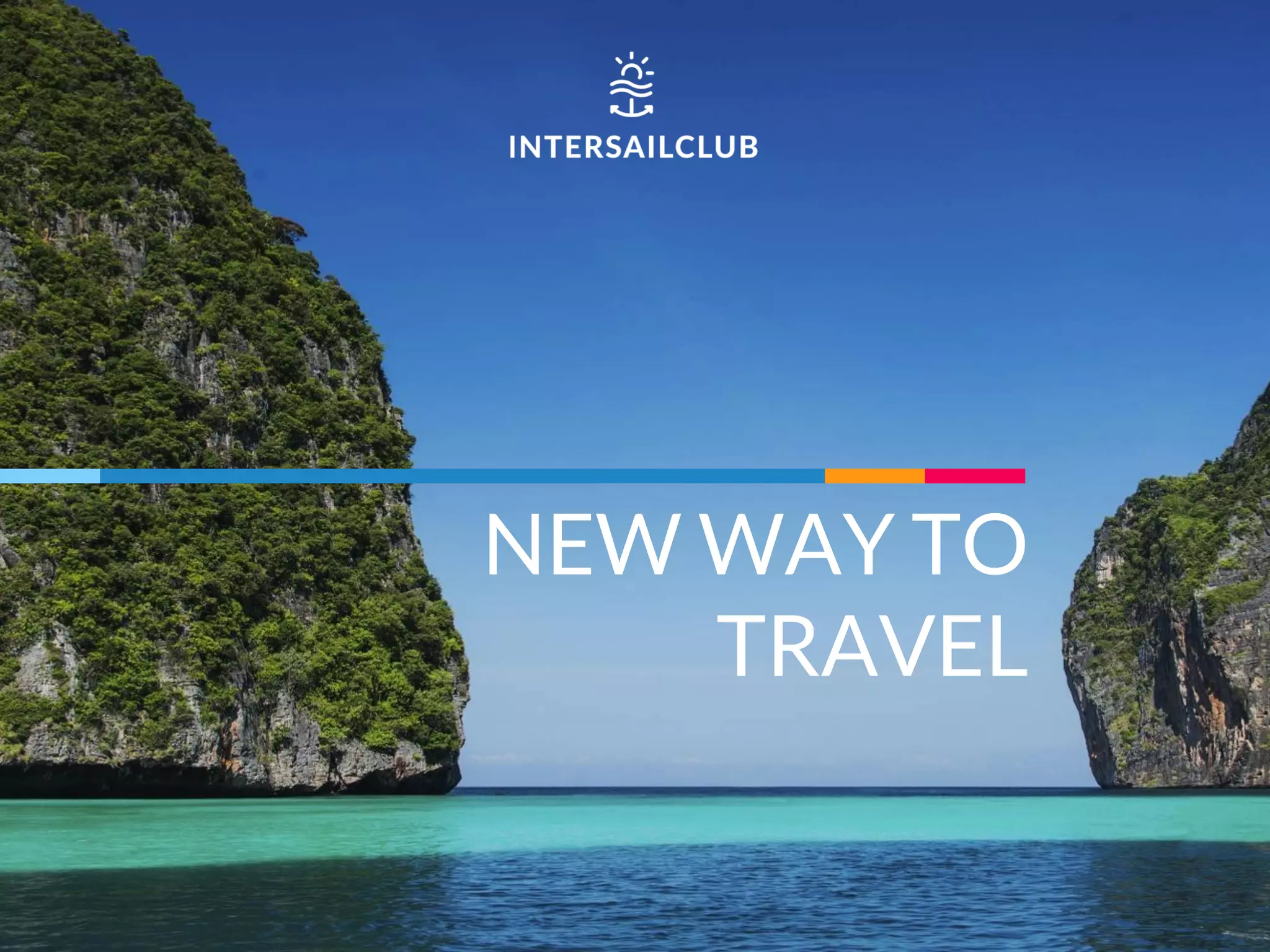
The cover slide features high-quality travel photography of a tropical lagoon, establishing the aspirational nature of the brand. The tagline 'NEW WAY TO TRAVEL' is broad but sets the stage for a disruptive approach to a traditional industry. The branding is clean, using a sun and anchor logo that clearly communicates the maritime focus.
Slide 4: The Problem
This slide breaks the problem down into three distinct pillars: Customer, Market, and Awareness. Customer: The difficulty of organizing a large enough group to justify a boat charter. Market: A fragmented and 'messy' landscape of charter companies. Awareness: The 'myth' that sailing is exclusively for the wealthy or is too complex to book. A testimonial from 'Loucas Papantoniou' at the bottom of the slide reinforces the emotional frustration of the current booking process, citing 'nightmares' and 'stress' caused by information overload.
Slide 7: Product Interface - Home Page
The deck showcases a mockup of the Intersailclub website. The interface is reminiscent of mainstream travel sites like Airbnb or Booking.com, featuring a prominent search bar for destinations and dates. Below the fold, 'Themed Cruises' are highlighted, including yoga and wine-tasting options. Prices are clearly displayed, such as '7 days cruises available at €650,' which directly combats the 'expensive' myth mentioned in the problem slide.
Slide 10: Product Interface - Maps
Slide 10 displays the platform's mapping capabilities on a tablet interface. The left screen shows a map of Italy dotted with pins representing available cruises. The right screen shows a specific sailing itinerary with a path connecting various ports. This visualizes the 'experience' aspect of the service, showing potential customers exactly where they will go, rather than just what boat they will be on.
Slide 13: Competitive Landscape
Intersailclub uses a standard checkmark grid to compare itself against competitors. The competitors listed include Sailsquare, Click&Boat, GetMyBoat, Sailo, Boatbound, Zizoo, and Incrediblue . The slide claims that while most competitors offer 'Entire Boat Cruises,' Intersailclub is the only one providing a full stack of services: Cabin Cruises, Experiences, Day Cruises, and Small Ship Cruises. This is a classic 'blue ocean' strategy slide, attempting to show that the company occupies a unique space in the market.
Slide 16: Customer Demographics
This slide provides data from a sales analysis conducted between 2015 and 2018. Two donut charts reveal that 61.4% of their customers are female and 38.6% are male. The second chart breaks down booking types: Singles (40.6%), Couples (31.9%), Entire boat (18.0%), Day trips (6.5%), and Mini group (3.0%) . This data is crucial as it validates the company's focus on cabin-level bookings, as over 70% of their business comes from individuals and couples rather than full-group charters.
Slide 19: The Roadmap with Investor
This is the most data-dense slide in the deck, outlining a five-year growth trajectory. The milestones are as follows:
2018: 240k revenue, 1,964 cabins, 19% repeat clients. · 2019: 3.6ml revenue, 17,261 cabins, loyalty program, and agency affiliation. · 2020: 6.6ml revenue, 28,913 cabins, mobile app, and luxury yachts. · 2021: 17.5ml revenue, 83,404 cabins, expansion to Asia, and ancillary services (insurance, flights). · 2022: 34.6ml revenue, 164,398 cabins, and tour/activity market entry. · 2023: 68.9ml revenue, 327,392 cabins, aiming for 5% of the Adventure Travel Market.
The revenue figures (presumably in Euros or Dollars, though not specified) show an extremely aggressive 287x growth over five years.
Slide 22: Upcoming Features
This slide lists four key initiatives intended to drive the growth shown in the roadmap: Agency Affiliation Programme, Open Market Place, Loyalty programme, and Travel guide optimizations . The 'Open Market Place' is particularly significant as it suggests a transition from a managed marketplace to a self-service platform for boat owners and operators, which is necessary for the scale projected in Slide 19.
Slide 25: Growth Driven Design
The final slide in the provided sequence discusses the methodology for continuous growth. It lists 'Marketing Experiment,' 'Conversion Rate Optimization,' and 'Data Driven Marketing' as core tenets. The sub-bullets emphasize making decisions based on data and continuous product development. While these are standard startup practices, their inclusion suggests a focus on capital efficiency and iterative improvement.
What Works Well in This Deck
The deck does an excellent job of identifying a specific, underserved niche within a large market. By highlighting that 40% of their customers are singles, they provide a data-backed reason for their 'cabin-booking' product focus. The use of actual product screenshots (Slides 7 and 10) gives investors confidence that the platform is functional and well-designed. Furthermore, the competitive matrix (Slide 13) clearly articulates their differentiation without being overly complex.
What Is Missing
The most glaring omission in this set of slides is the Team Slide . In early-stage travel tech, the founders' experience in both travel logistics and marketplace scaling is a primary investment criterion. Also missing is a Business Model slide that explains the 'take rate' or commission structure. While revenue totals are projected, we don't know how much Intersailclub keeps from each €650 booking. Finally, there is no Financial Ask . An investor viewing this deck would not know how much the company is seeking to raise or how that capital would be allocated across the roadmap milestones.
Founder Takeaways
Founders should take note of how Intersailclub uses historical data to justify future strategy . The demographic breakdown on Slide 16 is a powerful way to prove that the 'problem' identified on Slide 4 is real and that the 'solution' is being adopted by the target audience. However, founders should be cautious about presenting revenue projections that scale as aggressively as those on Slide 19 (from 240k to 68.9m in five years) without providing a very detailed explanation of the unit economics and the cost of acquisition required to reach those numbers. A 28,000% increase in revenue requires more than just a 'loyalty program' to achieve.
Frequently asked questions
- What is Intersailclub's primary value proposition?
- Intersailclub aims to democratize sailing by moving away from the 'entire boat' charter model. By offering cabin-level bookings and themed cruises (such as yoga or wine-tasting trips), they lower the cost and logistical burden for individual travelers or small groups who cannot fill a whole yacht. This addresses the 'messy offer' of traditional charter companies identified on Slide 4.
- How does the company plan to scale its inventory?
- The roadmap on Slide 19 and the upcoming features on Slide 22 indicate a shift toward an 'Open Market Place' and an 'Agency Affiliation Programme.' This suggests the company intends to move from a curated selection to a broader aggregator model, eventually expanding into Asia and the wider adventure travel market by 2023.
- Who is the target customer for Intersailclub?
- Based on the sales analysis from 2015-2018 shown on Slide 16, the primary customer is female (61.4%) and likely traveling alone, as 'Singles' represent 40.6% of bookings. Couples are the second-largest group at 31.9%. This data supports their focus on cabin bookings rather than full-boat charters.
- What are the projected financials for the company?
- The deck outlines a five-year growth plan starting from a base of 240k (presumably revenue) in 2018. They project reaching 3.6 million in 2019, 6.6 million in 2020, 17.5 million in 2021, 34.6 million in 2022, and finally 68.9 million by 2023. These figures are tied to a massive increase in cabin inventory (Slide 19).
- What critical information is missing from these slides?
- The provided slides omit the 'Team' slide, which is vital for assessing execution capability. It also lacks a specific 'Ask' slide detailing how much capital is being raised and at what valuation. Furthermore, there is no mention of take rates, customer acquisition costs (CAC), or lifetime value (LTV) metrics beyond the 19% repeat client rate.