The everbill pitch deck is a classic example of a Demo Day presentation designed for a live audience rather than a deep-dive read. Spanning just 8 slides, it positions the company as an all-in-one business management tool for SMBs. The narrative leans heavily on three pillars: existing traction ($120,000 in annual revenue), superior conversion rates (34% vs. 12% for competitors), and a scalable distribution model through T-Mobile. While the deck lacks a formal market size analysis or detailed competitor landscape, it successfully communicates a clear value proposition and a specific $500,000…
Key takeaways
- The company positions itself as 'SAP for Startups and SMBs' to immediately anchor its value proposition in a known category (Slide 1).
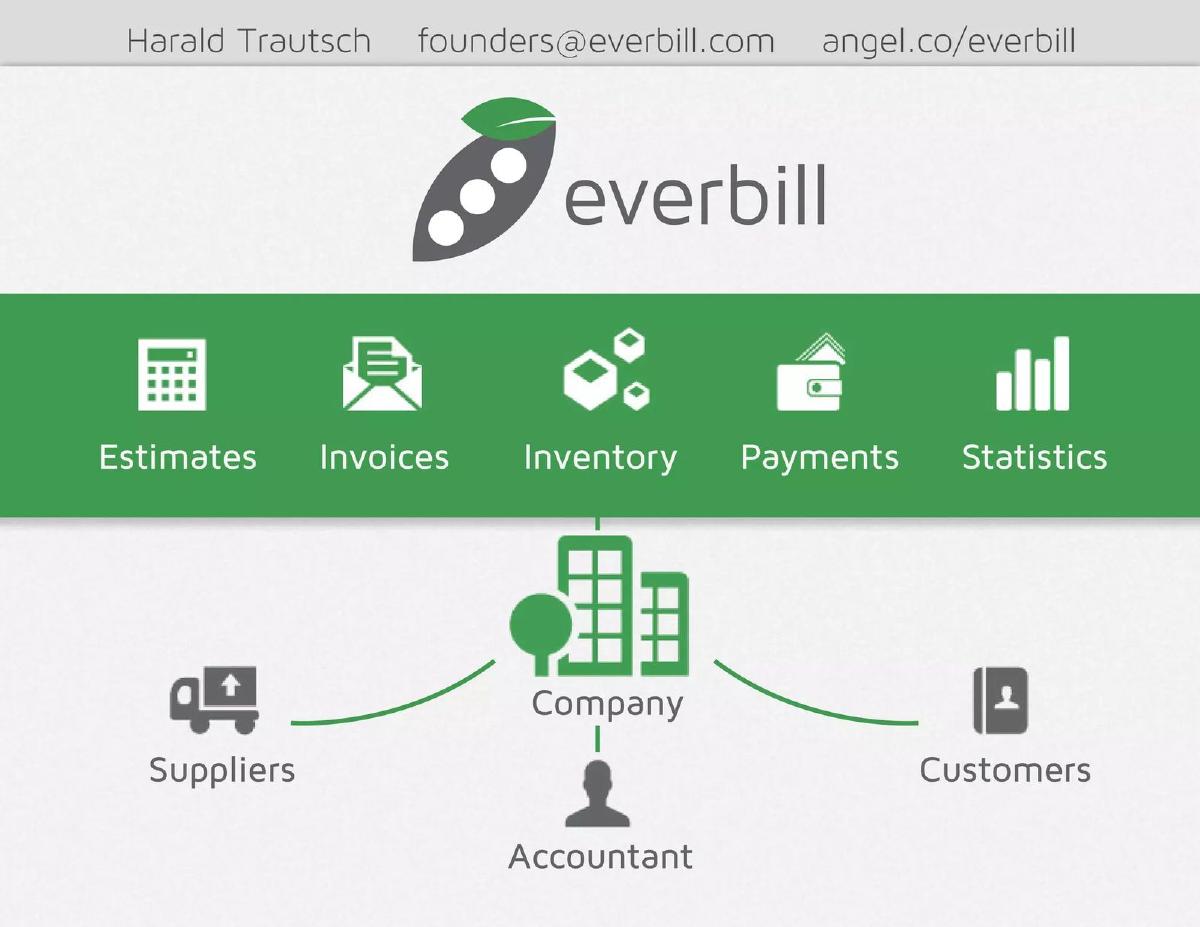
- The platform covers five core business functions: Estimates, Invoices, Inventory, Payments, and Statistics (Slide 3).
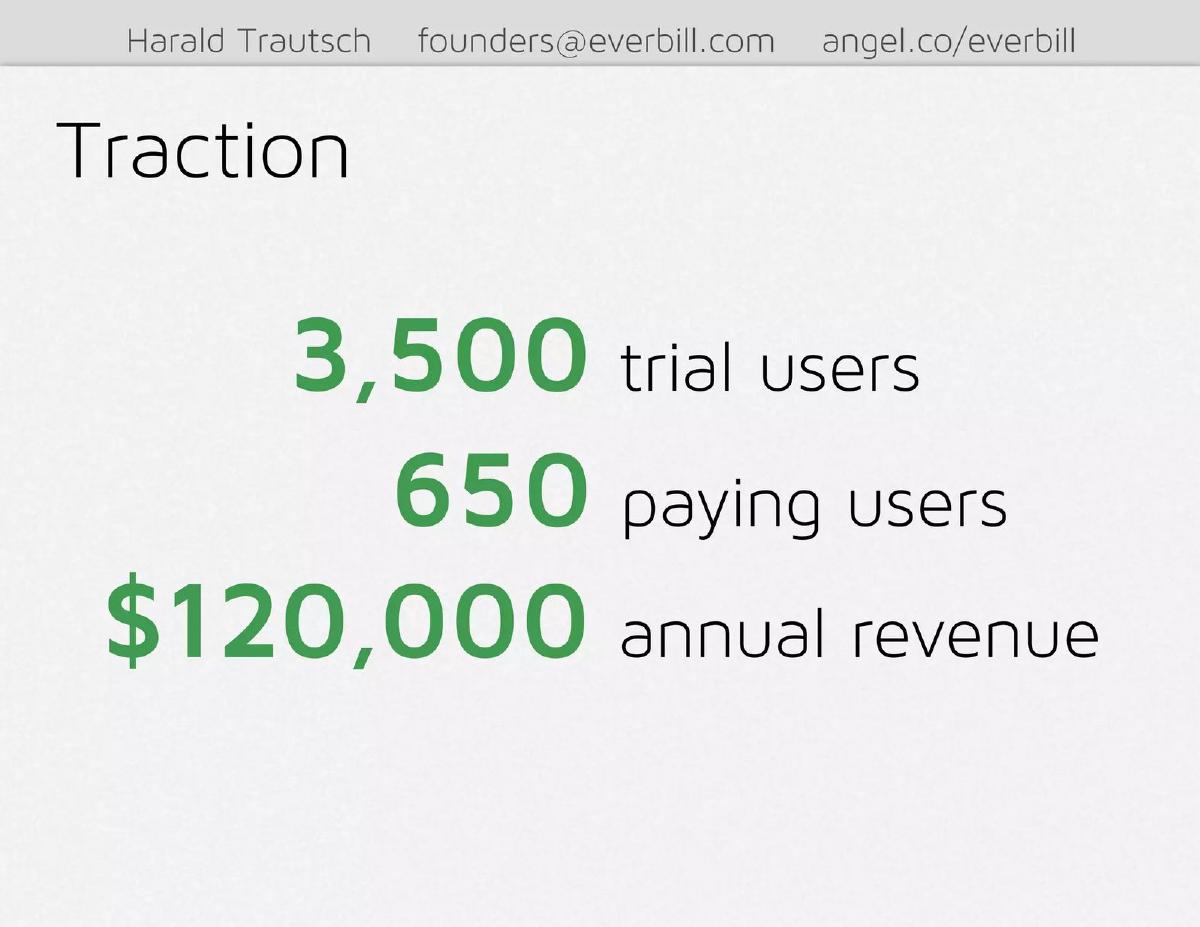
- Traction is quantified at 3,500 trial users and 650 paying users, generating $120,000 in annual revenue (Slide 4).
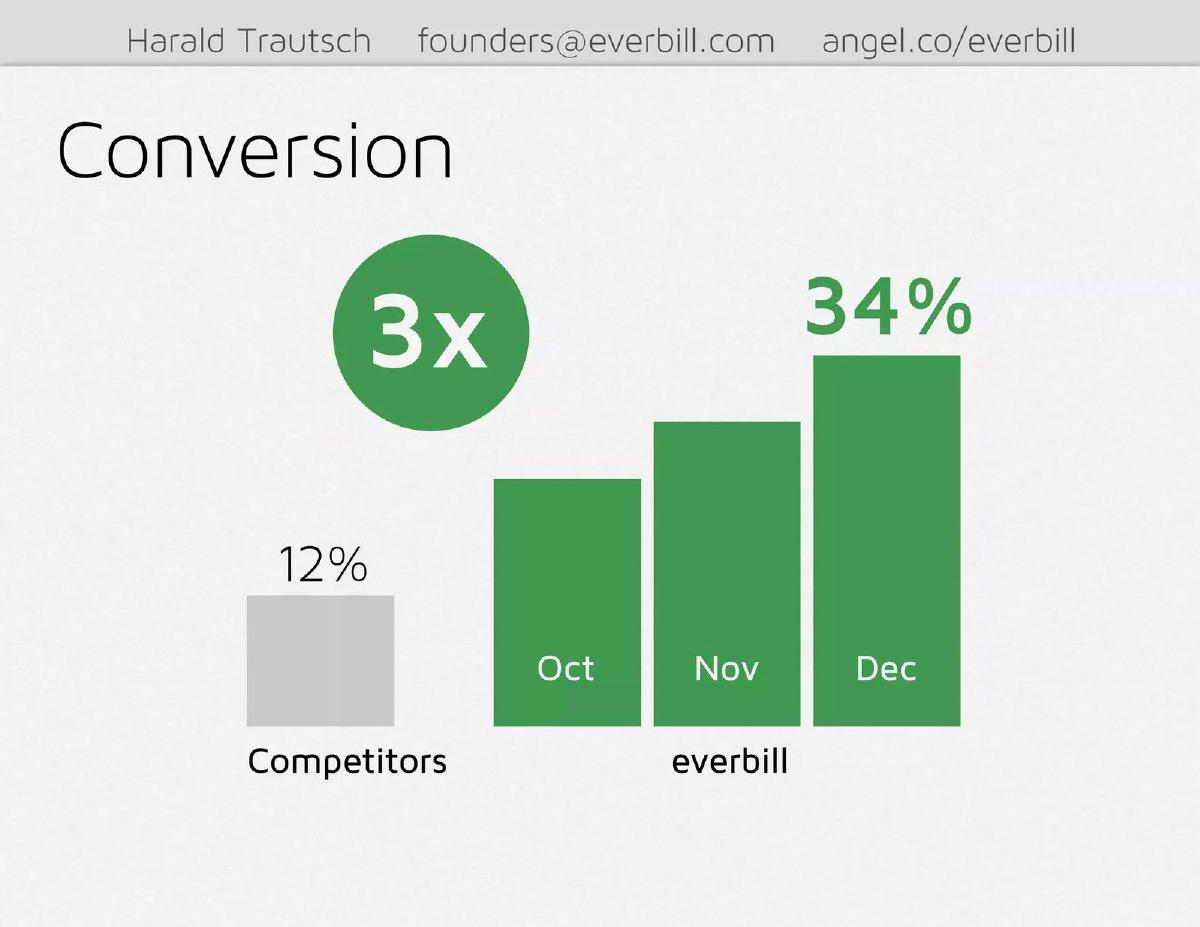
- The deck claims a 34% conversion rate, which it asserts is 3x higher than the 12% conversion rate of competitors (Slide 5).
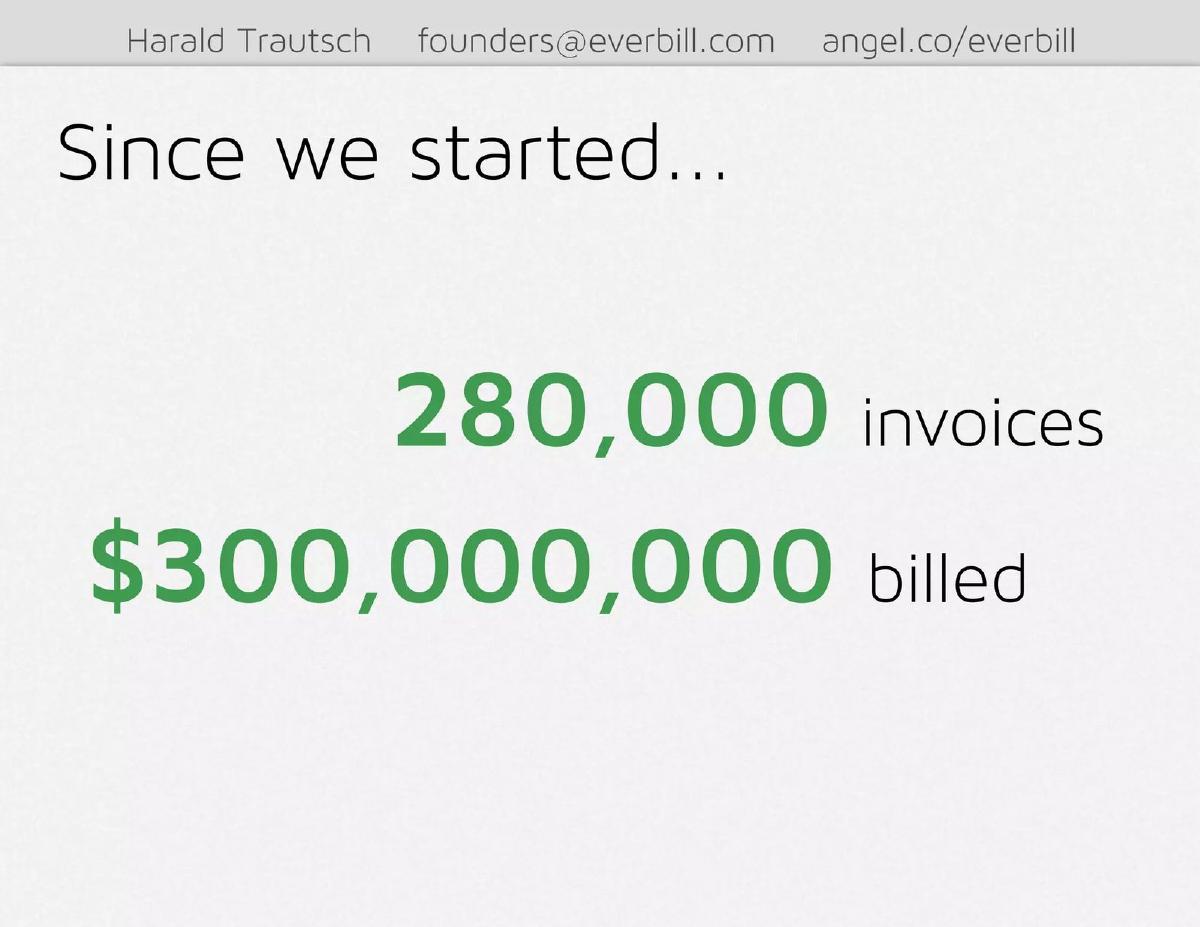
- Usage volume is highlighted by the processing of 280,000 invoices totaling $300,000,000 billed (Slide 6).
- Growth strategy is centered on a reseller model, specifically naming T-Mobile as a partner (Slide 7).
- The team consists of four executives: Harald (CEO), Michael (COO), Robert (CTO), and Gerald (CMO) (Slide 8).
- The funding ask is clearly stated as $500,000, with a progress bar indicating approximately 40% of the round is already committed (Slide 8).
The everbill Pitch Deck: A Demo Day Masterclass in Brevity
The everbill pitch deck, presented at a 500 Startups Demo Day, is a lean, 8-slide presentation that prioritizes high-level metrics over granular detail. It follows the classic accelerator format: one big idea per slide, large fonts for readability from the back of a room, and a heavy emphasis on traction to prove product-market fit. By positioning themselves as 'SAP for Startups,' the founders immediately communicate the complexity of the problem they are solving while promising a simplified user experience.
Slide 1: The Hook
The title slide introduces the brand and its positioning: 'SAP for Startups and SMBs.' This is a classic 'X for Y' value proposition. It tells the investor exactly what the company does (ERP/Business Management) and who they do it for (small businesses). The contact information for Harald Trautsch and the AngelList link are prominently displayed at the top, a practice maintained throughout the entire deck.
Slide 2: Founder History
Slide 2 contains no text, only a photo of two young boys. In a live pitch, this slide serves as the 'Team Origin' story. It is designed to build emotional rapport and demonstrate that the founders have known each other for a long time. In the venture capital world, team stability is a key de-risking factor, and this visual shorthand suggests a level of trust that predates the company.
Slide 3: Product Architecture
This slide visualizes the everbill ecosystem. It shows the 'Company' at the center, connected to 'Suppliers,' 'Accountants,' and 'Customers.' Above this, it lists the five functional pillars of the software: Estimates, Invoices, Inventory, Payments, and Statistics . This is the only slide that touches on product features, and it does so by showing the workflow rather than individual UI screenshots. It frames the software as a connective tissue for the entire business operation.
Slide 4: Traction Metrics
Slide 4 is the 'meat' of the deck. It lists three key figures: 3,500 trial users , 650 paying users , and $120,000 annual revenue . For a seed-stage startup in an accelerator, these numbers are respectable. They demonstrate that the product is not just a concept but a functioning business with a validated willingness to pay. The conversion rate from trial to paid (roughly 18.5%) is not explicitly stated here but is addressed in the following slide.
Slide 5: The Conversion Advantage
This slide focuses on a single metric: Conversion. It uses a bar chart to show everbill's growth in conversion rate over three months (October, November, December), culminating in a 34% conversion rate . It contrasts this against a 12% benchmark for 'Competitors.' Claiming a 3x higher conversion rate than the industry average is a bold statement intended to prove that their user onboarding or product value is significantly more effective than existing solutions.
Slide 6: Platform Volume
To show the scale of activity on the platform, Slide 6 highlights two cumulative figures: 280,000 invoices and $300,000,000 billed . This is a 'social proof' slide. Even if the company's direct revenue is $120,000, the fact that $300 million in commerce is flowing through their systems suggests that their users are active, serious businesses. It also hints at future monetization opportunities, such as payment processing fees or financing.
Slide 7: Growth Strategy
The growth strategy is distilled into one word: Resellers . The slide features the T-Mobile logo prominently, along with generic building icons. This indicates that everbill is moving away from expensive 1-to-1 customer acquisition and toward a partnership model. By piggybacking on the distribution networks of major telcos or banks, they can reach thousands of SMBs with minimal incremental marketing spend.
Slide 8: The Team and The Ask
The final slide introduces the four-man leadership team: Harald (CEO), Michael (COO), Robert (CTO), and Gerald (CMO). Below the headshots is the funding ask: $500,000 . A progress bar shows that roughly two-fifths of the round is already filled. The slide concludes with a summary of their focus: 'SaaS, enterprise software, B2B partnerships with banks and telcos.' This reinforces the reseller strategy mentioned previously.
What Works in This Deck
The deck excels at clarity and focus . In a Demo Day environment, founders often have less than three minutes to speak. By limiting the slides to high-impact numbers and simple diagrams, everbill ensures the audience remembers their three biggest strengths: they have revenue, they convert users at a high rate, and they have a partnership with T-Mobile. The use of a progress bar on the 'Ask' slide is a clever psychological tactic to create a sense of urgency and momentum among potential investors.
What is Missing
Because this is a Demo Day deck, it omits several elements required for a full due diligence process:
Market Size (TAM/SAM/SOM): There is no mention of how large the SMB ERP market is or what portion everbill expects to capture. · Unit Economics: While we see total revenue, we don't see Customer Acquisition Cost (CAC) or Lifetime Value (LTV), which are critical for SaaS companies. · Competitive Landscape: 'Competitors' are mentioned as a monolith. There is no specific mention of players like Xero, QuickBooks, or FreshBooks, all of whom operate in this space. · Product Roadmap: The deck shows what the product does now but gives no indication of future development or how the $500,000 will be spent.
Founder Takeaways
Founders can learn two major lessons from the everbill deck. First, anchor your startup to a giant . By calling themselves 'SAP for Startups,' they borrow the credibility and category definition of a multi-billion dollar incumbent. Second, highlight your 'unfair' metric . For everbill, that was their 34% conversion rate. If you have one metric that significantly outperforms the industry standard, make it the centerpiece of your presentation. It provides a 'why now' and 'why you' that is backed by data rather than just vision.
Frequently asked questions
- What is everbill's core product offering?
- Based on Slide 3, everbill is an integrated business management platform for SMBs. It connects a company with its suppliers, customers, and accountants through five main modules: Estimates, Invoices, Inventory, Payments, and Statistics. The goal is to provide enterprise-level ERP functionality (referenced as 'SAP for Startups' on Slide 1) in a simplified format for smaller businesses.
- How does everbill plan to acquire customers at scale?
- Slide 7 outlines a 'Growth Strategy' focused on Resellers. Rather than relying solely on direct sales or digital marketing, everbill leverages partnerships with large organizations that already serve the SMB market. The slide specifically highlights T-Mobile as a key partner, suggesting a strategy of bundling their software with telecommunications or other essential business services.
- What is the current financial status of the company according to the deck?
- At the time of this presentation, everbill reported $120,000 in annual revenue from 650 paying users (Slide 4). They also claim significant platform volume, having processed $300,000,000 across 280,000 invoices (Slide 6). The company was seeking $500,000 in new funding to expand their SaaS and enterprise software partnerships (Slide 8).
- Who are the competitors mentioned in the deck?
- The deck does not name specific competitors. Slide 5 compares everbill's 34% conversion rate to a generic 'Competitors' benchmark of 12%. This lack of specific competitive analysis is common in short Demo Day decks where the focus is on internal momentum rather than external market mapping.
- What is the significance of the second slide showing two children?
- Slide 2 features a vintage photo of two young boys, presumably two of the founders. In the context of a pitch, this is a common trope used to demonstrate 'founder-founder fit' and long-term history. It signals to investors that the leadership team has a deep, multi-decade relationship, reducing the perceived risk of co-founder conflict.