EV Technology Group’s January 2022 investor deck outlines a sophisticated 'house of brands' model for the electric vehicle sector. Rather than building a mass-market EV from scratch, the group acquires iconic, high-premium brands and integrates them into a shared engineering and manufacturing ecosystem, anchored by the acquisition of Fablink Group. The deck highlights a clear path from niche lifestyle vehicles like the MOKE Electric to high-performance grand tourers developed with Lotus Engineering. While the financial projections are heavily reliant on future acquisitions, the operational fo…
Key takeaways
- The company operates through three business lines: Strategic Brands, Advanced Engineering, and Distribution (Slide 21).
- A core pillar of the strategy is the 100% acquisition of Fablink Group, providing 500,000 sq. ft. of manufacturing space and 700 staff (Slide 21).
- The MOKE Electric is the immediate revenue driver, with ±800 units projected for 2022 and over half already pre-ordered (Slide 24).
- Strategic partnerships are central to the product roadmap, specifically a collaboration with Lotus Engineering to develop a new EV GT (Slide 31).
- The leadership team combines automotive manufacturing expertise with significant experience in public markets and capital raising (Slide 43).
- Financial forecasts are aggressive, projecting revenue to grow from $430m CAD in 2022 to $841m CAD in 2025, largely driven by M&A (Slide 46).
- The business model targets high-margin niche segments, with the DBA GT EV estimated to have a sales price exceeding £350,000 (Slide 31).
- The deck emphasizes a 'buy-and-build' approach, evaluating 5 additional acquisition targets to fuel growth (Slide 46).
Slide-by-Slide Teardown
Slide 1: Title Slide
The deck opens with the tagline "Electrifying iconic driving experiences." It is dated January 2021 on the main text, though the copyright footer says 2022, suggesting a possible typo in the deck's internal versioning. The branding is minimalist, featuring a dark background with teal and green geometric accents. It establishes the company as a premium, technology-focused automotive player.
Slide 2: Investor Overview (Table of Contents)
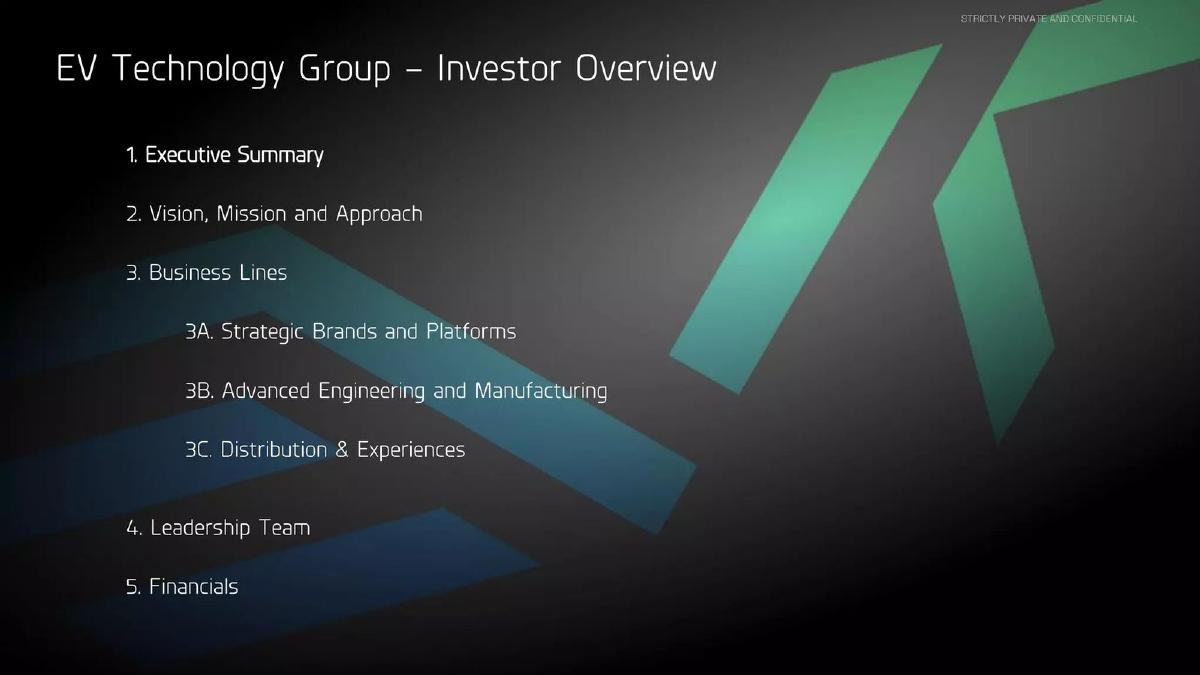
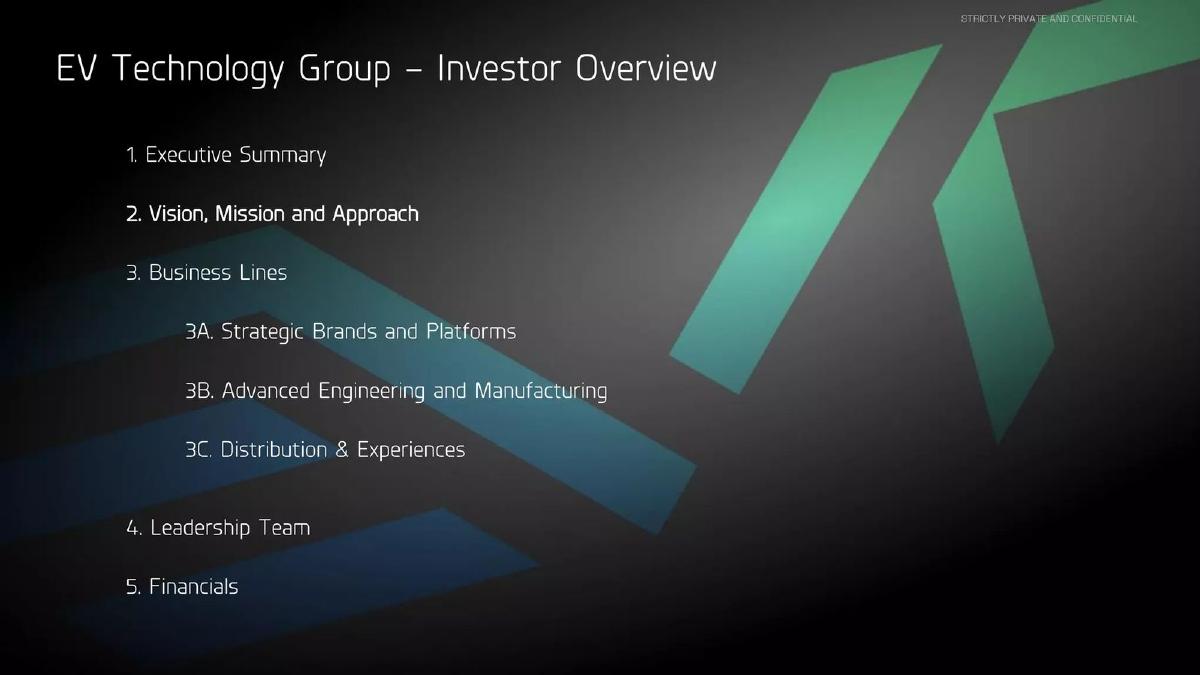
The agenda is structured into five main sections: Executive Summary; Vision, Mission and Approach; Business Lines (divided into Strategic Brands, Engineering/Manufacturing, and Distribution); Leadership Team; and Financials. This structure indicates a comprehensive deck intended for serious due diligence rather than a quick teaser.
Slide 11: Leadership Spotlight - Richard Westley
This slide highlights Richard Westley, the Group COO and CEO of Fablink Group. It emphasizes his 20 years of experience in automotive manufacturing and his track record in Mergers & Acquisitions. The slide lists major OEM relationships including JLR, CAT, JCB, Morgan, Lotus, and Volvo. This is a critical credibility slide, as it anchors the company’s manufacturing claims in a leader with a proven industrial background.
Slide 16: Market Context and Inflection Point
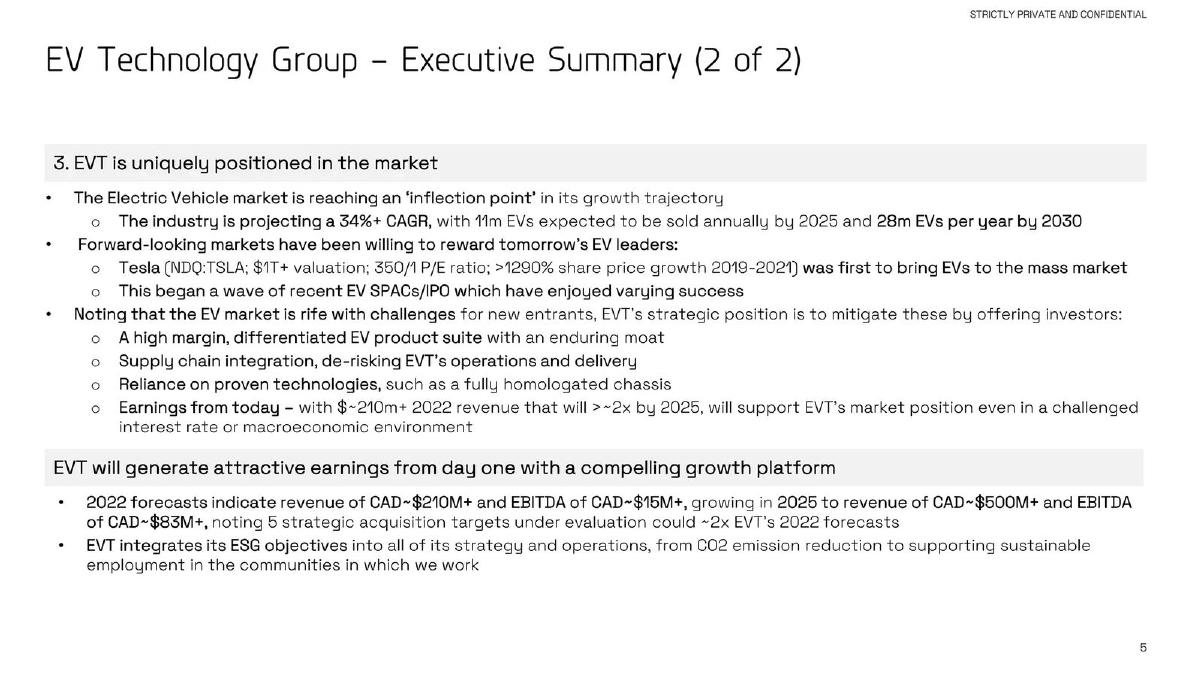
The company uses external data from the Financial Times and Companiesmarketcap.com to illustrate the EV 'inflection point.' It shows a global EV sales forecast growing from 3m units in 2020 to 28m units by 2030, an 833% increase. A second chart compares market caps, noting that 4 of the top 8 auto players are EV specialists (Tesla, BYD, Rivian, Lucid). This slide justifies the timing of the investment but does not yet address the company's specific niche.
Slide 21: Corporate Structure and Business Lines
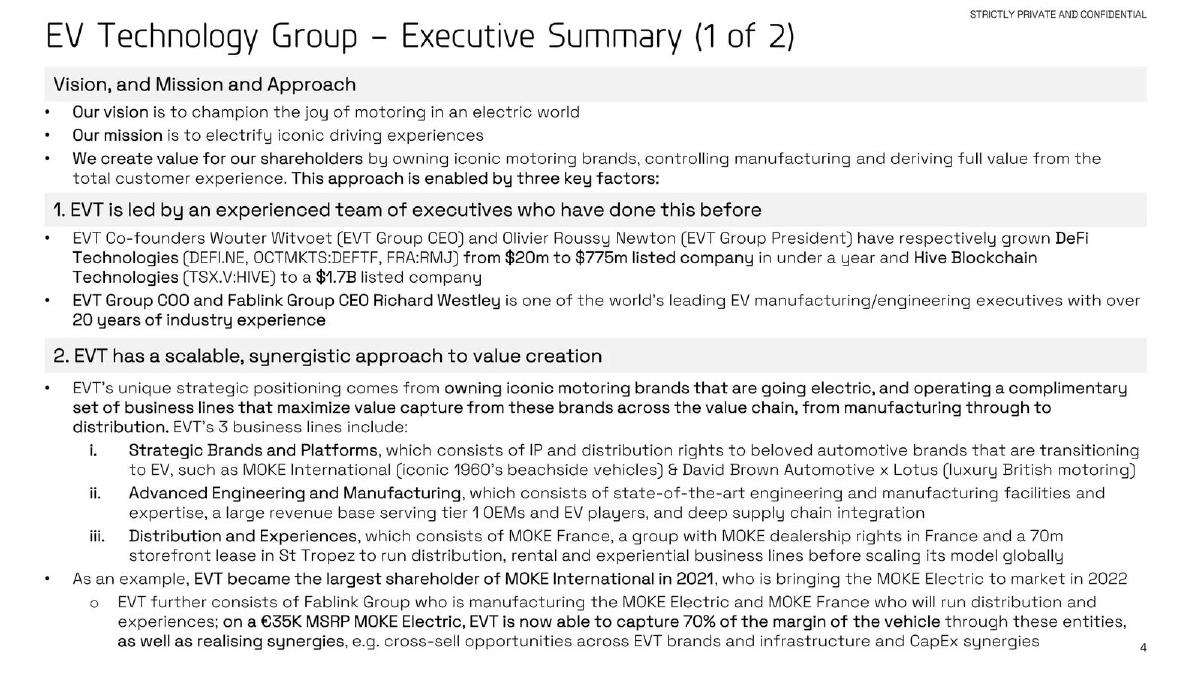
This is the most important slide for understanding the group's mechanics. It details three pillars: A. Strategic Brands and Platforms (MOKE International at ±21% stake, David Brown Automotive at 100% via LOI); B. Advanced Engineering and Manufacturing (Fablink Group at 100% via LOI); and C. Distribution and Experiences (MOKE France at 100%). It reveals a 'buy-and-build' strategy, mentioning active conversations with 5+ additional brands. The inclusion of Fablink’s 500,000 sq. ft. footprint and 700 staff provides the physical scale necessary to support these brands.
Slide 24: The 2022 MOKE Electric
This slide focuses on the first major product launch. The MOKE Electric is priced at ±£29,150 GBP ($40,000 USD). Key metrics include a target of 95% sustainable materials and a 75% reduction in CO2 footprint. The slide claims ±800 units will be sold in 2022, with over half already pre-ordered. Technical specs are provided: 144km range, 100 km/h top speed, and a 4-hour charge time. This positions the vehicle as a lifestyle/resort car rather than a primary commuter vehicle.
Slide 31: David Brown Automotive (DBA) x Lotus
The deck outlines a partnership with Lotus Engineering to develop an EV GT. By using the 'proven Evora platform,' the company saves time on homologation across three continents. The slide provides specific unit economics: Bill of Materials (BOM) costs are estimated at <£150K with a sales price of >£350K. This high-margin profile is intended to contrast with the lower-priced MOKE, showing the group's range across the luxury spectrum. A prototype is promised for late 2022 with production in Q1 2024.
Slide 38: Distribution and Experiences
This transition slide features lifestyle photography of a MOKE vehicle in a resort setting. It reinforces the 'Experiences' aspect of the business model, which includes premium sales, rentals, and 'sporting groups.' It signals that the company is selling a lifestyle, not just a hardware product.
Slide 43: Leadership Team (1 of 2)
The executive team is presented with a mix of finance and industry backgrounds. Wouter Witvoet (CEO) and Olivier Roussy Newton (President) are highlighted for their roles at DeFi Technologies and HIVE Blockchain, noting they have raised over $800m. Richard Westley (COO) brings the manufacturing weight, and Will Harris (CMO) brings marketing experience from Battersea Power Station and Karhoo. The team profile suggests a heavy emphasis on capital markets and brand positioning.
Slide 46: Financial Forecasts (2022-2025)
The final slide in this set presents aggressive growth projections in CAD. Total revenue is forecasted to grow from $430m in 2022 to $841m in 2025. However, a significant portion of this (represented by dark grey bars) is labeled as 'Incremental EBITDA / Revenue from potential acquisition targets.' For 2025, $333m of the $841m revenue is expected to come from companies they have not yet acquired. This highlights the 'roll-up' nature of the investment opportunity.
What EV Technology Group Does Well
The deck excels at explaining a complex multi-entity structure. By categorizing the business into 'Brands,' 'Engineering,' and 'Distribution,' the founders make a complicated M&A strategy digestible. The use of a 'proven platform' strategy (the Lotus Evora chassis) is a brilliant way to de-risk the technical and regulatory hurdles of car manufacturing, which usually scare off investors. Furthermore, the deck provides specific, hard figures for BOM costs and sales prices, which demonstrates a level of operational planning often missing in early-stage EV pitches. The inclusion of Fablink’s existing scale (700 staff) provides an immediate answer to the 'how will you build it?' question.
What is Missing from the Deck
The most glaring omission in these slides is the 'Ask.' While the financials show a need for significant capital to fuel acquisitions, the specific amount being raised and the valuation are not present in this selection. Additionally, while the deck mentions 'pre-orders' for the MOKE, it does not detail the cash-collection status of those orders (e.g., are they refundable deposits or binding contracts?). There is also a lack of detail regarding the competitive landscape for niche EVs. While they compare themselves to Tesla and Rivian on a market-cap basis, they do not address other boutique EV converters or luxury electric brands like Lucid or Polestar in a head-to-head product comparison. Finally, the 'Unit Economics' slide for the MOKE is missing, leaving investors to guess at the margins for their highest-volume product.
Founder Takeaways: What to Copy
The 'Platform' Strategy: If you are building hardware, show how you are using existing, homologated components to save time and money. The Lotus partnership slide (Slide 31) is a masterclass in de-risking. · Visualizing the Roll-up: If your strategy involves multiple acquisitions, use a structure similar to Slide 21. It clearly shows what is owned, what is under LOI, and what the future pipeline looks like. · Industrial Credibility: Don't just show designers; show the factory. Mentioning the square footage and headcount of the manufacturing facilities (Slide 21) gives the project a sense of 'inevitability' that software-only teams lack. · Clear Financial Segmentation: Distinguishing between 'existing' revenue and 'acquisition-dependent' revenue (Slide 46) is honest and helps investors understand the specific risks associated with your growth targets.
Frequently asked questions
- What is EV Technology Group's core business model?
- EV Technology Group functions as a brand holding company and integrated manufacturer. They acquire 'iconic' vehicle brands that command premium prices and transition them to electric powertrains. By owning the manufacturing entity (Fablink), they capture margins across the entire value chain, from engineering and assembly to retail distribution and lifestyle experiences.
- How does the company plan to achieve its 2022 revenue targets?
- The 2022 revenue target of $430m CAD is primarily supported by the launch of the MOKE Electric and the existing operations of Fablink Group. The deck notes that ±800 MOKE units are slated for sale in 2022, with more than 50% already pre-ordered at a price point of approximately $40,000 USD per vehicle.
- What role does Fablink Group play in the overall strategy?
- Fablink is the industrial engine of the group. As a leading UK-based engineering firm with 6 sites and a global customer base including JLR and Lotus, it provides the 'Advanced Engineering and Manufacturing' pillar. This allows EV Technology Group to insource production for its acquired brands, reducing third-party manufacturing risks and costs.
- What is the significance of the Lotus Engineering partnership?
- The partnership allows David Brown Automotive (a group brand) to utilize the 'proven Evora platform/chassis' for a new EV GT. This strategy saves significant time and resources on homologation in Europe, North America, and Asia. It moves the company into the ultra-luxury segment with a projected sales price of over £350,000.
- Is the company focused on organic growth or acquisitions?
- The strategy is heavily weighted toward acquisitions. Slide 46 explicitly shows that a majority of the projected revenue and EBITDA growth through 2025 is expected to come from 'incremental' sources—specifically five potential acquisition targets currently under evaluation, rather than just the growth of existing business lines.