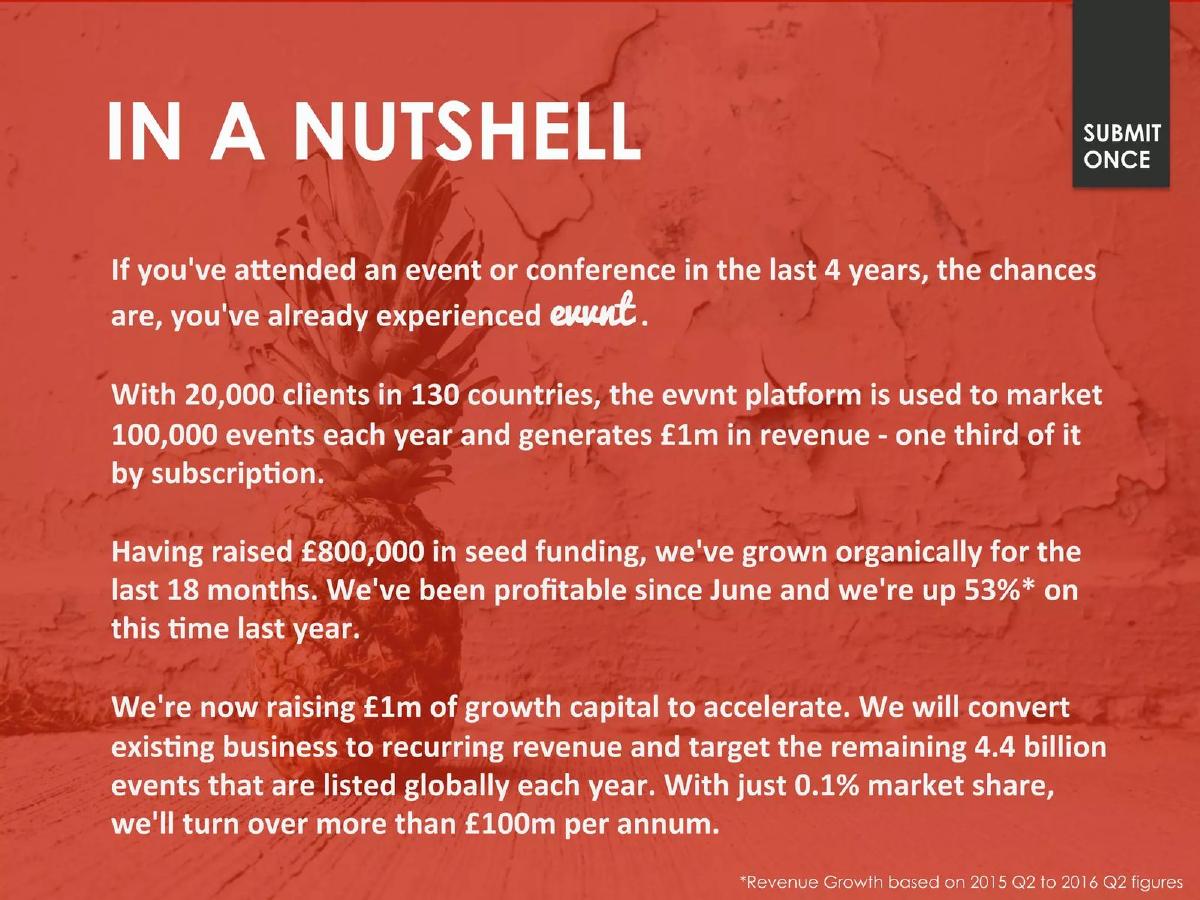
Evvnt’s 2016/17 investment deck is a growth-stage presentation seeking £1M ($1.3M) to scale an established event marketing platform. Unlike many early-stage decks, Evvnt leads with strong financial health, claiming profitability and 89% margins on software. The core value proposition centers on a 'Submit Once' technology that distributes event listings across a global network of 6,000 media partners and 30 strategic resellers. With a reported 20,000 customers and operations in 130 countries, the deck aims to transition the company from a successful niche tool into a £100m+ media entity. While…
Key takeaways
- The company sought a £1M ($1.3M) investment for the 2016/17 period as stated on Slide 1.
- Evvnt claimed to be profitable with a forecast of £1M ($1.3M) in revenue for 2016 on Slide 4.
- The platform boasts high efficiency with an 89% margin on software and 53% quarter-on-quarter revenue growth (Slide 4).
- The business model relies on a 'Submit Once' mechanism to distribute listings to 6,000 media partners (Slide 6).
- Traction is demonstrated by 20,000 customers and 2 million event listings created since founding in 2012 (Slide 6).
- The company previously raised £800k in seed investment and received an Innovate UK government grant (Slide 6).
- The exit strategy targets a £100m+ valuation within 4 years, projecting £13m in revenue by 2020 (Slide 8).
- The team is supported by high-profile advisors from Live Nation, Facebook, and 7Digital (Slide 9).
Executive Summary: The 'Submit Once' Value Proposition
The Evvnt investment deck from 2016/17 is a masterclass in presenting a 'boring' but highly profitable utility. By 2016, the company had already moved past the speculative phase, reporting profitability and a massive network of partners. The deck’s primary goal is to convince investors that a £1M injection will act as fuel for an already efficient engine, aiming for a 100x return on valuation within four years.
Slide 1: Title and The Ask
The cover slide is direct. It identifies the company as evvnt and sets the stage with the tagline: "Invest in the future of successful event marketing." Crucially, it puts the fundraising target front and center: GBP £1M ($1.3M) for the 2016/17 period. Using a high-energy, lifestyle-oriented background image, it attempts to humanize what is essentially a technical distribution platform.
Slide 2: Mission and Category
Slide 2 defines the mission: "To help people promote and find events." It explicitly categorizes the company within Marketing Technology - MarTech . The 'Submit Once' branding appears in the top right corner, a motif that repeats throughout the deck to reinforce the core product benefit: simplicity through automation.
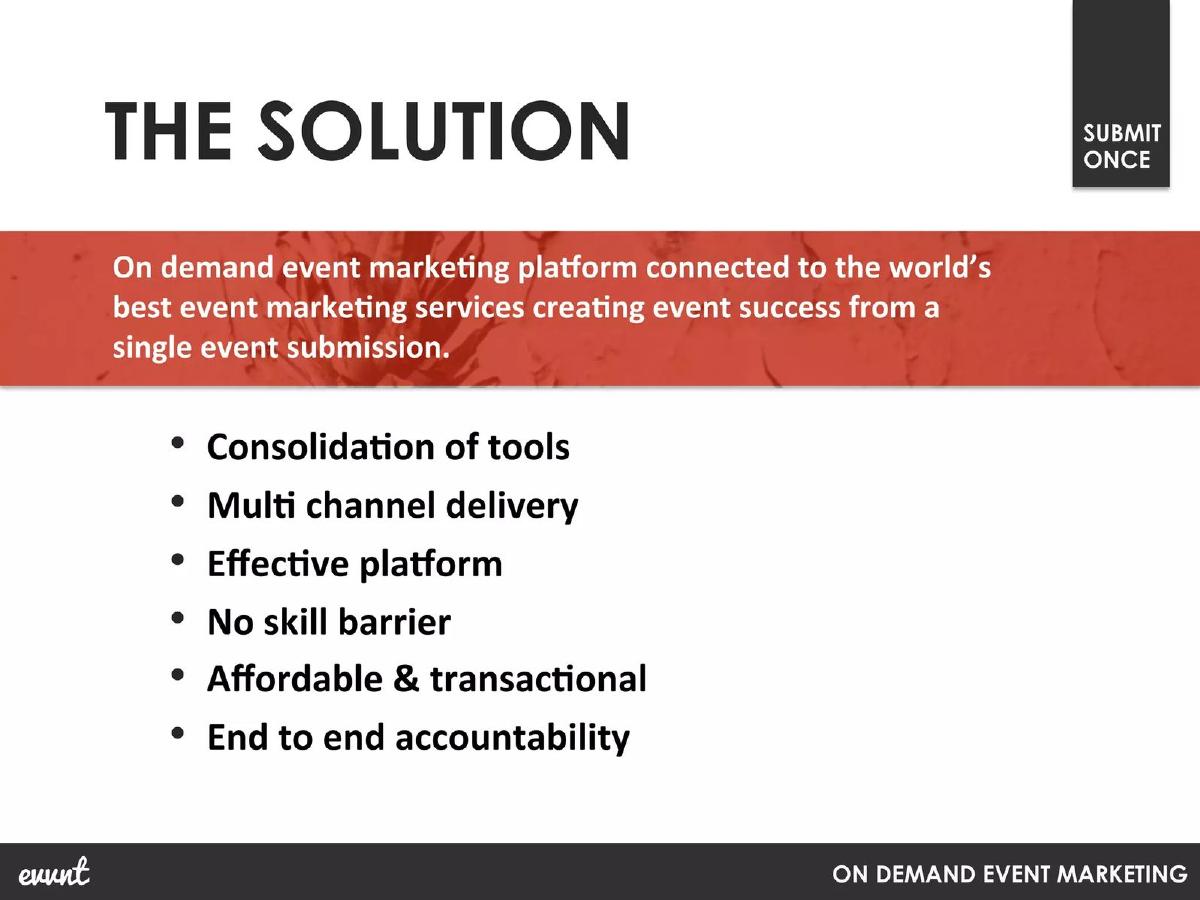
Slide 3: The Solution
The solution is described as an "On demand event marketing platform connected to the world’s best event marketing services." The slide lists six key benefits:
Consolidation of tools · Multi channel delivery · Effective platform · No skill barrier · Affordable & transactional · End to end accountability
This slide focuses on the user experience, emphasizing that the platform removes the technical and time-intensive barriers to event promotion.
Slide 4: Traction and Financial Health
This is arguably the strongest slide in the deck. It claims the company is profitable with a £1M ($1.3M) revenue forecast for 2016 . Key metrics include:
13 full-time staff members. · 89% margin on software. · 53% revenue growth quarter on quarter.
Two charts show cumulative sign-ups reaching over 20,000 by Q3-16 and quarterly revenues showing a steady upward trend, despite a slight dip in the final reported quarter (Q3-16). The inclusion of a trend line in the revenue chart suggests a trajectory toward £250,000 per quarter.
Slide 5: Social Proof
A single-quote testimonial slide features James Wight, Global Marketing Director at UBM. He states that Evvnt was the "number one choice for creating buzz" and saved "time, human resource and also gave us the results we needed quickly." Using a director from a major global events company like UBM provides significant enterprise-level validation.
Slide 6: Business Growth and Ecosystem
This slide provides a historical timeline and a snapshot of the current ecosystem. Founded on April 1st, 2012, the company had already:
Raised £800k in seed investment. · Acquired three companies. · Won an Innovate UK government grant.
The metrics listed are impressive: 20,000 customers , 60,000 event listing submissions, and 6,000 media partners . The right side of the slide displays logos of strategic partners, including TimeOut, Eventbrite, and Web.com , illustrating the breadth of their distribution network.
Slide 7: Investor Profile
Slide 7 details the existing cap table and investor pedigree. It mentions 2 institutional investors and 30 private investors. The list of individual backers includes former Managing Directors from Goldman Sachs, Royal Bank of Scotland, Morgan Stanley, and JP Morgan . This slide is designed to build trust; if high-level finance executives have already put money in, the 'smart money' signal is strong.
Slide 8: Timeline & Exit Strategy
2017: Double the sales team and launch publisher tools. · 2018: Geographical diversification and two new services. · 2019: 1 million event submissions and £6m ($7.3m) in revenue. · 2020: Projected £13m ($15.8m) in revenue.
The footer of the slide contains the 'big hairy audacious goal': "£1 million investment to create a £100m+ events media & marketing company in 4 years."
Slide 9: The Team and Advisors
The final slide in the provided set shows the organizational structure. It is divided into Management (MGTS), Tech, and Advisors. The management team is led by Richard Green. The tech team consists of five members, including a CTO and Technology Lead. The Advisor section is particularly strong, featuring Lee McCabe (Former Facebook) and Tim Chambers (Former Live Nation), which suggests the company has the right industry connections to scale its partner network.
What Works in This Deck
Profitability as a Hook: Most startups pitch on a 'burn to grow' model. Evvnt’s claim of profitability and 89% software margins makes the investment feel like a lower-risk opportunity for scaling rather than a gamble on product-market fit.
Network Effects: By citing 6,000 media partners, Evvnt demonstrates a significant moat. Building those integrations and relationships is a massive barrier to entry for new competitors.
Clear Value Prop: The 'Submit Once' branding is effective. It distills a complex technical process (API integrations and web scraping/posting) into a simple, three-word benefit for the customer.
What Is Missing
Unit Economics: While the deck mentions high margins, it does not show Customer Acquisition Cost (CAC) or Lifetime Value (LTV). For a 'transactional' business, understanding the cost to acquire a single event submission is vital.
Competitive Analysis: The deck assumes the reader understands why Evvnt is better than manual posting or using a PR agency. A slide comparing their speed and cost to traditional methods would have strengthened the 'Solution' section.
Use of Funds: While the ask is £1M, the deck only vaguely mentions 'doubling the sales team.' A more granular breakdown of how that £1M would be allocated (e.g., % to R&D, % to Marketing, % to Ops) is missing from these slides.
Founder Takeaways
Lead with Traction: If you have revenue and margins like Evvnt, don't bury them. Slide 4 is the heart of this deck because it proves the business works.
Leverage Your Advisors: If you have advisors from Tier-1 companies (Facebook, Live Nation), give them their own space. It lends immediate credibility to a small team.
Simplify the Message: Even if your backend is a complex web of 6,000 integrations, your customer-facing message should be as simple as 'Submit Once.'
Frequently asked questions
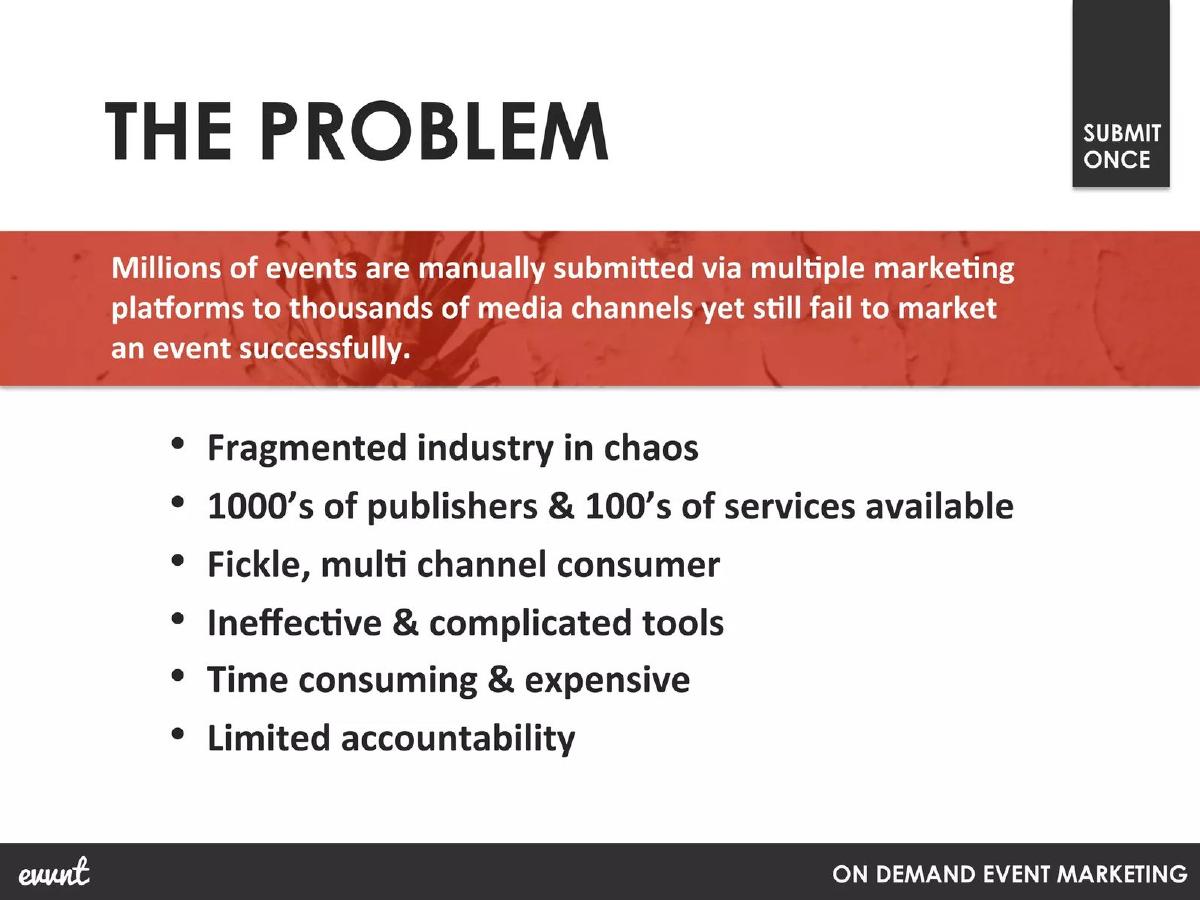
- What is the primary problem Evvnt solves?
- Evvnt addresses the inefficiency of manual event promotion. According to Slide 3, their solution is an 'on-demand event marketing platform' that allows users to submit event details once and have them distributed across multiple channels. This eliminates the 'skill barrier' and provides 'consolidation of tools' for event organizers who otherwise have to post to dozens of sites individually.
- How does Evvnt generate revenue?
- While the deck doesn't explicitly list a pricing table, Slide 3 describes the service as 'affordable & transactional,' suggesting a pay-per-submission or subscription model. Slide 4 highlights an '89% margin on software,' which indicates a highly scalable SaaS or automated platform model where the cost of distributing additional listings is marginal.
- What does the competitive landscape look like for Evvnt?
- The provided slides do not include a dedicated competitor matrix. However, Slide 6 lists Eventbrite and TimeOut as 'Strategic Partners.' This suggests that rather than competing directly with ticketing platforms or local guides, Evvnt positions itself as a distribution layer that feeds content into those established ecosystems.
- Is the company currently profitable?
- According to Slide 4, the company stated it was profitable at the time of the 2016/17 raise. It reported a revenue forecast of £1M for 2016 and a 53% quarter-on-quarter growth rate. This is a significant signal for investors, as it suggests the £1M ask is for accelerating growth rather than covering operational losses.
- Who are the key people behind Evvnt?
- The management team is led by CEO & Founder Richard Green and CFO Sacha Sebbah. The deck also emphasizes a strong technical team of five and a robust advisor board featuring former executives from major corporations like Live Nation (Tim Chambers) and Facebook (Lee McCabe), as shown on Slide 9.