How problem slides change from pre-seed to Series B: from the customer's pain to the cost, the market it holds back, and the trend making it worse.
Problem Slides by Stage: Real Pre-Seed to Series B Examples
Eight problem slides from pre-seed, seed, Series A and Series B decks, shown in full. Early slides describe what one customer can't do; later slides add who pays for the problem, how big it is and why it is getting worse.
TL;DR
At every stage the problem slide names one customer and what they can't do. What changes is the evidence around it. Pre-seed slides describe the pain in the customer's terms: Smarthost's "Hosts guess at pricing" with three things hosts "can't" do. Seed slides add proof from users: inDinero's "90% of our users have never tried using QuickBooks". Series A slides show the problem across a whole market: Sylvera lists what each of four groups lacks in "a market worth $50B by 2030". Series B slides show the problem is growing and the alternatives fail: Incredible Health's "1 million nurses short by 2024" and "82 days" to hire, with sources; PlayPlay's "only two bad options".
Problem slides from pre-seed, seed, Series A and Series B decks
Each example shows the exact stored slide above its analysis and links to the full teardown. Pre-seed first, then seed, Series A and Series B. Claims are as shown on the slides; we have not verified them.
Smarthost problem slide — slide 5
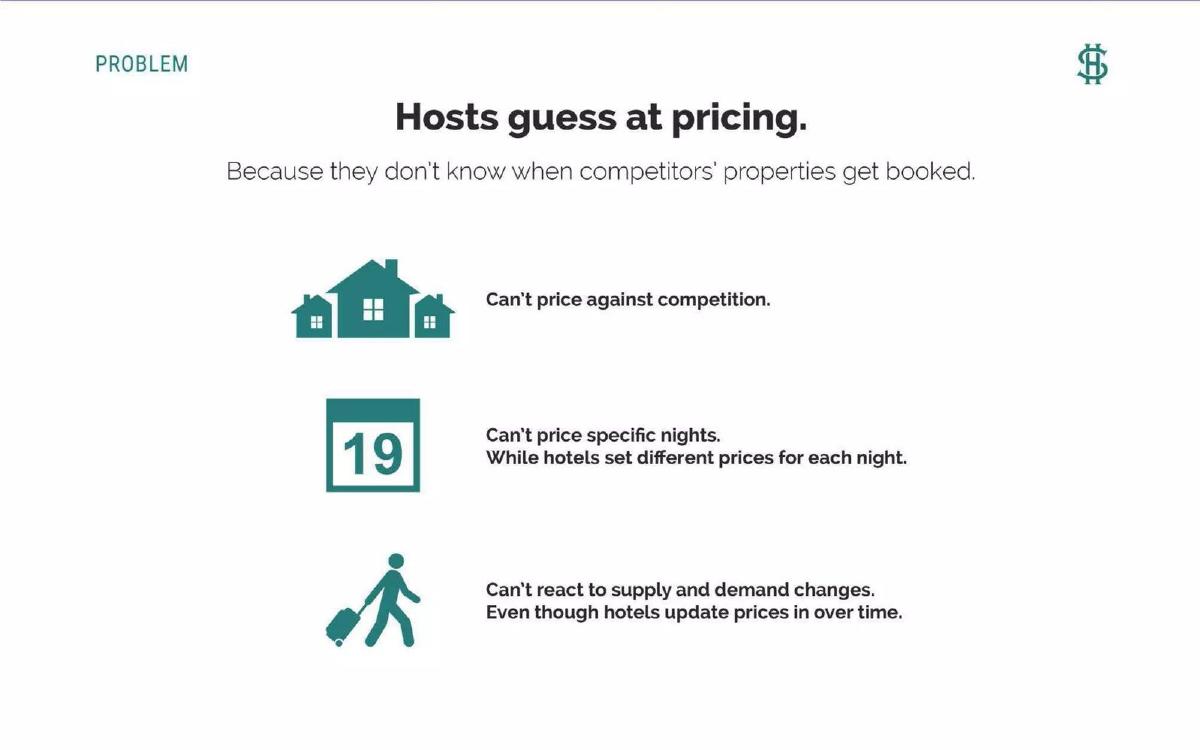
Pre-seed. Pricing for short-term rental hosts. Headline plus three icon rows.
Smarthost deck, slide 5. Exact stored slide matched to this analysis.
Our analysis: A clear pre-seed problem: one customer, one cause, three consequences.
Evidence and limitation: No figures; three specific things hosts can't do, compared with hotels.
What a founder can adapt: Write your problem as what the customer can't do, and name who already can.
Supporting analysis
What the deck claims: "Hosts guess at pricing. Because they don't know when competitors' properties get booked." "Can't price against competition." "Can't price specific nights. While hotels set different prices for each night." "Can't react to supply and demand changes."
Presentation choice: The hotel comparison shows the better way already exists elsewhere, so the gap is believable.
When it does not fit: Leaving out the cost; one line on revenue lost per night would make it stronger.
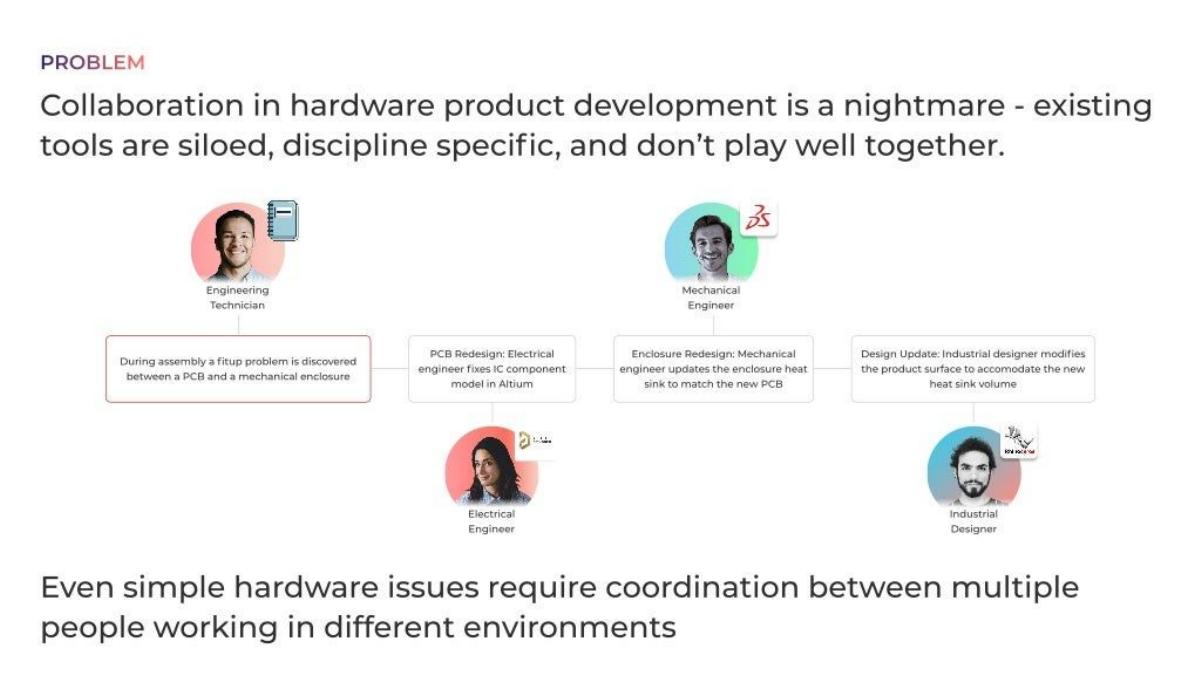
Pre-seed ($1.2M round). Collaboration software for hardware teams. Workflow diagram.
Five Flute deck, slide 4. Exact stored slide matched to this analysis.
Our analysis: Shows the problem instead of asserting it; the chain of handoffs is the argument.
Evidence and limitation: One worked example of a single issue moving through four roles.
What a founder can adapt: Trace one real incident through the people it touches.
Supporting analysis
What the deck claims: "Collaboration in hardware product development is a nightmare - existing tools are siloed, discipline specific, and don't play well together." A fit-up problem passes between an engineering technician, electrical engineer, mechanical engineer and industrial designer. "Even simple hardware issues require coordination between multiple people working in different environments."
Presentation choice: An investor who has never built hardware can follow one issue through four people.
When it does not fit: No sense of how often this happens or what a delay costs.
Seed. Finance software for small businesses. Three statements plus user posts.
inDinero deck, slide 2. Exact stored slide matched to this analysis.
Our analysis: The seed step up: the problem is backed by the company's own users, not only observation.
Evidence and limitation: A figure from its own users and three customer quotes.
What a founder can adapt: Add one figure from your users and one quote in their words.
Supporting analysis
What the deck claims: "Business owners don't do accounting. 90% of our users have never tried using QuickBooks before." "Business owners don't plan their finances." "No automated solution to tracking finances. QuickBooks + Excel are still manual ways to record transactions." Three public user posts complaining about QuickBooks.
Presentation choice: "90% of our users" shows inDinero reaches people the incumbent never did.
When it does not fit: Three headlines compete; lead with the one your product solves first.
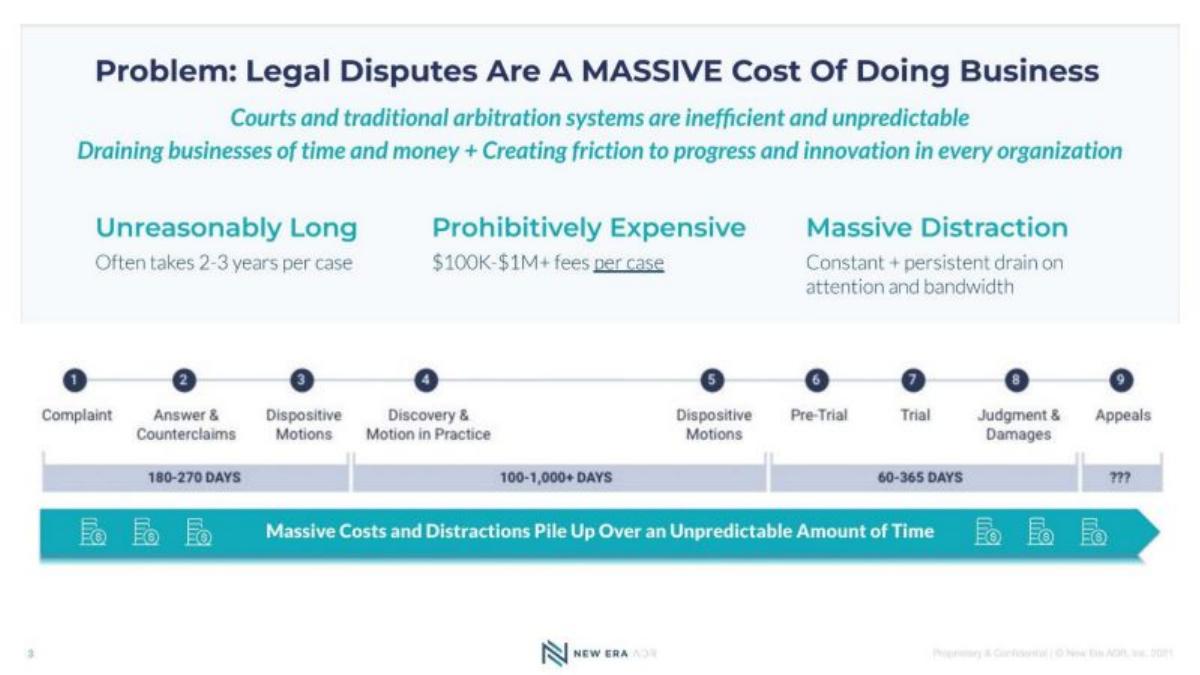
Seed. Online dispute resolution. Three cost headings above a litigation timeline.
New Era ADR deck, slide 3. Exact stored slide matched to this analysis.
Our analysis: Puts a price and a duration on the problem, then shows where the time goes.
Evidence and limitation: Time and cost per case, and the process that causes them.
What a founder can adapt: Show the current process step by step with time or cost on each step.
Supporting analysis
What the deck claims: "Problem: Legal Disputes Are A MASSIVE Cost Of Doing Business." "Unreasonably Long: Often takes 2-3 years per case." "Prohibitively Expensive: $100K-$1M+ fees per case." "Massive Distraction." Nine stages from complaint to appeals, with day ranges ("180-270 DAYS", "100-1,000+ DAYS", "60-365 DAYS").
Presentation choice: The timeline lets a buyer see which stages the product removes.
When it does not fit: Ranges with no source; say where the fee and day figures come from.
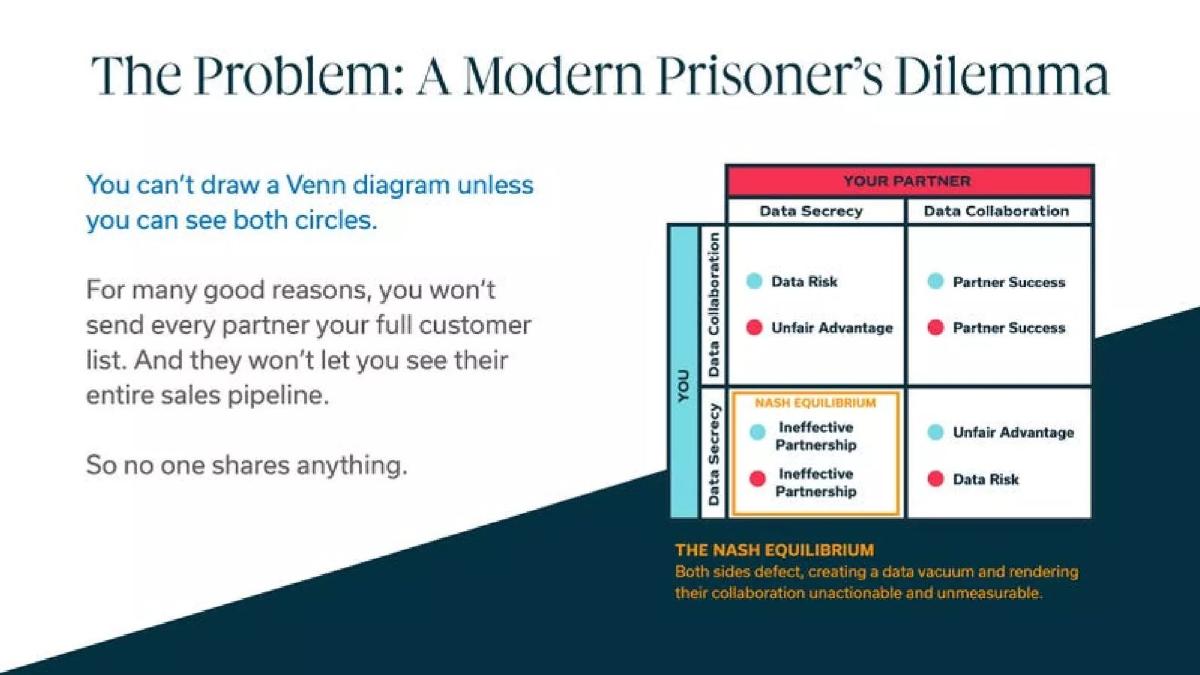
Series A. Data sharing between partner companies. Text plus a 2x2 payoff grid.
Crossbeam deck, slide 3. Exact stored slide matched to this analysis.
Our analysis: Explains why the problem persists between two companies, not just that it hurts one.
Evidence and limitation: A structural argument; no figures.
What a founder can adapt: If your problem comes from incentives, draw the incentives.
Supporting analysis
What the deck claims: "The Problem: A Modern Prisoner's Dilemma." "You can't draw a Venn diagram unless you can see both circles." "You won't send every partner your full customer list. And they won't let you see their entire sales pipeline. So no one shares anything." Grid of "Data Secrecy" and "Data Collaboration" for you and your partner, with the "Nash Equilibrium": "Ineffective Partnership".
Presentation choice: Showing both sides defect explains why no one has fixed it, which sets up a neutral third party.
When it does not fit: No size; a Series A slide can add how many partnerships or how much pipeline is at stake.
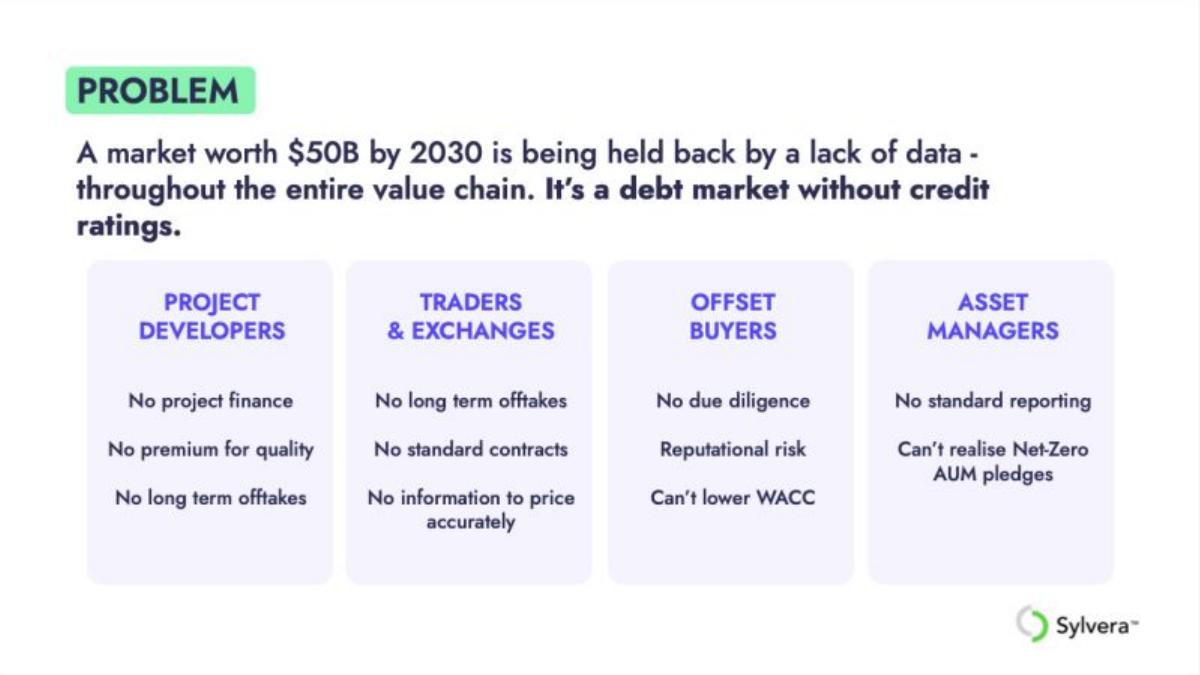
Series A. Carbon credit ratings. Four columns, one per market participant.
Sylvera deck, slide 3. Exact stored slide matched to this analysis.
Our analysis: The Series A move: one missing input (data) blocks every participant.
Evidence and limitation: A market-size claim and specific gaps for four groups.
What a founder can adapt: List who carries the problem and what each group can't do.
Supporting analysis
What the deck claims: "A market worth $50B by 2030 is being held back by a lack of data - throughout the entire value chain. It's a debt market without credit ratings." Project developers: "No project finance", "No premium for quality". Traders & exchanges: "No standard contracts", "No information to price accurately". Offset buyers: "No due diligence", "Reputational risk". Asset managers: "No standard reporting".
Presentation choice: "A debt market without credit ratings" gives investors a familiar analogy in seven words.
When it does not fit: The $50B figure has no source on the slide.
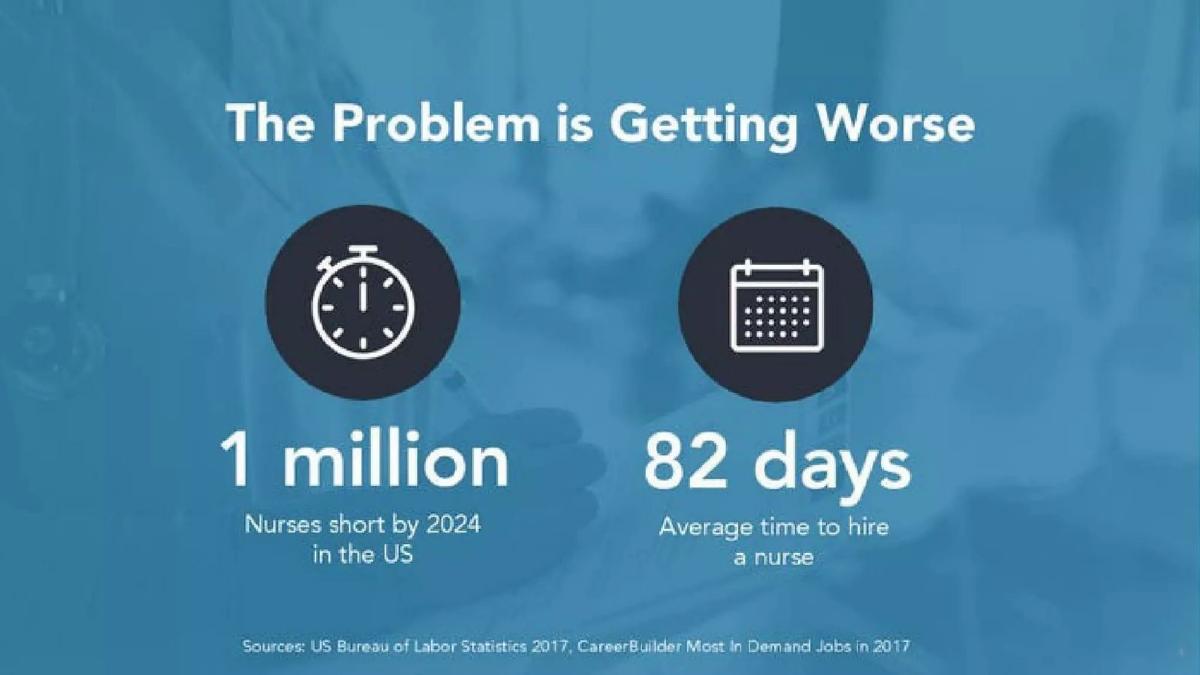
Series B. Nurse hiring marketplace. Two large figures.
Incredible Health deck, slide 4. Exact stored slide matched to this analysis.
Our analysis: Growth-stage framing: the problem is getting bigger and the numbers are sourced.
Evidence and limitation: Two sourced figures: size of the shortage and time to hire.
What a founder can adapt: Pick two numbers, one for size and one for cost, and cite both.
Supporting analysis
What the deck claims: "The Problem is Getting Worse." "1 million: Nurses short by 2024 in the US." "82 days: Average time to hire a nurse." "Sources: US Bureau of Labor Statistics 2017, CareerBuilder Most In Demand Jobs in 2017."
Presentation choice: Trend plus source is what later-stage investors check first.
When it does not fit: "Getting worse" needs a trend; a second year of data would prove it.
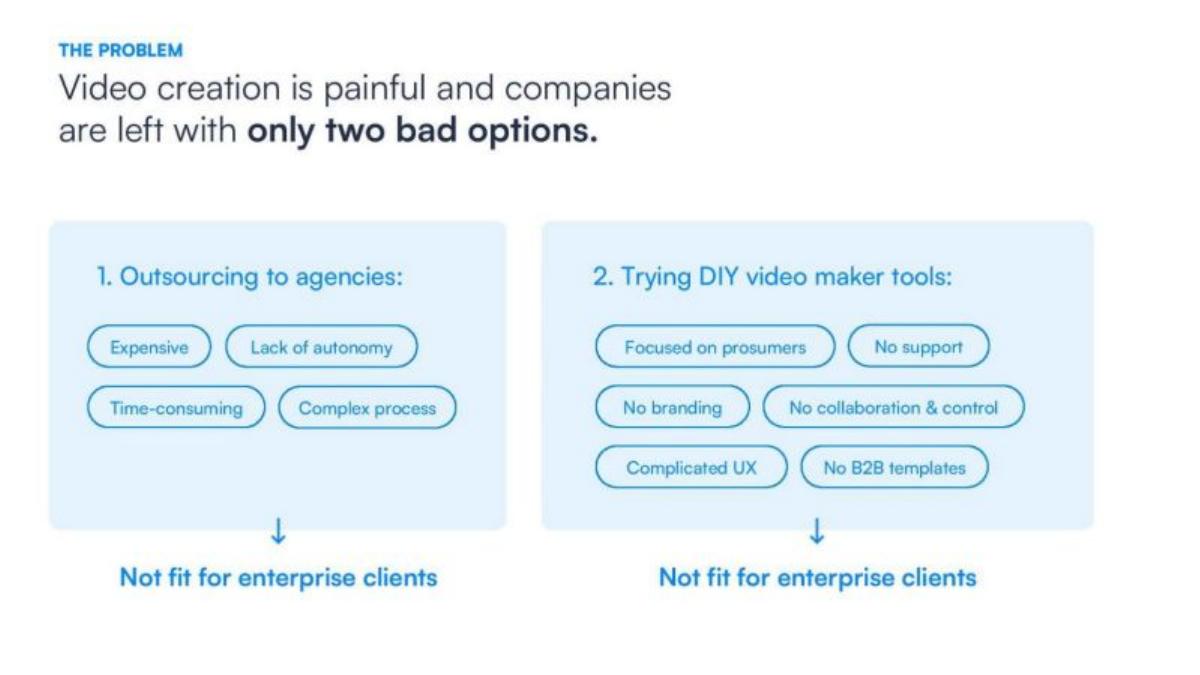
Series B. Video creation for companies. Two option boxes.
PlayPlay deck, slide 4. Exact stored slide matched to this analysis.
Our analysis: Frames the problem as the failure of today's alternatives for one buyer (enterprise).
Evidence and limitation: The weaknesses of each current option; no figures.
What a founder can adapt: List the ways customers solve it today and where each falls short for your buyer.
Supporting analysis
What the deck claims: "Video creation is painful and companies are left with only two bad options." "1. Outsourcing to agencies": "Expensive", "Lack of autonomy", "Time-consuming", "Complex process". "2. Trying DIY video maker tools": "Focused on prosumers", "No support", "No branding", "No collaboration & control", "Complicated UX", "No B2B templates". Both: "Not fit for enterprise clients".
Presentation choice: Naming both options answers "why not use an agency?" before it is asked.
When it does not fit: At Series B, one figure on spend or time per video would carry more weight than eight tags.
Stage, how the problem is framed, the evidence on the slide, and whether a source is given.
Example
Stage
Framing
Evidence
Sourced
Smarthost
Pre-seed
What hosts can't do
Comparison with hotels
No
Five Flute
Pre-seed
One issue through four roles
Worked example
No
inDinero
Seed
Owner behaviour
Own-user figure + quotes
Own data
New Era ADR
Seed
Cost of a dispute
Time, fees, timeline
No
Crossbeam
Series A
Incentives between partners
Payoff grid
No
Sylvera
Series A
Gap across a market
Four groups + market size
No
Incredible Health
Series B
Growing shortage
Two figures
Yes
PlayPlay
Series B
Current options fail
Weaknesses of two options
No
Key Takeaways
Name one customer and what they can't do, at any stage.
Pre-seed: describe the pain in the customer's own words.
Seed: add evidence from your own users.
Series A: show who else in the market carries the problem.
Series B: show the problem growing and the current options failing, with sources.
Build your problem slide for your stage
Start with the customer, then add the evidence your stage allows.
Customer. Who has the problem, in one noun (hosts, hospitals, finance teams).
Can't do. What they can't do today, in their words.
Cost. Time, money or risk per case, per month or per year.
Evidence. Pre-seed: an example. Seed: a user figure. Series A+: market scope, trend and sources.
Copyable framework: [Customer] can't [action] because [cause]. It costs them [cost]. [Evidence for your stage].
Illustrative example 1 — written by us
Before: Video creation is painful and companies are left with only two bad options.
After: Enterprise marketing teams can't make on-brand video in-house: agencies take weeks, and DIY tools lack branding and approval. [Add your figure on spend or time per video].
What improved: Our illustrative rewrite; not PlayPlay's wording. It names the buyer and leaves a marked place for a real figure.
What this guide adds
The library already covers problem slides in general and by industry. This guide compares them across funding stages, following the stage guides for traction and competition.
Stage labels come from the stage recorded for each published teardown, all high confidence: two pre-seed, two seed, two Series A, two Series B. None of these eight decks appears in another guide.
What changes with stage, and what doesn't
Every good example here names a specific customer (hosts, hardware engineers, business owners, partner teams, hospitals, companies making video). That doesn't change with stage.
The evidence does. Pre-seed decks have observation (Smarthost, Five Flute). Seed decks can quote users or their own data (inDinero). Series A decks describe the market structure the problem sits in (Crossbeam, Sylvera). Series B decks put numbers and sources on the size and trend (Incredible Health) or show why the existing options fail (PlayPlay).
Big market numbers alone don't make a problem. New Era ADR's "$100K-$1M+ fees per case" works because it is tied to a timeline a buyer recognises.
Common mistakes
No customer named. Say who has the problem.
Market size instead of pain. A big number isn't a problem; say what hurts.
Figures with no source. Cite them, especially after seed.
Too many problems. Lead with the one your product fixes first.
Ignoring today's options. Say why current alternatives fail.
Diagnostic checklist
One named customer.
What they can't do, in their words.
A cost in time, money or risk.
Evidence that fits your stage.
Sources for any figures.
Frequently asked questions
How we chose these examples
Corpus: published pitch deck teardowns on StartupFundraising.com. Founder-uploaded private decks are excluded.
Selection (2026-09-25): we took teardowns whose recorded stage is pre-seed, seed, Series A or Series B with high confidence, found slides whose text begins with Problem, excluded any deck already used in another guide, and kept only slides with a stored image. From the remaining candidates we chose two per stage with readable, specific content.
Stage is the round recorded for each teardown, not a judgment about the company today.
Review: all eight stored slide images were inspected on 2026-09-25 and matched to company, deck and slide number (editorial model review). No person has yet completed an editorial review of this page.
Claims are as shown on the slides; we have not verified them. We make no claim that any slide caused a fundraising outcome.