How competition slides look in pre-seed, Series A and Series B decks: logo lists, 2x2 maps and category comparisons.
Competition Slides by Stage: Real Pre-Seed to Series B Examples
Seven competition slides from pre-seed, Series A and Series B decks, shown in full. They show that the format (list, 2x2 map, category comparison) matters more than the stage, and what a later-stage slide can add that an early one cannot.
TL;DR
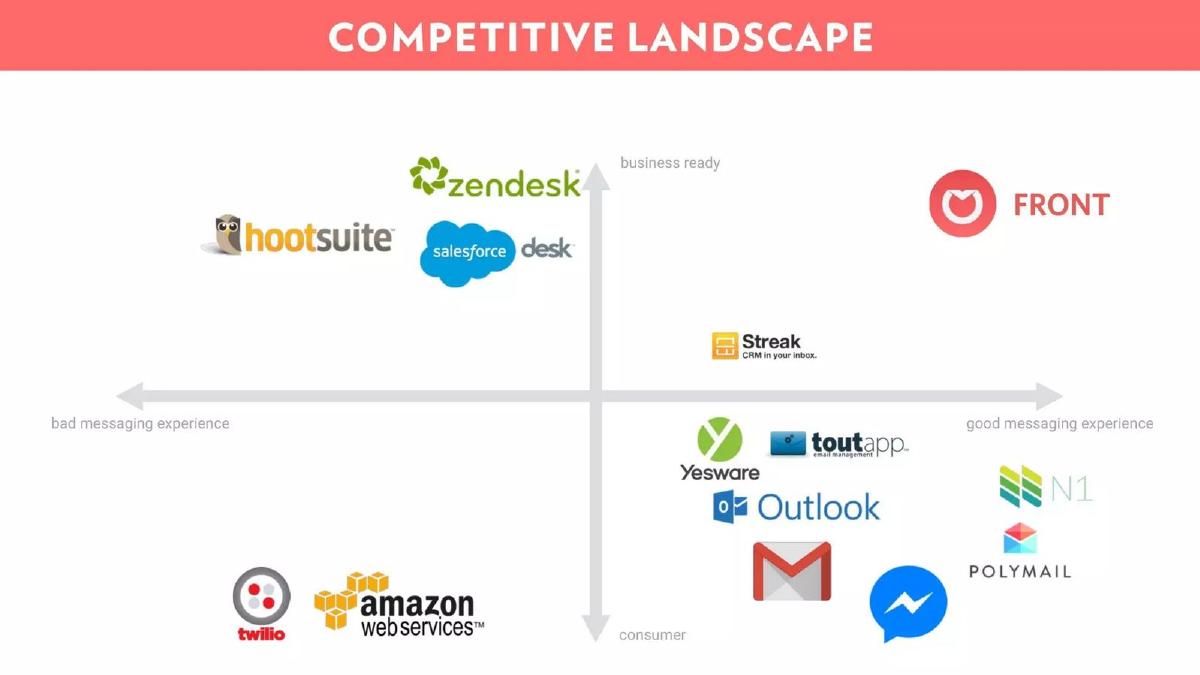
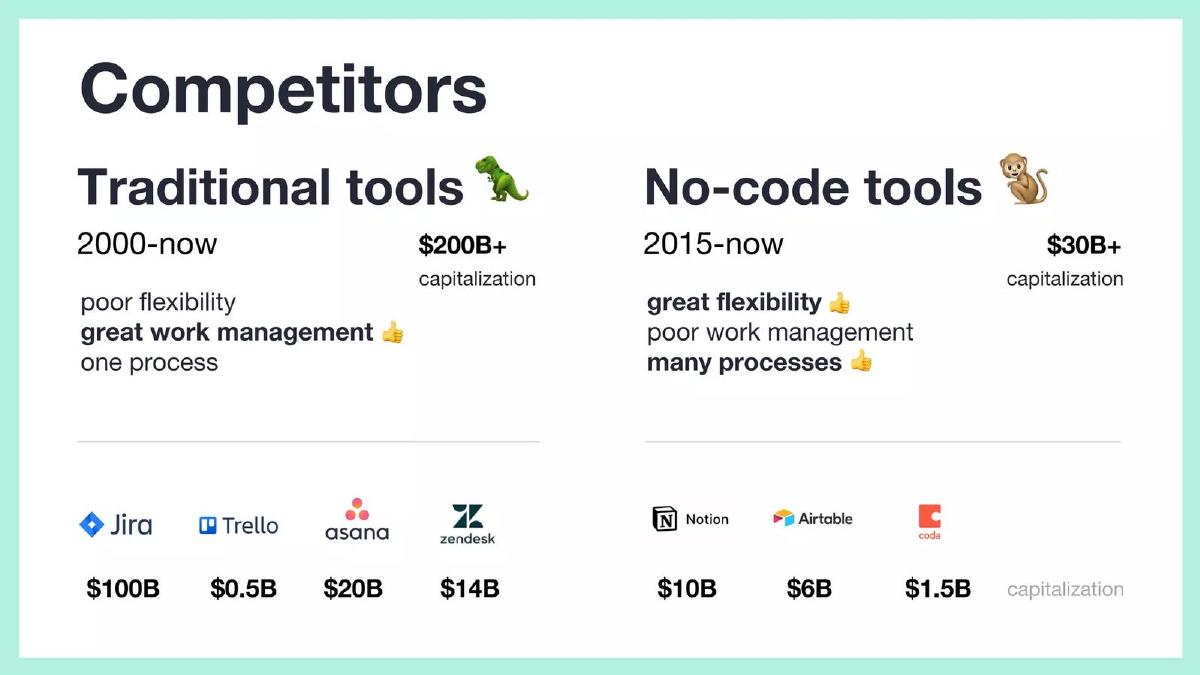
Stage changes what you can prove on a competition slide, not the format. A pre-seed slide can only claim a difference: Kama lists Tinder, Bumble and Hinge, then "Why Kama will win?" and "Competitive Moat" bullets. By Series A and B, the stronger slides place rivals on two axes that describe the market: Front plots "bad" to "good messaging experience" against "consumer" to "business ready"; Fivetran plots "Incumbent" to "Startup" against "Custom Workflow (ETL)" to "Automated (ELT)". Fibery compares two categories with their capitalisation ("$200B+", "$30B+"). A plain list of names, as in YouTube's Series A slide, gives no reason to believe you win.
Competition slides from pre-seed, Series A and Series B decks
Each example shows the exact stored slide above its analysis and links to the full teardown. Pre-seed first, then Series A, then Series B. Claims are as shown on the slides; we have not verified them.
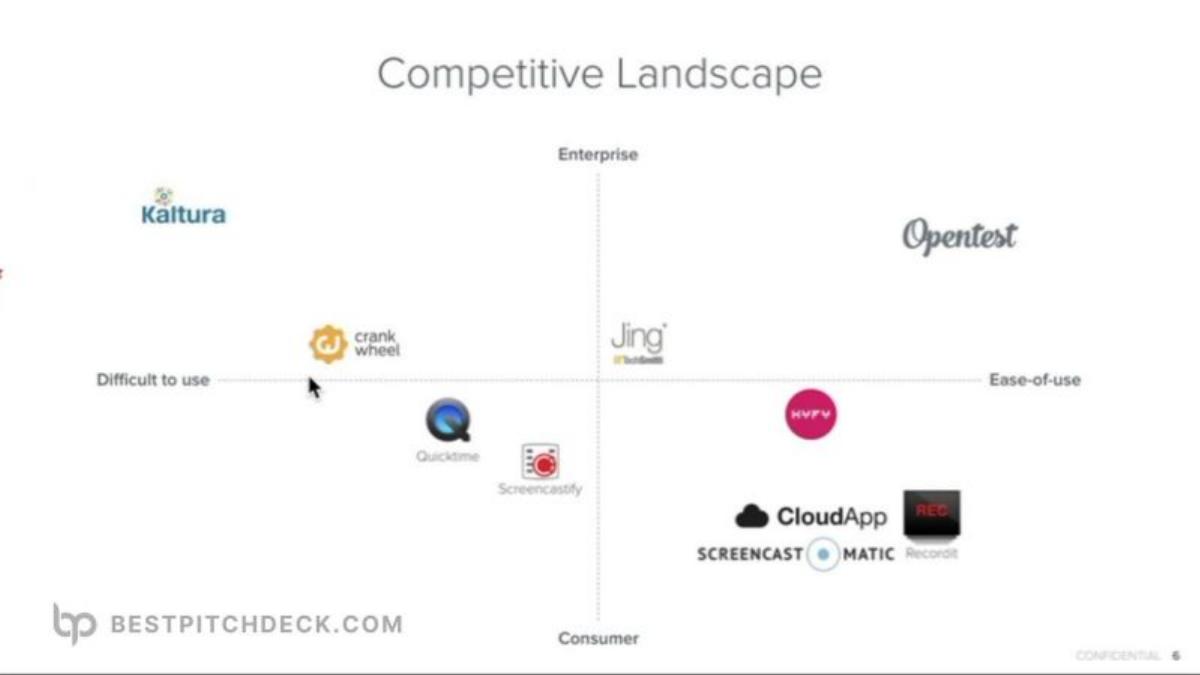
OpenTest competition slide — slide 6
Pre-seed. Screen recording (later Loom). 2x2 map.
OpenTest deck, slide 6. Exact stored slide matched to this analysis.
Our analysis: A clear pre-seed map: two axes customers understand and a visible empty quadrant.
Evidence and limitation: Named rivals placed on two axes.
What a founder can adapt: Choose axes a customer would use to decide, then show which corner is empty.
Supporting analysis
What the deck claims: "Competitive Landscape." Axes "Difficult to use" to "Ease-of-use" and "Consumer" to "Enterprise". OpenTest alone at top right; Kaltura top left; Jing, Screencastify, Quicktime, CloudApp, Screencast-O-Matic and others below.
Presentation choice: Ease of use and enterprise readiness are the choices a buyer makes, so the placement argues something.
When it does not fit: Alone in the best corner with no evidence; say on the slide what puts you there.
Pre-seed. Dating app that books discounted dates at venues. Logos above two bullet boxes.
Kama deck, slide 6. Exact stored slide matched to this analysis.
Our analysis: Typical pre-seed: rivals named, difference stated, nothing yet to prove it.
Evidence and limitation: Seven named rivals and six claims of difference.
What a founder can adapt: Lead with the one difference rivals can't copy quickly, and say how many partners you have.
Supporting analysis
What the deck claims: "Competition." Tinder, OkCupid, Bumble, Match, Badoo, Hinge, eHarmony. "Why Kama will win?": "Aligned with users' intention", "Unique IRL Kama Date Experience", "Only Marketplace for daters and venues". "Competitive Moat": "Only app that sets-up dates with discounts", "Only B2B Dating completely free for users", "Established partnerships with businesses".
Presentation choice: The venue side of the marketplace is a real difference; it is buried among general claims.
When it does not fit: "Aligned with users' intention" could describe any app; cut claims a rival could also make.
Front deck, slide 4. Exact stored slide matched to this analysis.
Our analysis: The strongest map here: each quadrant is a category a buyer recognises.
Evidence and limitation: Rivals grouped by two axes; help desks and email apps separated.
What a founder can adapt: Make each quadrant a category, so the map explains the market, not just your position.
Supporting analysis
What the deck claims: "Competitive Landscape." Axes "bad messaging experience" to "good messaging experience" and "consumer" to "business ready". Front alone at top right; Zendesk, Hootsuite and Salesforce Desk top left; Gmail, Outlook, Messenger, Polymail and others bottom right.
Presentation choice: It says in one picture that help desks are business-ready but clumsy, and email is pleasant but not built for teams.
When it does not fit: Many small logos; group them if they are hard to read.
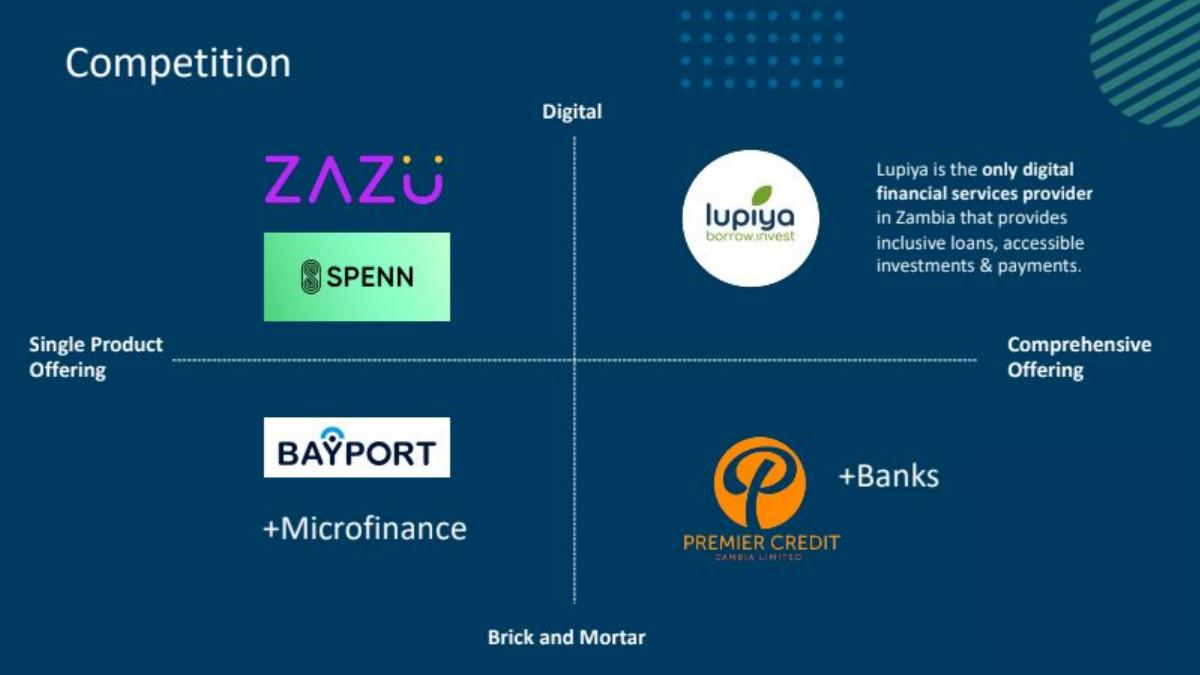
Series A. Digital lending, investments and payments in Zambia. 2x2 map.
Lupiya deck, slide 6. Exact stored slide matched to this analysis.
Our analysis: Clear and local; it counts banks and microfinance as competitors, not just apps.
Evidence and limitation: Named local rivals, categories and a one-line claim.
What a founder can adapt: Include the traditional option (banks, agencies, spreadsheets) on your map.
Supporting analysis
What the deck claims: "Competition." Axes "Single Product Offering" to "Comprehensive Offering" and "Brick and Mortar" to "Digital". Lupiya top right: "the only digital financial services provider in Zambia that provides inclusive loans, accessible investments & payments." Zazu and Spenn top left; Bayport "+Microfinance" bottom left; Premier Credit "+Banks" bottom right.
Presentation choice: Naming the offline alternatives shows the founders know how customers borrow today.
When it does not fit: "The only" is a strong claim; back it with a date or source.
Series B. Automated data pipelines. 2x2 map with a thesis line.
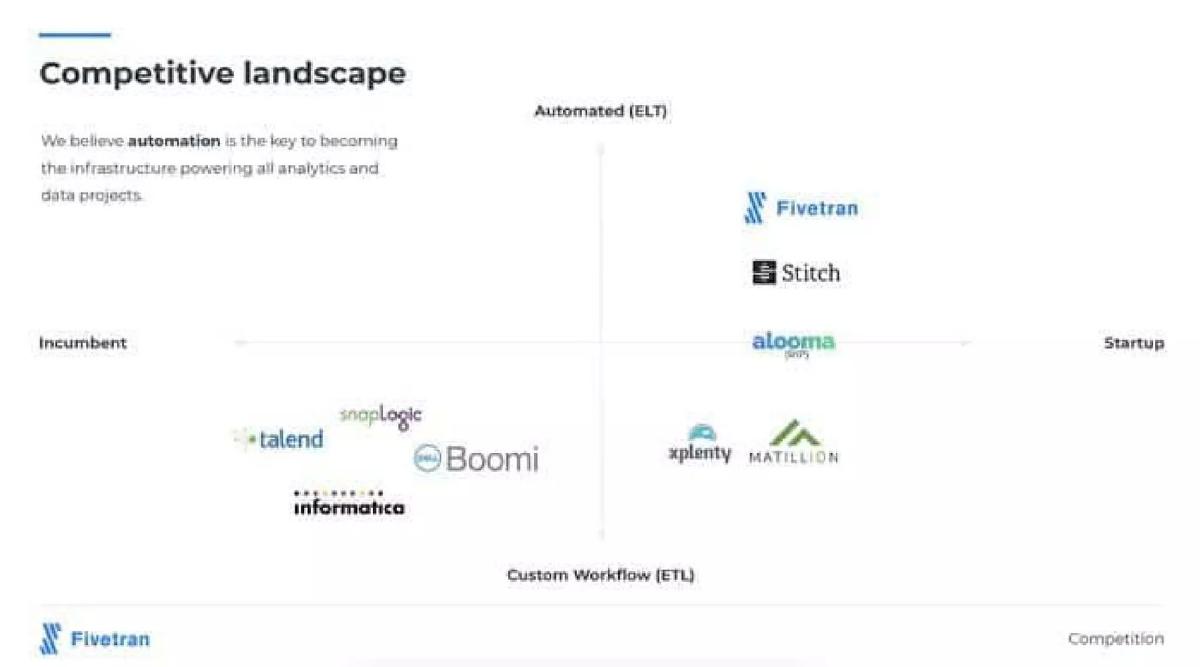
Fivetran deck, slide 6. Exact stored slide matched to this analysis.
Our analysis: Uses the map to argue where the market is moving, not only where rivals sit.
Evidence and limitation: A stated belief, two axes and grouped rivals.
What a founder can adapt: Add one sentence above your map saying which axis the market is moving along.
Supporting analysis
What the deck claims: "Competitive landscape." "We believe automation is the key to becoming the infrastructure powering all analytics and data projects." Axes "Incumbent" to "Startup" and "Custom Workflow (ETL)" to "Automated (ELT)". Fivetran top right with Stitch and Alooma; Talend, SnapLogic, Boomi and Informatica bottom left; Xplenty and Matillion bottom right.
Presentation choice: The thesis line tells the investor why the top-right corner will win.
When it does not fit: Stitch and Alooma share Fivetran's quadrant with no stated difference.
Stage, format, whether rivals are grouped into categories, and whether the slide says why the company wins.
Example
Stage
Format
Categories
Why it wins
OpenTest
Pre-seed
2x2 map
No
Implied by position
Kama
Pre-seed
Logos + bullets
No
Yes (six claims)
Front
Series A
2x2 map
Yes (by quadrant)
Implied by position
Fibery
Series A
Category comparison
Yes (two)
Implied by the gap
Lupiya
Series A
2x2 map
Yes (+Banks, +Microfinance)
Yes (one line)
YouTube
Series A
List
Unlabelled
No
Fivetran
Series B
2x2 map + thesis
Yes (incumbent vs startup)
Yes (thesis line)
Key Takeaways
Pick axes that describe how customers choose, and place yourself using them.
Pre-seed: name the rivals and give one or two reasons you differ.
Series A and later: group rivals into categories and say what each category lacks.
Name the old way (brick-and-mortar lenders, traditional tools) as a competitor.
A list of names alone doesn't show why you win at any stage.
Build your competition slide for your stage
Choose axes first, then add the evidence your stage allows.
Axes. Two things customers choose on (ease, price, enterprise-ready, automated).
Categories. Group rivals, including the old way (banks, spreadsheets, agencies).
Your position. Where you sit and the one reason you sit there.
Evidence. Pre-seed: a partner or pilot. Later: retention, share or category size.
Copyable framework: [Axis 1] vs [Axis 2]. [Category A] is [weakness]; [Category B] is [weakness]. We are [position] because [evidence].
Illustrative example 1 — written by us
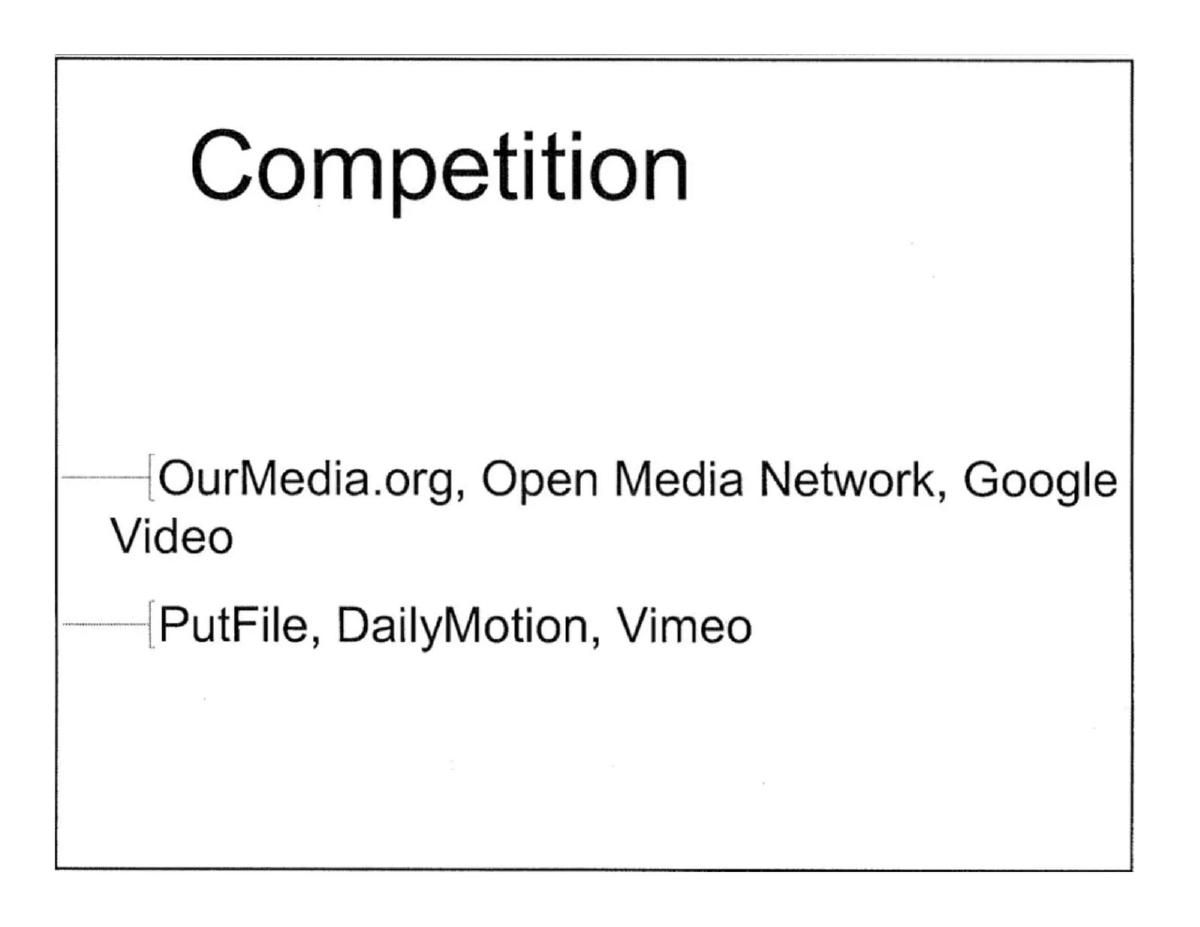
Before: OurMedia.org, Open Media Network, Google Video / PutFile, DailyMotion, Vimeo
After: Upload sites: hard to share. Media archives: built for publishers, not people. We make any video playable on any web page in one click.
What improved: Our illustrative rewrite of the list; not YouTube's wording. It labels the groups and states one difference.
What this guide adds
The library's competition guides cover the slide in general and by business type (marketplace, consumer). This guide compares competition slides across funding stages, following the stage guides for traction.
Stage labels come from the stage recorded for each published teardown, all high confidence: two pre-seed, four Series A, one Series B. None of these seven slides appears in another guide.
What changes with stage, and what doesn't
Every stage uses the same three formats: a list of names (Kama, YouTube), a 2x2 map (OpenTest, Front, Lupiya, Fivetran) and a category comparison (Fibery). Stage doesn't decide which works; the choice of axes does.
What changes is the evidence you can put beside it. A pre-seed deck has only claims ("Only app that sets-up dates with discounts"). A later deck can point to its own traction, retention or category size elsewhere in the deck; Fibery puts capitalisation on the slide itself.
Later-stage maps tend to name categories rather than every app: Fivetran splits "Incumbent" from "Startup"; Lupiya adds "+Banks" and "+Microfinance" to cover whole groups.
Common mistakes
A list of names. Group them and say what each group lacks.
Axes only you care about. Use what customers choose on.
Leaving out the old way. Banks, spreadsheets and agencies are competitors.
Claims any rival could make. Keep only differences they can't copy quickly.
Sharing your quadrant silently. Say how you differ from rivals next to you.
Diagnostic checklist
Axes describe how customers choose.
Rivals are grouped, including the traditional option.
Your position has one stated reason.
Evidence fits your stage.
No unlabelled lists.
Frequently asked questions
How we chose these examples
Corpus: published pitch deck teardowns on StartupFundraising.com. Founder-uploaded private decks are excluded.
Selection (2026-09-25): we took teardowns whose recorded stage is pre-seed, Series A or Series B with high confidence, then searched for slides headed Competition, Competitive landscape or Competitors. Trash Warrior slide 5 was excluded because it is in the marketplace competition guide. Agreatculture, Lazy Creatures, Mailage, Grid, Proof Technology, Anima, Fast and Juro competition slides were left out because their stored images are missing. Seven qualifying slides remained; YouTube is kept as a weaker contrast.
Stage is the round recorded for each teardown, not a judgment about the company today.
Review: all seven stored slide images were inspected on 2026-09-25 and matched to company, deck and slide number (editorial model review). No person has yet completed an editorial review of this page.
Claims are as shown on the slides; we have not verified them. We make no claim that any slide caused a fundraising outcome.