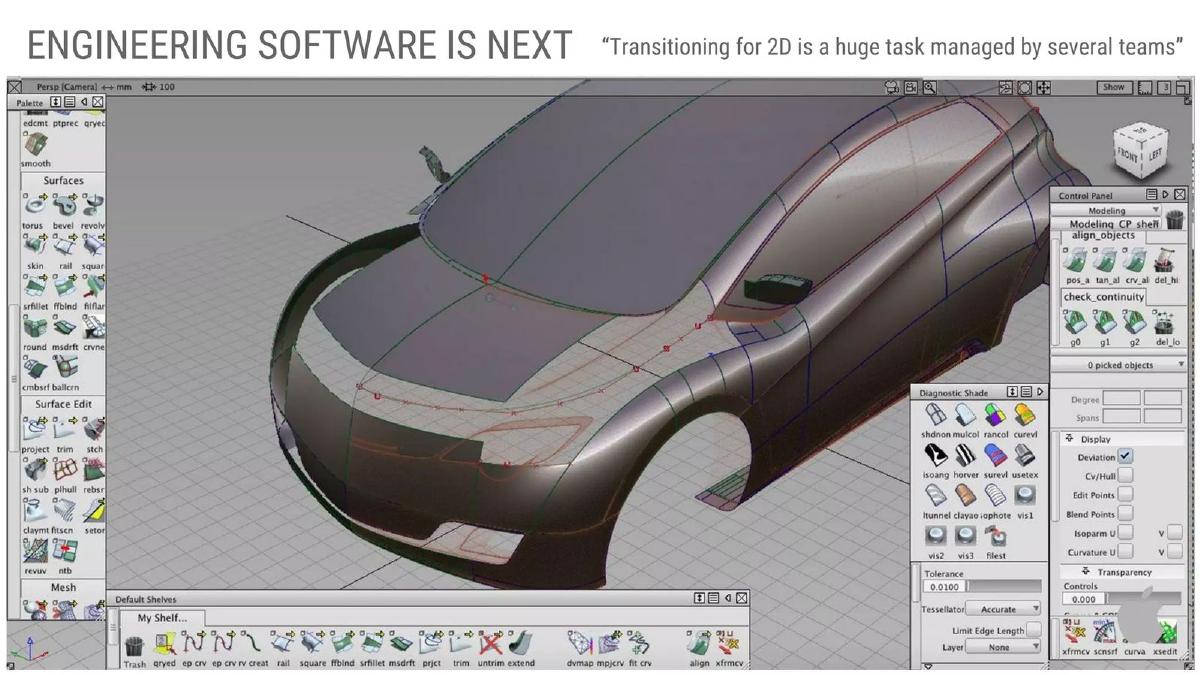
Gravity Sketch positions itself as the future of 3D design by bridging the gap between initial 2D sketches and complex 3D modeling. The deck excels at demonstrating social proof, featuring testimonials from a vehicle designer at Honda and the Art Director of the Avatar sequels. With 10,000 paid users and 250,000 iOS downloads reported on slide 5, the company shows strong early adoption despite having no formal sales team at the time of the presentation. The deck leans heavily on visual storytelling and industry partnerships, specifically highlighting its inclusion in the Oculus Connect 5 keyn…
Key takeaways
- The company reports 10,000 paid users and 250,000 iOS downloads on slide 5.
- Gravity Sketch claims to have achieved its traction with 'no sales team' as noted on slide 5.
- High-profile social proof is provided by a vehicle designer at Honda on slide 6 and the Art Director of Avatar sequels on slide 7.
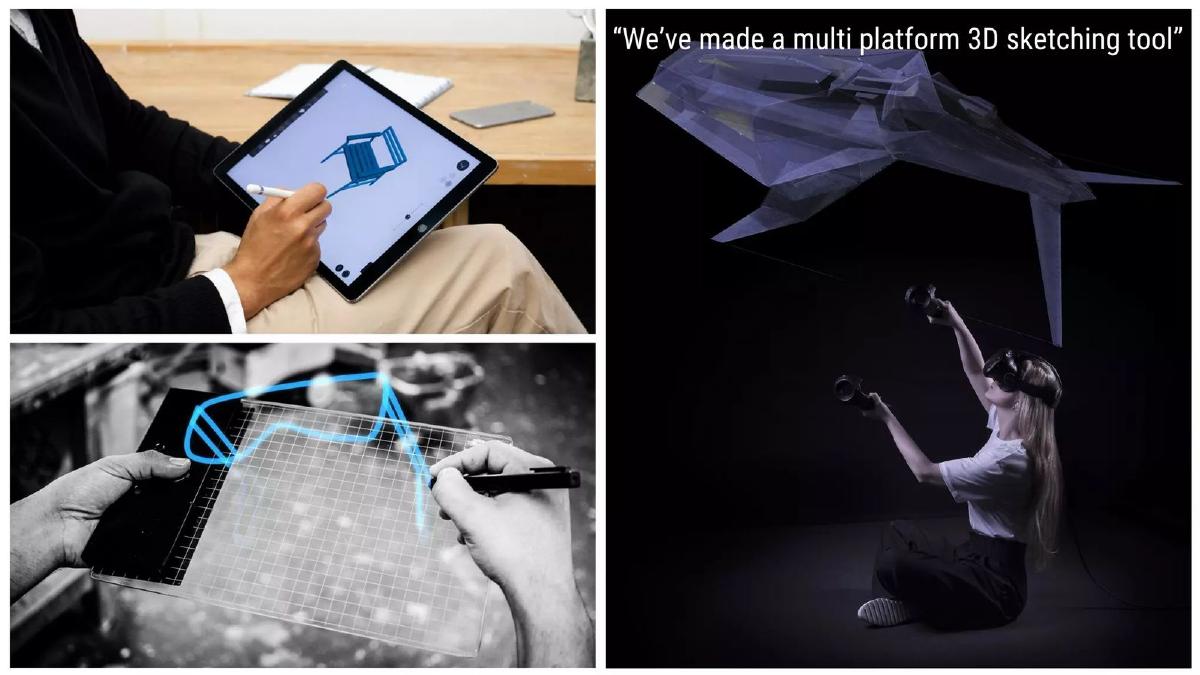
- The product is positioned as a multi-platform tool, supporting iPad, VR, and a cloud-based platform (slide 3 and 8).
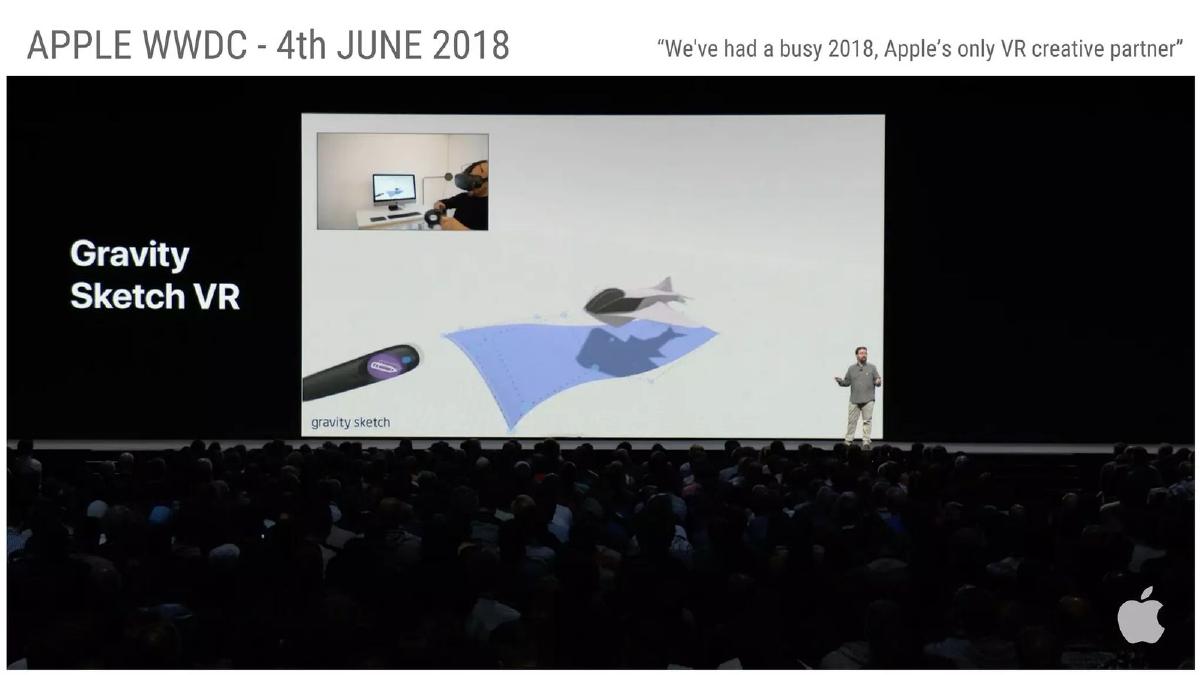
- The company highlights its GTM strategy through a partnership with Oculus, appearing at Oculus Connect 5 in 2018 (slide 4).
- Intellectual property is a focus, with 4 patents filed according to the traction slide (slide 5).
- The roadmap on slide 8 outlines a transition toward 'Co Creation' and 'Platform' (Cloud and education) through 2020.
- The deck uses a historical comparison on slide 9, equating the impact of Gravity Sketch in 2023 to Adobe on the Macintosh in 1984.
Gravity Sketch: Redefining the 3D Design Workflow
The Gravity Sketch pitch deck is a masterclass in using visual evidence and high-tier social proof to validate a technical product. Rather than spending time on complex market size calculations, the deck focuses on the immediate utility of the tool for professional designers in high-stakes industries like automotive and film production. By the time an investor reaches the end of these nine slides, the message is clear: the world's best designers are already using this, and they love it.
Slide 1: Title and Vision
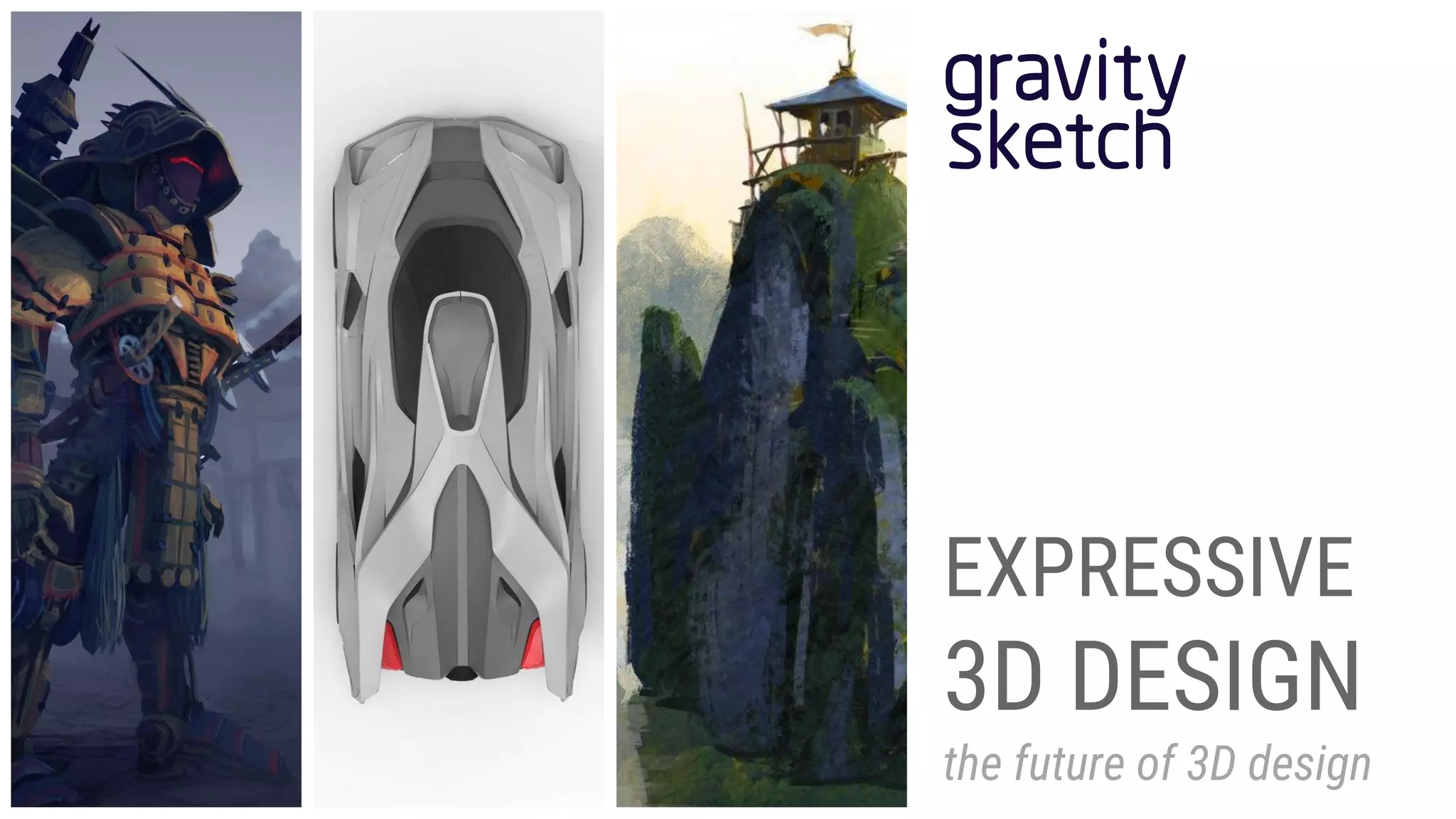
The cover slide introduces the brand and its core value proposition: "EXPRESSIVE 3D DESIGN: the future of 3D design." The imagery is split into three vertical panes showing a stylized character, a top-down view of a supercar, and a fantasy environment. This immediately signals that the tool is versatile, catering to concept artists, industrial designers, and environment builders alike.
Slide 2: The Status Quo
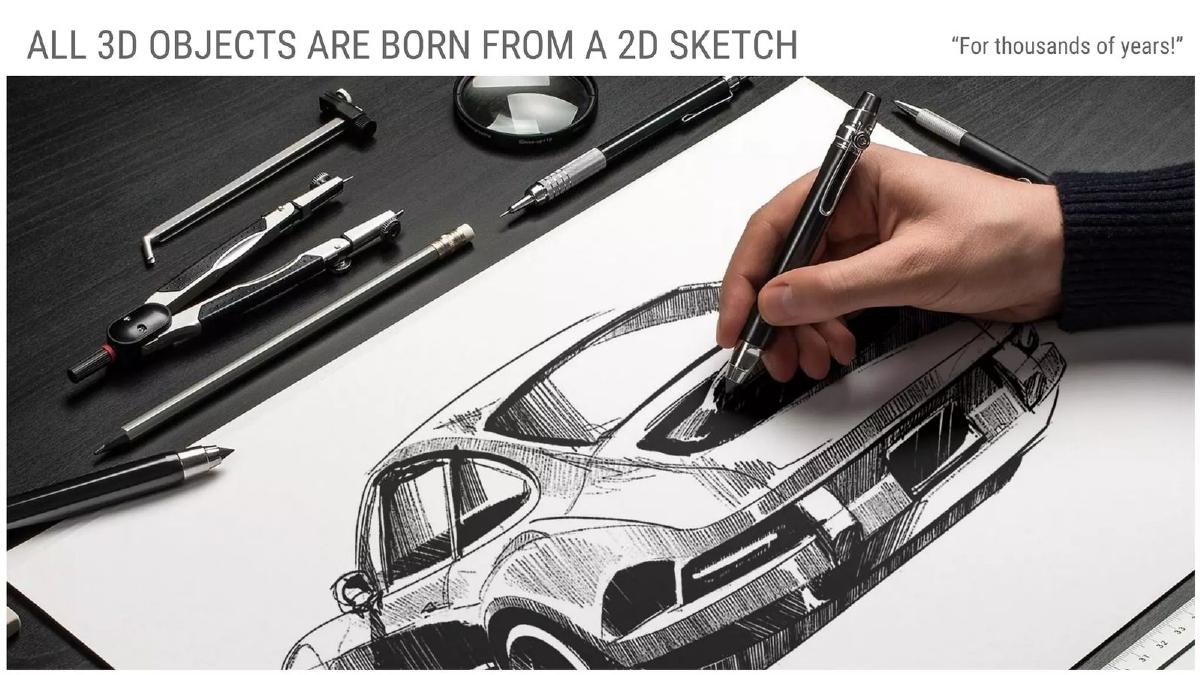
Slide 2 sets the stage by acknowledging a historical truth: "ALL 3D OBJECTS ARE BORN FROM A 2D SKETCH." The image shows a traditional drafting table with compasses, pencils, and a high-quality 2D car sketch. The quote "For thousands of years!" suggests that while this method is tried and true, it is also antiquated and ripe for disruption.
Slide 3: The Multi-Platform Solution
This slide introduces the product as a "multi platform 3D sketching tool." It uses three images to show the software in action: one on a tablet (iPad) with a stylus, one on a transparent physical grid, and a large image of a user in a VR headset manipulating a complex 3D geometry. This demonstrates that Gravity Sketch isn't just a VR app; it is a workflow that spans different hardware environments.
Slide 4: Strategic Partnerships
Slide 4 leverages the Oculus Connect 5 event from September 2018. By highlighting their logo among a sea of other developers (including SketchUp and National Geographic), Gravity Sketch positions itself as a key player in the VR ecosystem. The text "We've are a part of the GTM strategy" (sic) indicates a deep level of integration with hardware manufacturers, which is a significant competitive advantage for a software startup.
Slide 5: Quantifiable Traction
The traction slide is dense with impressive figures. It lists:
3 Enterprise Customers (names redacted) · 15 Enterprise Customers in Trial · 10,000 Paid Users · 250K iOS Downloads · Key Industry Partners · Industry Funded Accelerated Dev · 4 Patents Filed
The sub-headline "This has been a year of proof points / with no sales team" is particularly important for investors, as it suggests strong product-market fit and high efficiency.
Slide 6: Enterprise Validation (Automotive)
Gravity Sketch uses a full-slide testimonial from James Robbins, Vehicle Designer at Honda . He states that designers can now translate sketches to 3D themselves and "understand how their designs need to work in 3D." This directly addresses the pain point mentioned on slide 2, showing that the tool bridges the gap between 2D ideation and 3D execution in a professional setting.
Slide 7: Enterprise Validation (Entertainment)
The deck doubles down on social proof with a quote from Saiful Haque, Art Director of Avatar Sequels . He calls the tool "transformative," allowing him to create a "3D 'napkin sketch' straight from my brain." Referencing the "highest grossing film of all time" provides a level of credibility that few startups can match.
Slide 8: Product Roadmap
The roadmap covers 2019 through 2020, divided into several workstreams:
CO CREATION: Focused on the first half of 2019. · Mobile VR and PPT VR: Extending through mid-2020. · iPad and YouTube: Ongoing development and integration. · PLATFORM (Cloud and education): A long-term horizontal bar indicating a shift toward a service-based model.
This shows a clear path from a standalone tool to a collaborative platform.
Slide 9: The Historical Parallel
The final slide in this set makes a bold comparison. It places an image of the original 1984 Macintosh running Adobe software next to a 2023 vision of a user in a VR headset using Gravity Sketch. The implication is that Gravity Sketch is to the spatial computing era what Adobe was to the desktop publishing era. The slide concludes with a "THANK YOU" and a contact email.
What Works in This Deck
Unbeatable Social Proof: Most startups struggle to get a quote from a mid-level manager. Gravity Sketch has testimonials from Honda and the Avatar production team. This effectively ends any debate about whether the product works or if there is a professional market for it.
Efficiency of Growth: The mention that 10,000 paid users were acquired with "no sales team" is a massive green flag for VCs. It indicates a product that users are actively seeking out and recommending to peers, which lowers customer acquisition costs (CAC).
Hardware Agnostic Positioning: By showing the iPad alongside VR, the company avoids being pigeonholed as a "VR-only" play. This is crucial for risk mitigation, as the VR market has historically been more volatile than the broader mobile/tablet market.
What Is Missing from This Deck
The Financials: This 9-slide subset contains no information on revenue, burn rate, or pricing models. While we know there are 10,000 paid users, we don't know the Average Revenue Per User (ARPU) or the contract value of the enterprise customers.
The Team: There is no team slide in this selection. For a technical product in a niche field, seeing the pedigree of the founders (e.g., backgrounds in industrial design or computer graphics) is essential for building investor confidence.
The Ask: The deck ends with a thank you but does not specify how much capital is being raised, the valuation, or the intended use of funds. This information may be present in the remaining 8 slides of the full 17-slide deck.
What Founders Should Copy
The 'Proof Point' Strategy: If you have high-profile users, don't just list their logos. Use their words to explain why your product is better than the old way of doing things. The Honda and Avatar slides are much more effective than a simple logo wall would have been.
Historical Anchoring: The comparison to Adobe in 1984 is a clever way to frame the company's potential upside. It helps investors visualize the scale of the opportunity by comparing it to a known, massive success story in a similar category (design software).
Clear Roadmap Categorization: Instead of a messy list of features, the roadmap on slide 8 categorizes tasks into logical buckets like "Co Creation" and "Platform." This makes it easier for an outsider to understand the strategic direction of the product development.
Frequently asked questions
- What is the core problem Gravity Sketch aims to solve?
- According to slide 2, the core problem is the traditional workflow where 'all 3D objects are born from a 2D sketch.' This process is often slow and requires translation between mediums. Gravity Sketch aims to allow designers to 'start in 3D and stay in 3D,' as described by the Art Director of Avatar on slide 7, making the design process more intuitive and 'transformative.'
- What kind of traction has Gravity Sketch achieved?
- Slide 5 lists several key metrics: 3 enterprise customers (with names redacted), 15 enterprise customers in trial, 10,000 paid users, and 250,000 iOS downloads. Additionally, the company has filed 4 patents and claims to have achieved these milestones without a dedicated sales team, relying instead on product-led growth and industry partnerships.
- Who are the key users or customers mentioned in the deck?
- The deck highlights two specific high-value users to validate the product. Slide 6 features James Robbins, a Vehicle Designer at Honda, who discusses the ease of translating sketches to 3D. Slide 7 features Saiful Haque, Art Director of the Avatar sequels, who emphasizes the ability to create '3D napkin sketches' directly from the brain.
- What is the company's platform strategy?
- Gravity Sketch is presented as a multi-platform tool. Slide 3 shows the software running on an iPad with an Apple Pencil and in a VR environment with a headset and controllers. The roadmap on slide 8 further details plans for 'Mobile VR,' 'PPT VR,' 'iPad,' and a broader 'Platform' encompassing cloud services and education.
- What is the significance of the Oculus Connect 5 slide?
- Slide 4 shows the Gravity Sketch logo highlighted during the Oculus Connect 5 keynote on September 26, 2018. The slide notes that they are 'a part of the GTM strategy' for Oculus. This serves as powerful third-party validation, suggesting that major hardware players in the VR space view Gravity Sketch as a 'killer app' for their ecosystem.