India Future Society’s 2015 deck, prepared for the Founder Institute, positions the company as 'The New York Times for Future Technology.' The venture operates as a content and collaboration hub focused on longevity science and emerging tech. At the time of the pitch, the organization relied on a 25-person volunteer workforce with no paid employees. The deck outlines a tiered membership revenue model (Basic, Gold, Platinum) and seeks a $100,000 investment at a $500,000 valuation. While it claims three years of successful collaboration and shows a traffic spike of 8,000+ views in May 2014, the…
Key takeaways
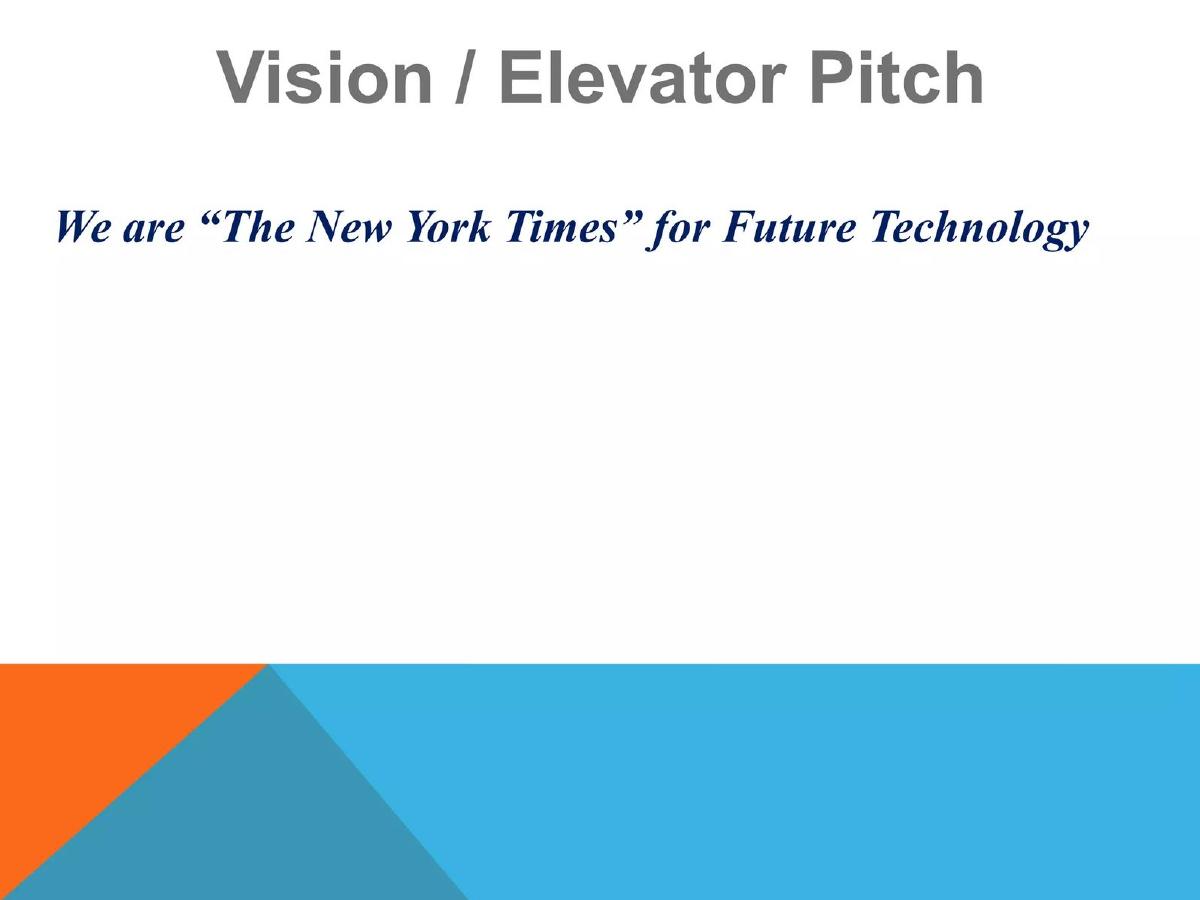
- The company uses a high-level comparison, calling itself 'The New York Times for Future Technology' on slide 2.
- The organization is entirely volunteer-based, with 25 team members who were not being paid at the time of the presentation, according slide 4.
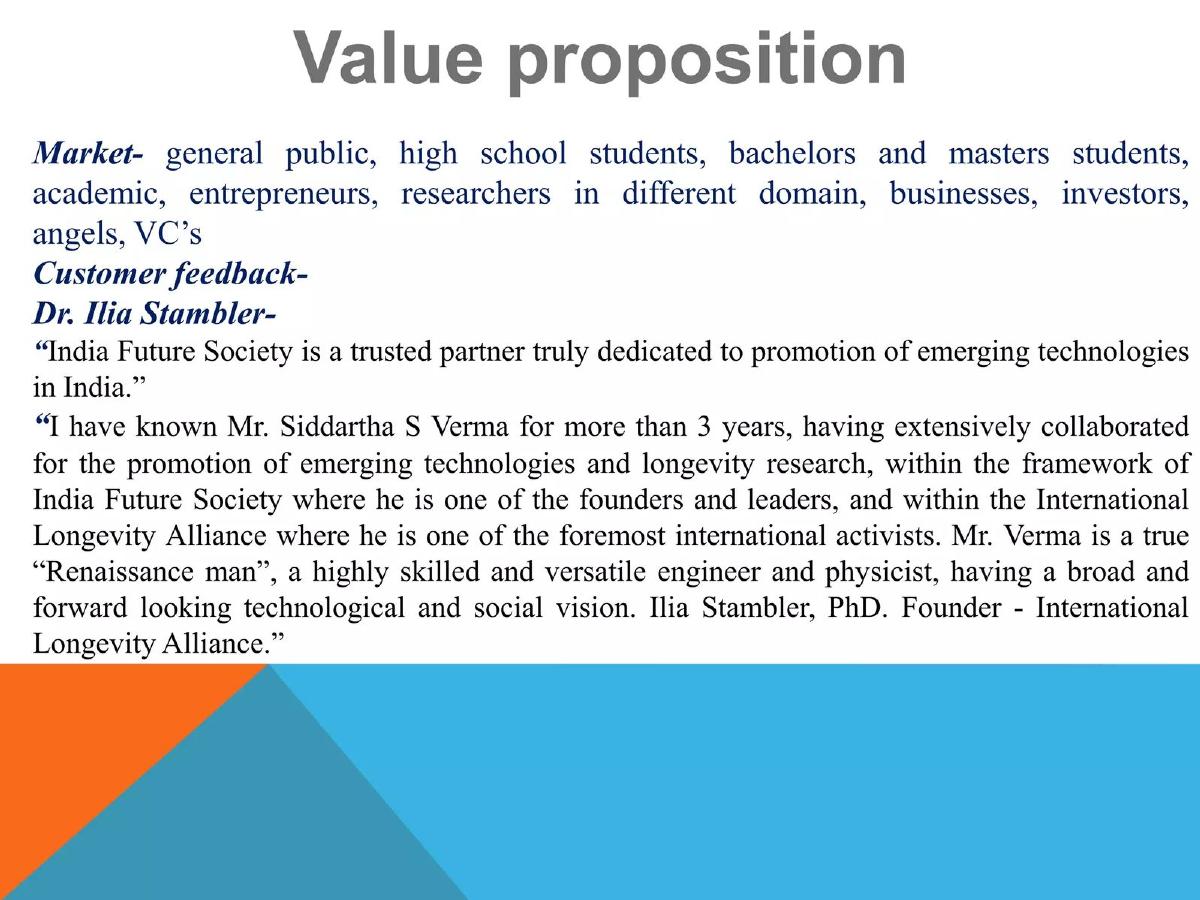
- The funding ask is $100,000 at a post-money valuation of $500,000, as stated on slides 3 and 5.
- Revenue is non-existent at the time of the pitch, with a projection to show revenue being generated one year from the presentation date (slide 5).
- Traction is demonstrated through a website traffic chart showing 52,464 all-time views and a peak of over 8,000 views in May 2014 (slide 6).
- The business model relies on tiered memberships, with 'Platinum' members gaining access to investors, angels, and VCs (slide 5).
- The project claims an official partnership with the International Longevity Alliance (Israeli Longevity Alliance) on slide 4.
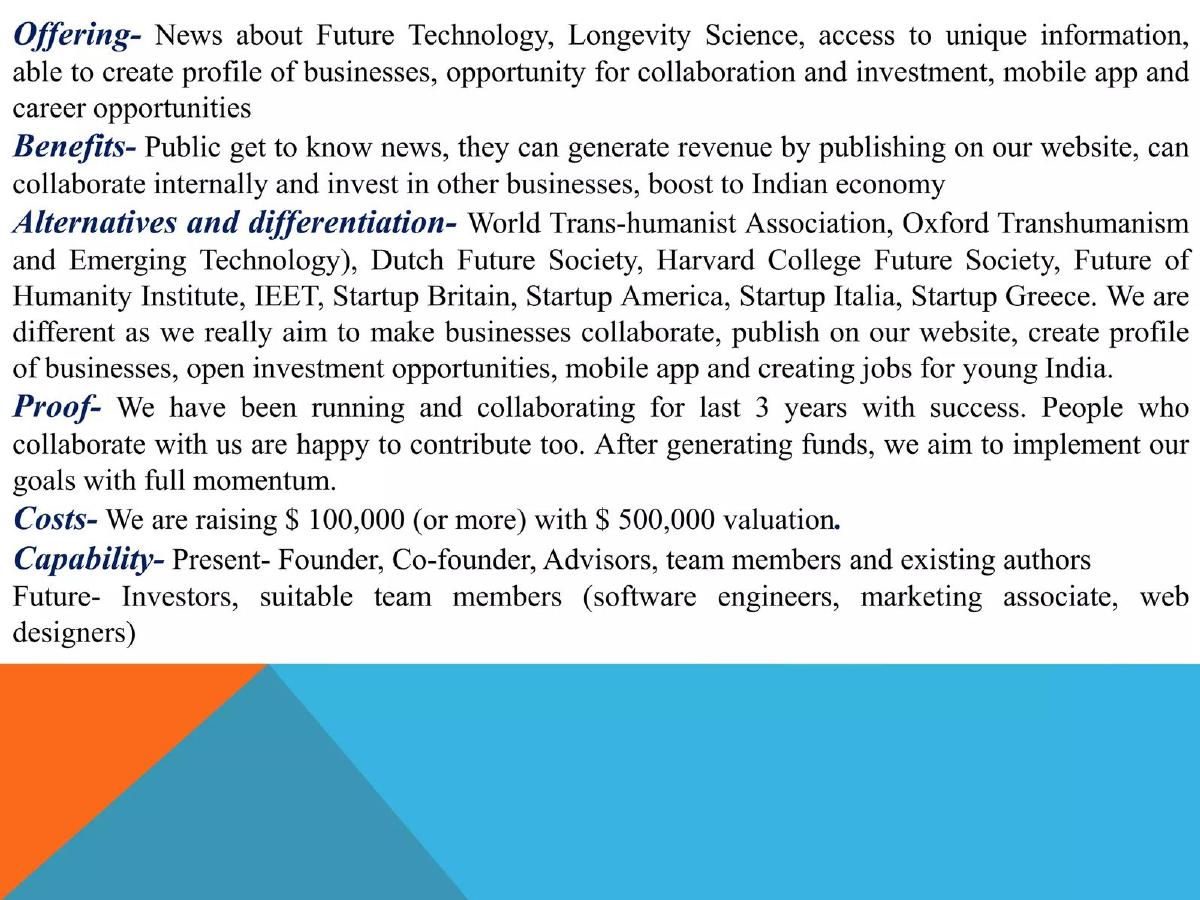
- The deck lists a wide array of 'alternatives' including the World Trans-humanist Association and various national 'Startup' organizations like Startup Britain (slide 3).
India Future Society Pitch Deck Analysis
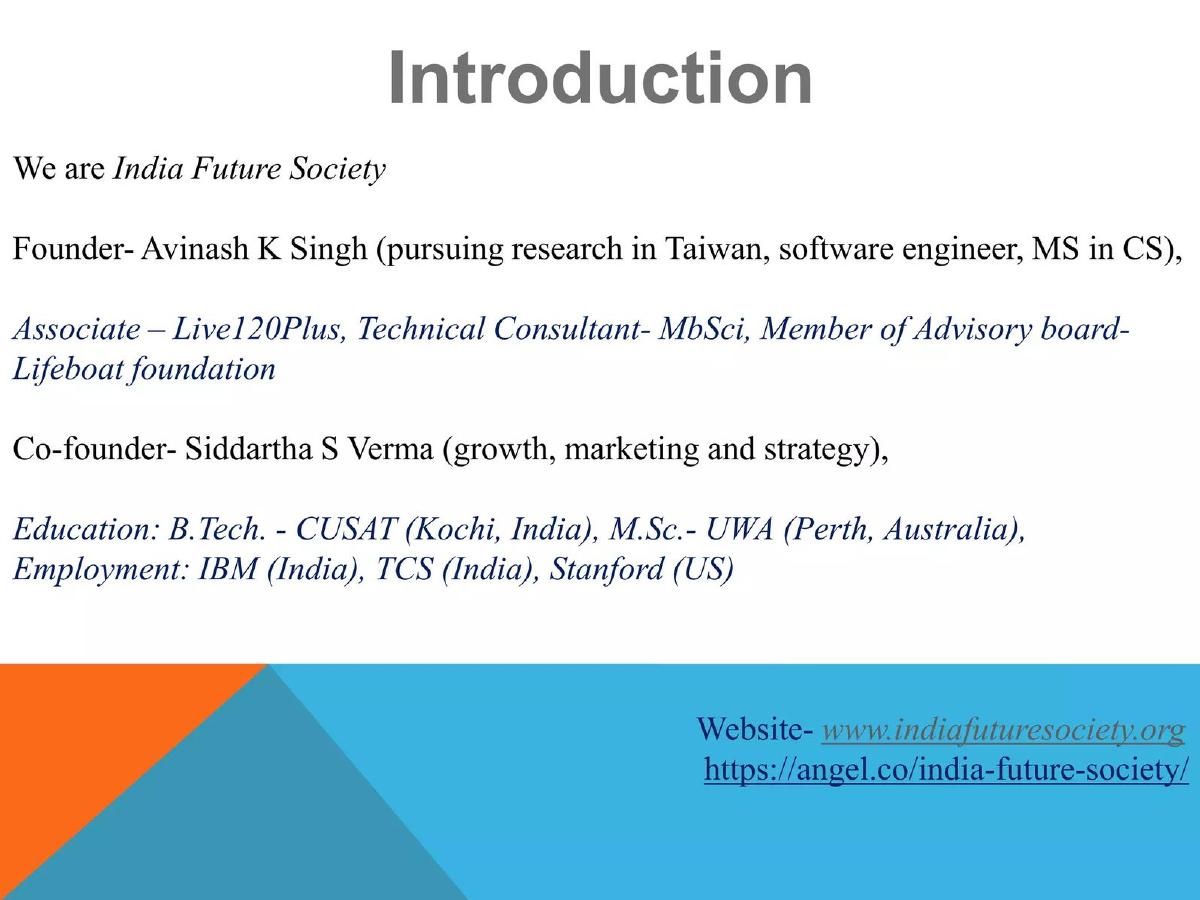
This pitch deck, dated August 2015, was developed for the Founder Institute (Founder Lab) by Sid Verma. It represents a transition from a volunteer-led content initiative into a commercial media and networking platform focused on the 'trans-humanist' and future technology sectors in India.
Slide 1: Title Slide
The deck opens with a simple title: India Future Society . It specifies the context as 'For Founder Institute (Founder Lab)' and provides the date of August 2015. The logo features a stylized 'IFS' acronym in orange, blue, and green.
Slide 2: Vision / Elevator Pitch
The company defines its identity through a comparison: "We are 'The New York Times' for Future Technology." This is a classic 'X for Y' pitch intended to establish immediate scale and authority, though it sets a very high bar for content quality and editorial reach.
Slide 3: The Executive Summary (Offering, Benefits, Costs)
This slide acts as a dense summary of the entire business. Key points include:
Offering: News on longevity science, business profiles, and a mobile app. · Benefits: Revenue generation for publishers and a 'boost to Indian economy.' · Alternatives: A long list of academic and national organizations, including the Oxford Transhumanism and Emerging Technology group and Startup America . · Proof: Stated three years of successful collaboration. · Costs: A clear ask of $100,000 (or more) at a $500,000 valuation . · Capability: Current team consists of a Founder, Co-founder, and 25 volunteers; future needs include software engineers and marketing associates.
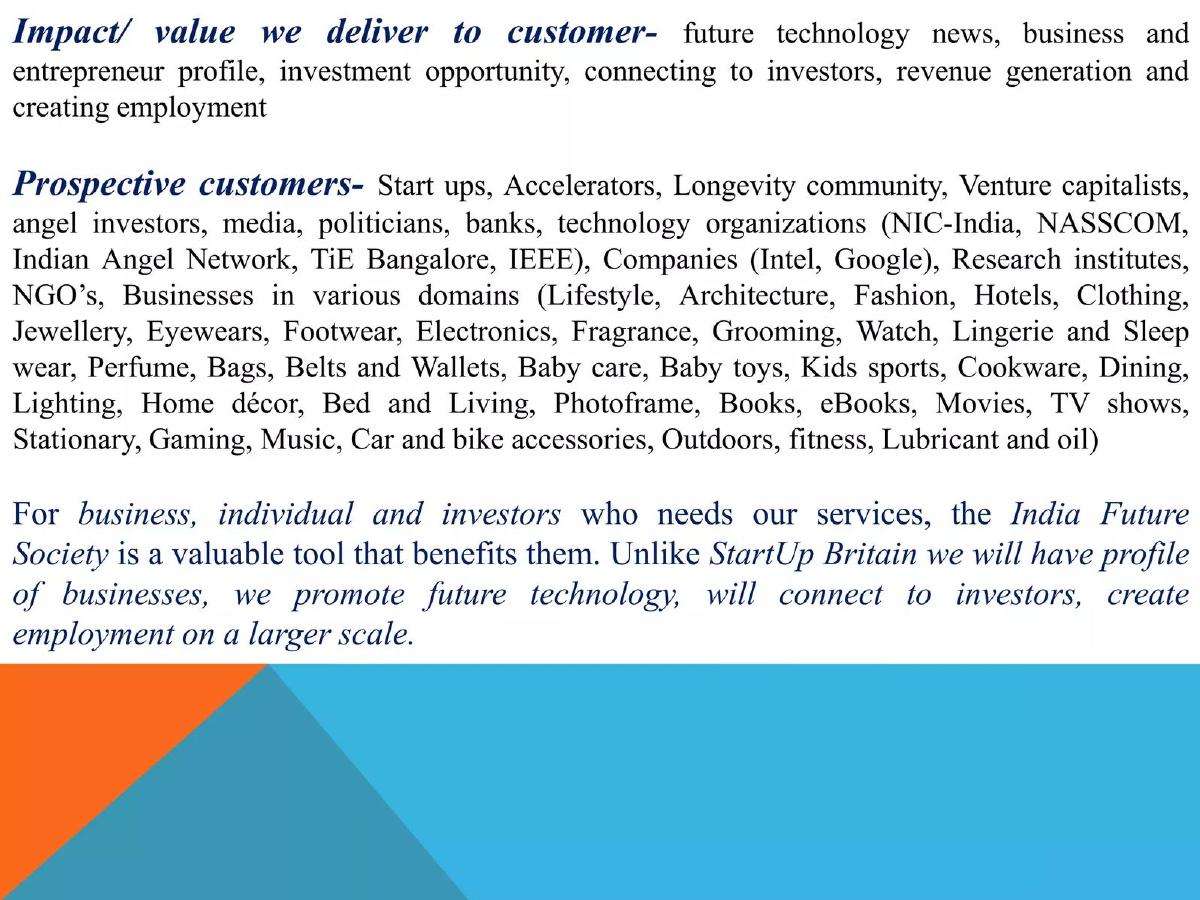
Slide 4: Customer Value Proposition
The slide details the ecosystem surrounding the project. It names the International Longevity Alliance (Israeli Longevity Alliance) as an official partner and mentions collaborations with futureday.org and humanity plus . A critical disclosure is made here: "We have 25 team members. We are not paying anybody yet, so all are volunteering as of now." This indicates the project is currently a community-driven effort rather than a commercial enterprise.
Slide 5: Revenue Model
Free website: Access to news. · Basic membership: Ability to post business/organization profiles. · Gold membership: Access to information about all clients/customers. · Platinum membership: Access to investors, angels, and VCs for collaboration and investment.
The slide notes that they expect to show clients in 6 months and revenue generation in 1 year . The $100,000 ask is repeated at the bottom of the slide.
Slide 6: Traction and Analytics
This slide provides a visual representation of website traffic. The data shows:
All time views: 52,464 · All time comments: 58 · Best ever: 2,920 views (in a single day, presumably) · Today: 13 views
The bar chart shows consistent but low traffic from 2013 to 2015, with one significant outlier in May 2014 where monthly views exceeded 8,000.
Slide 7: What You Are Looking For
This slide serves as an expanded 'Ask' slide. Beyond the $100,000 in funding, the founders are seeking:
Networking with entrepreneurs and VCs. · Employees to deliver tasks. · International exposure and sponsorship. · Recommendations from the Indian Government, Department of Science and Technology (DST) .
Slide 8: Product or Service: Your Solution
The solution is described as a "mixture of means of publishing" that promotes unique content. The slide is largely qualitative, stating that they plan to solve problems through "marketing strategy" and "hiring intelligent work force." It admits that at present, the work is limited to publishing content and organizing events.
Slide 9: Thanks & Attribution
The final slide credits various startup frameworks and figures for the deck's structure, including 500 Startups / Dave McClure , Reid Hoffman , and TechStars . This suggests the founder was following a specific accelerator template.
What India Future Society Does Well
The deck is very transparent about its current stage. By explicitly stating that the 25 team members are volunteers and that revenue is a year away, the founders avoid misleading potential investors about the company's maturity. The inclusion of a raw analytics screenshot (Slide 6) provides a realistic, if modest, look at their actual reach. The 'Platinum' membership tier (Slide 5) is a clever way to monetize the 'networking' aspect of the community by charging for access to a database of investors and VCs.
What is Missing from the Deck
The most significant omission is a Problem Slide . The deck jumps straight into a vision and a solution without clearly defining what pain point in the Indian market they are addressing. While they mention 'longevity science,' they don't explain why a new media entity is required to cover it. Additionally, there is no Unit Economics or Financial Projection slide. While they ask for $100,000, there is no breakdown of how that money will be spent over a 12-18 month runway. Finally, the Team Slide lacks names, photos, or bios for the 'Founder' and 'Co-founder,' making it impossible for an investor to vet the leadership's expertise in media or technology.
Founder Takeaways: What to Copy and What to Avoid
Copy the transparency: If you are a volunteer-run organization, say so. Investors value knowing exactly where the capital will go (e.g., transitioning volunteers to full-time staff). The use of a clear, tiered revenue model on Slide 5 is also a good practice for early-stage media companies.
Avoid the 'Template' feel: Slide 9 admits the deck is 'distilled' from various sources. While using templates is fine, the content on Slide 8 is too generic. Phrases like "solve the problem by marketing strategy" and "hiring intelligent work force" are filler. Founders should replace these with specific, actionable plans (e.g., "We will acquire users via a partnership with X and hire 2 React developers to build our mobile app"). Also, ensure your traffic metrics (Slide 6) show a trend; showing '13 views today' next to a 'best ever' of 2,920 highlights a lack of current momentum.
Frequently asked questions
- What is the primary product of India Future Society?
- According to slide 3, the offering includes news about future technology and longevity science, business profiles, a mobile app, and opportunities for collaboration and investment. Slide 8 clarifies that they currently work by publishing content and organizing events, with plans to expand into a more 'unique' organization that connects customers through a specific marketing strategy.
- How does the company plan to generate revenue?
- Slide 5 outlines a tiered membership model. It includes a 'Free' tier for news access, a 'Basic' tier to post business profiles, a 'Gold' tier for access to client information, and a 'Platinum' tier that offers opportunities for collaboration and investment follow-ups with VCs and angel investors.
- What is the current scale of the team and operations?
- As of the August 2015 pitch, the company had 25 team members, all of whom were volunteers (slide 4). They had been operating for three years prior to the pitch. The team includes founders, co-founders, advisors, and authors, but they explicitly state they have no paid employees or suppliers yet.
- What specific traction metrics are provided in the deck?
- Slide 6 provides a screenshot of website analytics showing 52,464 all-time views and 58 comments. The chart shows monthly traffic from July 2013 to May 2015, with a significant spike in May 2014 reaching approximately 8,500 views, though daily views at the time of the pitch were as low as 13.
- What are the intended uses for the $100,000 funding ask?
- While slide 5 lists the 'Ask' as $100,000, the specific allocation of funds is vague. Slide 3 mentions that future 'capability' needs include hiring software engineers, marketing associates, and web designers. Slide 7 also notes they are looking for 'International exposure' and 'Sponsorship' alongside the funding.